The plant hunter
For Jay Kuethe, there’s just something about Passiflora.
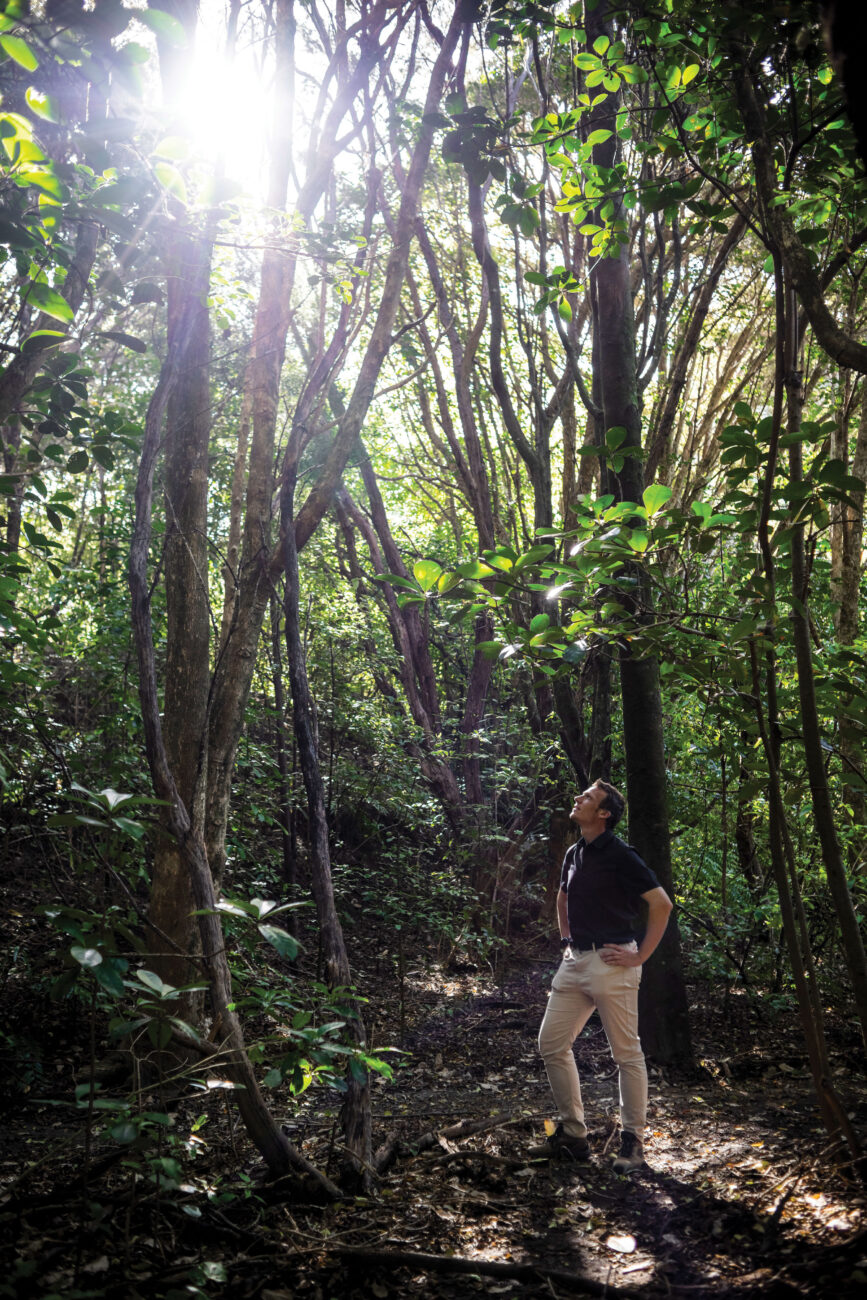
All his life, Jay Kuethe has been a collector. When he was growing up in 1990s Britain, his immigrant Dutch parents gave him an old-fashioned, outdoor childhood. From the age of around five, he grew sunflowers and cacti, and filled labelled cabinets with seeds, crystals, and minerals in his bedroom-turned-museum.
A passion for plants and adventure ran in the family. A great-aunt had collected epiphytic orchids in Indonesia, and grew a clutch of them from the legs of her oak dining table—right at young Kuethe’s eye level. “I was fascinated by them,” he says. But fate had a different flower in store for Kuethe. As a teenager, he did an internship at a large nursery outside London that specialised in Passiflora.
Comprising many hundreds of species, the genus includes passionfruit-style clambering vines, as well as shrubs and trees. Only around 150 have edible fruit. Many have distinctive, geometric flowers—beribboned ballgowns in white and magenta, scarlet and violet—that have been used as symbols of both the crucifixion of Jesus Christ and the Hindu epic the Mahābhārata. Most Passifloras hail from the Americas; New Zealand has just one native species, Passiflora tetandra, a vine with white flowers and deep-orange, teardrop-shaped fruit, known to Māori as kōhia.
Kuethe wanted them all. “There’s always one big question: how many species are there? When can you consider your collection complete? And what really fascinated me was that there was no answer to that. No-one had a clue.”
In 2009, Kuethe travelled to the annual meeting of Passiflora Society International. He was 17. “I brought the average age down a bit.” He excitedly pitched to the assembled grey-beards his idea for an updated Passiflora monograph—a complete encyclopaedia of the genus, describing every species and its distribution. Unlike the most recent Passiflora monograph, published in 1938, Kuethe’s would include photographs and ecological and conservation information for every species, he announced. While the botany professors liked his enthusiasm, they also tried to knock some sense into him: “You’re young, you’re foolish, you’re going to have to wake up to the fact that it’s almost impossible.” Kuethe was undeterred, and ever since, he’s been working on his monograph.
“For me, it’s a passion,” he says. “Pun intended. It’s like a hobby. It’s just a very scientific hobby.”
Alongside his day jobs—including pursuing the doctorate in geology at the University of Auckland that brought him to New Zealand four years ago—Kuethe started organising and self-funding expeditions to Passiflora heartlands around the world, to try to find and photograph species presumed extinct.
He calls himself an exploration ecologist, a play on exploration geologist. Unlike exploration geologists, however, who mostly hunt for minerals to extract so money can be made, Kuethe takes a much more collaborative and low-impact approach.
For instance, in 2023, Kuethe travelled to Samoa to look for Passiflora samoensis, a species last recorded by scientists in 1924 and therefore classed as extinct. He met with Samoan authorities, connected with local plant enthusiasts, and with their help found the “lost” species at a forest reserve on his first day in the country.
Its blooms were a glorious peach and apricot, with sprays of spiky corona filaments like scarlet eyelashes at their centre. The plant was rare—like the endemic miti tae bird (Lalage sharpei) that depends on it. Kuethe spent the rest of the trip helping to set up a nursery to propagate the plant, to ensure its survival and conservation.
In the past five years, Kuethe has also led Passiflora expeditions to Guatemala, Niue, Bolivia, Ecuador, Panama, Jamaica, El Salvador, Honduras, Australia, and Mexico—as side-trips from geological conferences, or supported by grants from universities and other organisations. In Papua New Guinea, he was shot at—breaking the tension when he managed to communicate he was interested in plants, not minerals. With his local collaborators, often students or non-governmental organisations, he has named at least 30 new species, with a dozen more currently in peer-review.
Often, the name references a nature reserve where the plant is found. With their intricate spirograph-shaped blooms, many Passiflora are keystone species— their life histories woven with pollinating and dispersing insects and birds—so protecting them and their habitats helps ecosystems more broadly, Kuethe says.
Two modern tools of connection are crucial to his process.
“I’m a massive contributor to iNaturalist,” he says, referring to a social network where people record and share observations of biodiversity. When he wakes up, he checks the website for any Passiflora photographs that have been uploaded overnight, and identifies them. “I can also see who are the local people that take photographs—and this has expanded my social network tremendously.” Then he connects with them over WhatsApp. In 2024, he went looking for Passifloras in Niue, and had no internet for four days. When he got back online, he had 416 messages—“and all but 20 of them were about Passifloras, all from the local people from Guatemala, Bolivia, Ecuador, Brazil, Guyana, you name it. It really sketches how lively the community is.”
Kuethe has now fully documented 695 Passifloras. He thinks just 16 elude him. Though they’ll probably be the most difficult to find, his collection is almost complete. It’s not, however, the at-home jungle he once dreamed of. At one point, he had them growing up his walls and ceiling, much to the amusement of his neighbours. But each plant is “a big commitment, like having a pet. You can’t leave it alone for too long.” Now, he leaves the specimens where they belong—to be cared for at herbariums and botanical gardens in their countries of origin—and accumulates only photographs.