We’re going on a hornet hunt
The fight to eradicate the yellow-legged hornet involves poison-puffing spears, spacesuits, Christmas tinsel, hectic chases through the bush—and an unflagging conviction that this time, we really could win.
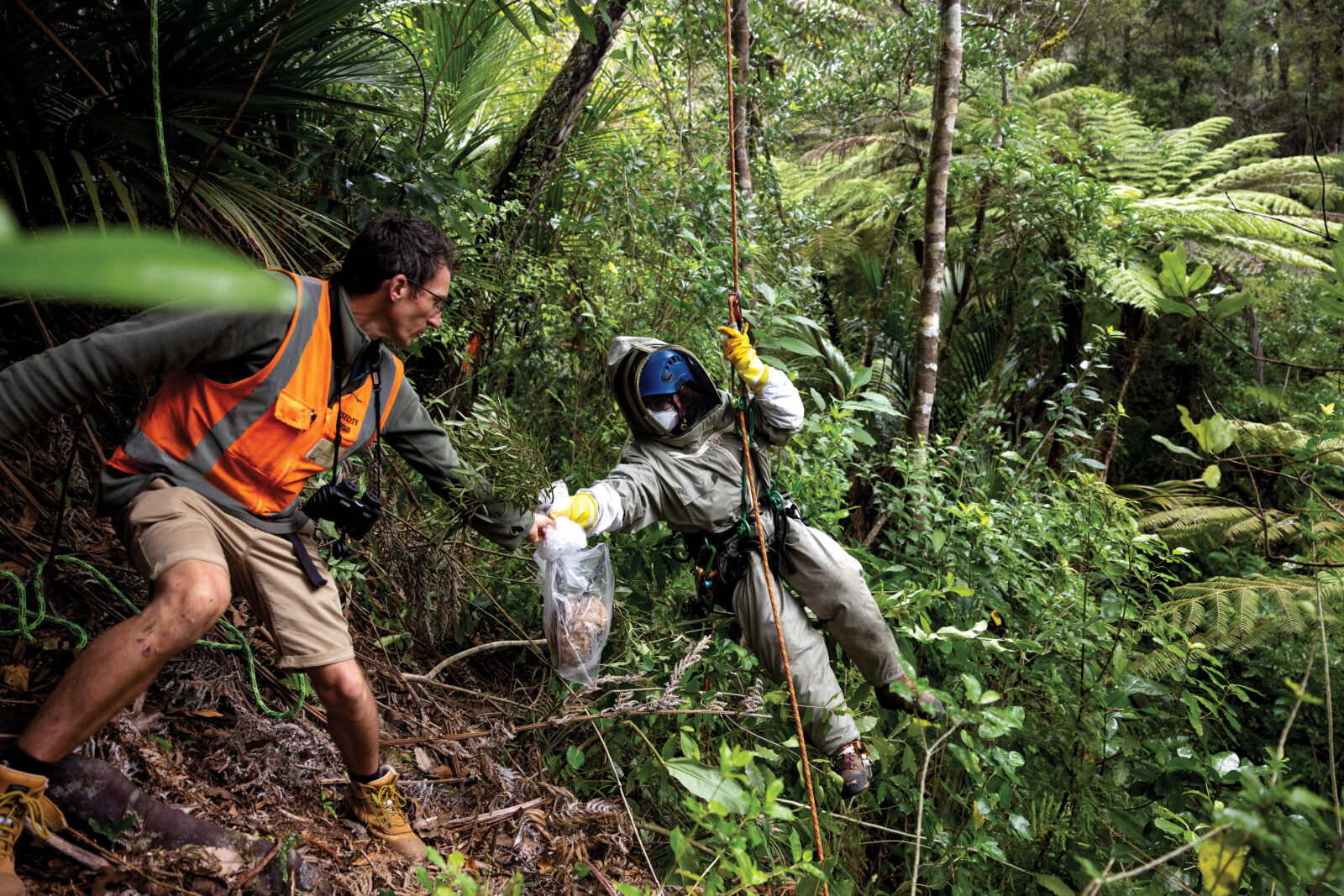
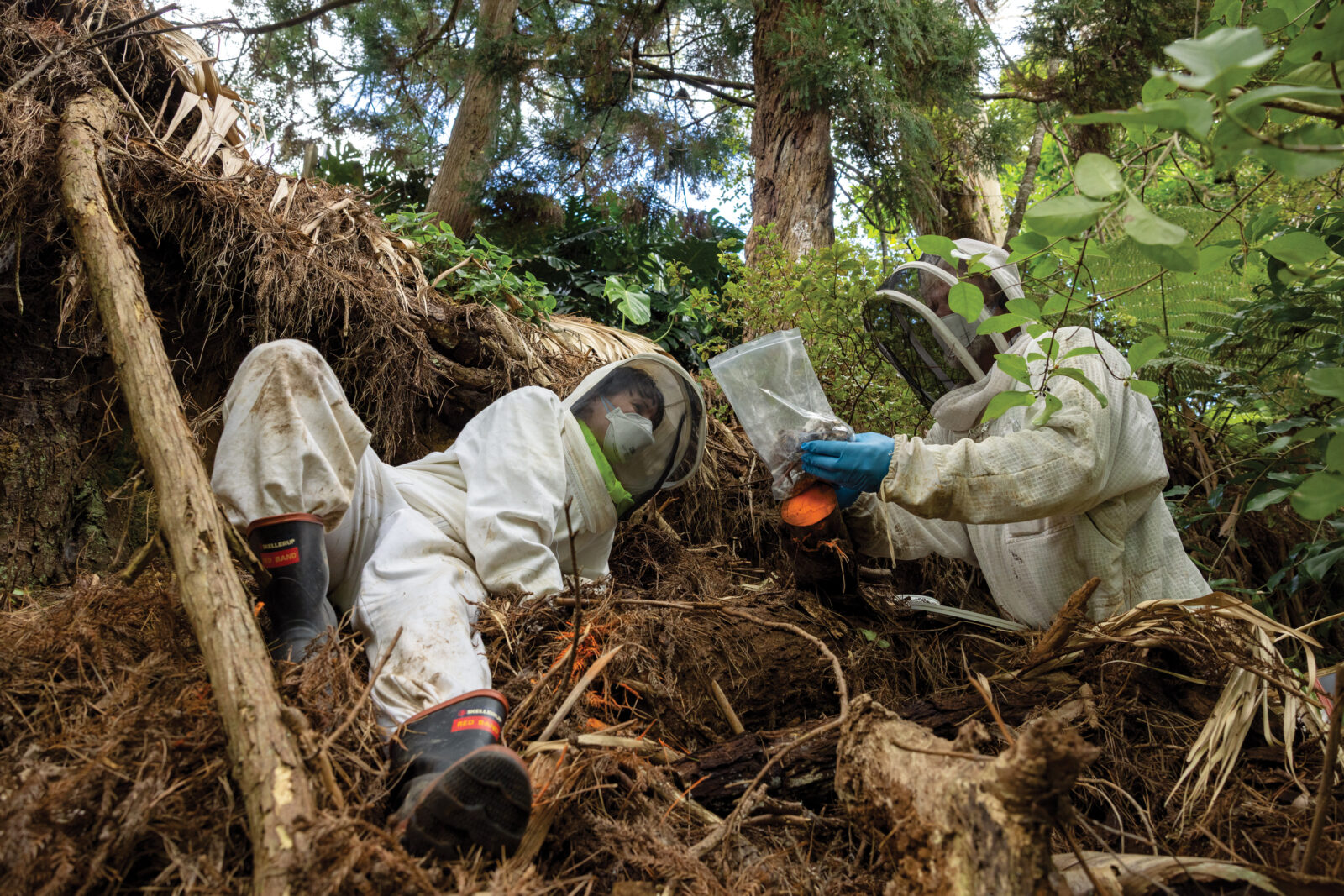
Young arborists Aaron Douglas and Luke Lew are about to kick their first hornet nest.
“We were volunteered,” says Douglas.
“Voluntold,” says Lew.
“You were given the opportunity,” says Chelsea Robertson, their team leader.
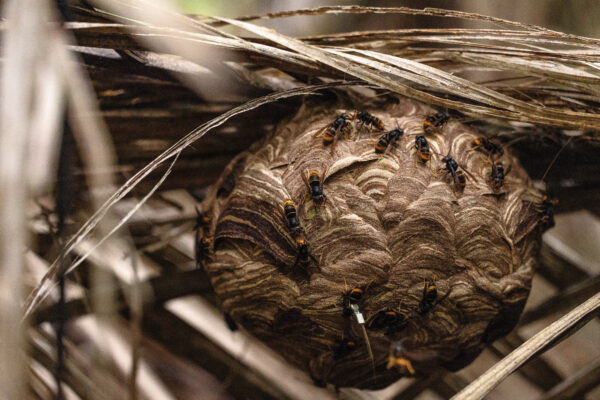
The nest is smallish, maybe the size of my head, and it is some 15 metres above the ground, in a spindly kānuka that teeters over a steep slope, its lower branches roped in moth plant. This will not be an easy kill. “As soon as we found it, I was, like, ‘Oh, shit,’” says Dan Etheridge, a hornet expert who has been fighting repeated incursions in the UK for almost 10 years, and flew in to help get the New Zealanders up to speed.
Lew will be stationed at the base of the tree. Douglas will have to climb it in the “close-combat suit” he’s now stepping into for the first time—imagine a full-body duvet, sealed at every juncture, in 30 degrees Celsius—while holding a four-metre pole with which he will stab the nest and deliver a lethal puff of permethrin powder. His usual arborist ropes and gear are belted over the top of the suit. Under the veil he wears a respirator, so he doesn’t suck in any of the permethrin, and sunglasses, for the late-January glare.
“Whoo!” he says, as Robertson finishes taping him in. He does a clumsy star jump. Andrew Blakie hands him a can of Slay. “They start swarming you, you can spray that,” says Blakie. It’s enough to kill the hornets—don’t bother with regular fly spray—and it disrupts their attack pheromone. “If anything gets into the suit and you want it dead in a hurry, that’d be an option,” Blakie says. He’s a biosecurity expert with SPS Biota, and is helping organise the hornet operation. He has the manner of a dad staying deliberately calm while teaching a teen to drive. Douglas tucks the Slay into a chest pocket.
Now Blakie hands him the pole, and runs through the instructions again. Don’t disturb the nest until you’re ready to stab it. Push the sharp end in nice and gentle. Don’t let it pop out the other side. Pull the trigger and listen for the pffft; the “noise of death”, as Blakie puts it. Don’t pull the pole back down straight away because the hornets will be hammering it.
Douglas strides off to the tree. Soon he is high in the branches, roped up, moving slow and smooth like a great white ape. He can see hornets above him, but not the nest; he leans back horizontal in the ropes, holding the pole like a spear, swinging slightly to peer up into different bits of tree. Robertson guides him to the nest with a laser pointer.
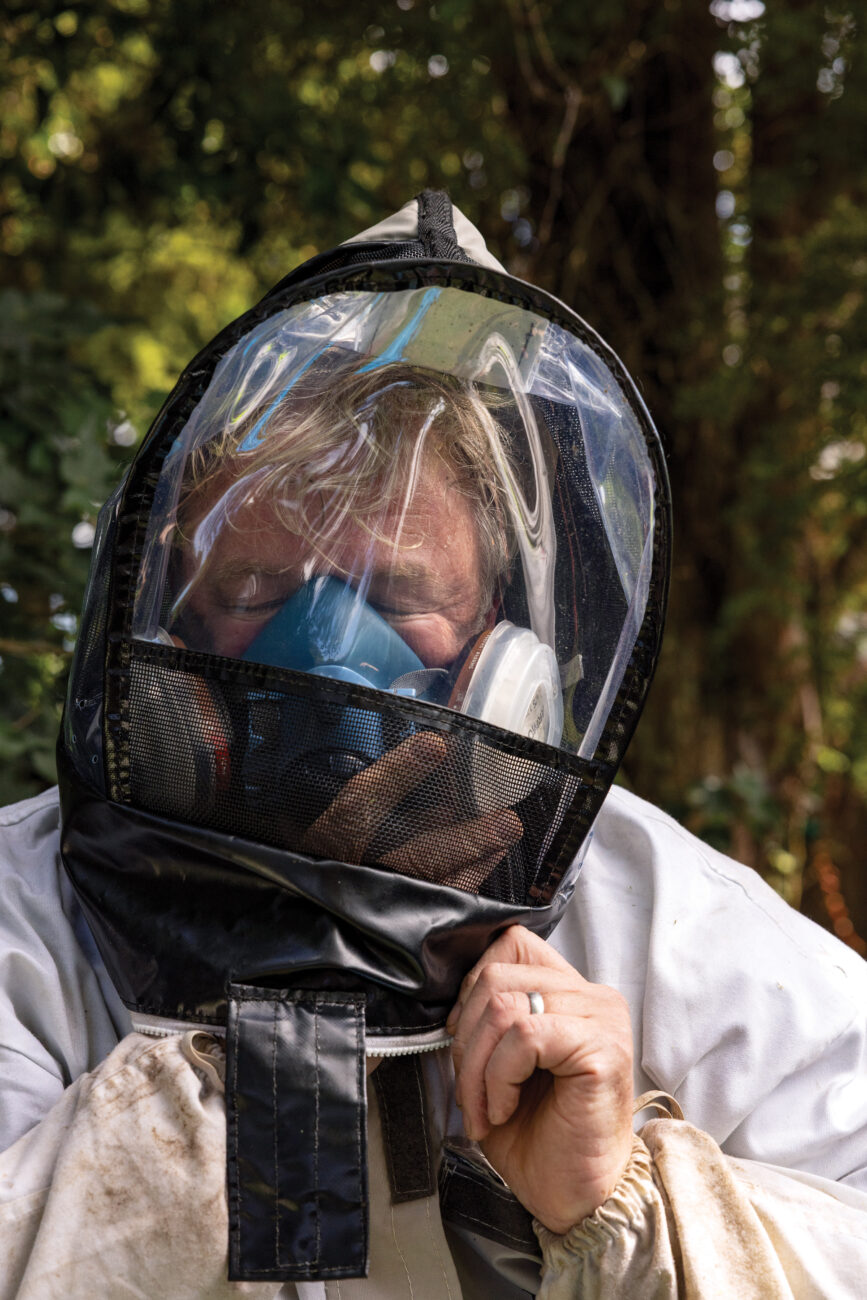
A flock of rosellas flies over. Douglas fiddles with his veil, his glasses. “It’s making me nervous,” Robertson says quietly. Douglas takes aim, pushes softly up; there is a pffft like a Bunsen burner, and a small cloud of white drifts into the sky.
That’s too much powder. Etheridge suspects the pole went right through the nest. Douglas has more immediate concerns. “They’re everywhere,” he calls down, between blasts of Slay. “F*cking tons of them.”
Three black shapes rocket low over my head and into the bush.
Is Douglas okay to stay up there and have another crack?
He’s not thrilled about it, but sure.Pffft.
“That was better,” Etheridge says. “That was good. He should notice a difference in behaviour as well. They’ll be less pissed off.”
The permethrin we use here is triple the strength of what they have available in the UK. Any suggestion of mist will take a hornet down fast, including those returning to the nest.
On the ground, Douglas unzips his veil, grins, wipes his face. “That was fine, actually,” he says. “I wasn’t, like, scared scared.”
“You’ve done your first one now,” says Etheridge proudly. “You’ve felt that crunch. That’ll stick with you.”
[Chapter Break]
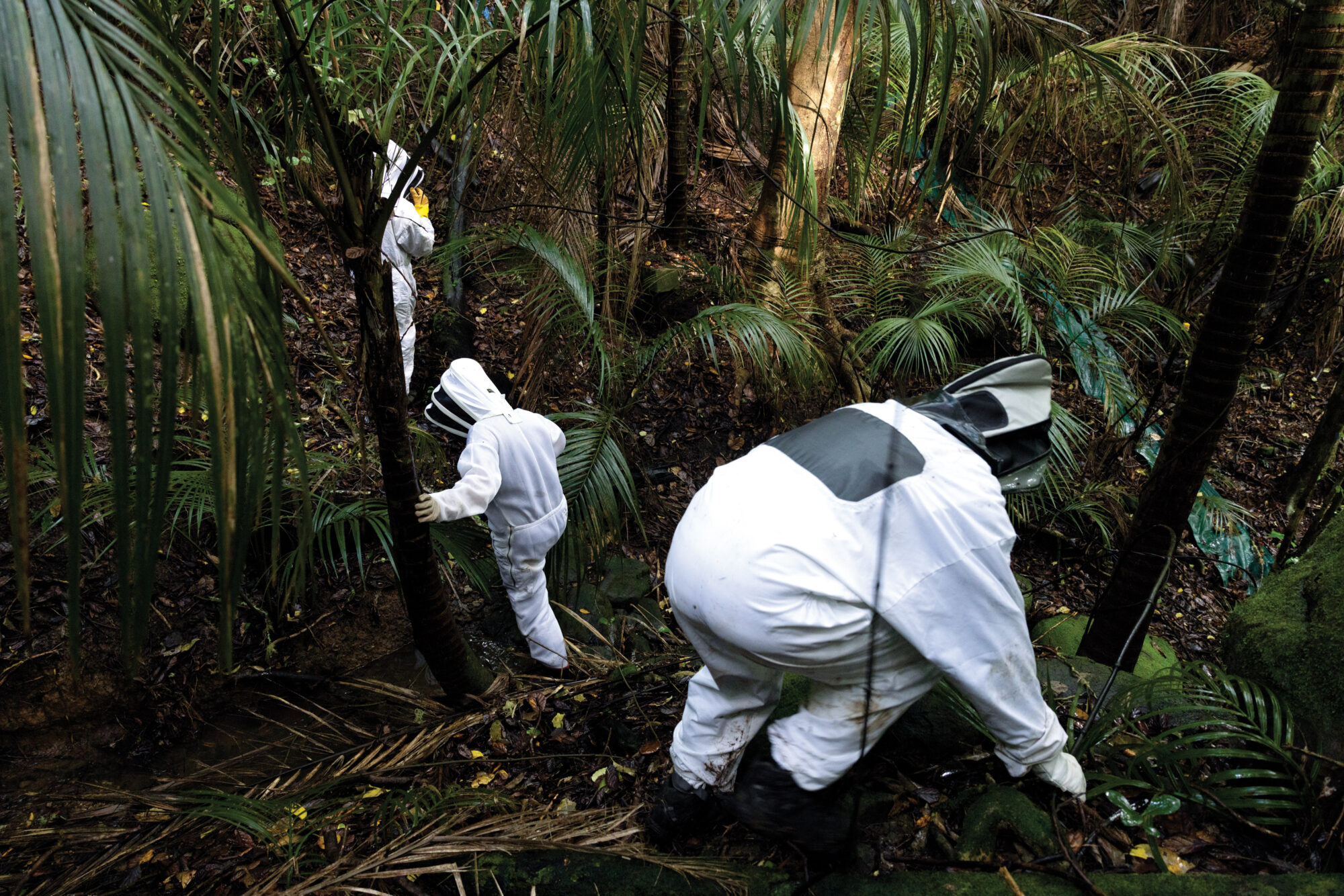
Windy Ridge, Glenfield, Hillcrest: all this is hornet country. You could describe these suburbs as leafy, but we’re not talking the Remuera kind of leafy. Here, on the non-fancy side of Auckland’s North Shore, every second street backs onto a gully stuffed with wild ginger, honeysuckle and old bikes. Blink and your garden will throw on a cloak of morning glory. As well, there are beautiful bush reserves full of kauri and nīkau and pūriri—properly big trees, the kind you feel you should acknowledge as you walk past. There are mangroves, bogs. Too many stray dogs. People go to the dairy in their PJs, swing poi on the walk home from school. I have lived here for 14 years, and I love it.
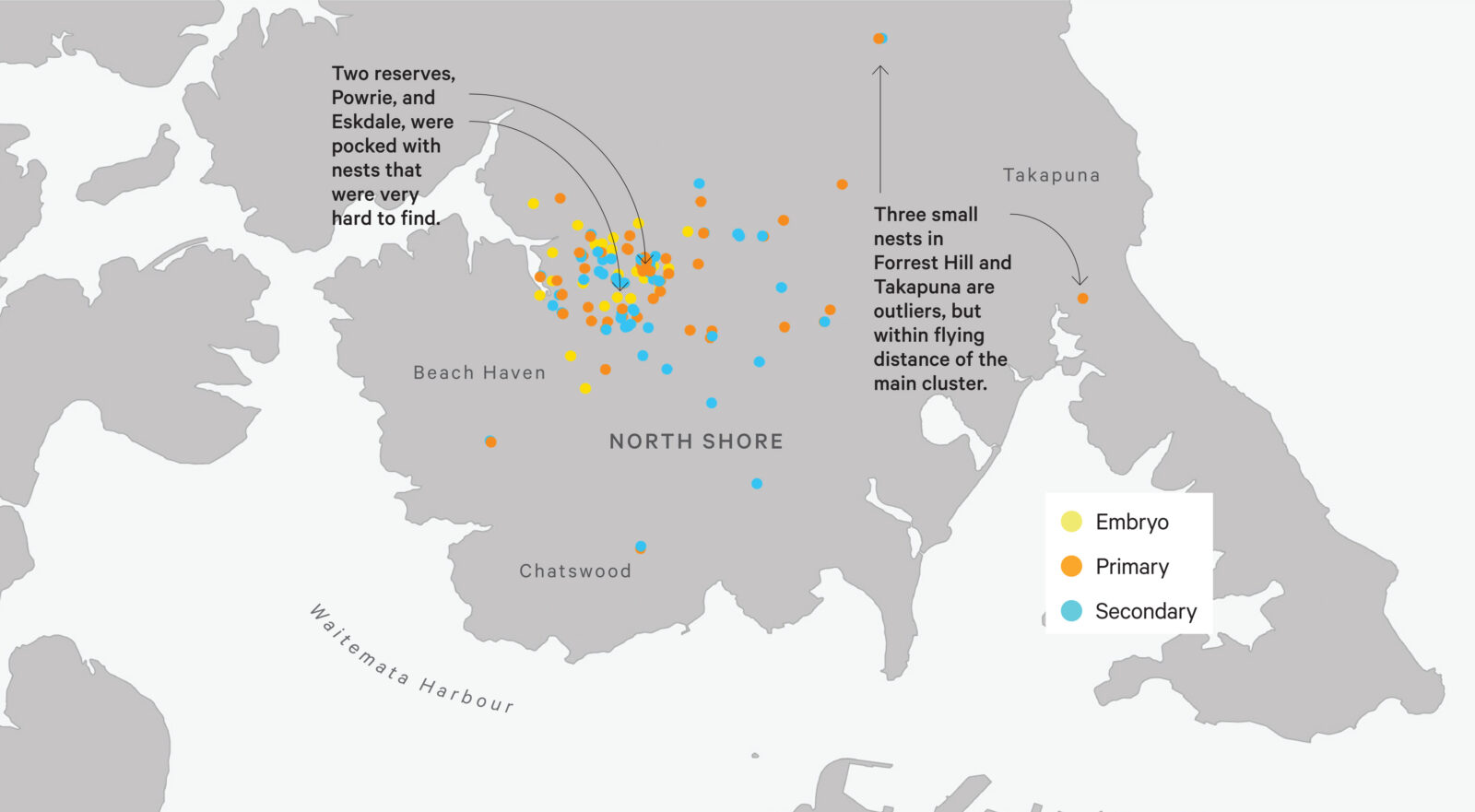
Vespa velutina love it here, too. One queen arrived by pure luck in late 2024 or early 2025, scientists believe—perhaps hidden in a container from Europe, where the species has spread rapidly in the past two decades, or east Asia, its original home. Already laden with fertile eggs, she started a nest, a sneaky one that grew and grew yet got through a whole season without being noticed. And, most pertinently, she made dozens of new queens. That second generation didn’t fly far. They didn’t have to. Here was water, loads of sugary banana flowers and pōhutukawa, endless forgotten scraps of wild in which to hide. Each new queen just zipped over a fence, or up the hill a bit from her sisters. She mated; tucked herself away somewhere to see out the winter.
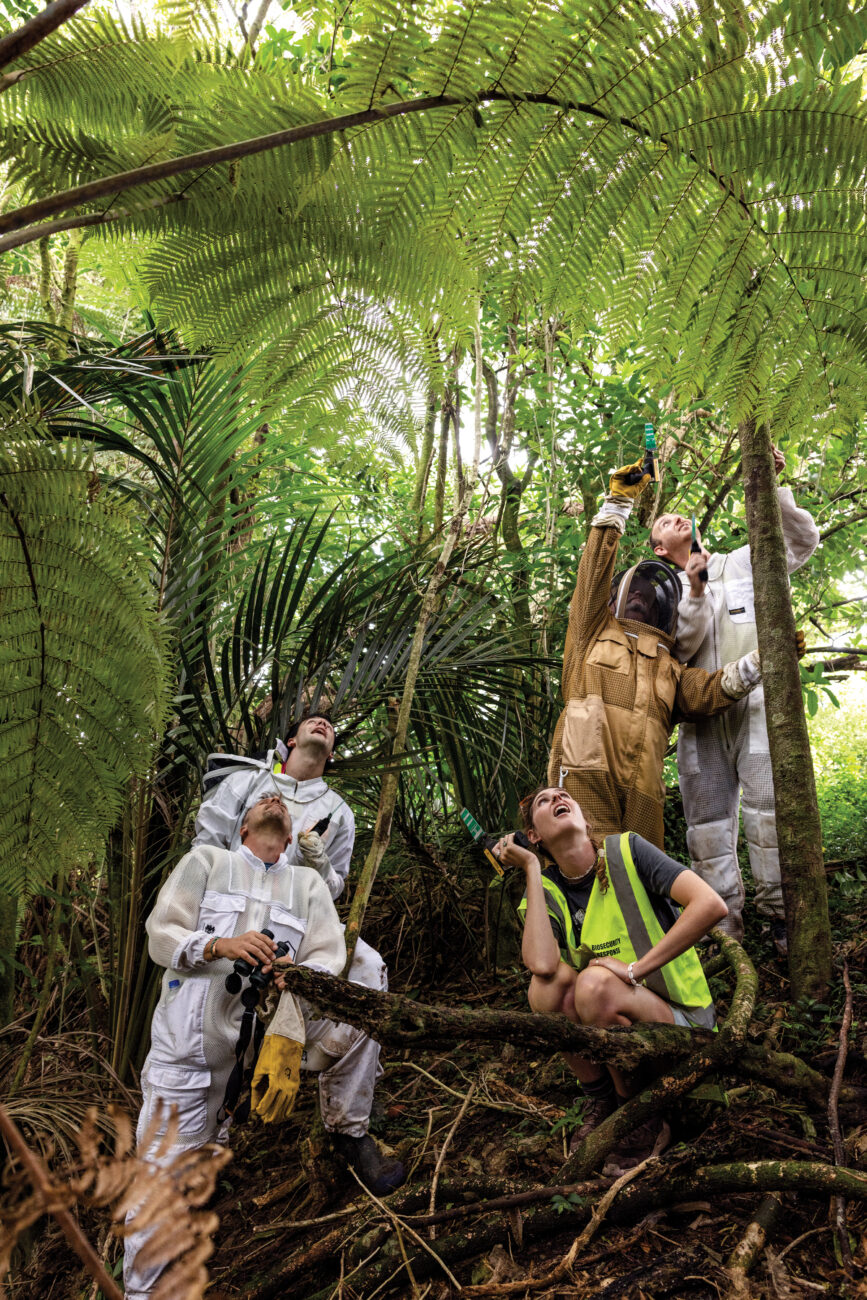
Come spring, those that survived started building. First, a fist-sized nest somewhere easy: under the eaves of a house, maybe, or on a fence, or in some nook in the ground. This home was temporary, like living in a caravan while you tackle the dream house. As soon as she reared herself a crew of labourers, they got to work on a much bigger nest: high up a tree, on the eastern side, usually, where the sun hits nice and early to warm up the workers in the morning.
Primary and secondary nests, they’re called. On the app the Ministry for Primary Industries uses to map the nests, you can neatly pair them up in the sparser areas, a game of join the dots. In other places, like the scruffy edge of a reserve where Douglas has just made his first kill, there are so many nests, so close together, that all I can conclude is: not taking my kids in there for a while.
[Chapter Break]
One of the contractors got one sting and ended up in A&E with a full-body rash. A member of the public was stung a few times on the head after disturbing a nest in a bird box near his washing line.
Someone shows me a video of a hornet attacking a thick leather glove—there’s a wet patch of venom around the stinger already and the hornet is still stabbing away, its whole body working, furious.
These hornets are much more dangerous to people than wasps or bees are, and they can upend a native ecosystem, but that’s not what’s triggered the comprehensive, $14 million response. It’s the risk to honeybees, and the honey industry, and the ripple effects across other sectors that rely on pollination. The hornets have torn through much of Europe, but France, invaded in 2004, is hardest hit: beekeepers there are losing NZ$63 million in revenue every year because of the hornet, one study estimates, and trying to control the pests is costing about $24 million annually.
To take down a bee, a hornet uses a strategy called hawking. It hovers in front of a hive, facing outwards, away from the entrance, to target the weighed-down worker bees on their way home from foraging. It hangs there in the air, dark and loud, an Iroquois chopper calmly sizing up a flock of sweet little Robinson R22s.
In France, Etheridge has watched 40 hornets hawking a hive at one time. They’ll grab a bee on the wing, he says. “And then they fly up to a branch or somewhere nearby and they’ll strip the bee down. They’ll dismember it. You can look at them and watch a leg drop, another leg, a wing…” The hornet wants one thing from the bee: protein, for the ravenous larvae at home. It takes only the thorax back to the brood. And then it comes back for more.
A Glenfield beekeeper got hawking on video: in the clip, the hornet hangs upside-down from a twig like a trapeze artist, its front legs and mandibles busily pulling away bits of bee. It reminds me of stripping a corncob in the supermarket.
Once a hive is weakened, Etheridge says, the hornets will invade, chasing the bonus of honey and bee larvae, soft blobs of protein set out so neatly, helpless.
[Chapter Break]
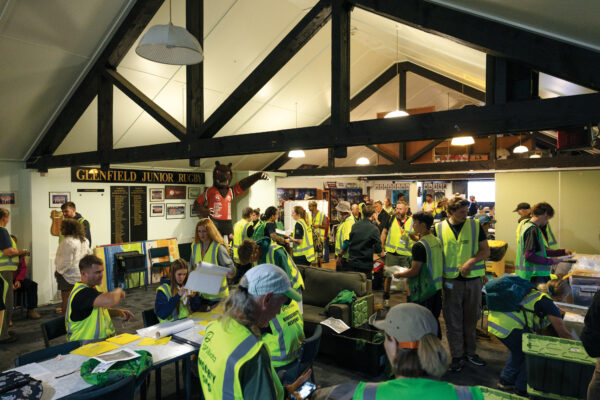
Home base for this operation is that most classic of Kiwi hives, the Glenfield rugby clubrooms. It’s bang in the middle of hornet town. There are wasps floating in every toilet: trap bycatch that didn’t flush on the first go. Upstairs, trestle tables are stacked as if for a very strange school camp: instant coffee, rubbish bags, stepladders, reels of blue cord, zappy tennis rackets, first-aid kits heavy on the antihistamines. The bar has become a charging station for myriad laptops and phones and the floor is tacky not with last night’s beer, but Hawkeye wasp lure. This pink, viscous stuff is the lifeblood of the resistance. It keeps the network of hundreds of traps topped up, and brings hornets into the feed stations: pot-plant saucers in which river stones act as landing pads. Any hornet turning up will unwittingly turn traitor.
When the hornets first arrived in the UK, Etheridge pushed to try zeroing in on nests using “beelining”: you mark a bee, then note the direction it zooms off in after each feed, and how long it’s gone between visits. You know how fast bees typically fly, and how long they spend at home unloading, so you can triangulate that information, get out a map, and draw a line to where the hive is. To his satisfaction, it turns out to work beautifully for hornets, too—Etheridge proved it by dropping a pin within one metre of what he fondly calls his “eureka nest”. In New Zealand the situation is more diabolical. We have heaps of nests packed into a small area, so the flight lines criss-cross. And that’s before the hornets start swerving around trees and slopes and townhouses.
“It can still tell you a lot,” Etheridge says. For a hornet, one minute in the air is around 100 metres. “So it gives you a boundary to aim for. If she’s gone for three minutes, you know it’s not going to be past 320 metres, say.”
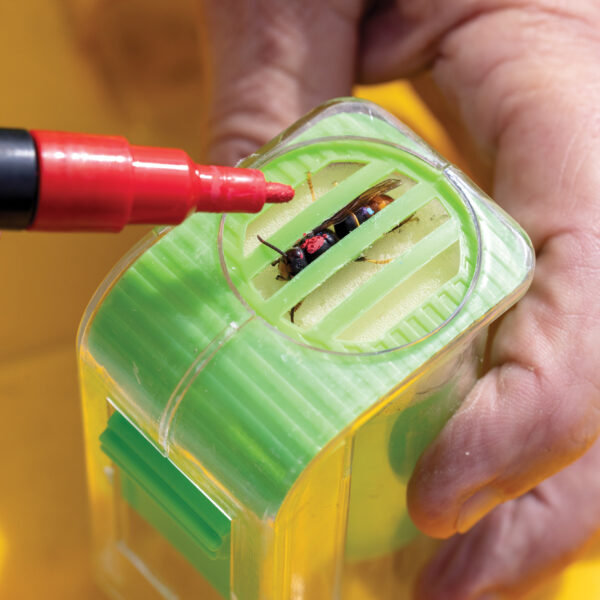
To mark a hornet, you dab the visitor with ink as it feeds, or catch it in a butterfly net and decant it into a nifty device with the mechanism of a Push Pop lolly: you raise a floor of foam up inside a transparent tube, until the hornet is backed against a grille it can’t sting through. Then you glue on a very undignified tail of Christmas tinsel, which catches the light so that the black hornet flickers as it flies, like a fairy.
Pete Davies, who led the UK’s hornet response for five years until his retirement early in 2026, is with Etheridge in New Zealand, helping out (Davies is volunteering, with expenses paid; Etheridge is on his usual government salary). He has bedazzled so many hornets he now uses “tinsel” as a verb. He appreciates “a little bit of glinting going through them trees”.
Red and yellow tinsel work fine, he’s found, but best of all is a pretty mother-of-pearl.
[Chapter Break]
Hornet health and safety briefings tend to involve instructions about EpiPens and the edict, “If someone says run, you run.” Daniel Christopher’s not exactly saying run, but his tone is exceptionally urgent. “Keep walking keep walking keep walking,” he says. I’m halfway down a narrow path in Glenfield. It curves down the side of a house, depositing me on a square of lawn at the back of the property.
Once the group is down the path safely, Christopher, a quantity surveyor and beekeeper turned biosecurity contractor, beckons me back to the nest he’s just spotted after a morning monitoring hornets at a feed station. “It’s very hard to find,” he says, holding flax leaves out of the way. “Come here, a bit closer.”
He points to an egg cup-sized shadow at the base of the flax, right beside the path, so close one misstep would put your foot on it. “Just keep looking,” Christopher says quietly. “You’ll see something fly out.” A dark shape emerges and shoots off to the feed station.
This morning, Christopher watched two hornets tussle in mid-air like sea eagles and fall to the ground still brawling. That level of aggression indicates they’re from different nests, one of which has not been found. Nobody is surprised. The house borders Powrie Reserve, a wickedly steep and tangled bit of bush which is notorious for its dense network of cryptic nests. “Powrie”, everyone calls it now, with the same exasperated tone.
“You don’t get to revel in the glory for long,” Etheridge tells Christopher as we gingerly pick our way back up the path. “On to the next one!”
[Chapter Break]
When all else fails, you go high-tech: radio tags. But first you need to find a hornet big enough to carry one, and lots of ours are much too small. “Your little skinny hornets,” Davies mutters at one point, growling into his instant coffee.
Beside a stream, in a gorgeous overgrown garden, Tara Wills and Margot Ferguson ease a freshly radio-tagged hornet into a fine mesh box. It does a few angry jiu jitsu rolls, trying to rip the gadget from its back. Then it sits quietly, recalibrating. Ferguson dunks a leaf in sugary lure and holds it close to the hornet. “Giving her a bit of Red Bull,” Wills says. “Give her wings.” After its sticky drink, the hornet gives itself a wash.
The white suits go on, four scanner guns are handed out. These will track the hornet, pinging and flashing in certain patterns to indicate distance. Often, the team stand around for ages waiting for the hornet, with its new backpack, to fly. Other chases are hard and fast; the trackers have been known to hop in a car, scanners brandished out the windows, in an effort to keep up.
One of the team, Ben Kneijber, heads up the hill with his scanner to wait in ambush. As the mesh box is unzipped, the guns are trained on the hornet, flashing and bleeping at the proximity. They trace its woozy launch—but after just a few giddy circles, the hornet disappears into a lilly-pilly. Everyone stands still, gormlessly pointing their guns at the tree. Abruptly the tone of the bleep changes. “Yep, she’s moved,” says Ferguson. “I’m down to three reds,” says Nick Ward, an MPI team manager. “Tally ho!”
Guns beeping madly, the hunters crash along the stream, past a ponga fence, a droopy badminton net, a mossy gazebo, a magnolia. Within 30 seconds, the white suits are out of sight. I hear the women calling to Kneijber. “She’s going up the gully!” “On her!” They follow the hornet right up the hill and across two roads—all the way to a nest that another team happened to find just an hour or so earlier.
One Saturday, a friend sends me a photo: taken from her upstairs window, it shows three people climbing into hornet suits next to the trampoline. The team used radio tagging to find one small primary nest in the ground, she says—in the patch of native bush where our six-year-old daughters were playing a couple of days before. Soon they spotted the secondary, invisible from the ground, brewing high in a tānekaha.
A few days later, my friend sends another picture: her daughter grins a bit nervously in the foreground, clutching her schoolbag straps, and a couple of metres behind her, someone in a close-combat suit holds up a bag full of dead hornet nest.
[Chapter Break]
There is a glamour to this work. “Tell you what,” says Ken Brown, with a fierce joy in his eyes. “I said, ‘I don’t want to do fruit flies. The only thing I want to do is hornets. Or maybe if we get wolves, or lions, or crocodiles.”
Brown is the president of the Auckland Beekeepers Club and spends his weekends teaching budding apiarists what to watch out for: parasites, diseases, wasps. Hornets were never on his radar, or anyone else’s, really. But now they’re here he’s all in. He and his students are an important resource: they’re used to things that swarm and sting, and they have the “soft hands” required for working with hornets. They are getting paid, but they’d do it for free. Brown grins. “We’ve got the best job of all, being on the kill squad.”
After his first few nests, Brown concluded the poles, one of which extended to 23 metres, were too awkward to stab nests in the ground or those low in the trees. He’s made his own sawn-off version, about the size of a light sabre.
Adapting, he says. Unfortunately, everyone suspects that the hornets will, too.
Wasps are the cautionary tale here. They were introduced to New Zealand last century; we now have the highest density of wasps in the world. And as the climate shifts, our German and common wasps are pulling off a new trick: whole nests are surviving the winter. That means more wasps around, total—and massive, dangerous nests. Given two seasons they can grow as big as a car.
Then there’s the rate of spread, driven by the dozens, or hundreds, of queens that each hornet nest produces in a last gasp at the end of the warm season. In the UK, about 10 per cent of those young queens survive the winter. Here, Brown worries “it could be 20, 50, 80, 100 per cent”.
He winces when he turns up to dispatch a hornet nest and there are kids playing nearby. The nests are very hard to spot, and while wasps usually need to really lay into a person to kill them, hornets can do it with just a few stings.
If the hornets are allowed to settle in like the wasps have, Brown says, you wouldn’t want your kids making huts in the overgrown corner of the garden. You wouldn’t want to go off-track in the bush. As well as the economic shock of pollinators getting hammered, and the “apocalypse” of the hornets tearing through our native bees and other insects, what motivates Brown is the prospect of that cultural shift, the fracture in the way people connect with the land.
“It’s huge,” he says. “It gives me goosebumps thinking about it, actually.” He runs a hand up his arm.
[Chapter Break]
Three seconds after I zip up the veil on my hornet suit, it establishes its own foggy microclimate. Sweat breaks out all over my body. It’s only 24 degrees Celsius today and we’re in the shade, and this is one of the mesh suits, the ones that are meant to be positively breezy. Ye gods. “Yeah,” says Brown, deftly zipping up his own suit. “And then once you start walking, or just being under stress in any way…”
We scramble down into a scrappy, steep stitch of bush. Brown killed a nest here yesterday and it’s time to collect. The air is a soup of privet pollen and mosquitoes.
Brown stops and kneels at one end of a fallen ponga; the nest is inside it, right at the end, but all you can see is one wall the size of my palm, a light-brown facade that looks entirely unremarkable, like a splodge of dried mud. An orange bullseye marks the small hole where the pole went in. Brown kneels for a moment and listens. Nothing doing. He starts pulling wedges of rotten ponga off the top of the nest.
Quite often, he tells me as he works, the larvae are still alive, “still wriggling”. You can hear them rasp, rubbing their mouth parts against the wall of their cell. That noise tells the adult hornets the kids are hungry. (The kids are always hungry.) This time everything’s silent.
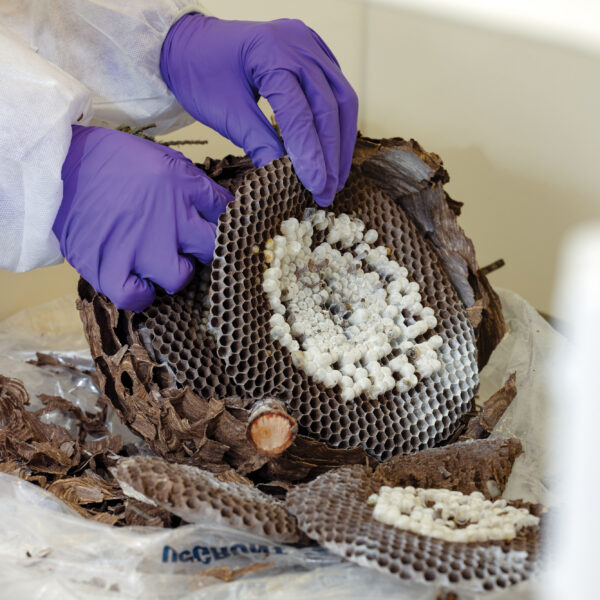
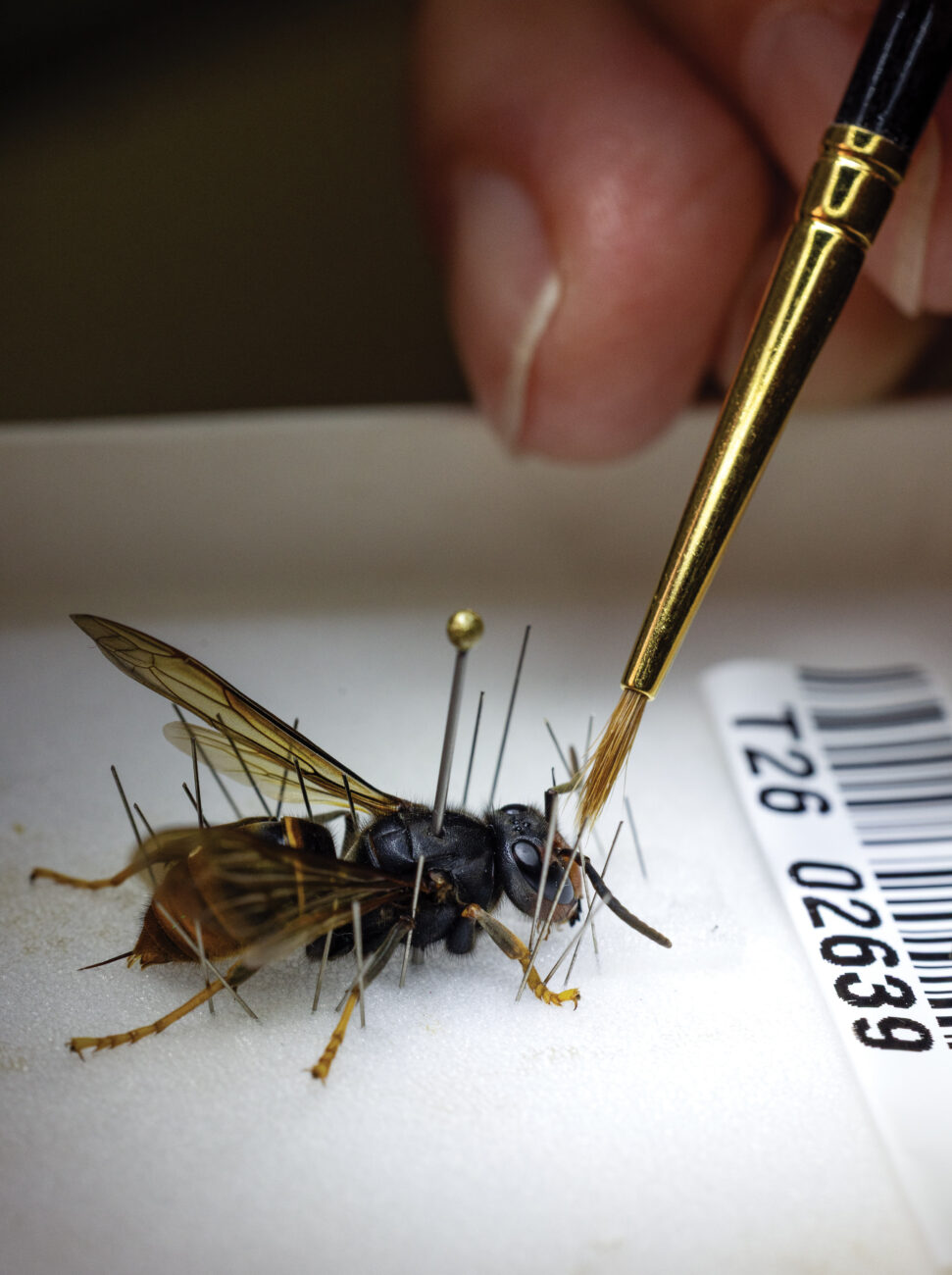
Exposed, the nest is the shape of a sausage and a bit thicker than my arm. Toasty brown-and-white flakes slough off in Brown’s hands as he slides the nest into a bag. He reclines beside the log now, a mermaid on a rock, and starts the delicate work of sifting through bits of nest and leaf litter, adding to the bag every last dead grub and powdered hornet. All of it is headed to a laboratory across town, where entomologists will dismantle it and tally each hornet, as well as the swollen larvae and pupae—the almost-adults, fully formed but entirely, eerily white, as if they’ve been moulded from wax. There will be DNA testing. They’ll look especially for the queen. Every now and then, Brown confides, he likes to drop in a cockroach or a spider that’s been caught in the crossfire, just to keep the lab on their toes.
The nest goes into a white plastic bucket with a lid, with a biosecurity sticker and an unwanted-organism sticker. Back at Brown’s van, he opens the door to stow the bucket and a dozen or so honeybees lift into the air, his
constant entourage.
[Chapter Break]
To annihilate a colony of hornets you must keep hornet hours: evenings, early mornings, weekends. Many of the team are away from their families, or bookending each day with a long commute across the city; they talk of “peacetime”, normal life, with a fond nostalgia. But after a few visits I realise: they’re having a ball. “It’s the coolest nerd job I’ve ever had in my life,” Wills says, dead serious. There is a big plush bee that is bestowed upon anyone who’s had a blinder. People show me photos of themselves posing with conquests, holding nests in both arms like big snapper. “Pew pew,” says Ward, playing silly buggers with a scanner gun. He grins. “What? You’ve got to, don’t you?”
Whenever I get someone by themselves, I ask what they really think of our chances here. And again and again, they say something like: Oh, we’ll get them for sure. Or, maybe we won’t get them all this year, but we’ll definitely get them next year. It is a rare, galvanising, evidence-based optimism.
Here is the crucial data point: We’ve had just one queen arrive. All the others are her daughters, genetically linked to her. Knock this dynasty out and we’re in the clear. Contrast that with the UK, which in 2022 got down to just one nest—but the next spring, more than 70 new queens blew in from France. Theirs is a losing battle, Davies knows. And no other country has banished these hornets so far. New Zealand is in a unique position, he says, and now he has great pride and satisfaction in his voice. “I believe you can win.”