Hope for the underbirds
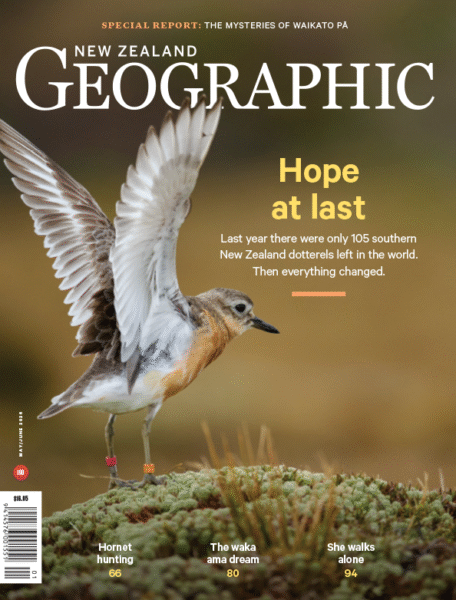
For decades, the southern New Zealand dotterel had been disappearing, bird after bird killed on the nest, mostly by feral cats. Only 126 birds were left. Two years later, 105. Then everything changed.
It is such a dismal winter day at Awarua Bay, near Bluff, that the chimney stack of the Tiwai Point aluminium smelter is hidden in cloud. The smelter is on the edge of the estuary, on the edge of everything; the sort of place where we build our heavy industry, the sort of place where the birds are.
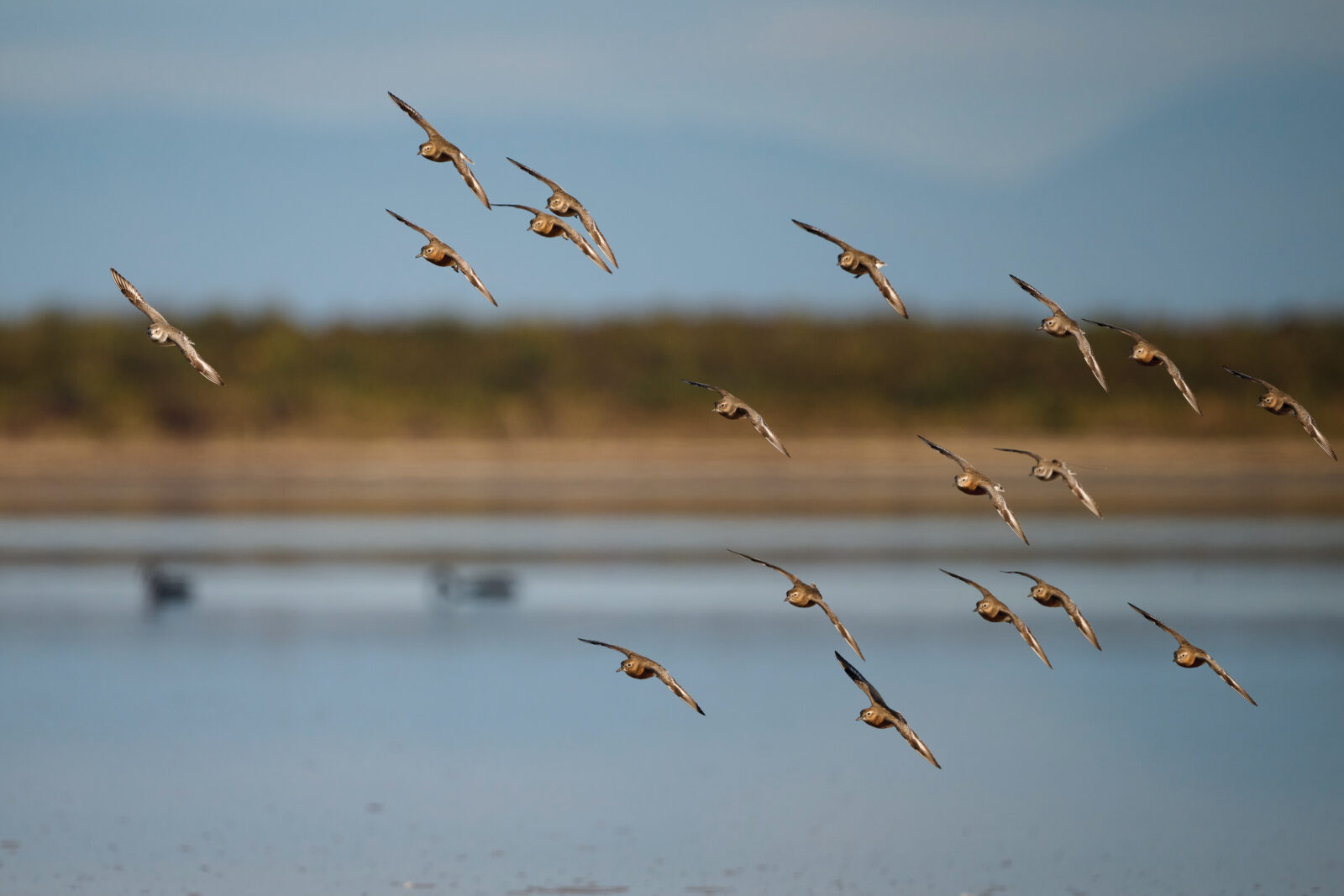
It’s June 2025, and a handful of the world’s last pukunui, or southern New Zealand dotterels, are spending the winter here. Across Foveaux Strait are the mountaintops of Stewart Island/Rakiura, the birds’ home for the rest of the year. These are the only places left for them in Aotearoa.
Awarua is a favourite spot of Gore bird photographer Glenda Rees, who has today invited me on one of her trips. The flock’s arrival each February is a joy for Rees. She knows the birds by ID band, name and personality, which isn’t that difficult to do when there are only 105 left in the world. Unless the fortunes of the pukunui change drastically, they are tipped to be the next bird New Zealand will drive out of existence altogether.
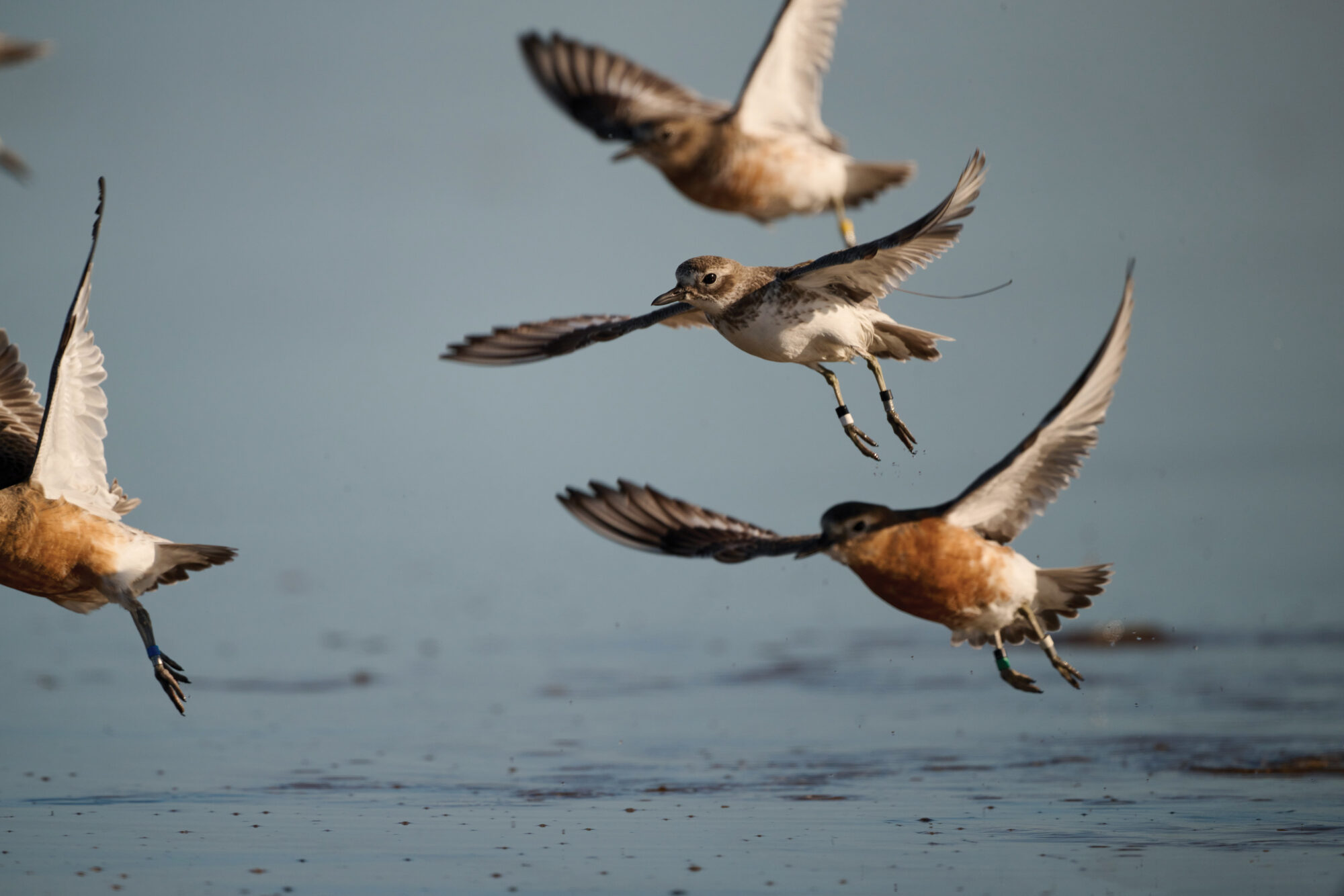
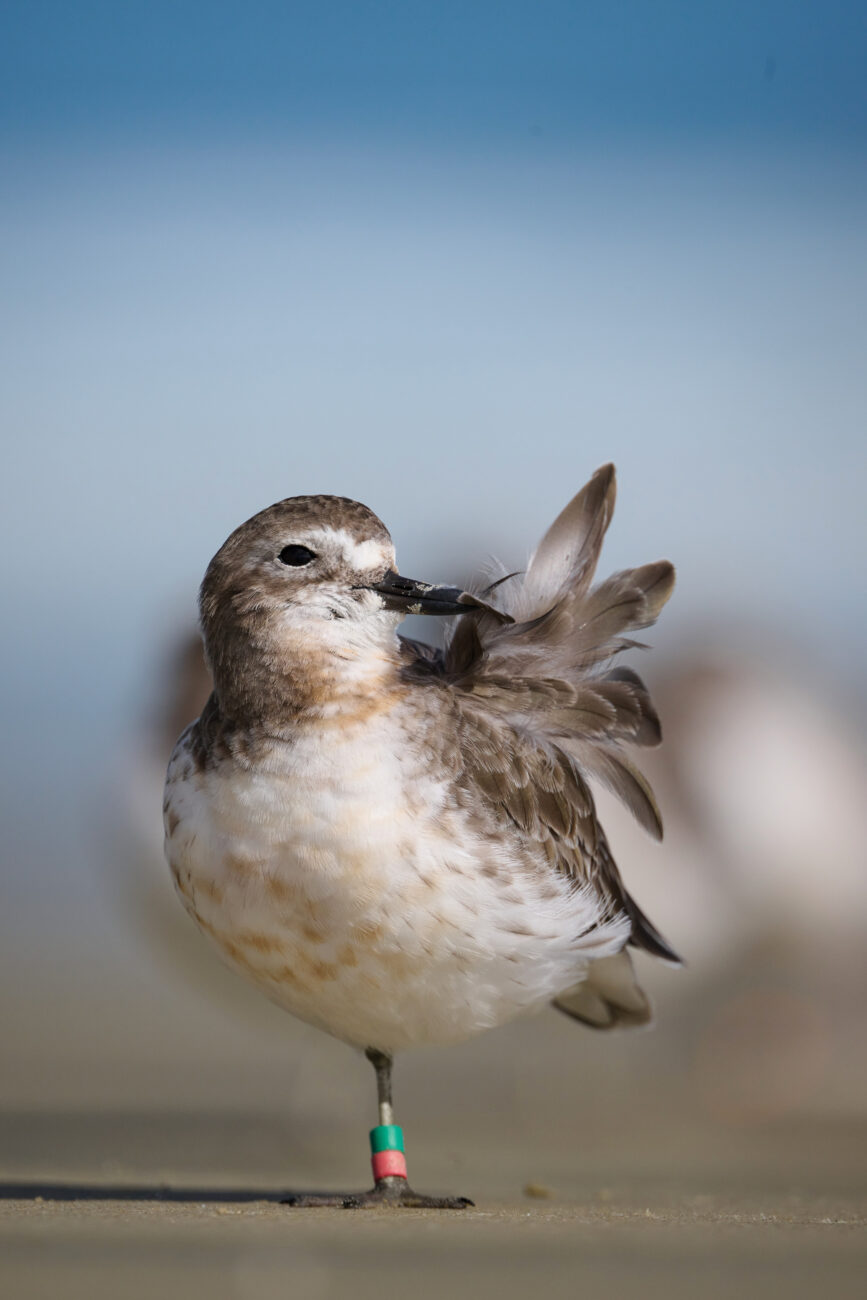
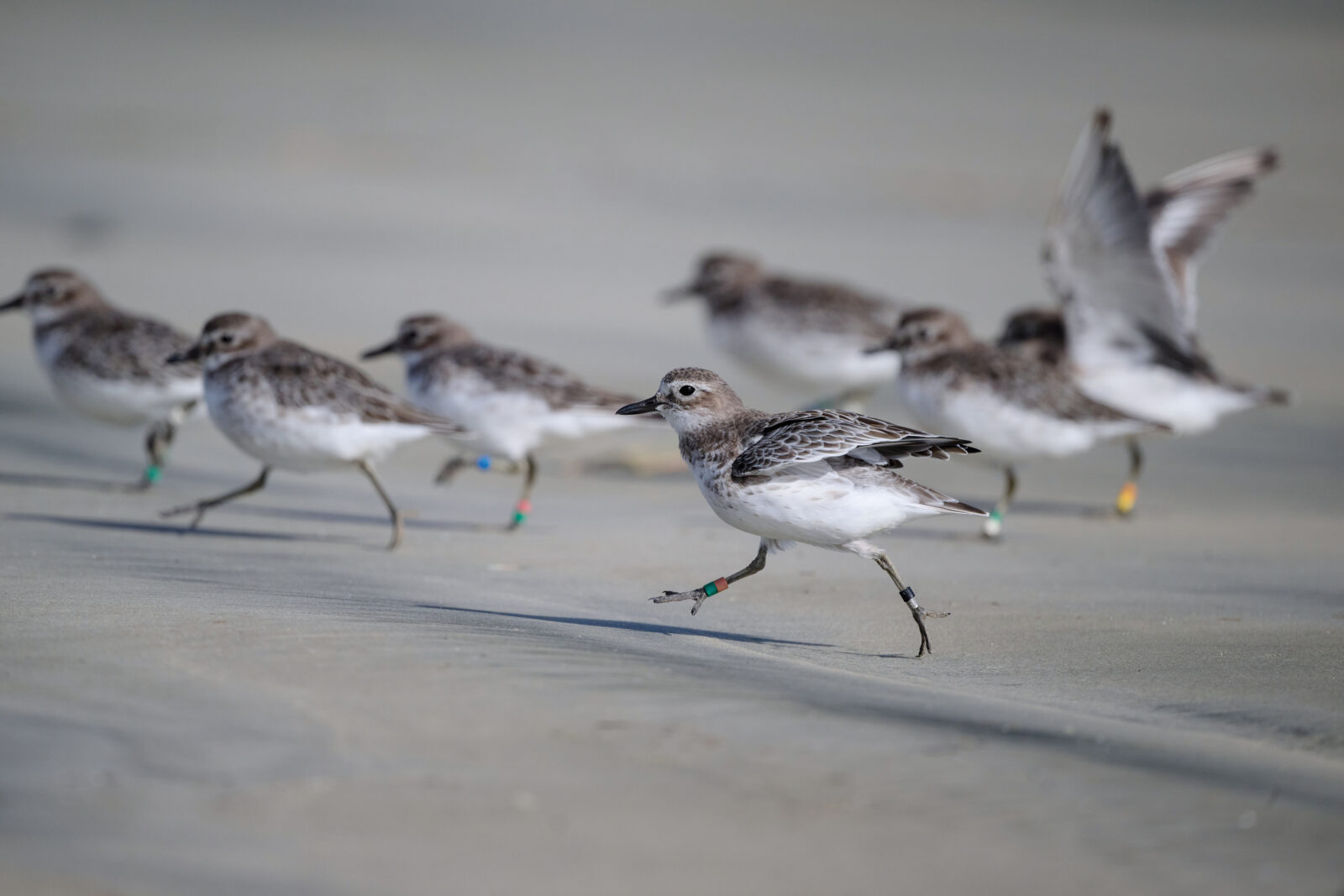
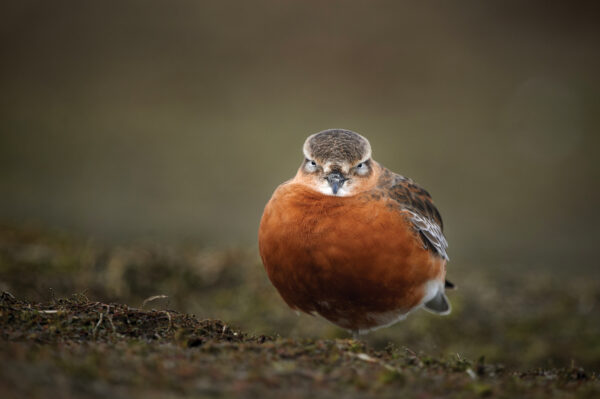
“There’s one,” Rees says, and hoists her binoculars. “Do you see it?” It takes a minute or so to get your pukunui eye in, she says. And once I spot the bird darting across the sandflats with a funny dash-stop-dash gait, I see more, hunched against the pattering rain. Pukunui are bigger, heavier, and darker than their cousins from up north. At this time of year they are the colour of the beach: brown and white. But before the breeding season their breast plumage turns a deep, flaming reddish-orange, helping them blend in on Rakiura’s alpine herbfields, where they nest.
“They’re just snoozing,” says Rees. “They’ve got their heads tucked in, which you would on a day like today. Don’t they blend in so well?”
All morning, Rees delights in the birds, pointing out their big round bellies, or the way they hop along with one leg tucked up. Then she chastises herself for getting too attached. But the birds have had her heart since April 2011. In fact, they got her into bird photography, which on an average day consists of her lying down in the wet and cold muck of the estuary propped on her elbows, spending hours peering through the viewfinder.
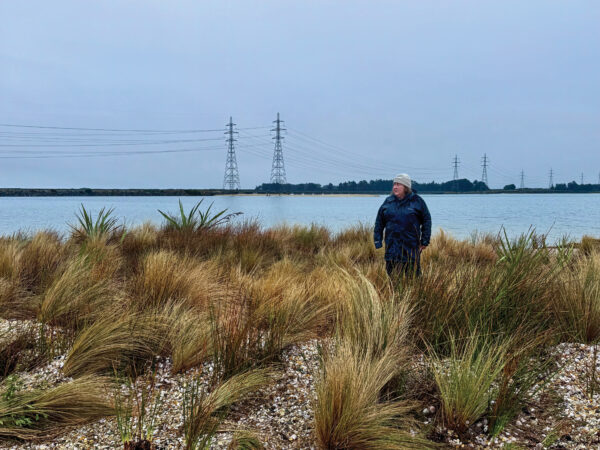
She cried for weeks when her favourite bird, Boom, disappeared. Late last summer, just before the dotterel flock came back to Awarua, a fire started here and burned more than 1200 hectares of conservation land. (The vegetation was full of fernbirds, she says darkly, which would have burned as well.) For Rees the fire meant an agonising extra wait on top of a season apart. When she was at last allowed back to the estuary, she scanned the flock, ticking off her birds.
“‘Where’s Boom? Where’s Boom? Has anyone seen Boom?’ No.”
The birds shouldn’t really be named by Pākehā—the privilege is reserved for iwi—but their band colours create acronyms that beg for nicknames and enable their fans to tell them apart. Boom, for example, had blue, orange, and metal tags. Rees once got a great shot of him spearing a small flounder. She talks wistfully of his little ways, then sighs.
“He was nine-ish. How could a bird skipping along like that die of old age? I hope he wasn’t eaten by a cat.”
She knows it’s quite likely that he was. The pukunui’s normal lifespan is thought to be around 20-25 years, but predators have been killing most of them by the time the birds are five, barely breeding age. Rakiura’s feral cats, rats, and possums are many and voracious. They don’t eat just the birds, but also their brownish speckled eggs. White-tailed deer, beloved of Rakiura’s hunters, have been filmed eating the eggs, too. Black-backed gulls will go for eggs, and probably chicks. Kārearea and spur-winged plovers are other aerial threats.
“I really feel for you,” I tell Rees.
Her voice is soaked with anguish. “I’m anthropomorphising them,” she sighs again. “Which is not right.” But Rees estimates she’s now visited Awarua more than 500 times, in rain, hail, and snow. She once considered moving from Gore to Bluff to be closer to the pukunui. But then she realised that with only about 30 breeding pairs left, she’d probably outlive them.
[Chapter Break]
The birds once nested across the Southern Alps, but pests forced them to a last stronghold on Rakiura; by 1992, the Department of Conservation estimated there were just 62 pukunui left. Pest control spiked the population up to 290 in 2009, but numbers have fallen away precipitously.
Among those already lost on this island are brown teal/pāteke, South Island saddleback/tīeke, yellowhead/mohua, fernbird/mātātā, and kākāpō. Others, such as kererū, kakariki, tītipounamu, and kākā, have dramatically declined.
A huge and ambitious predator-control machine is working to permanently clear Rakiura of cats, possums, hedgehogs and rats. It will be the biggest and most complex project ever attempted on an inhabited island, and people are a serious complicating factor. But the pukunui cannot wait.
After my morning with Rees, I catch a ferry to Oban. Tonight, there’s a public meeting about the island’s first aerial 1080 drop, and the short walk from the wharf to the island’s library and community centre is dotted with protest signs. Inside, kai has been laid out, and the hall is full to the back row.
Whānau from Raukūmara Pae Maunga, the stunning mountain range of Ngāti Porou and Te Whānau-ā-Apanui on the eastern shoulder of the North Island, have come to talk about what happened on their land after 1080 drops in 2023. They are enthusiastic, warm, and open about how difficult it was to get everyone in the community onboard. In their rohe, everyone had to agree before the 1080 went ahead. That meant 135 hui, as well as wānanga and conversations with landowners, farmers, hapū and hunting clubs to build trust and understanding. The results have been spectacular.
“I was a hater,” Wiremu Wharepapa says. He’s a hunter, and says he once had an attitude of “everything in [the forest] is mine”.
“I wanted all of it.”
The forest might have looked healthy to the untrained eye, he says, but “behind the curtain, there was another whole story going on. It was the Wizard of Oz.” Chew cards deployed in the forest to test pest numbers were completely destroyed, bitten to shreds by rats.
Wharepapa tells the crowd that post-drop, there is now a deep understorey, and the moss on the ground is not crackling and dry. There are fewer holes in the canopy. The birds have come back.
That night, I join some of the whānau and the sole local policeman, Stuart Newton, who has offered to take them kiwi-spotting. Newton drives slowly around Rakiura’s tiny network of roads, and we exclaim at seeing tokoeka, the island’s shy kiwi, waddling across the tarseal.
This is a common experience for locals; while there are myriad predators here, there are no stoats, ferrets or weasels—which means kiwi chicks have a better chance of survival than on the mainland. Seeing this one is an utter thrill for us visitors. On the way home, the four of us in the car voice our common thought: All of Aotearoa used to be like this. All of Aotearoa could be like this again.
[Chapter Break]
The next morning, I walk to the library, and say hello to Lake and Flynn, two boys dressed in oversize hi-vis who are checking Halfmoon Bay School’s pest traps in the gardens outside. With help, they prise one open and reveal a dead grey rat, flattened in the trap’s jaws. For more than 20 years now, hundreds of volunteers with the village’s community environment group have planted trees, destroyed weeds, and killed thousands of rats each year, as well as other predators.
Out in the hills, DOC has seven people dedicated to saving the pukunui. This team spend weeks walking the ranges, checking traps, tossing aside dead bodies, rebaiting, and resetting. Their cat-trapping network covers four of the birds’ key breeding sites in the central mountains of Rakiura, and it’s expanding every year; the team caught 11 cats in the summer of 2022-3; two years later, they caught 64. But the pukunui nest widely across the hilltops; the proposed 1080 drop zone is 43,000 hectares. The traps are not enough.
The team have started calling the pukunui “underbirds”, because they’re down here at the bottom of the world, and because it seems like everything is stacked against their survival.
I ask Southland lad Dan Cocker how the team keep going when they tally the dead, morning after morning. The birds either simply disappear, or sometimes a grim token is left behind, such as a pair of wings and a severed,
banded leg.
“We don’t,” he says. He and Guy McDonald, who leads the field team, are its longest-serving members; they’ve been doing this nearly four years each.
“I’ve mourned every bird that’s disappeared,” Cocker says. “They’re so tough, they live in these extreme conditions, and they’re like so many endemic birds of New Zealand once were. Still trusting and friendly.”
It’s the males that incubate the eggs on the nests each night. That makes them particularly vulnerable, so the population is skewed; going into this breeding season, there are fewer than 30 males left, and the team suspect most are either sexually immature or still learning how to breed.
They call one female the Widow; her partners die every year. But she always rallies, finds a new male, and produces more eggs.
[Chapter Break]
Each autumn, when the pukunui leave their nesting grounds after another hammering by predators, they split into three flocks. The DOC team follow each flock to their home patch of coast. It’s their first chance to see the birds in groups, rather than scattered around the hills.
How many adults survived? How many chicks? Lately, this has been just another exercise in despair.
But this year might be different. Before the nesting season, after trials and non-toxic pre-feeds to get the predators used to eating cereal baits, a helicopter spent an August day criss-crossing the Rakiura tops. It precisely sowed two kilograms of green 1080-laced pellets per hectare.
“The 1080 knocked the crap out of the cats,” says Rose Collen, one of four DOC rangers gathered around the dinner table of the department’s homestead at Rakiura’s Island Hill. McDonald serves up pasta with tomato sauce and showers of cheese.
They’re cautiously hopeful. A few weeks ago, in February, the team counted 80 eggs across 36 nests in the mountaintops, and 37 chicks exploring the alpine herbfields. McDonald says nine out of 10 adult pukunui survived the previous breeding season. “Which is just exceptional,” he says—before that, they had been losing more than 40 per cent of the adult birds in those vulnerable months on the nest.
Before the drop, there were dozens of cats prowling the area. Now, the trail cameras are picking up none. It’s the same story with possums and rats. For the first time in decades, the birds have been able to mate and nest and raise their chicks in relative peace.
Collen and McDonald have just come back from a visit to the flock that gathers at Cook Arm, a remote inlet on the island’s south coast, and the news is “amazing”, Collen says. There were 14 birds there last year. A few of the adults have been lost—but they banded six chicks. At Awarua Bay, the spot on the mainland where Glenda Rees goes to photograph the birds, the news is even better.
“Of the adults that we found there last year,” Collen says, “one hundred per cent survived the year and came back, which has not happened before to my knowledge. Plus there were eight chicks.”
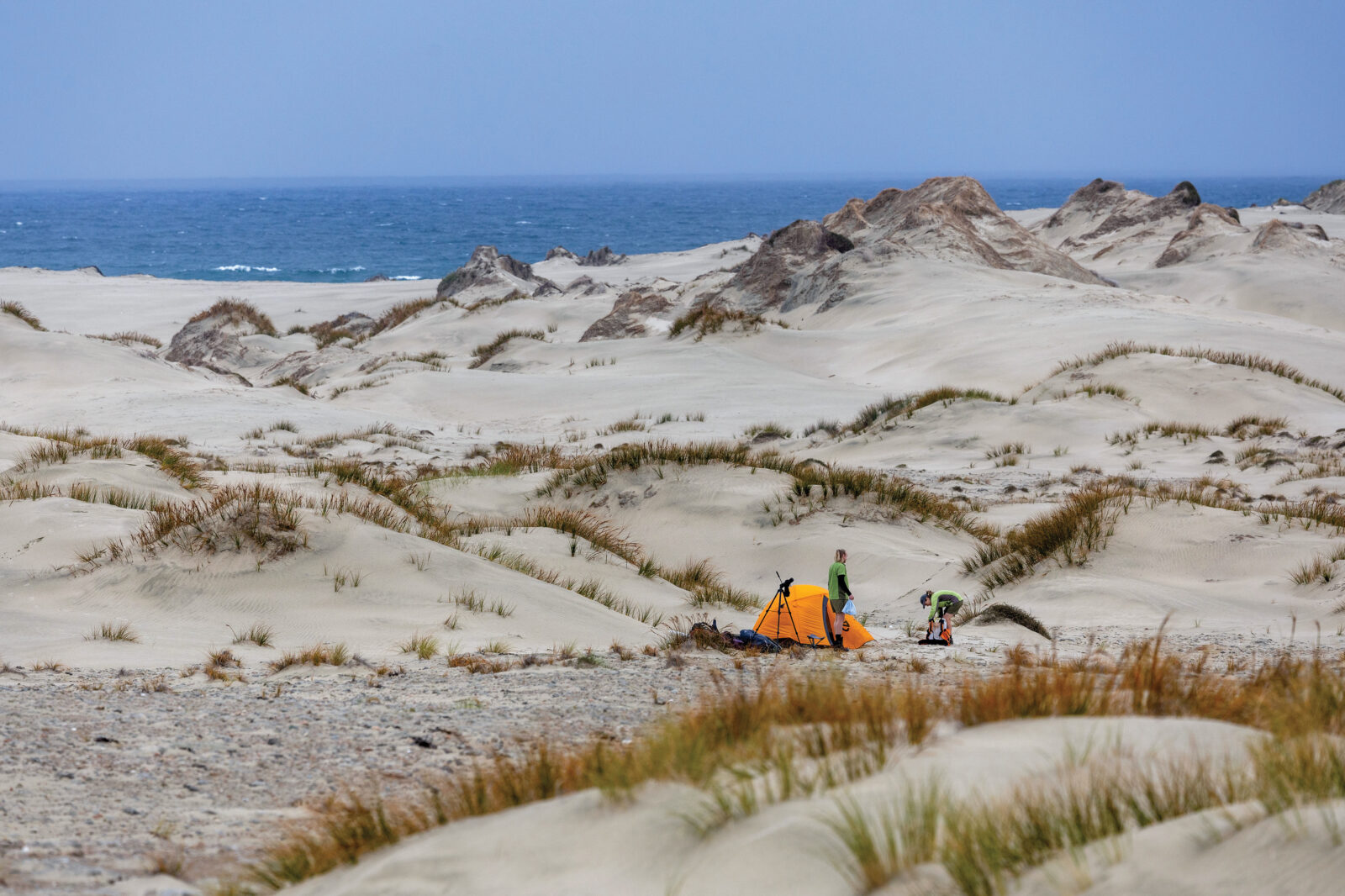
They’ll find out more when they visit the third flock, at Mason Bay, tomorrow morning. The beach is just over the dunes from us, a remote scoop of sand on Rakiura’s west coast. There is an air of contained anticipation.
“It’s exciting,” Collen says. “Conservation work is often quite grim.”
[Chapter Break]
After sunset, I go for a walk and surprise a white-tailed fawn on the track. It looks at me curiously, and then a doe steps out in front of it from behind a clutch of fern and stares me down, her large ears as alert as a rabbit’s.
The wind is blowing towards me, and evidently they can’t scent me or figure out what I am, but I see their noses twitching. The doe stalks closer, holding her white flag of a tail straight out. She stamps hard with her front hooves, right then left, warning others, warning me. I stand as still as a post. Her tongue flicks across her nose a few times. The fawn stays close behind.
For more than three minutes, we watch one other, the doe stomping and stepping forward, me refusing to move, until a sandfly becomes so irritating that I barely flick my hand to brush it away. That’s enough—they’re off, leaping back down the path, tails flashing.
This species was introduced in 1905 and has become a point of contention: the deer are denuding the understorey across the island, but their elusive nature and high-quality venison attract thousands of hunters each year, propping up the local economy. A 2023 survey run by the Game Animal Council showed many hunters considered the trip to Rakiura an annual pilgrimage. Others saw the deer as crucial meat on the table. The hunters said they wanted the “plague” of other pests, especially cats, dealt with—in fact many were happily shooting them during their trips—but not the deer. Unfortunately, deer eat 1080. Months before the drop, Cocker and McDonald gave a presentation to the community, explaining that the pukunui were soon going to be extinct. That they were out of options, other than 1080.
Some of the baits were laced with deer repellent, and a network of motion-detection cameras was set up to find out how well it worked. Not very well, concluded researchers from the Bioeconomy Science Institute: in the areas with the special bait, three-quarters of the deer population still died. The report found Rakiura white-tailed deer are more susceptible to eating a lethal dose of 1080 pellets than other deer populations in New Zealand, potentially because they’re smaller and there isn’t enough food to go around. Before the drop, the cameras took pictures of deer so skinny that their ribs were sticking out. Perhaps, on this island where so much of the forest has already been eaten, the deer were so hungry that they ate the baits anyway.
[Chapter Break]
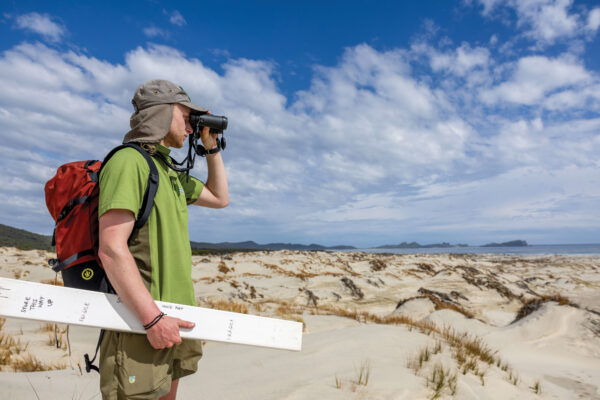
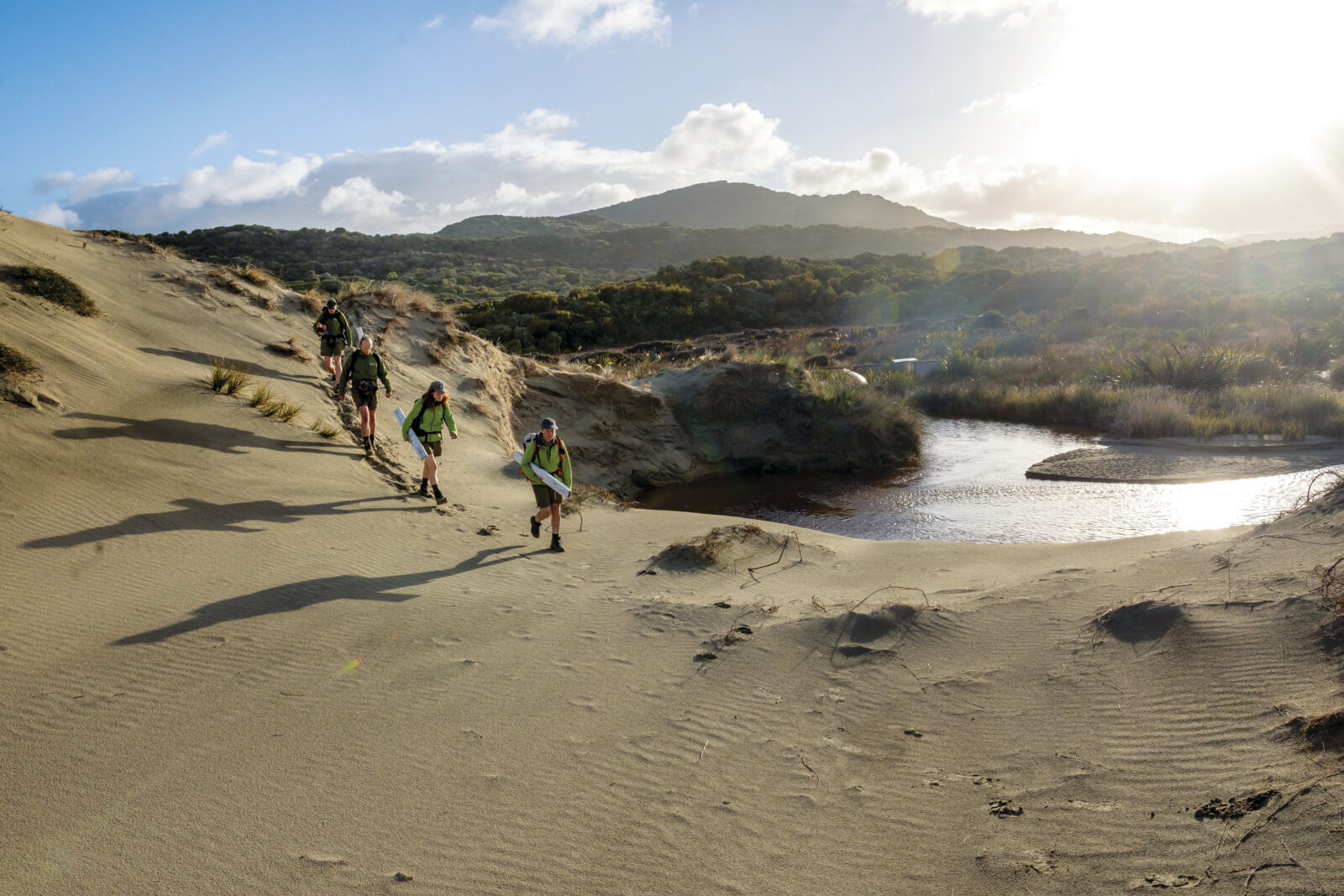
Next morning, on the walk back to the beach, the rangers march at pace, their lean calves tan beneath DOC-green shorts. McDonald’s legs are riven with red scratches from pushing through scrub.
“What are you hoping for?” I ask Sara Larcombe on the way. She is usually on the mainland, handling planning and logistics as leader of the overall pukunui project, and like those based in the field, has learned to be circumspect.
“You can get your hopes up and say, ‘Well, the team killed 60 cats this year’, so you think it’ll be a good year—but then you do the count and there’s lots missing,” she says. “We’ll see.”
The surf is thundering. We climb over sand dunes littered with chains of animal prints crossing each other like tyre tracks—kiwi, possum, deer, rat, cat, some kind of insect, and pukunui, a ballet of predator and prey playing out every night. I walk down to the beach with McDonald. Spotting a strange, round white shell embedded in the sand, I stoop down to inspect it, and then realise it’s plastic.
“If you start picking up plastic you’re going to have a very full pack,” he says, and within a few metres I see what he means: plastic rubbish litters the beach like driftwood. Tangles of thick fishing rope are behaving like vegetation, trapping sand to create their own brightly coloured, plastic-filled dunes.
The dotterels are hard to spot. They blend in perfectly with their brown and white environment, and every chunk of quartz shines like a round white breast. That’s until they move, and suddenly you see them everywhere, like fleas jumping on a dog.
“We’ve got some,” McDonald says. Beyond the heaps of plastic, a few young, unbanded pukunui are pottering about—likely to be new chicks that have survived the summer. McDonald raises his binoculars and spots an entire flock in the distance, crouched on the sand facing the dunes.
“There are quite a few unbanded,” he says, and I raise my binoculars, too.
“How many unbanded do you count?” he asks. I think I see 22—a massive increase given there were just 105 pukunui left in the world last year. A glorious forest of unbanded legs is parading in front of us.
McDonald radios the others, then crouches on the sand and tempts a few of the young birds with mealworms, getting them used to the treat for later catching and banding. But they don’t quite know what to do with the worms yet; they toss and play with them, before pecking them up. Sometimes a bolshier and more experienced bird will chase the juvenile away and grab the treat, a behaviour the team jokingly calls DOC-blocking. McDonald is quiet, smiling, watching.
Wary of scaring the birds and ruining his ministrations, I take a walk through the plastic graveyard, examining each piece as though it is a body on a battlefield. Detergent bottles. Cracked buckets. A glass Coke bottle from the mid-1980s, still with pristine white plastic screwcap, its plastic wrap barely faded. The inevitable fish bins: “Stolen from Talley’s.” “Stolen from Piners Fisheries.” “Stolen from Wrightson NMA Ltd.”
I crouch down and look closer at the sand at the high-tide line, then take a handful and sift it through my fingers. There are tiny specks of bright pink, green, blue, and yellow. Floods of microplastics must wash up on this remote beach day after day, the eternal detritus of the Anthropocene.
I walk back to McDonald. He has been properly counting the flock, adults this time as well as chicks, and to my astonishment I see his eyes are red and full of tears.
“There are 72,” he manages to say. “Seventy-two.”
That won’t even be all of them; there are more birds scattered around the sands. He wipes the back of his hand against his cheeks. “Sorry.”
“Don’t be silly, it’s okay,” I say, and I am crying now, too. “That’s amazing. How many did you think there’d be?”
“About 60,” he says, and laughs through his tears.
“Was it the 1080?”
“That’s the only conclusion I can come to.”
Collen sheds a few tears as well when the rest of the team join us on the beach.
“It’s so good. So much work,” she says. “It’s been a hard few years. I’m glad you guys stuck around to see the results. We should have brought a bottle of champagne.”
Today happens to be McDonald’s 28th birthday. He has spent most of the past four years in the field, often in the cold, rain and wind, watching his charges die season after season. That evening, back at the hut, the radio crackles as his colleagues sing him a happy birthday from across the island, and he shares the good news.
“Woohoo!” comes one voice down the line. “Three million birds for Guy McDotterel’s birthday!”
[Chapter Break]
The next day is threatening rain, but it’s time to get down to business, catching and banding as many birds as possible.
“It can take you several years to get your hand in,” Collen says. She makes the snares herself, dabbing glue onto a long strip of flexible green plastic trellis, then securing small loops of fine fishing line.
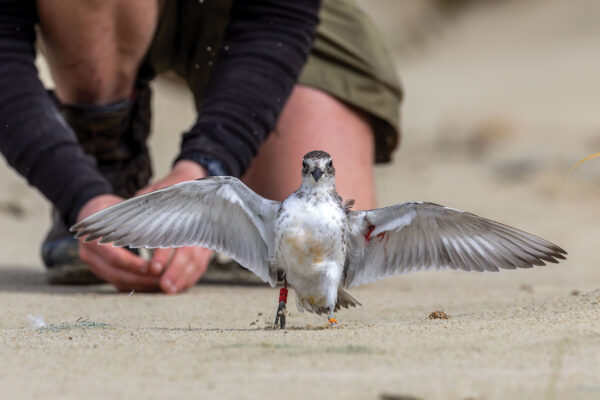
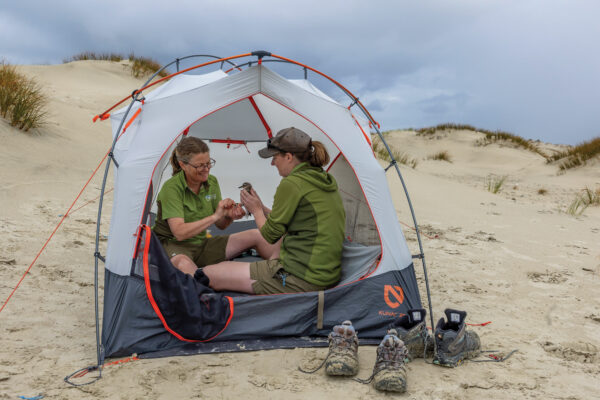
To catch a pukunui, you spot a likely-looking bird and toss mealworms at it to tempt it closer. You lay down your mesh, still crouching and throwing worms, burying the mat in the sand so the fishing-line loops stand up. When the pukunui ventures across the mesh its feet catch in the loops and after a brief flurry of beating wings, you collect it, unhook it, put it in a cotton bag and carry it off to a small tent, to be treated out of the sun, bumblebees and the sandblasting wind. Today, Collen is waiting inside, her banding and medical kits at the ready.
While McDonald holds a small and befuddled dotterel in both hands like a crystal ball, Collen glues on the band, checks its body condition, swabs the beak and cloaca, and draws blood from under a wing, to test for viruses and add to the DNA record. I grab wet wipes and clean dotterel shit from McDonald’s thigh and the tent floor. Focused on the bird in his hands, he barely notices.
When the procedures are over, they take each bird outside, murmuring to it as though they’re carrying a sleepy child inside from the car, and let it hop away to join its cousins.
The team catch, check, and band until it’s low tide and the birds fly off to feed on nearby tidal flats. At high tide, they’ll start again.
In the afternoon, Liz Brown emerges from the tent and hands me a freshly banded dotterel. She’s usually in Twizel, leading the work to protect kakī, our rare black stilts. But she’s come to give the pukunui team a hand this week. She is very good at handling birds with long fragile legs.
“Do you want to release him?” she asks, and she shows me how to hold a pukunui: a bit like a small rugby ball, with my pinky fingers tucked under its wings. I crouch down to the sand. The pukunui leaps out of my grip, then hops off across the stonefields, bouncing up and down as it tries to shake off the new weight of the bands, eventually tottering away on matchstick legs. I sit back on my heels and watch it go, marvelling at how delicate its hollow-boned skeleton felt under soft down, how small its pulsing heart.
On April 20, Larcombe sends a jubilant text. The official census is done. Last season there were 105 pukunui left in the world. Now there are 160.