House of cards
In Lake Wānaka the Australasian crested grebe reigns supreme from a flotilla of nesting platforms strung close to shore. The birds love the platforms. The locals love the birds. But the man who started it all worries the project could be doing more harm than good.
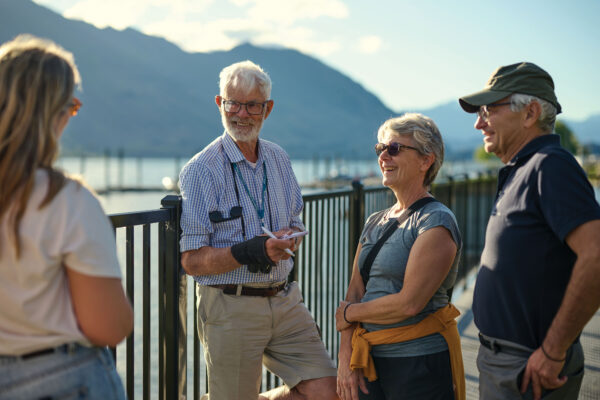
Grebes go for the eyes, says John Darby. To his immense frustration, at 88 he has recently become too creaky to get in a kayak, and he wants me to paddle out to one of the floating nest platforms in his place. He can’t find the long leather glove he usually wears. “You’ve got glasses, that’s the important thing,” he says. “You’ll just have to do it and hope you don’t get too badly hurt.”
Darby has trim white plumage and a slight forward lean. He is very good at staying perfectly still. He has binoculars around his neck, a shy British accent, grebe-inflicted scars on his arms. He has been helping the Lake Wānaka grebes for 11 years, and they have been helping him. For the past three years he has allegedly been in the process of handing the project over. He is here every day.
I haul the kayak across a strip of pebbly sand to the water. It’s clear, like a posh swimming pool, and cold, even though Wānaka is cooking. Half an hour and I’m burned through my tee shirt. All over town neat hedges of lavender broil, billowing scent.
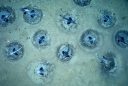
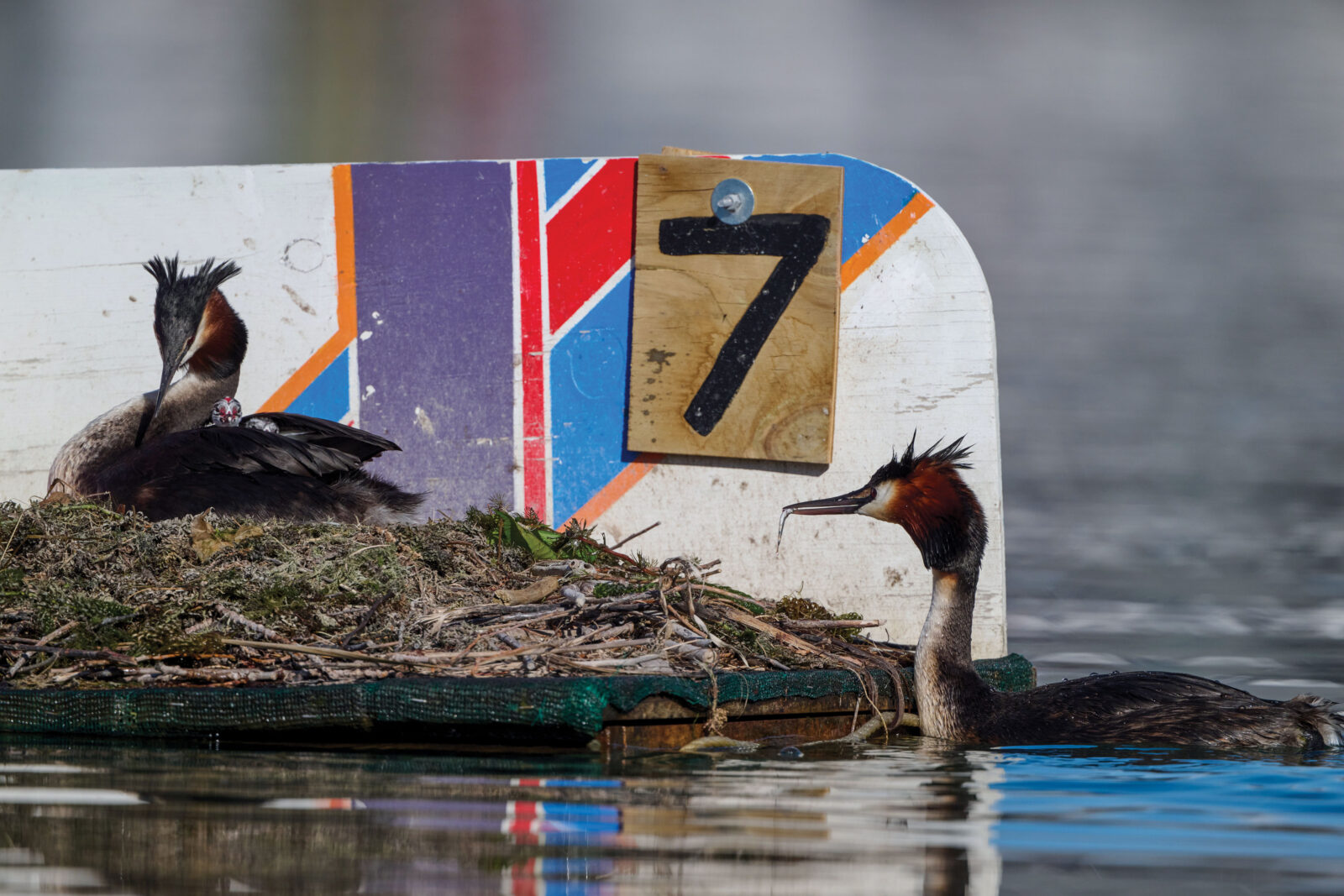
Strung in a line, in an elbow of shallow water between a row of expensive apartments and a row of expensive boats, is just about the only thing that smells bad in this place: wooden platforms, floating low, topped with rotting volcanoes of waterweed and willow. “There’s NUMBERS on them,” shrieks a little boy on the boardwalk nearby, pointing. “Five! Six! Seven eight nine ten THIRTEEN!”
I’m paddling to one of the handful of platforms that’s tied to the marina. Grebes do a lot of things wrong, Darby says, and one of the things is that they will continue piling weed and muck onto their nests even when the weight of it threatens to flip the platform. Even a slight incline can make things precarious. On this nest, one parent has managed the lurching climb. We’ve been watching its mate heave itself at the slope and slide off. Shake itself, try again.

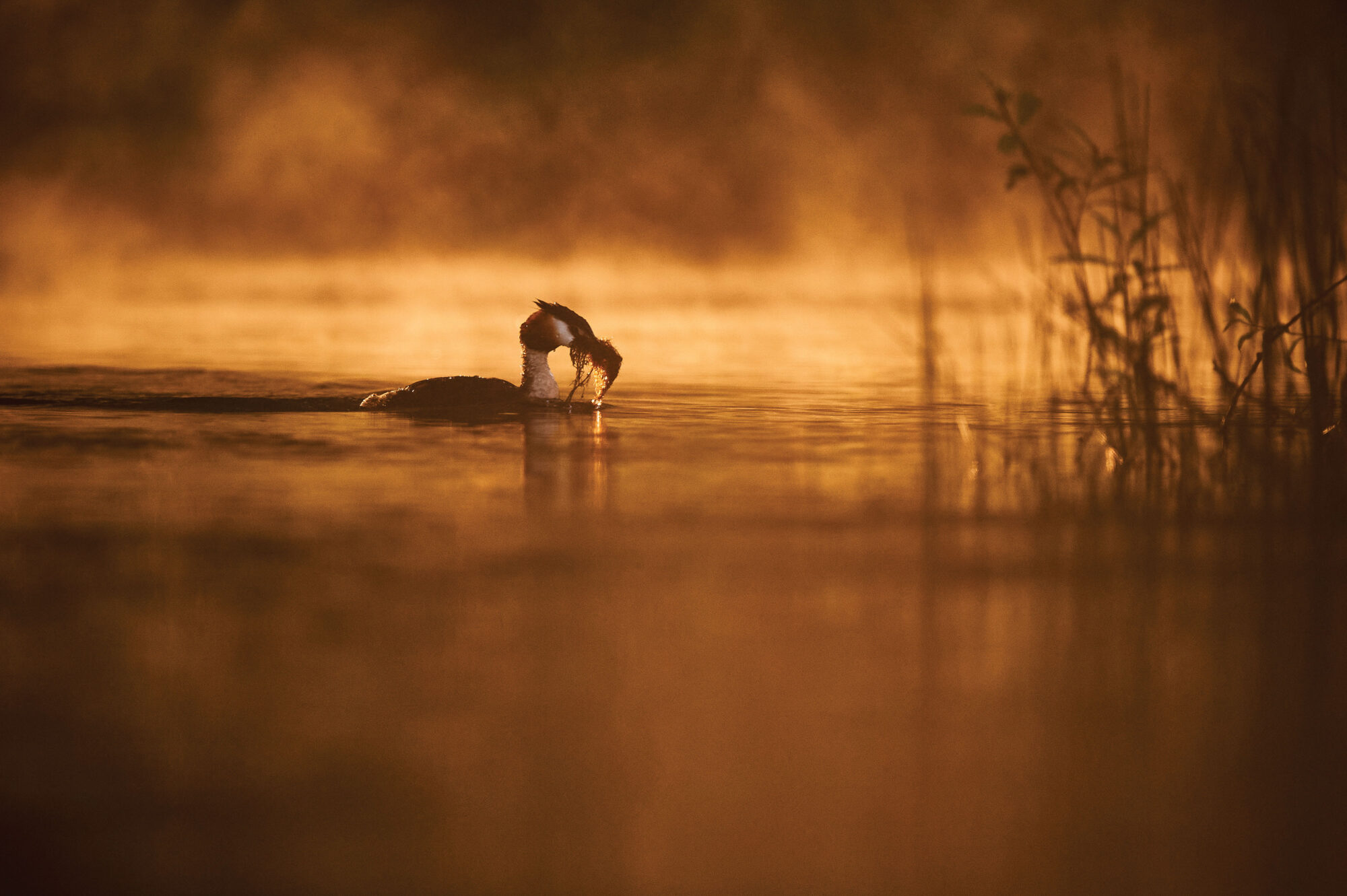
When I’m a metre or so away, the bird on the nest clocks where I’m headed and it growls. It’s loud, enraged, and it ends with a series of clipped bleats. Sliding close, I raise the flat of the paddle between my face and that dangerous beak. Poised, quiet now, the head held still and high; I think of snakes, and Viking long ships. Then, abruptly, the grebe flops into the water, puffs out its Maggie-Barry ruff and sheds all sense of menace. It’s Princess Beatrice in an absurd hat. Your aunt peering disdainfully at the Christmas dinner.
The bird is also staying very, very close to me. And Darby, instructing from the marina, wants me to turn my back on it. “Centre the eggs,” he tells me. I move a couple of outliers—they’re grimy, and a bit smaller than chook eggs—into the crater of the volcano. “Now really get your arms around it.” I turn my head so I’m eyeing the grebe, hold my breath, lean out of the kayak and embrace the nest, tugging it toward me at the base. In sixth-form Japanese we had a nori-eating competition and I vomited acid seaweed. The nest smells like that, and now it’s all over me.
“Good,” Darby says. While I’m there, could I hold each of the five eggs up to my ear and see if any are peeping? The clutch is too big and he wants to remove those that are infertile. The grebe growls again as I pick up the first egg.
This one has a comfortable weight to it. I close my eyes, hold the egg close to my ear. There’s no peeping, but after a moment there comes a scrabbling from inside, and I sense a rearrangement of long infant neck and floppy feet. I have a flashback to being pregnant, holding my tummy, reverent.
“Am I allowed to be doing this?” I ask. Darby waves a hand. “Yes, yes, because you’re under my supervision.” Two further eggs feel alive in my palm. I put the two that do not in the bottom of the kayak, where they’re cradled by a foam strut. “You’ve just done something hardly anyone in New Zealand will ever do,” Darby calls, as I paddle the few metres to shore.
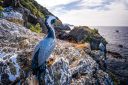
The Department of Conservation (DOC) considers grebes “nationally vulnerable”. They arrived from Australia, perhaps on purpose, perhaps via a storm, more than 10,000 years ago. Māori called them pūteketeke or kāmana. Fifty years ago, the species was considered extinct in the North Island. They were being squeezed out of the South Island, too, gradually abandoning its northern lakes. A survey in 1980 turned up only around 200–300 adults. But now the grebes are on the rebound. They are returning to old haunts, and they’re breeding: a national “grebe census” in February turned up 1047 birds. That’s likely an undercount, because many birds will have been tucked out of sight on willow-curtained nests.
The remarkable recovery is at least in part because of Darby.
Late in 2013, he was walking along the Wānaka beachfront at a bit of a loss. He’d retired from a much-loved role at Tūhura Otago Museum in Dunedin, separated from his wife, moved here and left behind the hoiho/yellow-eyed penguins to which he had devoted decades of volunteer research and conservation effort. In the move, precious notes, as well as a unique collection of Zeiss microscopy journals, went missing. “My pride and joy,” Darby tells me. “I was absolutely gutted.”
Then he saw the grebe. It was scrambling around near the shore at Roys Bay, the scenic scoop that takes in the town as well as the marina. It appeared to be trying to build a nest. “Oh,” said a man who ran eco tours nearby. “The silly bugger’s been trying for two or three years!”
Darby went home, read everything he could find about grebes in New Zealand—“almost nothing”—and realised “they had the most hazardous approach to survival of almost any bloody species in the world”. The most pressing problem was how the birds nested: in great messy piles near the shore, among willows or other vegetation, anchored to branches in the water. It was like setting a table for rats, ferrets, and cats. The nests were also in the way of human nosiness, and exquisitely vulnerable to changing water levels—when the water dropped, the nests were hoisted out of reach. Too much rain and they drowned. The wake of a single boat could swamp a season’s work. And in this tidy, gleaming stretch of lake there was no vegetation for the bird to build on; its best bet was simply making a pile on shore.
“I’m thinking: I’m gonna go out there and build the best grebe nest that any grebe has ever seen in its life,” says Darby. “And that’s exactly what I did.” His nesting platform would float offshore, in one nifty stroke solving the problems of predators (except, it transpired, black-backed gulls), people and fluctuations in water level. He used a wooden pallet and stuffed the underside with 10-litre containers for ballast. He roped it up, rotted down some hay to strew across the top.
He didn’t want to seem like a nutter, so he waited until it was dark, then drove to the marina, hopped in his kayak and towed the platform under the jetty. He could hardly sleep; he was back at 6am. The grebes were there before him and they were flat out, piling the platform with weed. “I was like, ‘Yeah!’”
The first years were low-key. Darby kept building and the grebes kept coming, just the odd pair. Chicks thrived. By year three, word had got around. Something like six pairs turned up and they all wanted platforms. “Since then,” Darby recorded in his diaries, “mayhem has ruled.” This January there were 170 grebes on the lake.
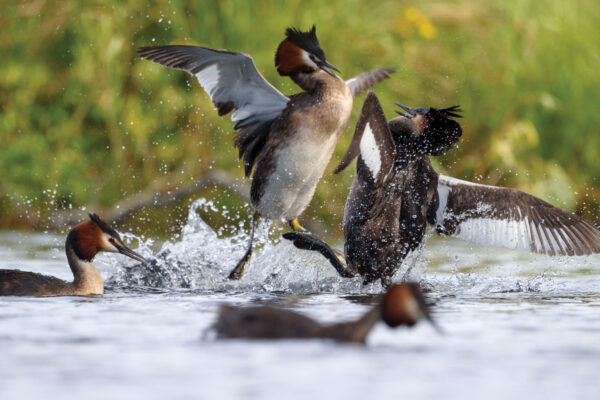
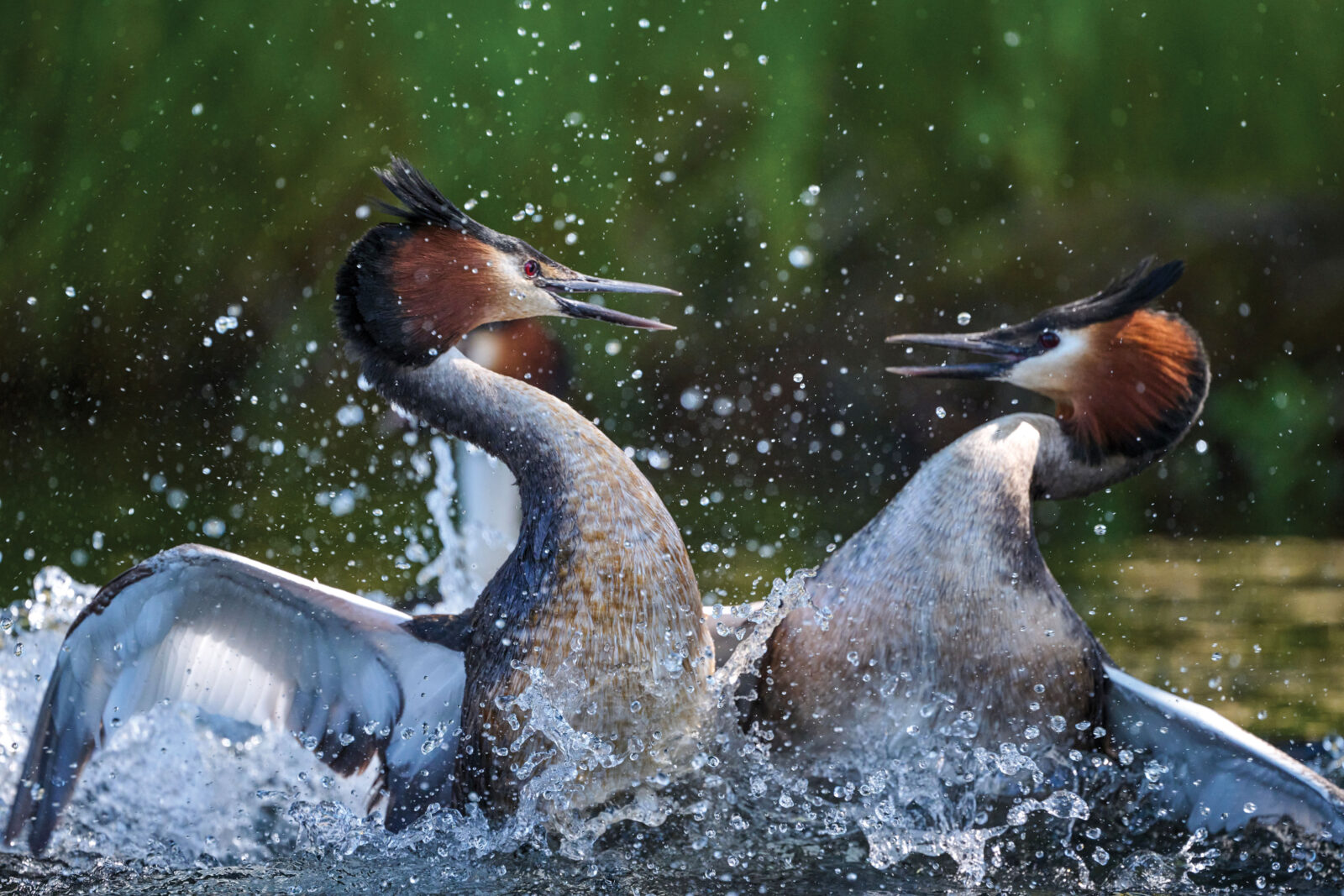
The breeding season, which can span six to eight months, is now a jabbing, rolling maul over platform space. Pairs actively maraud, going from nest to nest, hijacking entirely where they can, or sneaking in to lay a few eggs cuckoo-style.
Working together, stabbing and shoving, a pair can easily bully a single parent off a nest. It’s risky for any incubating bird to leave for a feed. Unsurprisingly, Darby says, parents have taken to cutting their losses: instead of sticking around for a last egg to hatch, a pair will settle for hatching one or two, then skedaddle the family off to somewhere quieter.
The violence of this avian housing market is obvious to anyone who stops and watches for five minutes. People often ask Darby why he doesn’t just put out more platforms (two more went out over summer, bringing the total to 21). For him it is a conundrum. More platforms will just attract more grebes: it’s like building roads to fix traffic. Then there’s the neighbours. The grebes are here by the good graces of the marina users, who like their boats accessible and pay hundreds of thousands of dollars for the privilege. Some of these boaties have warmed to the birds, keeping an eye on the families nearest their boats, chatting about them with Darby. Others are weary of the whole exercise.
A desperate grebe will nest on anything that’s relatively flat and close to the water. This means the birds are forever piling crud on spotless transoms. One of the many jobs for Petrina Duncan and Markus Hermanns, Darby’s two main sidekicks, is scraping the half-formed nests back into the water, wiping off the mucky streaks, and trying to keep the boat owners sweet.
[Chapter Break]
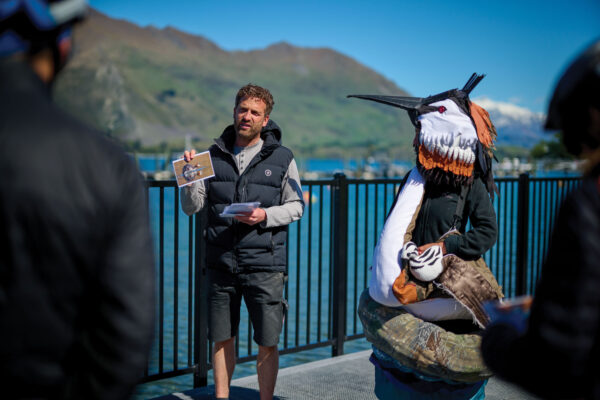
The least interesting thing about the Australasian crested grebe is that last year it won Forest and Bird’s bird of the century competition. That was down to a running gag by American talk-show host John Oliver, who funded elaborate election-grabbing gimmicks: billboards went up in Paris, Tokyo, Mumbai, London. A plane flew a banner over Ipanema Beach in Brazil. Oliver took to donning an enormous and extremely lifelike grebe costume. God knows how much it all cost; the Wānaka grebes got two $50 Facebook donations out of it. A big “donate now” button on Forest and Bird’s voting website fared much better. “If you think of the greater good,” Duncan points out, “Forest and Bird got $600,000 instead of the usual $100,000.” (Duncan, a zoologist, works for Forest and Bird and for the Southern Lakes Sanctuary; under the umbrella of the latter she is paid to manage the grebe project. In practice, she still defers to Darby. Hermanns, a local teacher, does not get paid for the hours he spends with the grebes every week, despite cheerfully doing much of the donkey work. Darby, of course, is in it for love.)
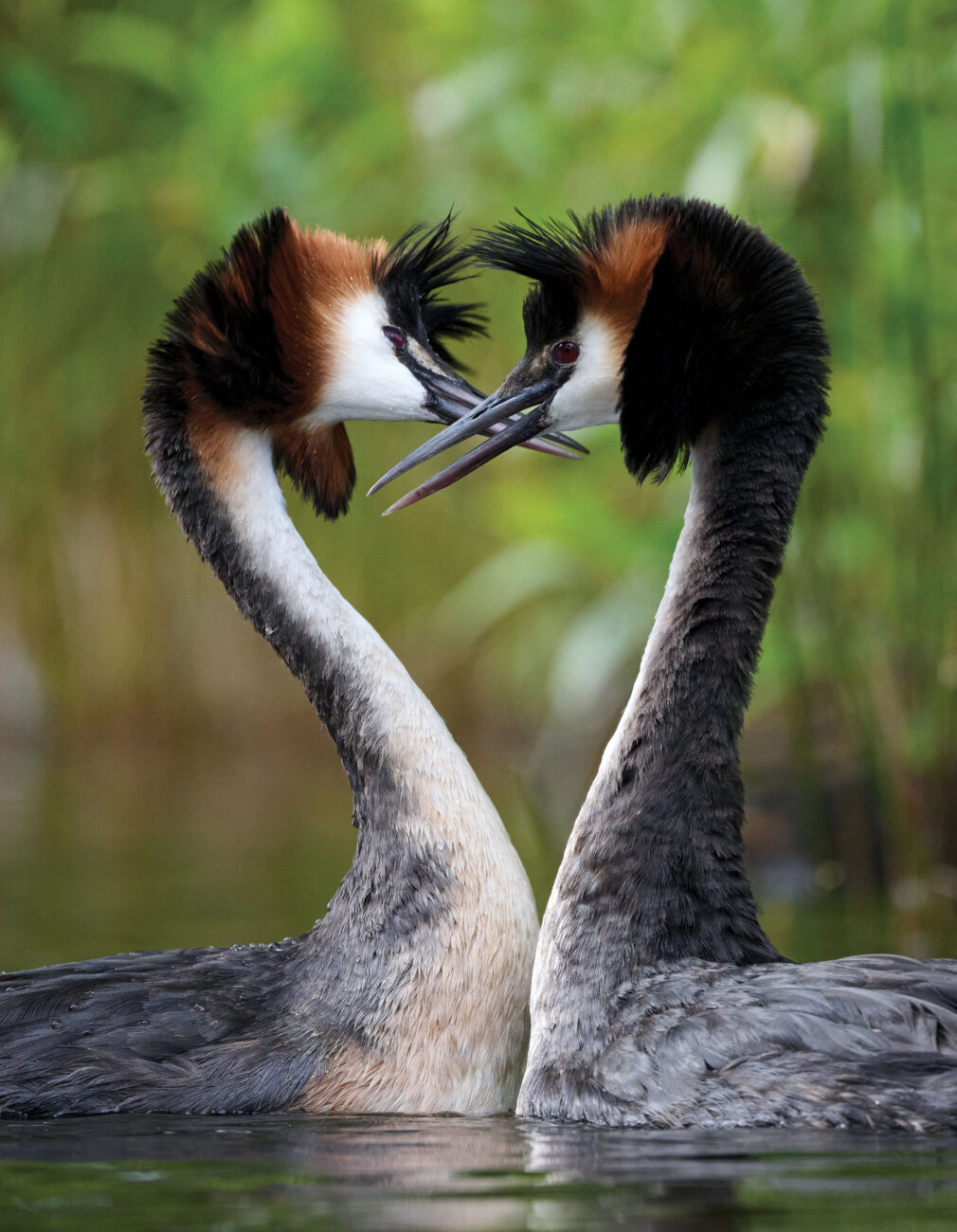
By Oliver and others, much is made of the bird’s synchronised courtship dance—think Bridgerton ball—as well as its proud bearing and upmarket colouring. Grebe parenting is also pretty cute. Duncan nods at a cool-looking young guy photographing an egg on platform 13. “Before the John Oliver campaign we did not have this level of interest,” she says. “Now it’s just everyone.” The most sought-after picture, apparently, is an adult with a chick on its back (they can even hang on when the adult dives underwater).
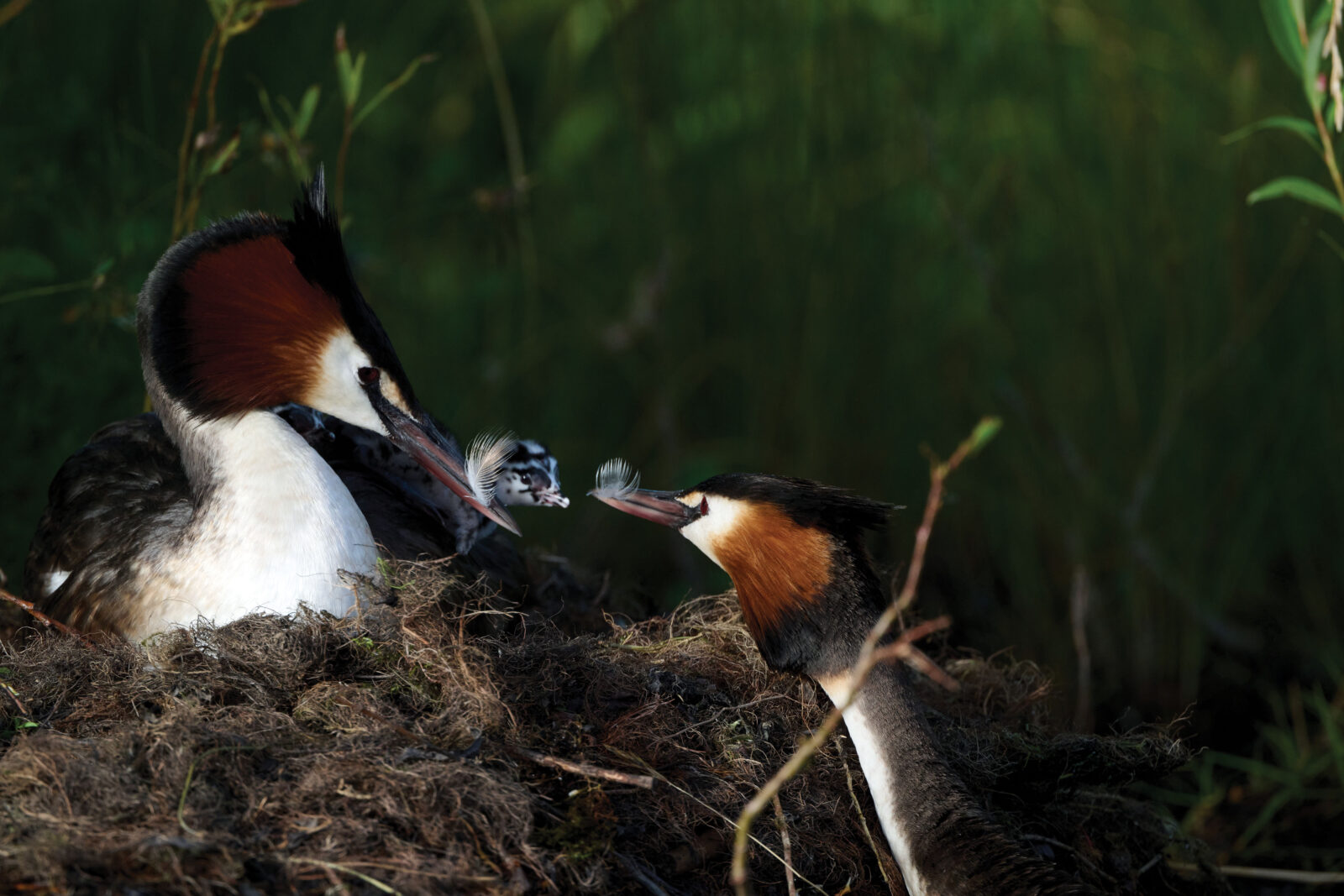
But the defining feature of the grebe is the placement of its legs. Picture a rugby ball. Attach a heavy, muscled neck to one end and a pair of floppy legs to the other. Now ask that rugby ball to stand. You see the problem.
This anatomy worked just fine back when our waterways were edged by raupō and, later, willows—the grebes’ favourite nesting sites. But now that we’ve chopped back so much vegetation in favour of beaches and boat ramps, or neat plantings of natives set back from the water, the soft and ill-placed legs are an existential design flaw.
Today, one grebe thinks it is a scaup. It trails a flock of the tyre-coloured ducks as they paddle to shore and trundle up the beach. Now the grebe hits the sand and attempts to stand. Whump. Tries again. Whump. Oh, mate. With a flounce, the bird turns and heaves itself, seal-like, into deeper water.
Under the surface the legs splay and flick, creating an eerily smooth momentum. This bird could balance a book on its head. I hop back in the kayak, paddle to a shady spot under the jetty and spend two hours trying to emulate Darby’s stillness.
Black-backed gulls are watching, too—perched high on marina piles, they have a clear view of every nest. A few platforms wear canopies of wire, just two pieces strung diagonally in a cross. Keeps the gulls off, Darby says. Given half a chance they’ll nail both eggs and chicks. (During the 2018-2019 season, Darby tried laying booby traps: draining chicken eggs, he mixed the gloop with cayenne and chilli powder, then refilled the eggs and put them on nests. Ha, he thought, when the eggs went missing.)
The grebes on nest 14 are mating on repeat. This is an exercise devoid of dignity: after each session, the male bounces down his partner’s neck into the water, a kid on a blow-up waterslide.
Others are actively at war. One grebe has had enough of the raiders, and chases off a particularly annoying pair. The three of them dive and hoon under the kayak, pulling hairpin turns and feints. (Colin O’Donnell, a principal science advisor at DOC and one of the handful of people to study this species in New Zealand, snorkelled with them in Canterbury’s Lake Heron—he remembers silver, amorphous flashes, like speeding blobs of mercury.)
In autumn, the grebes leave this lake. They fly at night. High stakes! If a grebe runs out of oomph over land, how does it get back in the air? How does it get anywhere? O’Donnell says the odd one is picked up on roadsides, carparks. A few years ago, in Utah, some 4000 grebes of another species slammed into a Walmart carpark; 1500 died in the crash. The others just flopped about, stuck. It’s thought they mistook the wet concrete, shining in the carpark lights, for water.
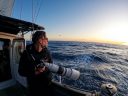
One morning in March, a couple of months after my visit, photographer Eiko Jones pops down to the lake; he’s been trying to shoot the grebes underwater. But they’re gone, he says. I picture Darby hitching himself into the cold night sky like the Lorax and flying creakily after them.
[Chapter Break]
Ask Darby a question and it is as if he opens up a book, finds his mark—which may or may not immediately relate to the question—and begins to read aloud. Steady and neat he recounts: his summers at Scott Base, employment politics, scientists he admires, his drive to make conservation interactive and kid-friendly. He talks about his love of penguins and microscopy and woodturning, which is becoming difficult now as his hands stiffen. Then one grebe stabs another on the lake in front of him and he loses his place. “To cut a long story short,” is something he says but does not often manage. Perhaps my pecking at threads of his story disturbs the whole. Perhaps he simply wants to talk and be heard.
So we sit and watch the grebes tussle over platform five, and he tuts at kids hooning past on scooters, and he tells me a story that for a long time, he never told anyone.
“I was brought up entirely in orphanages in the UK,” he says. “I lived in eight orphanages and one short-term foster home.”
As he speaks, his shoulders come up. He is seven years old again. “I got to hate Saturday mornings,” he says, with venom. On Saturday mornings, at one institution, the children would gather in the playroom to receive clean clothes for the week to come—and punishments, for the week just passed. None of the boys knew who was going to get caned. Many would cry from the stress of it, and from watching the pain and humiliation of others.
Overseeing was a man who, Darby says, seemed to enjoy the sound of that crying. This master got a particular kick out of a ritual called “tabling”, where four boys would spread-eagle a fifth on a table, and hold him still to be caned. Sometimes the four would volunteer. “Me, sir!” Darby imitates, wincing. “But then sometimes, the master would call out the names of boys that he wanted … And so one morning, he called out my name.”
In tears, the boy walked up to the man and said he wouldn’t do it. “From then on, he just absolutely hurt me, every possible way he could ever hurt me.”
Forty years later, a clerk in a UK records office spoke the name of this orphanage and Darby burst into tears. That little boy had made a promise to himself. “I vowed I would never cry for that bastard again.” He seems astonished, still, to have been brought undone. Maybe he was crying for himself, not the master, I say, and he gives a small, sad laugh.
And in any case here he is, all these years later, building homes for lost souls. Looking after them. He’s tickled by that—he laughs again, as if the parallels have never struck him—but then, without any further response, he’s back into the story.
There are further cruelties. At seven he lost an eye—he was trying to build a boat from a tree branch, and a splinter flew up. (His rescue collie, Patch, is blind in the right eye, too. “Oh, you noticed that!” Darby says, chuffed. Maybe, he’ll allow, the eye had something to do with him falling for the dog. Maybe.) At 16, he managed to track down his mother, and she agreed to meet him—on the condition that he would never try to find out where she lived, or try to follow her. Gutted, he instead moved to New Zealand, and by 18 he was working on a pig farm. One Thursday, he told his boss he was too sick to work. By Sunday the teenager could barely move. He had polio; he spent seven months in Ward 22B of Auckland Hospital.
But this story is populated, too, with people who saw a child floundering and reached out to help. The doctor who ripped the pig farmer to pieces for not seeking help sooner. A psychiatrist who insisted that the small boy brought to see her should not be put in a borstal—that he would not survive it. A foster mother who seemed to truly understand the small person entrusted to her. Various staff at Lincoln University who helped him find his feet over here. It just takes one kind person, sometimes, we agree. He sighs. “You just have to find them.”
[Chapter Break]
None of the grebes are tagged, and only one, who grew up here 10 years ago, has ever had a name. “Have you heard the story of Greg?” Darby asks. When Greg hatched, he was just an ordinary no-name grebe. He had one sibling, and two attentive parents, and for three weeks they cruised the marina, a unit.
But one day, Darby noticed only one chick was with the parents: the other was limp on the nest. From the kayak, Darby saw the chick’s right leg had been all but ripped off its body. He took the chick to a vet, who cut the leg off completely. During the vet visit the chick, now known to be a male, became Greg—for Gregory Peck, because no matter how weak and hurt the chick was he always pecked when picked up.
Darby released Greg the next morning. The parents immediately stuffed him full of fish. Darby, watching anxiously, saw one-legged Greg turning arcs and doughnuts on the water, yet managing to sort of keep up—and he smiled. Five weeks later, Darby watched Greg for the last time, following his parents and their second clutch of chicks away from the breeding ground, making a wake of tiny crescent moons.
[Chapter Break]
Greg got lucky. Darby will deal with immediate, life-and-death needs, but he does not like to get too involved with injured or abandoned birds. He says he learned the hard way, through years of tending injured hoiho, that extended hands-on interference severely compromises a bird’s chance of surviving in the wild. And presented with a sick or hurt bird, it’s hard to know whether it’s going to be a quick fix, like Greg, or months of rehab.
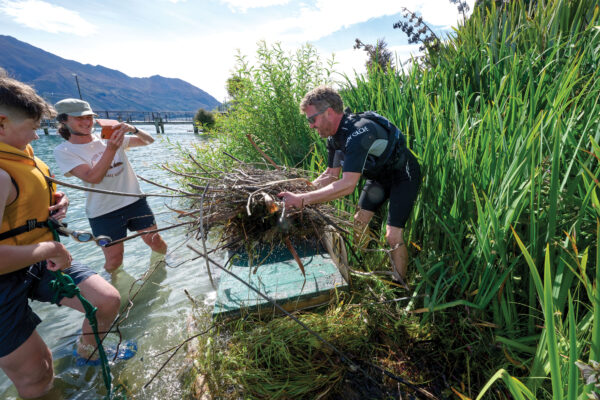
Where, I wonder, is the line? Is it not considered interfering to build a habitat for a species which otherwise would not have found a foothold here—to establish an entire breeding colony? To monitor the nests closely, regularly? To remove eggs? For Darby, these are fraught questions. If he had his way he would be out there tomorrow, gleefully planting willows and rushes, turning this moneyed, clear patch of shallow water back into leafy grebe habitat. He worries that the platforms, for the grebes an “easy option”, might be damaging the species’ chances long term. (This autumn, four adults were found dead at nearby Lake Hāwea—starvation, Darby believes. It’s possible that the whole area lacks enough food; nevertheless, a few platforms have been installed and there, as in Wānaka, pairs are fighting for space.) He also worries that the birds are getting too used to people—although the grebes I got close to certainly seemed shockingly hacked off about it. For these birds, there are simply not enough safe spaces. “The reality at this stage,” Darby says, “is that we don’t have a lot of options.”
Regardless of his personal conflicts, and the hustle of being a grebe in this place, the colony Darby built is now acting as a reservoir. On other waterways, like Lake Alexandrina to the north and Lake Hayes to the south, dozens of pairs are nesting naturally in reeds and submerged branches. They’re doing just fine, and they seem more relaxed than the grebes on Lake Wānaka—but a drought or a big rain could wipe them out. Darby’s grebes would have a better chance of floating through the fray and repopulating the natural nesting sites.
[Chapter Break]
One rabidly hot morning, Duncan spots a chick quiet and still on the slope of nest 13. It must have hatched after its parents bailed. Like Darby a decade ago, Duncan’s overwhelming instinct is to rescue. There’s a black-backed gull wheeling a hundred metres or so down the lake. Duncan makes her decision.
In her cupped hands the baby flops and wobbles, stretching its neck, flailing soft frogskin legs.
The feet are three-lobed, and splayed they look like clover leaves. The chick has a bare, pulsing patch of red just above its beak—this is common among grebe chicks but not universal, and it’s not clear what the function of it is. The patch slowly fades from a bright scarlet to a dull pink. Duncan’s worried this means the chick is dying. Darby arrives, and she peppers him with ideas. Try to get some fish into it? Take it to a bird hospital? (Darby shudders.) Put it on another nest? None of the birds has chicks right now, which could make adoption tricky…
Darby holds the little orphan for a few moments, then hands it back. He recuses himself from the conversation, and he does not ask about the chick again. This time, the ethical line is Duncan’s to draw.
Perhaps, she thinks, the eggs on one of the platforms floating next to the marina are close enough to hatching that she can fool the parents into thinking this chick is theirs. She waits until the adult turns away, then places the chick gently down. The adult immediately hiffs it into the water. Duncan picks the chick up and tries another nest. Again, she puts the chick down and backs off. An adult approaches, eyeing it impassively. A still second passes. Two. On three the bird strikes, hard and sharp, grabbing the hatchling by the neck and flicking it, cartwheeling, into the water. The chick flaps and flails on the surface, a soft morsel.
Four adults glide close. Encircle the chick. They cock their heads, red eyes staring.
A couple of metres away Duncan crouches on the marina. She could reasonably give up now, call this a failed experiment—it’s only nature, after all—and the chick a meal for the gulls, or the grebes. But the current is pushing the baby toward her, and in the end it also feels natural to do what she does. She stretches out a hand.