The Keeper
What compelled a South Auckland dairy farmer to amass New Zealand’s most significant collection of seashells?
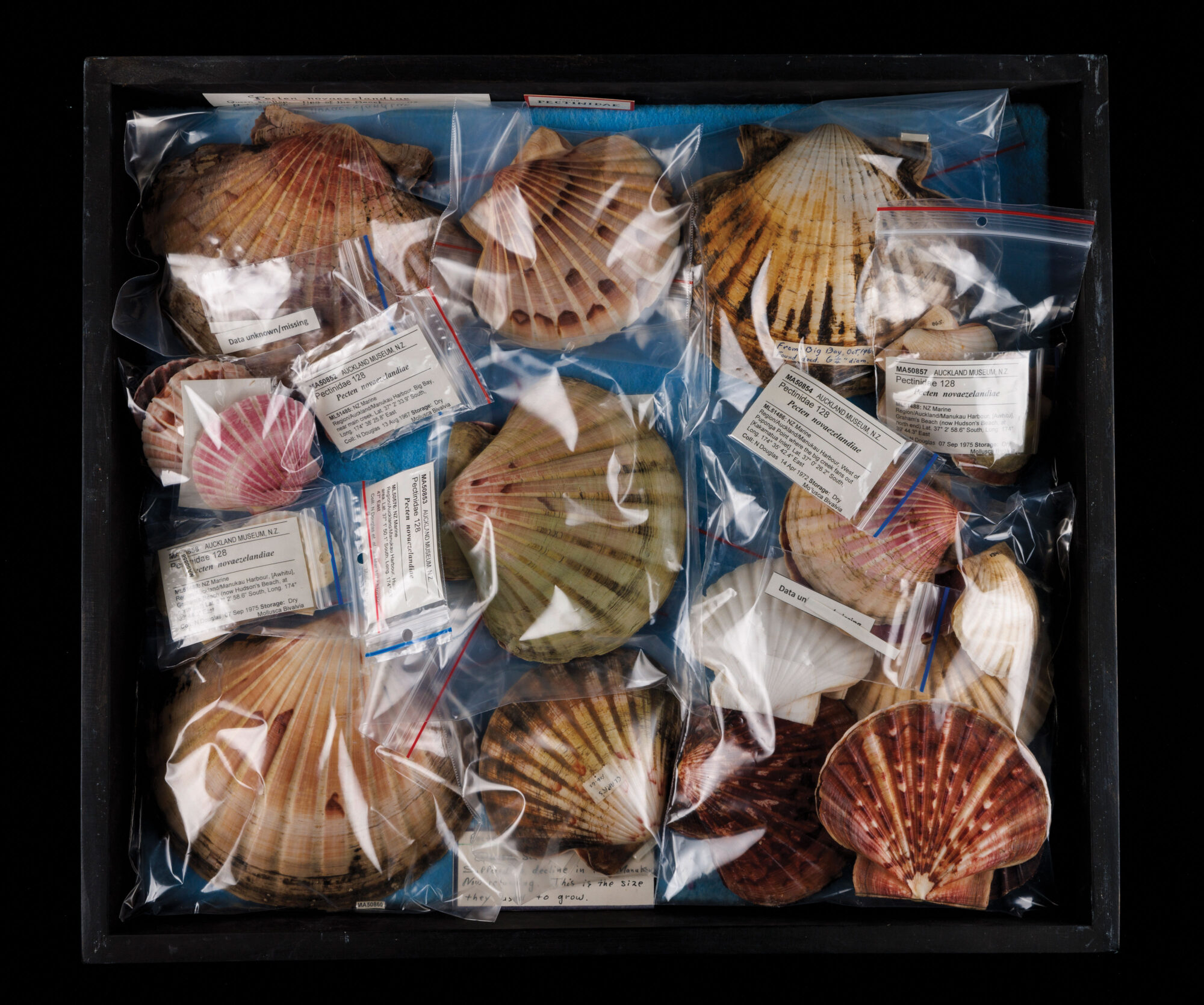
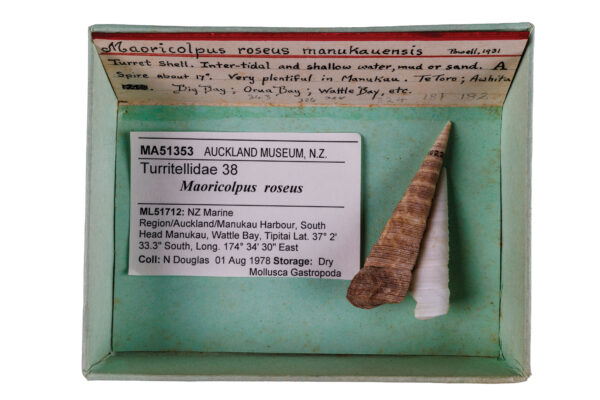
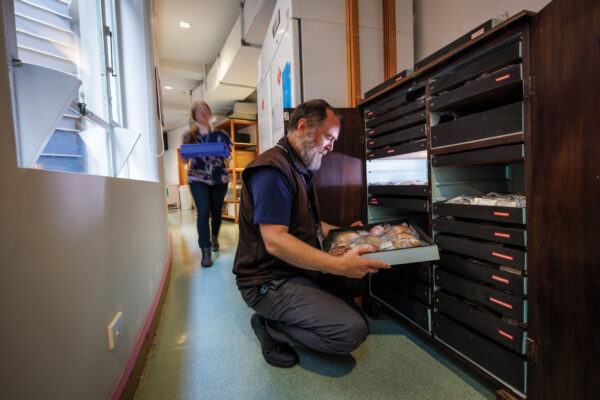
It arrived in a wooden cabinet, each drawer of it a family: Calliostomatinae, Volutidae, Turbinidae. One of every kind of shell to be found in the Manukau Harbour. Sometimes more than one: an ark of molluscs.
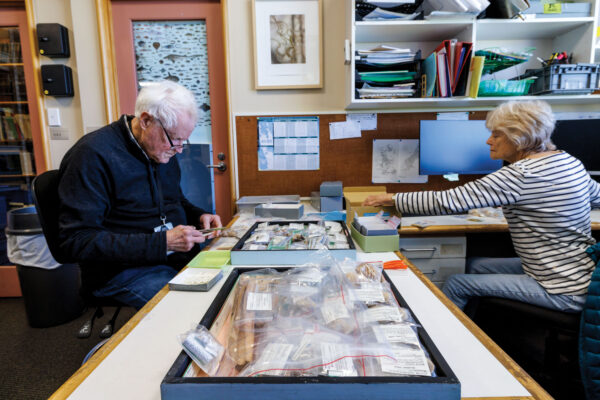
The cabinet waited in the circular corridor at the heart of Auckland Museum for more than seven years, in between the marine department’s freezer for fish bits and a shelving unit filled with jars, labels, bags. When collections technician Darryl Jeffries sat down to catalogue its contents, he knew little about it or its maker.
But the cabinet came with a pair of hand-illustrated journals detailing exactly where and when each specimen had been found. As Jeffries read, hints of the collector, Norman Douglas, emerged.
Inside were delicate hand-drawn maps, a meticulous record of observations spanning three decades, and a clear devotion to one particular stretch of coastline on the Āwhitu Peninsula. There was delight at finding spotted whelks laying eggs, at the sight of hundreds of violet globe snails blowing in on a sturdy northwesterly; delight at a shell appearing to move of its own volition and the discovery of a Zegalerus sea snail beneath, using it as a shield or a disguise.
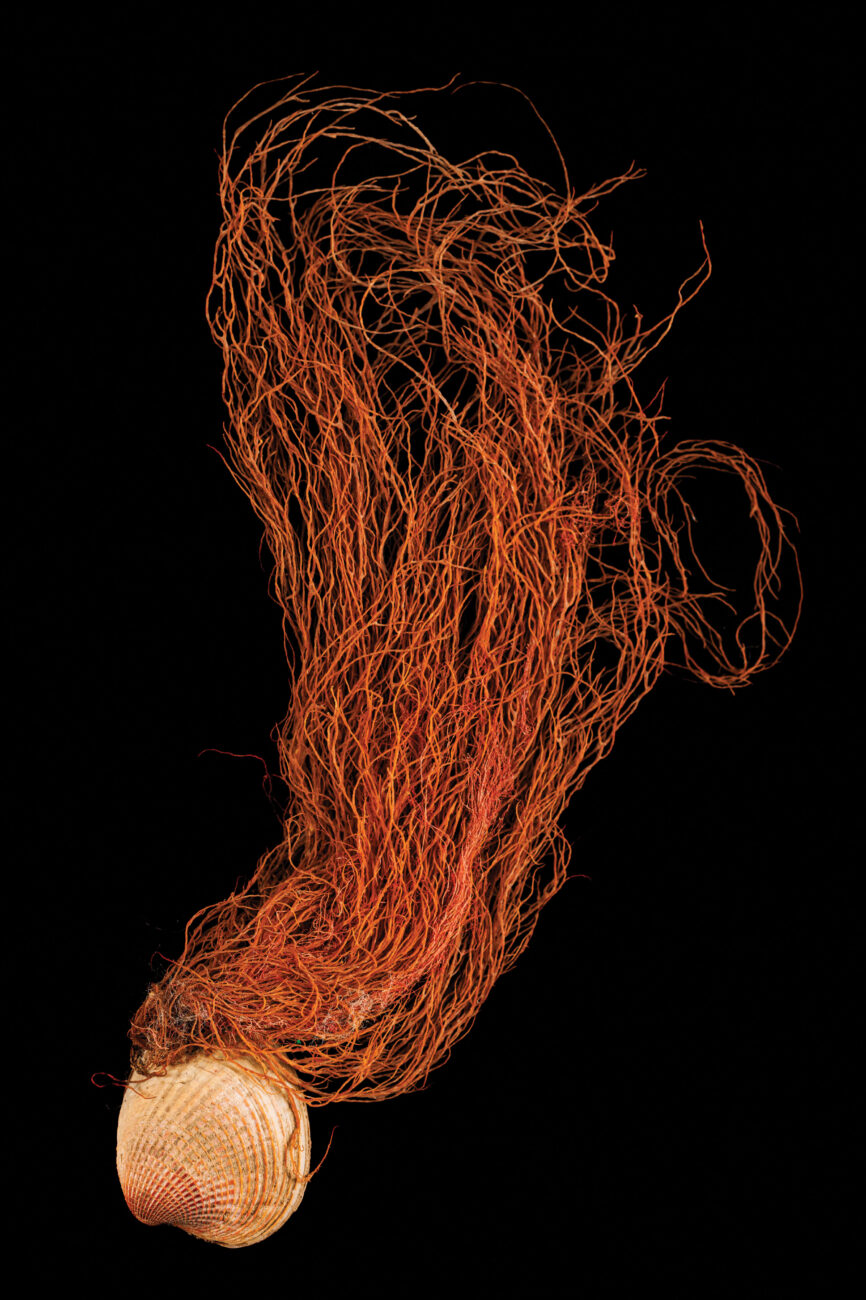
Norman had searched comprehensively, Jeffries realised: if he hadn’t found a shell, it probably wasn’t there. He found an extinct species of clam alive and well. He swept others along with him on searches, always noting the true finder of any specimen: often it was Lorna, his wife. Sometimes it was Heather, or Shirley, or Murray, their children. He looked along the tide line and in the crevices of rocks. He dug in the soft sand where waves fan out, to see what was underneath. He convinced boaties to tow a dredge so he could investigate what lay in the seabed. “He was really good at getting all the habitats,” said Jeffries, “at a time where the environment seemed to change a lot—because we had the Pacific oyster come in and get everywhere, and all the industrialisation that happened in Manukau over that period.”
Turning the pages of the journals, I turned through years: each page a list of findings, some commonplace, some rare. Like Jeffries, I became curious about Norman: what had sent him back to the coast, over and over again, on a search that never ended, on the fringes of a harbour most regarded as muddy and polluted.
But it was impossible to ask Norman anything. He’d passed away in 1989.
And so I set out on a search of my own: for the man who had recorded all of this, and why.
[Chapter Break]
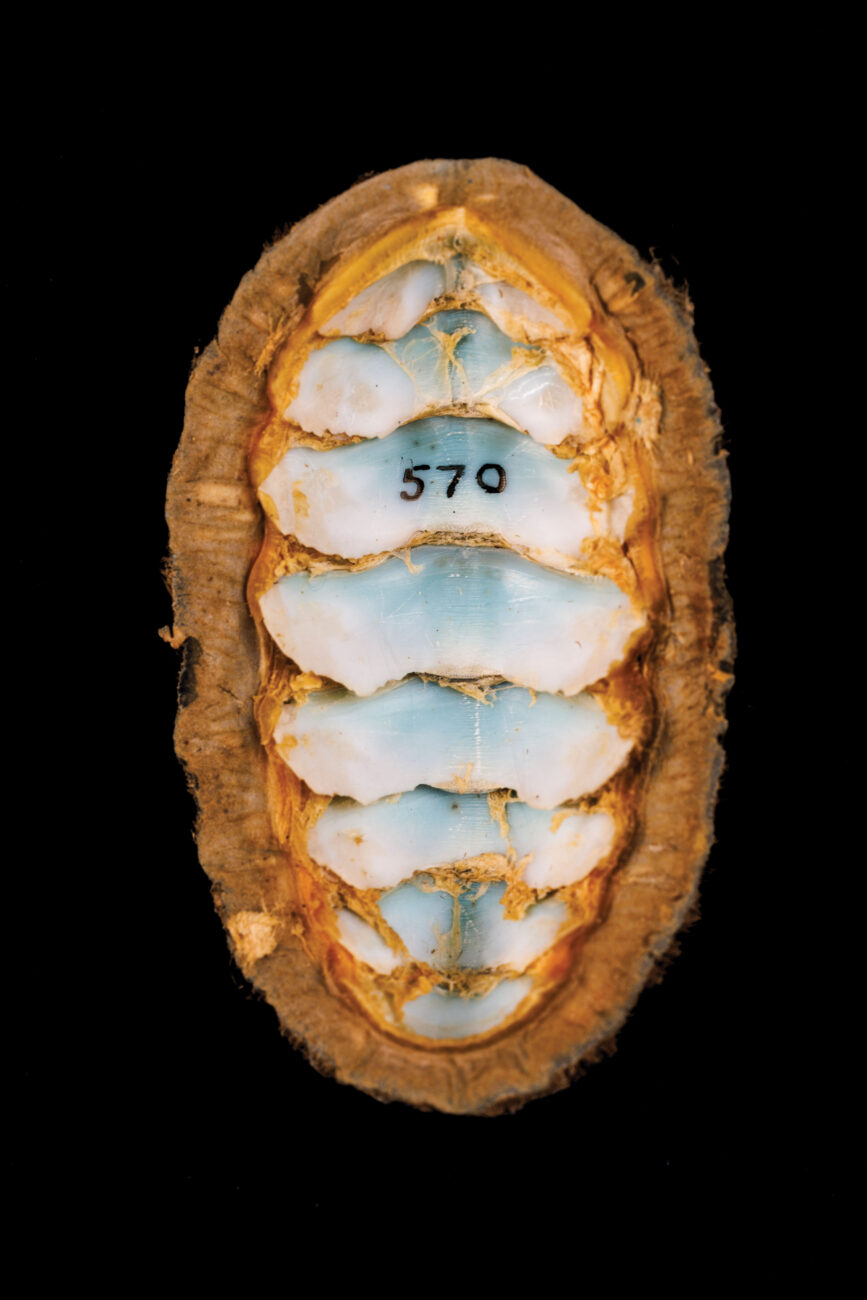
But first, the shells. Slide a drawer out of the cabinet and it’s filled with giant trumpets, or the armour plates of chitons, or whorled turbans; shells that are striped, spotted, spiked, smooth as earlobes. One tray reveals three parchment-thin argonaut cases, delicately knobbled. Another is full of triangular white shells that all look the same to me, but which Norman could tell apart at a glance.
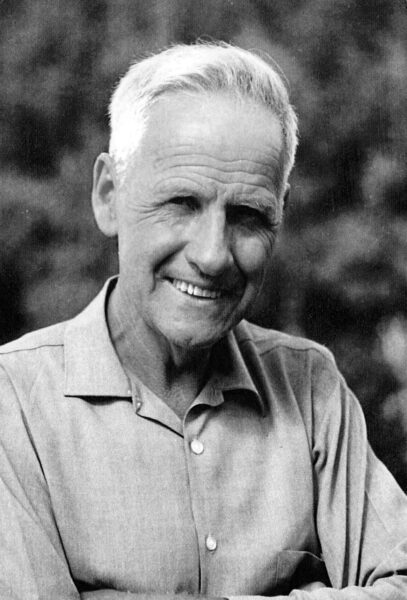
Some of the shells belonged to animals which were simply visitors to the harbour, while others were long-term residents: the collection encompasses anything that floated into the harbour’s arms or lived invisibly in rock or muck. Norman found them all, even as he saw everything change.
[Chapter Break]
When Norman was a child, Āwhitu was wilder than it is now. In 1910, when he was born, the peninsula hadn’t yet been cleared for farmland. Thick bush came up to one side of the family homestead; sometimes weka crept out of it and got into the henhouse and sucked the eggs, which enraged his mum. Kākā were constant companions, karrak, karrak, karrak, and he’d hear kōkako most days, kong, kong, kong, a peculiar sound, he thought, like someone beating on an anvil.
The creeks were filled with kōkopu, eels, trout, which Norman and his brother, Irwin, caught with a string and a bent pin. Their record was 90 in one day. If they needed a snack, he and Irwin would cut the soft hearts out of nīkau palms: juicy, nutty, sweet. It killed the palm, but there were so many. Big kauri, too. And on the farm, they had apple trees, damson plums, quinces that withered his mouth.
On picnic days, people dug toheroa—giant clams—fresh from the sand, trousers rolled up, because no one wore shorts then, even in the summer. Norman and Irwin would watch a toheroa rebury itself, then dig it up again, a slow-motion chase. When a whale stranded on the coast, Norman went along with his father to cut blubber from the carcass. His dad boiled it down and used it to oil harnesses.
They got everything done with horses. Norman learned to ride so young that he couldn’t remember it, in the way no one remembers learning to walk. The roads were sealed with shells, if at all.
The cream from the family farm was picked up from the cream stand by a horse-drawn wagon, to be sent on to Onehunga. But Norman’s parents took the cheese they made down to Āwhitu wharf themselves, and Norman liked going along with his dad on the buggy, through the mānuka and kānuka, stopping at Sam Dickey’s store on the way home.
Norman used to say that he became notorious for collecting things from about the age of five, and after all, there was so much to be found; ploughing turned up Māori artefacts so often that his grandfather had a benzine tin full of adzes.
But Norman gravitated to the living world: moths, butterflies, eggs of all kinds; tusks and horns from animals killed on the farm. His dad had a gun with the barrel worn down so much you could cut your finger on the muzzle. Norman would always be careful of guns, his whole life.
On his second-ever day at school, he got the supplejack cane, which is about the only story he ever told about his education. Sometimes, his teachers entered his paintings in competitions. There was no question of university—what was the point? Farming was how one made a life. It was growing, it was profitable, it was transforming the land. As teenagers, Norman and Irwin sharemilked together for a while on a farm at the base of the peninsula, and when Norman married Lorna, she simply moved in. He’d never again live anywhere else.
[Chapter Break]
A shell is a home, and a creation of one animal, and so when we collect shells we’re collecting abandoned homes, homes emptied by bereavement, the last sign that something once lived. In this sense, an empty shell is something in between a tombstone and an empty set of clothes—but it’s more personal than that, because each one is self-made.
Norman couldn’t preserve the animals that made his shells, but he drew careful pictures of them, their squishy bodies seeming to leak out of spirals and trumpets.
It always strikes me as remarkable that creatures as soft as marine molluscs—cousins to snails—can make something so hard and lasting. They build their shells out of seawater, turning dissolved molecules of calcium and carbon, invisible to our eyes, into hard, real substance. “That makes every shell not only a work of art, but a chemical vault,” writes Cynthia Barnett in The Sound of the Sea; “carbon bound up in beauty rather than warming the world.”
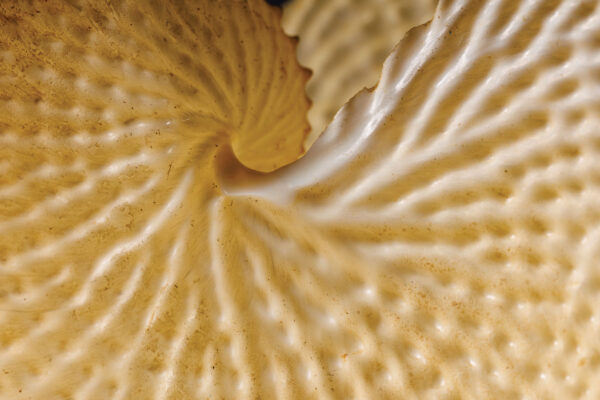
If you pick up shells from the beach and treasure them, you’re engaging in an act your ancestors took part in long before they were human. Even Neanderthals collected shells. “Seashells were money before coin, jewelry before gems, art before canvas,” writes Barnett. “Seashells are the earliest-known keepsakes tucked into graves.”
Norman was doing something as old as singing, something older than farming.
[Chapter Break]
The shell collection began, improbably, on a hunting trip. Norman and his uncle, Edwin, were deerstalking in the King Country, in the heart of the Waikato, about as far as it’s possible to get from the sea. One day, they were travelling along a river bank when Norman spotted something odd about one of the boulders. It seemed as though a shell was embedded in the rock, had become part of it, imprinted on the stone. Norman dug the boulder out of the bank, and dumped everything out of his pack so he could fit the boulder at the bottom. He carried it all the way out of the bush, kept it until he confirmed: this was a fossil oyster. How had it been made, he wondered, and how had it arrived here, so far from the sea?
He wasn’t the first to wonder this. A couple of centuries ago, the presence of fossil shells far inland led geologists to conclude that the world, once, had looked very, very different. Parts of it had been underwater, so long ago that the expanse of time is as hard to fathom as the distance between stars. Even the peak of Everest is made of squashed-up shells.
[Chapter Break]
Norman’s uncle, the one who took him hunting, also taught him how to tan leather with bark resin, and Norman took to the craft of it, turning skins into belts, saddles, shoes. He taught himself taxidermy to preserve hunting trophies, as well as anything else that crossed his path—a bittern, a kororā. He developed a system for assessing deer antlers, to determine which trophies were the most impressive: the Douglas Score is still used today by deerstalkers in New Zealand and Australia. He rescued rare native snails from patches of bush being cleared, and hand-reared them, noting down what they ate and how quickly they grew. And he collected shells haphazardly, bringing interesting ones home. That was until someone else noticed his interest and the focus he brought to the world.
Later, Norman described the person only as “a chappie in the biology line”, who told him, “Why don’t you make a project of the Manukau Harbour?” Norman thought about it for a while. He thought, why not?
“It became a very interesting project,” Norman said, in a documentary filmed towards the end of his life. “And each time we’d go down the harbour, we’d look around for something else, and gradually learned more and more about the harbour that we didn’t know before.”
The two sides of the Manukau Harbour almost meet, like arms reaching around for an embrace, but they are made of completely different stuff. On the north side, the hills are volcanic, and where the rock is exposed it looks like solid fruitcake, studded with pebbles. On the south side, under the grass of Āwhitu, is hardened sand. The whole peninsula used to be giant sand dunes, and it still has the shape of them, long planes slanted right down to the water.
Norman explored both sides of the harbour exhaustively, but the top of the Āwhitu Peninsula was his home stretch—a hand-drawn map that appears frequently in his journals. Darryl Jeffries wanted to see it for himself, and I joined him.
[Chapter Break]
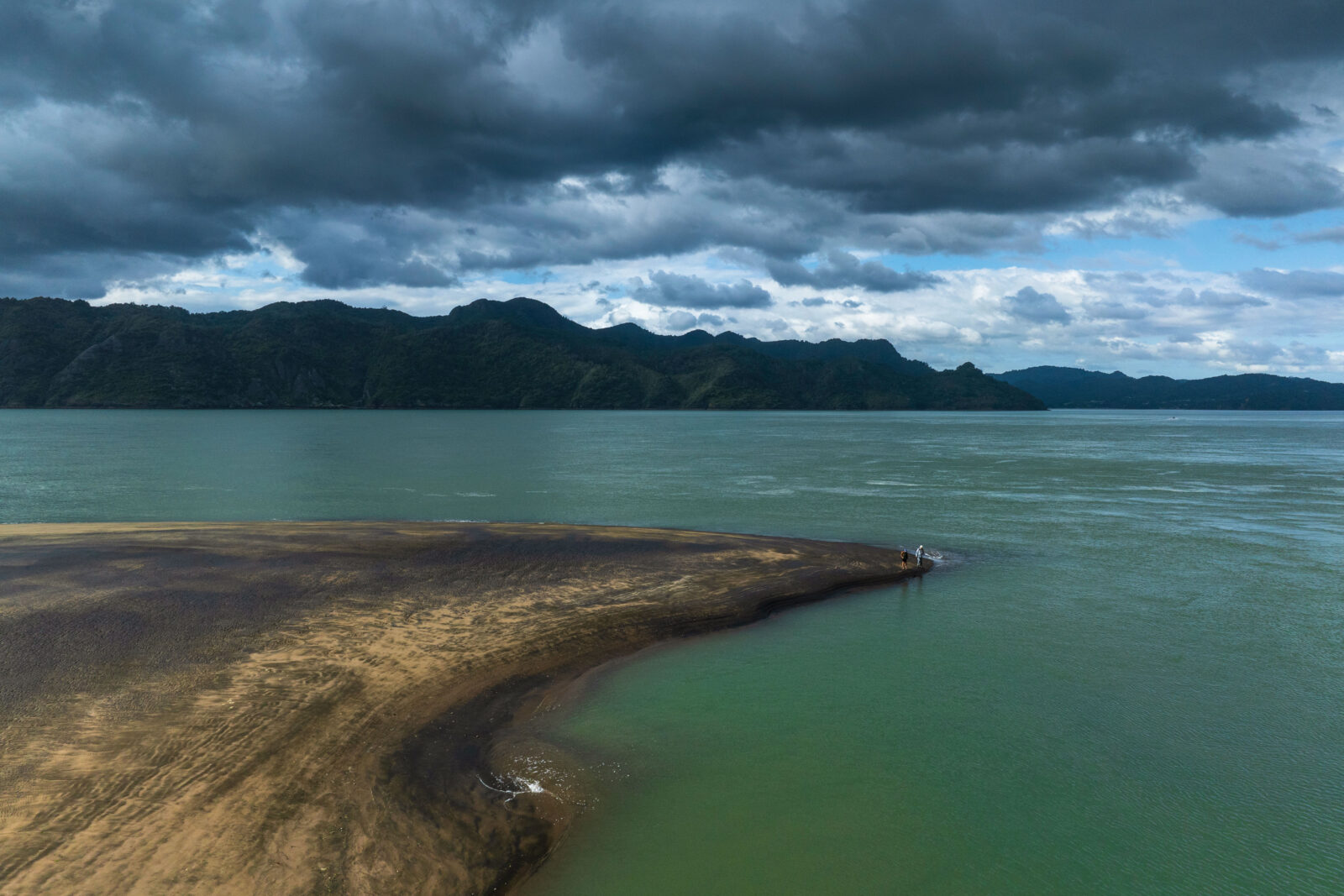
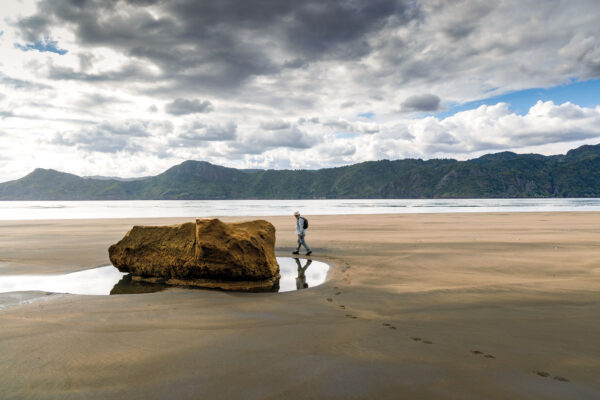
Where we walk, there are no other footsteps; the sea has swept the beach blank, leaving only pale lines marking the limit of the waves. It’s hard to believe we’re still in Auckland. The ranges across the harbour are forest-clad, and look close enough to swim to—except for the current running as fast as a river out towards the harbour mouth.
Blocking our way is a hill shaped like over-risen bread: this appears frequently on Norman’s maps as the Cake. Around the corner are the Big Blowhole and the Little Blowhole, where the harbour current eddies in a kind of whirlpool, so that it’s easy to imagine it flinging out treasures around its edges.
The hills behind us are ridged by cow tracks and festooned with yellow tree lupins, pampas that rustles in the breeze. Shags stand at the shoreline as though they’re waiting for something to happen. When they take flight, they leave behind little white sploodges on the sand.
“Shell collecting is very much governed by the tides,” Murray Douglas, Norman’s son, had told me two days earlier. “Sometimes, after a big storm, there’s a period of calm weather; that’s when the shells get pushed in and they come in on the tide.”
Norman would look for these days in the almanac—the spring tides, where the water was lowest. When these coincided with high-pressure systems, the sea would be drawn back even further.
We can’t go around the Cake, so we’ll have to climb over it. Above our heads, aircraft pass silently, followed by a belated hum. Auckland Airport is a straight flight down the throat of the harbour; I’ve seen this land so often from above, but I’ve never walked on it.
On the next beach, among the seaweed rubble at the tide line, is a collection of junk: cable ties, bits of timber, plastic bottles, a waterlogged soccer ball, the smashed face of a light bulb, and three Crocs, none of them matching. Otherwise, the beaches are bare; anything would stand out here on the black sand. Have they always been this empty?
Norman’s journals recount loss. “The tide was very low,” he writes in October 1983, after a visit to Pye’s Point, around the corner from here. “Only six Cabestana spengleri were seen. They are very few there just now.” The final entry, from 1989, the year he died, records just one large wedge-shaped shell, Macomona liliana, collected at Wattle Bay. “Maybe they are growing larger here as pollution increases,” he writes. His last words on the Manukau.
[Chapter Break]
There were various sheds on the farm, and over the years, they filled up with objects, perfectly catalogued. Not just shells: everything else Norman found on the beach. “In the cowshed there were just stacks of old chocolate boxes full of his beach combings, and they were all carefully labelled,” says Brenda Morrison, Murray’s wife, over cheese scones that he has made. “So we had combs, we had buckles, we had white buttons and red buttons and black buttons and shirt buttons, you know, just masses of stuff that he had found he thought might be useful someday. He could lay hands on anything at any time. You need a buckle for your belt? Here, choose from this selection.”
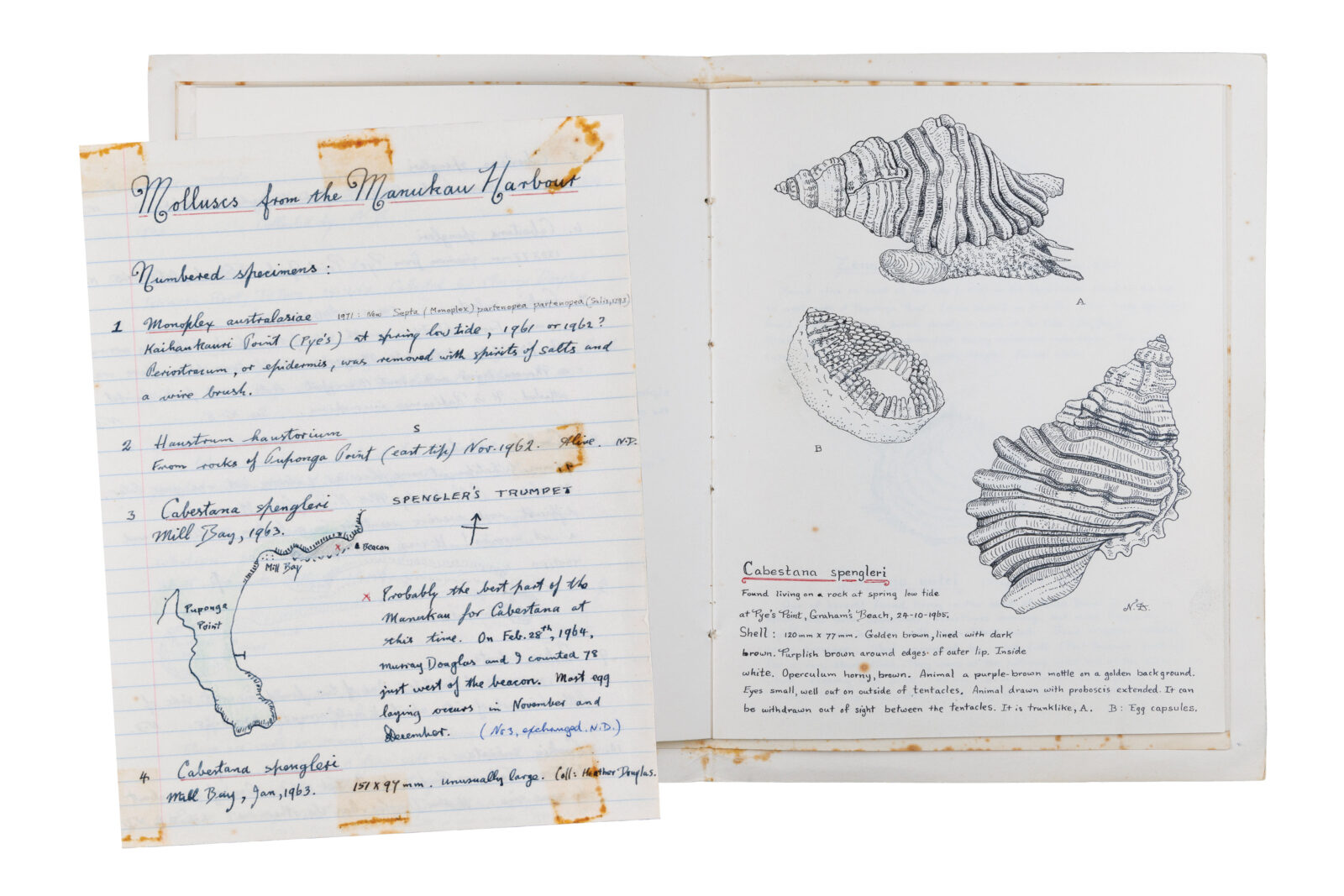
In page after page of journals, Norman writes down not only shell observations but anything interesting he notices or acquires. “He documented everything because his father left him no records of his family history,” says Murray. “And my father was quite upset that he had no history, so he wrote everything down himself, and was very interested in making sure he made everything correct and wrote it right.”
One leatherbound notebook, different from the rest, is like a recipe collection for Norman’s life, each page a set of instructions and diagrams: waterproofing for shirts, school floor oil, sole leather, canvas coat dressing, a calf collar, a strap for a bull’s head, a stallion bridle, a gig harness, traces, martengales, girths, shaft tugs, a spider britchen, plough reins, surcingles, cruppers, plough backbands, britchen straps, wagon couplings, endless plaits, mullet nets, plaster for walls, and a wholesale price list for hemp and buckles dated to 1935.
Perhaps what fascinates me most about Norman is how much time he had. He went hunting. He spent hours in his workshop. He corresponded with fellow conchological enthusiasts. A single taxidermy project would take him 60 hours.
I think about how long it takes to catalogue things, to sort them into the right chocolate boxes. Sure, he never had to make a meal, or do the laundry, but Lorna, too, spent hours in the garden, her pride and joy, or on shell trips with Norman.
“He did get offered a job at the museum at one stage years ago,” says Murray, “but he turned it down because he wanted his own freedom and independence. He liked the idea of the farm because you could milk the cows in the morning, and then do a bit of fencing when it suits you.”
“Yes, well, he was only reluctantly a dairy farmer,” says Brenda.
When the milking was done, they’d go off for the day, he and Lorna. “She was a very keen and enthusiastic partner in the searches,” says Brenda. “She actually found quite a lot of the pieces that were in the collection.”
Was Lorna secretly running the farm? “I’d have to say my mother did 99 per cent of the cooking and the household things,” says Murray. “He got off pretty cheaply from doing those mundane things. And she even mowed the lawns, which was a bit embarrassing, but he was so focused on writing up something in a catalogue.”
But the farm, says Murray, ran itself. The cows turned up of their own volition to be milked. Irwin would stop by to milk them whenever Norman was away. “It was quite easy to make a living off the farm on a small block, right?” says Murray. “And they didn’t want as much as we want these days. So, their expectations were to live on the farm, and live off the land, and have a house.”
“They didn’t yearn for more than the basic home comforts,” says Brenda.
As part of the generation usually accused of yearning for more, I often wonder what it is that I’m assumed to want. My own wishes feel both modest and impossible: a home of my own, friends around the corner, time enough to spend with them. Either I watch other millennials struggle to afford their bottom-of-the-ladder houses or their children, or I listen as they reconcile themselves to not having either. Sometimes, time is the only meaningful thing any of us can afford, and it’s acquired through conveniences that seem frivolous from the outside.
What I hear most from Aucklanders of my generation is a desire for time. Time to properly pay attention to relationships, hobbies, gardens. Time as slack as the water at the changing of the tide. Who among us has the freedom to spend hours beachcombing at the perfect conjuction of a spring low tide after a storm? Will we have that when we retire? Will we retire?
[Chapter Break]
When Norman retired, he sold most of the farm, keeping the homestead and the land around it, and used the money to extend the house. He added a museum wing—the size of a living room—to hold his acquisitions, with custom-made drawers to display his entire New Zealand shell collection. (Te Papa has that, now.) There was a cabinet for the antique bottles he’d found with his daughter Shirley, and another for the Manukau shells.
“Nearly all the people who come here get a surprise to find what’s in the Manukau Harbour,” Norman says in the documentary. “They think, you know, ‘Oh, that’s a great big dirty hole. A great big fat muddy-looking place. You’d never get much in there but pipis.’ And instead of that, there’s over 300 kinds of shells here.”
“He’s fascinated by everything,” I say. “Everything,” says Murray. “Everything that’s new, he’s never seen before, he’s fascinated by it.”
“He has an eye,” says Brenda.
In a video, Norman shows off a carrier shell: a sea snail that’s glued bits of other shells onto its own shell, the kind of kitsch undersea maximalism embraced by my grandparents’ generation.
“Look how old he is,” says Murray, because this isn’t the Norman he remembers best.
“So he was 72,” says Brenda, “and I hate to say this—”
“Yes,” says Murray. “Same age as me.”
Murray, who collected snails alongside Norman and tried to keep them alive, grew up to get a zoology degree and a job at the Department of Conservation. He, too, knows the difference between Cyclomactra and Cabestana, reels species names off the tongue that neither Brenda nor I recognise: an invisible inheritance.
[Chapter Break]
The Manukau no longer has its keeper of the coast. If there aren’t Normans—if no one has the time—then who will record arrivals and departures from the shore?
It’s Norman who recorded the slow return of scallops to the harbour in the 1970s, and the explosion of invasive Pacific oysters in the 1980s, which turned rocky tidal beaches brown, and made it dangerous to walk with bare feet at low tide. It’s Norman who had a sense that the mud under the Waiuku wharf might contain something precious. And it’s Norman who understood, deep down, that keeping these records had meaning. He gathered and assembled all these sightings, like molecules out of seawater, and turned them into something lasting: what lived, what left, what stayed.