Pattern recognition
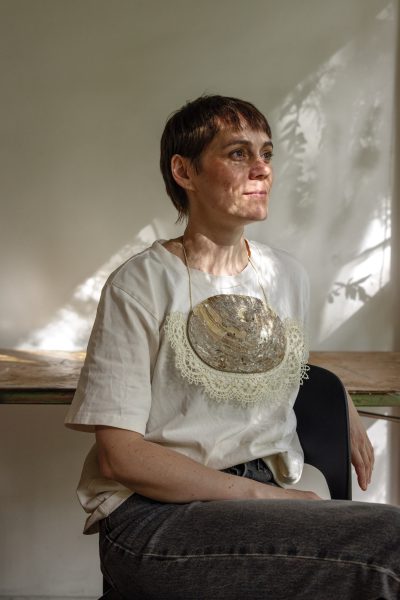
How Tara Viggo fled fast fashion and cut herself a new career.
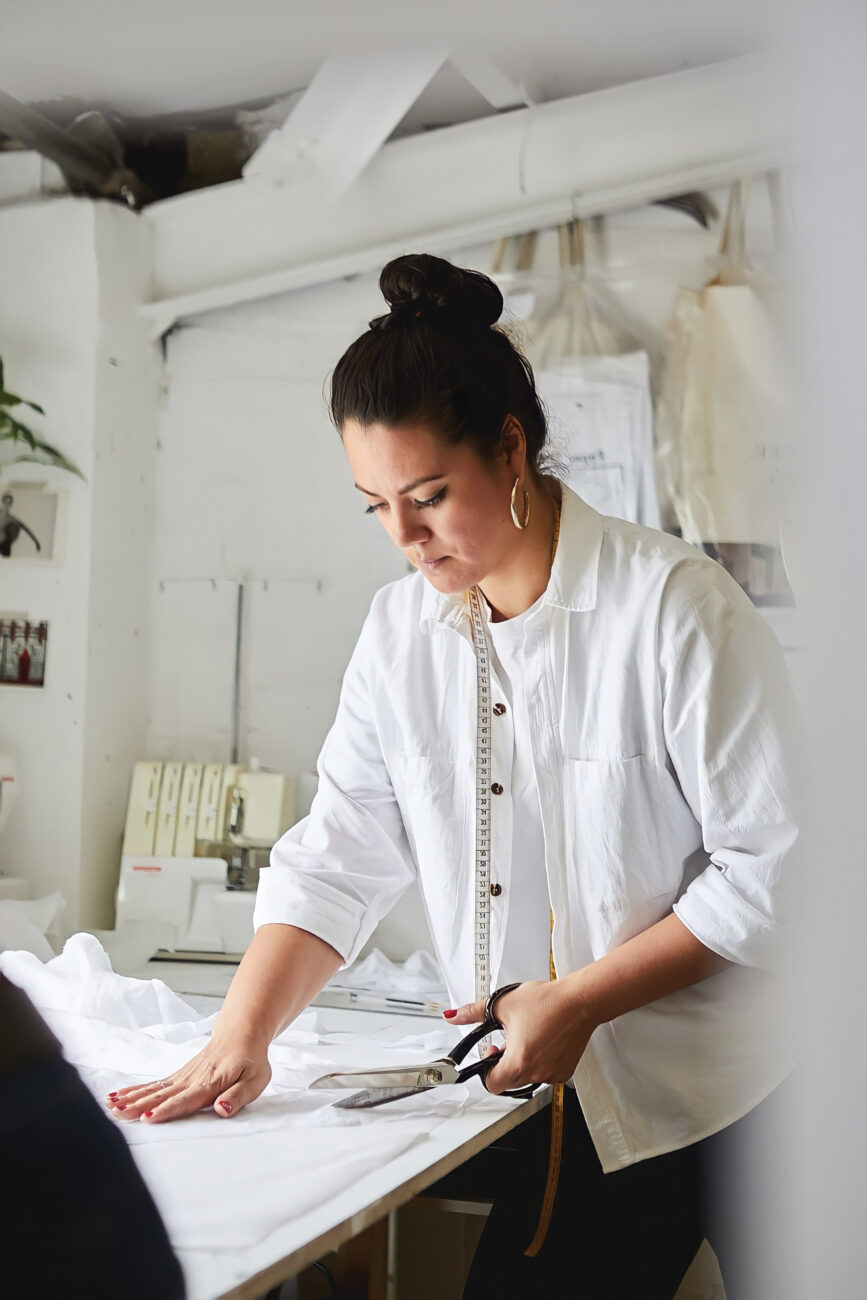
One day, drawing patterns for huge clothing brands in the UK, Tara Viggo made a mistake. On a blouse with a keyhole opening at the front, she omitted an important X. “The keyhole was the wrong length, basically.” The garment was unwearable, but in the grinding demand for more clothing, 60,000 pieces had already been made. They went straight to landfill.
“I could see that I was a cog in this big, evil machine,” Viggo says 11 years later from her home in Ōtepoti/Dunedin. “I was totally complicit. It was that gut-wrenching feeling of ‘Shit, I’ve done something really bad.’” She couldn’t bear her colleagues’ assumption that mass destruction of clothing was “just how the world works”. She quit her job. She toyed with becoming a landscape architect. She went back to working in a restaurant, just as she had when she was a beginner designer trying to make ends meet.
And still, every week, the trucks rolled in full of clothes from factories in Eastern Europe; every week, the displays in the department stores were switched out. “I realised that evil machine was continuing whether I was there or not.” Was it possible for Viggo to be part of the fashion industry and not be part of the waste and labour abuses?
While designing for others, Viggo had mostly bought her own clothes, rather than making them. They were just so cheap—“the same price as my lunch”. She tried to turn her sick feeling into action: she stopped buying clothes for two years, and in 2016, she started Paper Theory, her online pattern business.
Viggo gravitates towards plain, sturdy fabric. She’s designed a skirt with pockets big enough for a novel; a shirt where the front yoke is cut ingeniously, from the same piece of fabric as the sleeves; a jumpsuit with a comfortable tied waist. Rather than trends, Viggo thinks about what her own wardrobe might need. And instead of producing a garment before seeing it on real bodies, she works with pattern testers, who sew the pattern then give her feedback on fit and clarity of instructions.
Each pattern is graded up to size 36 and adjusted for the different curves of plus-size people. For example, from size 20 upwards, she redrafts the pattern lines for someone with a larger bust. Home sewing means fewer constraints for those not served by the fashion industry. But making clothes is work, as Viggo learned when she began sewing as a high schooler. It started out of necessity, because it was so hard to find clothes in shops which fitted her. “Being Polynesian, I’m a bit short, a bit stocky. Whenever I bought jeans, I’d have to chop four or five inches off the bottom.” Then there were the possibilities for customisation. Her Logan Park High School kilt jingled with dangly decorations; her shirts had darts so they fitted differently. “I was constantly getting suspended from school for uniform violations,” Viggo says.
When you make your own clothing, you have to decide what is worth that work. “You can’t still hold the idea that you’re entitled to a new outfit whenever you think of one,” she says.
She knows that not everyone has the time or knowledge or inclination to sew for themselves. Even though it is possible, for most of us, to simply buy less, the fashion industry and its many sins can’t be completely avoided. Viggo’s five-year-old daughter wears clothes from the high street. “I thought I’d make all her clothes, but now I understand that I can’t.” Viggo will start making a tiny shirt, set it aside for a few weeks to do some sewing for work—and realise her daughter’s grown out of it. And a well-lived childhood is hard on clothing. “They get dirty, they get ripped, they grow out of things.”
Viggo’s father’s family is from the Manihiki atoll in the northern Cook Islands; Viggo was born in Rarotonga and grew up in Dunedin, becoming obsessed with hip-hop style after watching Boyz n the Hood with her cousins, then moving on to Otago Polytechnic’s fashion school. Then came 13 years in the UK.
Viggo, her partner and their daughter moved back to Dunedin last year, to a spectacular view of Otago Harbour. She missed the sea in London.
She’s excited that Pacific designers are becoming an established part of the fashion world, making clothing distinct to Aotearoa. Most of her customers, though, are in the US, and found her on social media. Viggo has more than 100,000 Instagram followers. “It feels like the community bit has kind of gone from social media now there’s so much money involved,” she says. “I’ve lost any passion or interest for it—it’s kind of a drag that I have to be there.” Nine years ago, when Viggo started Paper Theory, her posts were frequent and educational. How are clothes made? What kinds of fabric should you look for? Updates are occasional now and mainly used to announce new designs, or to share a photo from her garden.
When she doesn’t have to do the solitary, indoor work of sewing, designing and running a business, Viggo loves to be outside. Regular surfing is a joy, as is the garden. “I’ve been trying to grow indigo—I want to dye my own jeans,” she says. The plants are thriving and dye experiments are ongoing. “But my scientific knowledge when it comes to turning these plants into dye is terrible.”
Her favourite walking track weaves up the side of Signal Hill through bush that forms an evergreen tunnel. Viggo has noticed herself gravitating more to deeper colours since returning to Ōtepoti, a “black and dark and intellectual” palette over the brighter shades she favoured in London. She’s thinking about designing outerwear, now—a jacket made for rainy winters and moving through the forest. At the top of the walk is a lookout, where the view “just falls open before you”. The city, the sea and the hills beyond: like bolts of textured fabric on a patternmaker’s table, waiting.