Our deeply toxic relationship with willows
Willows can stop a river flooding a farm. Or they can turn a river dark and mean. Trying to control them, we’re realising, has always been a fool’s game. But we can’t stop now.
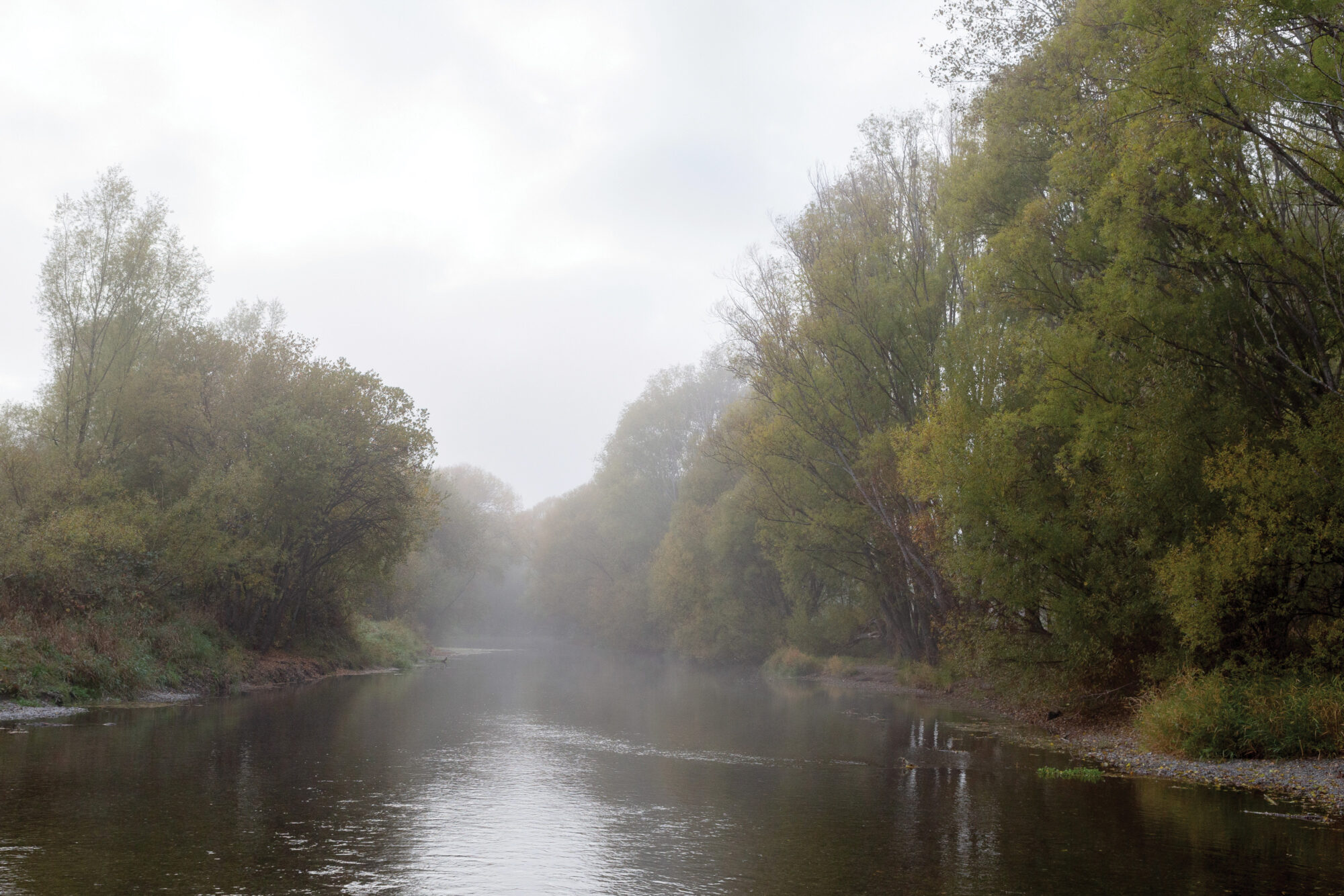
For centuries, the Taiari River has woven a shining tangle across its floodplain, pushing water across soil and gravel in an ever-shifting kaleidoscope of bends, oxbows and dry water-scars.
Once, these waterways were clogged with tuna, eel, and kanakana, lamprey. Ducks and swans flocked here to rest and breed. When Kāi Tahu looked at this landscape, they saw the tormented wanderings of the taniwha Matamata, his agitated tail sweeping across Mānia-toto; the plain of blood. Farmers in the 1940s saw a river that needed to be controlled. Crack willow, introduced to New Zealand from Europe a century earlier, was their tool of choice.
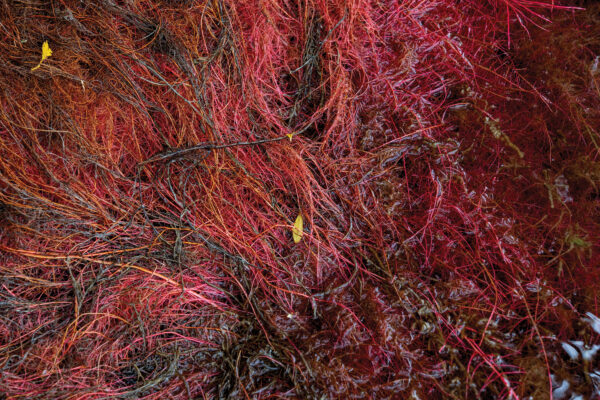
In the upper Taiari, as in many other places around New Zealand, these exotic trees with their mats of scarlet roots held the river against its will, allowing farmers to cultivate and irrigate the flat, fertile land bordering the river. But before long, the willows had taken over.
Crack willow is brittle and it breaks with a snap and a promise: every tiny twig or branch can regenerate, and each sapling has the potential to grow into a sagging behemoth, weighing many tonnes.
The newcomers clogged parts of the river, creating choke points that, in heavy rain, simply couldn’t flush water through fast enough. The farms beside the river were regularly swamped by floods that sprawled across the scroll plain like a giant lake. Willow branches washed downstream in floods, tangling in bridges and causing expensive road blow-outs.
Now, it’s illegal to plant crack willow, or certain other invasive willows.
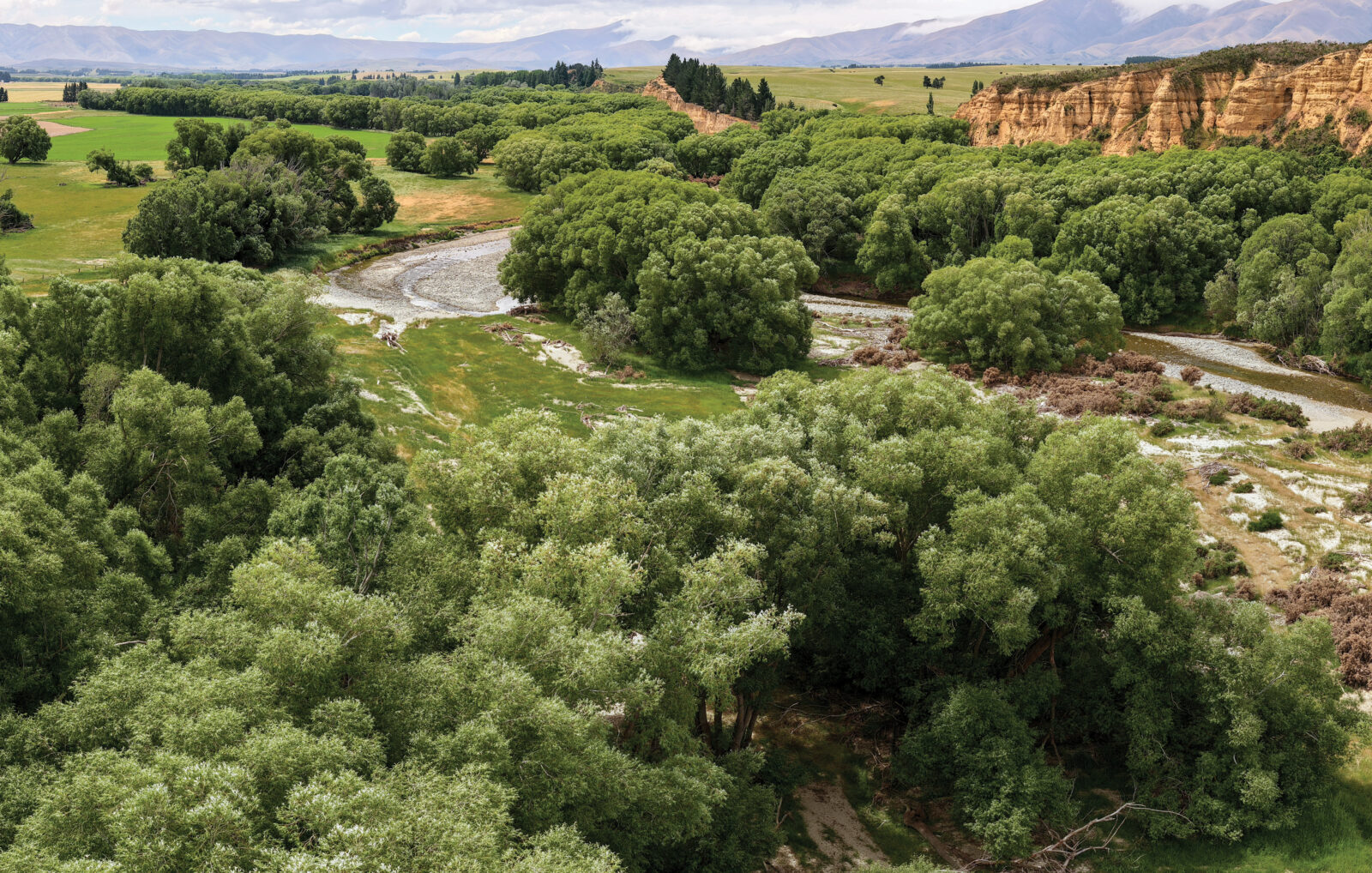
But they’re still going strong in the Taiari, and it’s a bind seen best from the air. On a hot January afternoon, I put my drone up and watch the handheld screen. Puffs of exotic green chaperone every curve of the river.
I guide the drone over a spot known locally as “Willow Island”. It’s a kilometre-long pillow of imported forest that completely conceals the river. Upstream and down, as far as my drone’s camera can see, thousands more young willows are sprouting.
At their ancestral homes in Europe and Asia—drooping over wetlands in the Danube, or lining Mongolian rivers—willows are a benign presence. They stop stream banks from eroding and provide shade and habitat for fish. They dump their leaves in autumn, feeding crucial nutrients into streams. Their tender shoots and flowers provide food for animals, especially bees.
But New Zealand has no native plant that works quite like a willow. Our plants evolved to move with rivers—to recolonise ground after a river shifts, rather than holding the water in one place. So willows have utterly changed the way that freshwater ecosystems operate here.
[Chapter Break]
For the past three years, I’ve worked with Tiaki Maniototo, a Jobs for Nature-funded freshwater conservation project in the upper Taiari. Willows are a big part of our work, and to grapple with them we collaborate with local farmers, the Otago Regional Council, the Department of Conservation (DOC), Fish & Game, Kāi Tahu and Herenga ā Nuku.
Crack willow has penetrated to the very top end of the Taiari catchment, where the young river tumbles out of the tussock-clad Lammermoor Range onto Canadian Flat. I visit here for the first time with Chris Kavazos, a freshwater technical advisor for DOC, and a team from Te Nukuroa o Matamata, a local iwi-led conservation group that’s been contracted to deal with willows in a wetland connected to the river.
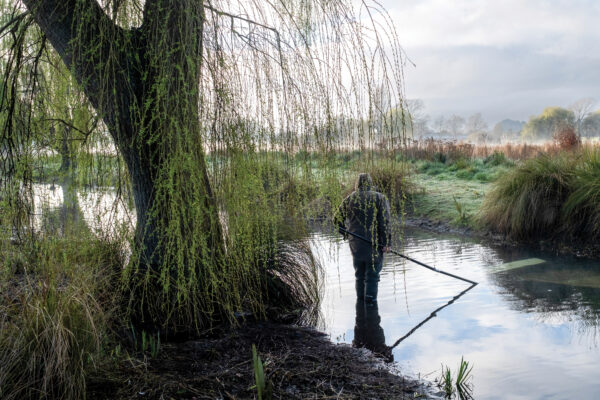
Tūmai Cassidy, of Kāi Tahu’s Ōtākou rūnaka, is one of that group. For centuries, Cassidy’s ancestors ventured into these wetlands to harvest tuna, lamprey and birds. He tells me willows not only impact on traditional kai gathering, they’re also smothering whānau understanding of waterways.
“You have generations of people who think wetlands are full of willows,” he says.
“They create a barrier for our people and communities to experience what an actual wetland ecosystem actually looks like.”
Willows also fundamentally alter those ecosystems, as Kavazos points out. They change the microclimate, for example, “so a lot of native plant species can’t exist underneath them. Eventually you end up with a monoculture of willow.”
The Taiari winds through a landscape where every drop of water is precious. In summer, its willows are robbers, sucking up enormous amounts of water—reducing the amount available for both fish and farmers.
Autumn brings another reckoning. As I write, the willows are turning yellow. Soon they will drop tonnes of leaves into the water, creating an artificial spike of nutrients. That can trigger algal blooms, sucking all the oxygen out of the water and culminating in lethal “blackwater” events. Kavazos talks of sludgy rafts of algae and the bloated bodies of dead fish. The dead, sulphurous smell.
The willows we’re dealing with today are relatively small, but left unchecked they will quickly seed new trees downstream. Starting at the top of a catchment and working down, says Kavazos, is the only way to keep on top of them. But destroying willows in a landscape like this is not easy. They must first be killed with poison, and that’s what the Te Nukuroa o Matamata team are busy doing today.
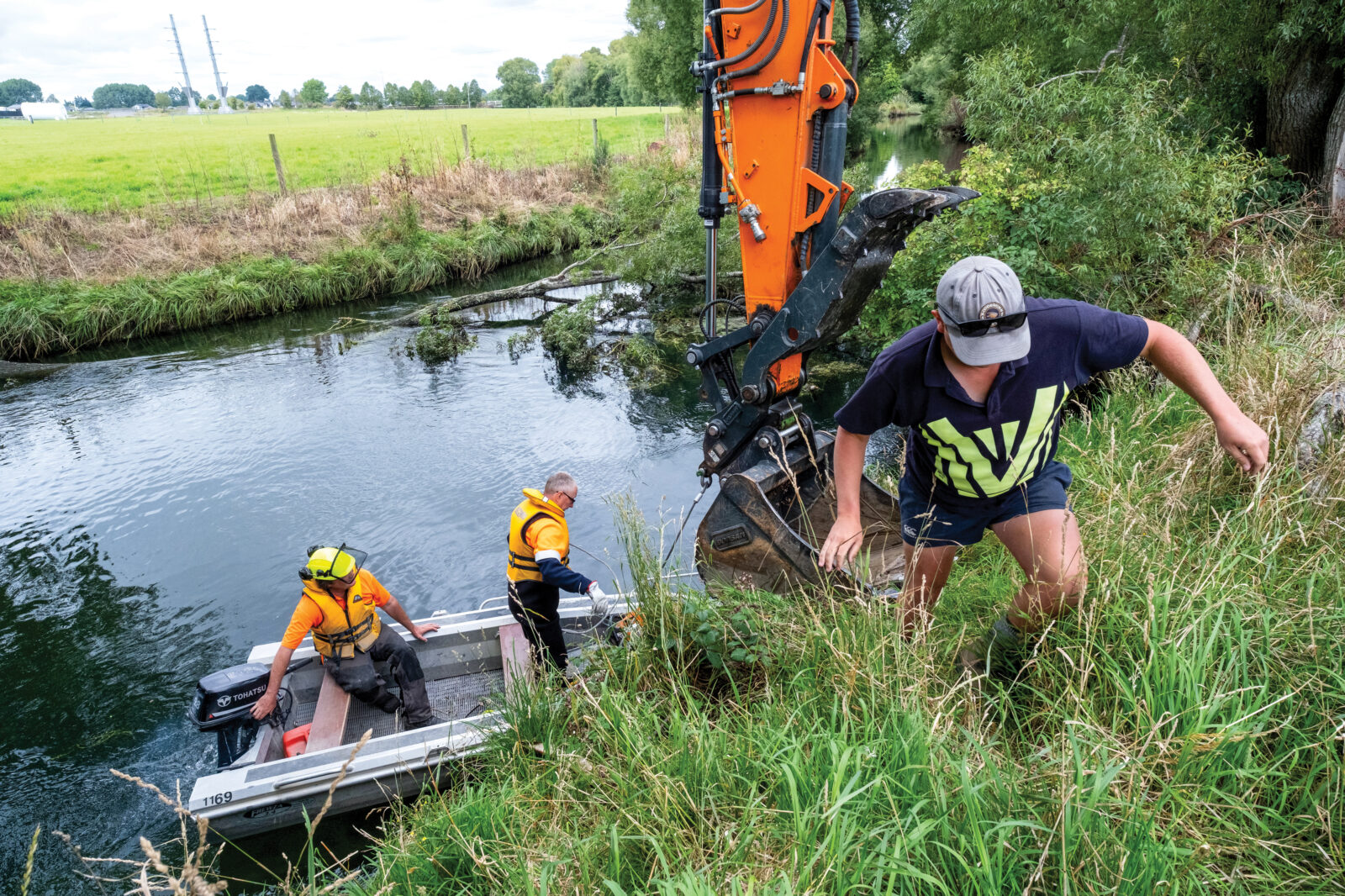
Sweating in gloves and long sleeves, they’re on hands and knees amid an infuriating tangle of whip-like branches. I watch them take to a multi-stemmed willow with a cordless drill.
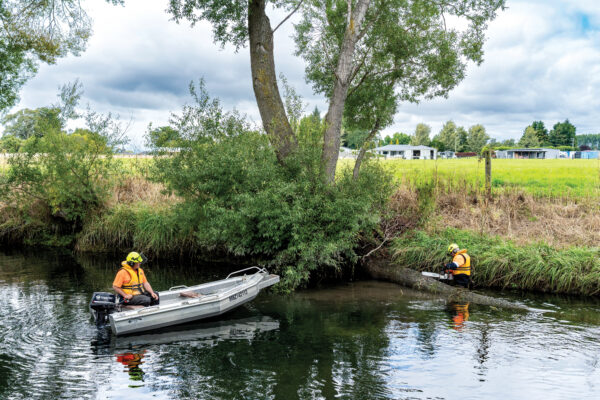
The first hurdle to controlling willow in wetlands, team member William Dawson (Kāi Tahu) tells me, is sometimes just getting close to the trees. Often, a boat is required.
Once in position, they have an array of poisons in their arsenal. If, as is often the case, the branches and leaves of a tree are touching the river, glyphosate is the only option, as it breaks down relatively quickly in water.
Elsewhere, the team can use more powerful compounds that penetrate the bark. On young, smooth-barked branches they paint on a herbicide. Bigger trunks, like the tree they’re dispatching now, need to be “drilled-and-filled” with a different herbicide that will spread throughout the plant and into the roots. One hole won’t do it: you need a ring right around the trunk and managing that, says Dawson, is not always easy.
“You have to actually move your body around the whole side of the plant. When you’ve got really dense willows, you sometimes actually can’t do it.”
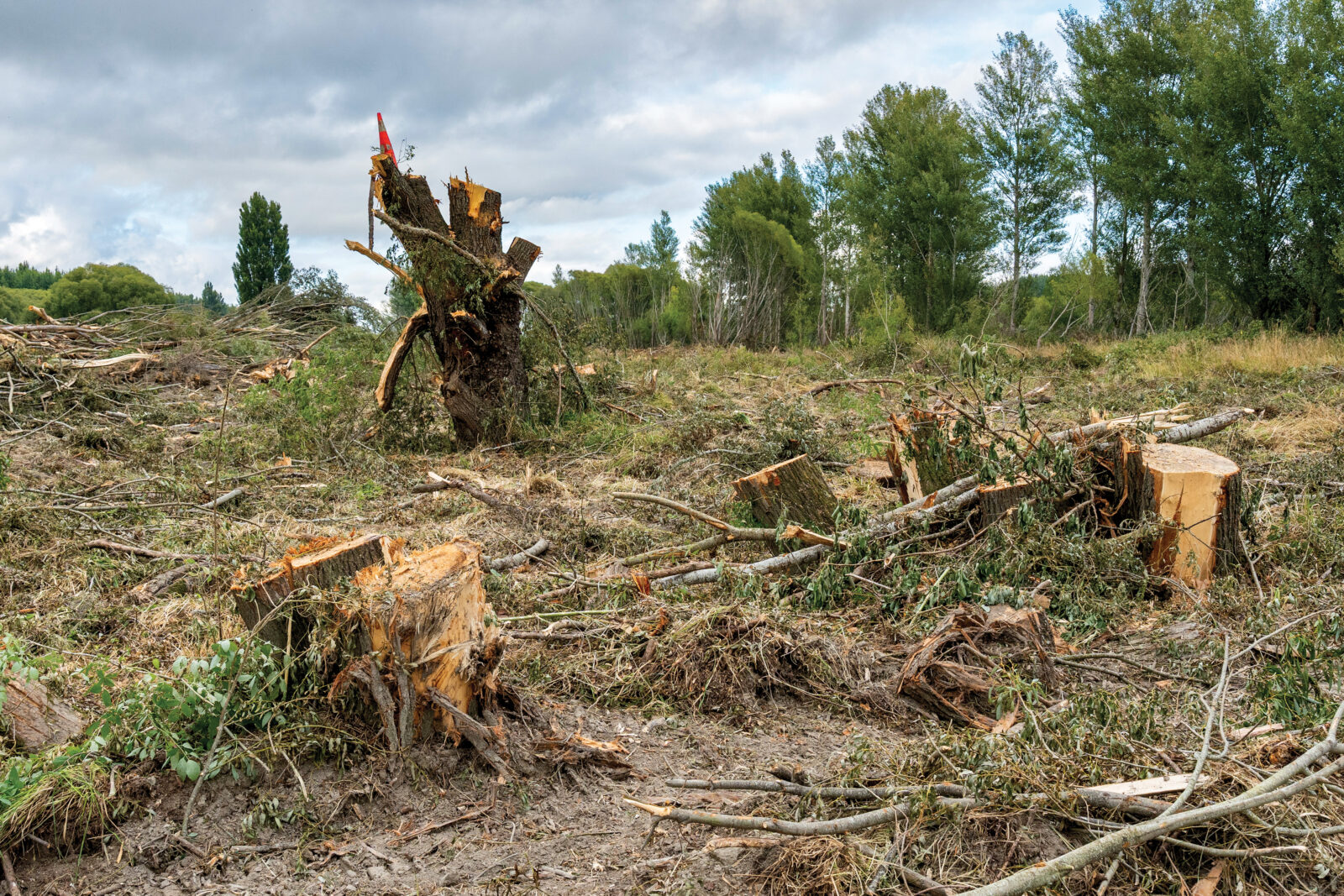
Even dead, the willows are a pain: they can take decades to rot down, during which time they’re an eyesore, and a hazard during floods.
Most farmers in the upper Taiari now want the willows gone. There is, perhaps, more of an understanding that the natural processes of the river can’t so easily be tamed. Geoff Crutchley, of Puketoi Station, has lived with the Taiari his whole life. It’s always involved a bit of give and take, he tells me.
“You just have to sort of wear it when the river decides to pinch four or five hectares off you. You’ll get it back in 50 years, probably.”
There’s also an awareness that there is no end game here. We’ve been trying for decades to unstitch crack willows from this landscape. And the willows are winning.
[Chapter Break]
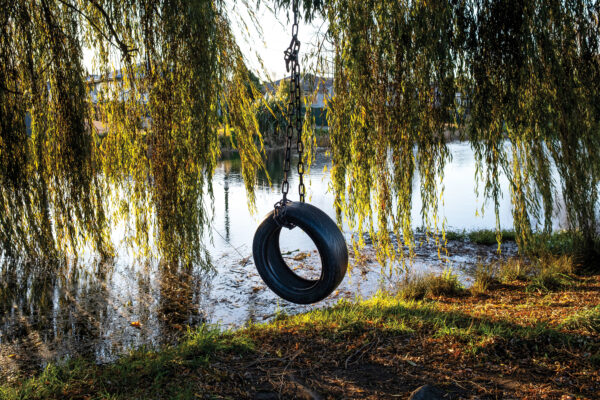
Willows have plenty of allies. After all, they look nice. They provide shade on hot days. Willows are extremely important in apiculture, providing food for bees in early spring, when there is little else available. Insects love willows, and many fishers consider these an important source of food for introduced trout. Willows also keep water cool and give fish a place to escape the sun’s rays.
But Gerry Closs, a freshwater ecologist with the University of Otago, notes that there are plenty of native species that would do the same job.
“Willows almost provide too much shade,” he tells me. “They tend to stifle productivity. You end up with a river channel which is all willows and gravel sediments in the middle. That uniformity is going to come at a cost for biodiversity.” I think of the monsters of the Taiari catchment—the big trees leaning over waterways, clamping them in darkness.
Underwater, a willow-lined bank provides a trove of tangled hiding holes for trout and eels. Such streams become gauntlets for the small native fish on which these predators feed. Willows also make excellent cover—and bridges—for cats, mustelids and other hungry mammals. Pity the kāki, our endangered black stilt, that nests too close to a willow.
Yet getting rid of these trees brings its own complications. That’s because in many places, we still need them.
[Chapter Break]
When people ask Shane Jellyman what he does for a living, he sometimes tells them he’s “part of the generally futile effort of thinking we can keep rivers where we want them”. More formally, he’s a rivers and coastal engineering officer, working for the Tasman District Council.
I’m in Jellyman’s work ute, heading out to look at some of the key pinch-points in the Tasman region—places where he and his team battle to prevent rivers from flooding farmland and towns.
Jellyman’s job is all about buying time. There is nothing we can actually do to stop a river from overtopping its banks: eventually sediment will build up, the water table will rise and the river will have its way. But ratepayers expect Jellyman to hold off the inevitable, so he persists. Willows, he tells me, are crucial.
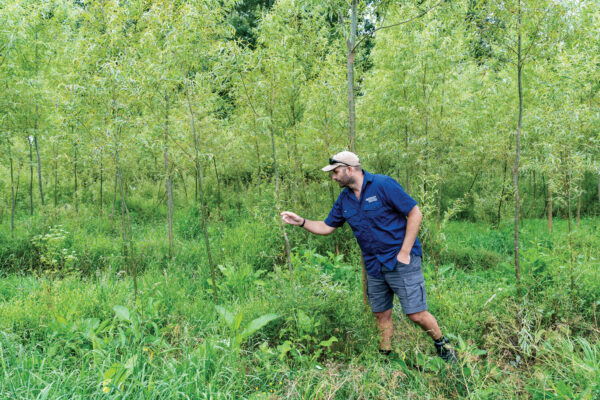
Our first stop is a nursery. Jellyman drives a slow loop around regiments of hybrid willows. Like many of the hybrids councils are trialling, these are a cross of twisted willow Salix matsudana and white willow, Salix alba. These ones have been grown from cuttings, and every year the poles they sprout are sliced off for planting elsewhere: a cloned army of hybrid soldiers, annually giving up their limbs in service to the cause. These willows are all of a single sex, and theoretically unable to breed.
The nursery can’t keep up with demand—it produces around 2000 poles a year for the Tasman and Marlborough district councils. Still more poles are harvested from wild willows in the river.
Jellyman drives us deep into the hills, out onto the upper Motueka floodplain. The valley is a long funnel directing every drop of rain into the river at our feet. Today, you’d cross the Motueka without getting your shorts wet. When the river rages, as it did in 2021, it becomes a surging grey-brown monster that eats fences and roads and covers farmland in silt. There is no practical way of stopping that happening again, but hundreds of willows have been planted here in the hope they can lessen the impact of the next flood.
We brush through a grove of them to get to the riverbank—lines of frail, pale-green trees standing sentry against a river that’s been doing whatever it wants for a long, long time.
Iain Hogg, a rivers manager with Taylors Contracting, is here to meet us. Hogg has been in the “futile” game of trying to control rivers for more than 20 years. “Mother Nature always wins,” he tells me.
When Hogg started out, “willowcraft”, as he calls it, was how we held rivers. Engineers strategically planted crack, grey and bitter willow, and worked with willows already growing in the river, cutting down big trees and anchoring them to the bank, where they quickly resprout, creating a living buffer.
As machinery became bigger and more capable, councils shifted to “hard” solutions—rock walls and stopbanks. These are expensive, though, and ugly, and leave no habitat for native species. And they’re all-or-nothing. A wall will stop a flood in its tracks entirely, until it can’t. Then the flood overtops it with full force.
Willows wield a softer power. They’ll slow a flood down, attenuating its destructive power and forcing it to drop some of its silt burden before it crosses farmland. They’re also far cheaper than building rock walls. So now, the emphasis is shifting back towards willows.
Getting them started is easy: simply bang a stick in the ground, and its rooting hormones will do the rest. From there, says Hogg, “management is the key”. To show us what that looks like, he and Jellyman take me into the Tapawera district, one of the country’s most important hops-growing regions. The market is dire; for many growers, it wasn’t worth planting this year. Bare trellises stretch for kilometres.
We drive across a paddock to the edge of the Sherry, a tributary of the Wangapeka. The river is a sullen loop, lost in a dark corridor of wild willow trees. Trellises are anchored to the bank just a few metres from the water. Land here is so valuable that farmers leave no room for the river to shift.
It then falls on Hogg, Jellyman and their teams to defend that property from floods and erosion.
When willows get too big, they topple, ripping massive plugs out of the bank. So Hogg’s team has recently been through this spot with a newly acquired tree shear, a powerful cutting device that beheads willows, keeping them at a manageable height. Jellyman would like to have it out topping willows year-round, but funding won’t allow it.
Hard lessons have been learned here. In 2009, the council embarked on an ambitious programme of crack-willow destruction in the Upper Moutere and the neighbouring Dove River. For months, teams hammered willows, spraying and cutting down every tree in those basins.
Seven years later, just as the root boles from those trees were finally breaking down in the soil, a big flood hit. With no willows in place to hold the bank, Hogg recalls, “it just blew everything apart”. For the next three years, the team were on salvage duty: “tidying up, replanting, reshaping, having to rock-armour everything, to hold the corners to get everything planted”.
A well-meaning attempt to replant the riverbanks in natives failed, costing landowners another couple of years. Finally, the engineers gave in and replanted willows.
[Chapter Break]
Similar stories are playing out around the country: most councils are, like Tasman, trapped in an expensive nightmare, endlessly destroying and planting willows at the same time. Regional councils are also funding an organisation called the New Zealand Poplar and Willow Research Trust, a group that advocates for the use of willows.
Trevor Jones, the trust’s lead scientist, says willows are a necessity in our highly modified environment. Widespread deforestation, he tells me, means water flows off the hills faster than it would have before humans turned up, so floods are more extreme and damaging now. We have little choice but to trust in trees that have evolved to deal with that. The trust breeds and propagates new hybrid willows to stop hillsides slipping and to control rivers, chasing desirable attributes such as drought tolerance and disease resistance.
Hybrid willows are typically bred to be all-male, so they can’t produce seed, or, if female, to have an odd number of chromosome sets, which makes them “usually infertile”. These plants are then propagated—that is, bits are cut off and planted—as clones. The idea is that these “sterile” clones will provide all the benefits of willows, without the invasiveness.
Jason Butt, Environment Canterbury’s principal biodiversity advisor for wetlands, tells me we need to be very careful about how we use that “S” word. “It’s difficult to say ‘sterile’ about any plant,” he says, “because they don’t always remain that way.”
He and I are gumboot-deep in the mud of Tārerekautuku wetland, near Lake Ellesmere/Te Waihora on the Canterbury Plains. It’s a small wetland, but in the context of what surrounds it, crucially important. The Canterbury Plains, says Butt, are “ground zero for biodiversity loss”. Only about 0.5 per cent remains of the native plant life that was once here. In such a decimated space, Butt says, “even individual plants become important”.
When he first visited Tārerekautuku 10 years ago, it was being grazed by cattle, which, although pugging up the ground and defecating everywhere, were nonetheless doing a good job of keeping willows at bay.
“The landowner did what he was supposed to do, and got the cows out,” says Butt. “Three years later, it was a solid canopy of willow and everything underneath was dying.”
In autumn, the willow leaves threw the nutrients of the wetland out of whack—a disaster for rare native plants that thrive in low-fertility areas. Like, for example, the tiny carnivorous plant Butt crouches down to show me. In the whole of the Canterbury Plains, this plant exists only here and in one other place, near the airport.
After years of spraying, weed control teams have finally got on top of the grey willows at Tārerekautuku, and native Coprosmas and rushes are returning. In time, Butt hopes, the nutrients will rebalance and a more natural ecosystem can return here.
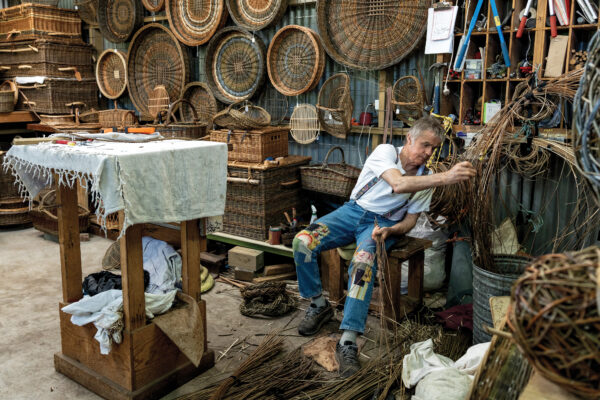
But now, another threat is looming. Purple willow (Salix purpurea) has been planted in New Zealand for over a century. Its flexible, strong branches once made it an important species for basket making. For decades, cloned, “sterile” varieties of purple willow have been planted all around New Zealand for erosion control.
It’s done that job well, and for a long time, Butt tells me, purple willow has “behaved itself” by not spreading. In recent years, though, “something has changed”.
For reasons that no-one can fully explain, at least one purple willow variety is now spreading explosively in Canterbury. And it is spreading by seed, something it theoretically shouldn’t be able to do.
“It’s gone nuts and is filling up our braided rivers at a rapid rate of knots,” says Butt. “It’s frightening.”
Purple willow has become weedy in the Hurunui, the Conway/Piri-tūtae-putaputa, the Waiau Toa/Clarence and a few other major Canterbury rivers. It also poses a major threat to wetlands such as Tārerekautuku.
Cheviot nurseryman and environmental consultant Jamie McFadden has been planting trees, and destroying them, in the North Canterbury region for 30 years. He’s never seen anything that can move at the speed of this purple willow, which he calls a “superweed —crack willow on steroids”.
Unlike crack willow, which clings to the edges of the river, this willow is choking entire riverbeds, locking up their natural gravel movement and swallowing habitat for nesting riverbirds. Now, says McFadden, it’s moving into farmland and pushing up tributaries into native forest. “We don’t know how far this thing’s going to go.”
How this tame willow suddenly went rogue no one knows. Each clone produces all-female or all-male flowers, and they’re deliberately planted out in single-sex blocks. But river engineers aren’t the only people planting purple willow. It’s also been used for decades in private gardens and for basket-weaving. Perhaps a compatible male and female got too close to each other, and pollinators did the rest.
Jones is quick to deflect blame from the cloned erosion army. He believes the willows are most likely spreading from fertile plants that have been planted out for other reasons.
There’s another potential loophole. Globally, at least 18 willow species have been recorded as being sexually fluid, with female flowers occasionally popping up on male trees, and vice versa—a phenomenon thought to be more common in hybrids.
Whatever the case, “it’s very much a ‘sit up and pay attention’ moment for us”, says Greg Stanley, who leads braided-river revival work for Environment Canterbury. He and his team are busy wiping the invaders out as fast as they can, while also trying to understand exactly what they’re dealing with. To Stanley, the “worst-case scenario” is that the willows we so carefully bred and planted out have created their own viable hybrids—in which case, the notion that they’re under control falls over.
David Glenny, a botanist with Manaaki Whenua—Landcare Research, says our grasp of the “weediness of willows” is woefully inadequate. Purple willow, he says, is likely doing something that exotic weeds all around the world do. After many decades quietly getting used to life in New Zealand, it has finally found its feet, in a genetic sense, and come into its own as the invasive weed it was always destined to be.
Glenny loves willows. He and Trevor Jones created the key for willows in New Zealand—the definitive guide to the nearly 60 species and hybrids we have here. Sometimes botanists accuse him of having Stockholm syndrome. “You can’t work on a group of plants without coming to like them, right?” he says. “You just come to be fascinated by them.”
Still, he is concerned at the enthusiasm with which we are filling our rivers with willows. “I think there’s still a lot of planting out of things that shouldn’t be put out,” he says.
He fears a wilful ignorance has crept in, and that we’re not keeping a close enough eye on cloned willows, even as evidence mounts that some are spreading.
“There’s a kind of an unwillingness to accept that what we’ve been doing for so long needs to change in any way,” he tells me.
“We should stop assuming that single-sex clones in New Zealand are safe to propagate.”
The Trust is still producing purple willow hybrids. The troublemakers are also readily available to the public through nurseries.
Last year, DOC added purple willow to its “List of Environmental Weeds.” I ask Jones if that concerns him. “It does when it’s used inappropriately,” he says, “when people are planting female clones where they really shouldn’t be.”
[Chapter Break]
A hot Canterbury nor-wester kicks up dust along the Waimakariri River. I stand with a team of river engineers and biologists and watch the river throwing its weight against a hard stopbank. This is probably the most important front line of river control in New Zealand: on the other side of that stopbank lies the famously flat city of Christchurch, and its international airport.
The Waimakariri wants to wander south or north across its vast floodplain, just as it has for millions of years. But we can’t let it do that now—if it were to break these banks and cut through Christchurch, as it did a number of times prior to 1957, it would do damage estimated to top $5 billion.
Environment Canterbury river engineer Fred Brooks is in charge of making sure that doesn’t happen. “Seven years of anxiety” is how he describes the job so far.
The worst flood he’s seen in that time was in 2021, when the river tested the flood protection scheme here to only around half of its capacity. “Terrifying,” says Brooks. “You’re hearing trees getting ripped up and thrown about. It’s a very aggressive beast.”
Here, on the mighty Waimak, the complexities of our relationship with willow are on full display.
Crack willow makes rivers deeper, faster and meaner, so Brooks and his team are busy destroying those trees in the riverbed, killing them with sprays and tearing them out with heavy machinery. But they also use willows—specially grown “sterile” varieties. They plant them, and also bundle up their branches with steel ropes, anchoring them to concrete blocks on the outside bends of the river to resprout—classic Kiwi willowcraft in action.
Willows form a wide buffer between the Waimak’s first and second stopbanks. The idea is they will slow the river in a big flood, reducing its ability to scour out that crucial second stopbank.
The flood protection scheme here cost $40 million. Upstream, though, the money soon dries up. Brooks pulls out a map and traces the upper reaches of the Ashley River/Rakahuri, which neighbours the Waimakariri—it’s thick with willows, but councils can afford to manage only crucial flashpoints. Individual landowners don’t have a show.
[Chapter Break]
As long as we persist in living on floodplains—farming them, building them up—it’s likely our grandchildren’s grandchildren will still be planting willows, and pulling them out. We’ve forged a relationship with rivers, and willows, that can’t be unstitched.
But perhaps we can learn from the rivers; learn to shift and bend. In vulnerable riverside areas around Canterbury, Greg Stanley and his team are working on what they call “transition berms”.
First, they install willows to hold the gravel still. Then they plant natives such as kōwhai, māhoe and kōhūhū, and help them fend off weeds. Given time, says Stanley, this diverse crew can hold a river.
Getting them started is a much bigger task than plonking in a grid of willow poles. But Stanley tells a story of a healthier future. The willows, which are naturally fragile, age and fall over. Every willow seedling in the area chases the sudden splash of light, but now it’s the native plants—given the head start—that have the edge. They close the canopy. The river is reclaimed.