“Evans is not to be trusted”
A story of bitterness and betrayal at the South Pole.
If we remember anything about Robert Falcon Scott, it is usually his choice of ponies over dogs in his march to the South Pole; his discovery that the Norwegians had beaten him to it; and the harrowing return march that claimed the lives of himself and four other men. Much lesser known is the tumultuous relationship Scott had with his second-in-command, Edward Evans, and the revelation that after the expedition, Scott’s backers suspected Evans of playing a role in his death.
In 2017, the Australian polar researcher Chris Turney dug up some old papers in the British Library that show a remarkable exchange between members of the Royal Geographical Society—talk of Evans being blameworthy for Scott’s shortage of food and fuel, secret enquiries, and the importance of keeping their suspicions hidden from the public and the press. I went to view the documents in London, and was surprised to learn that the captain and his lieutenant had clashed from the very start of their expedition. There was a sense among the other officers that Evans was the wrong man for the job, and his foolhardiness and insubordination were dangerous. Scott and Evans were two very different men, with competing ideas about the whole point of polar exploration.
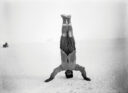
Evans was a swaggering bodybuilder who talked incessantly of promotion and had no interest in science. Scott brought him into the fold as an expedient, to keep the ambitious Evans from launching a competing expedition to the Pole. Almost immediately their differences jarred. Scott saw his expedition as essentially scientific, while Evans blustered about snatching the Pole for Britain. At every opportunity he undermined Scott’s leadership. On the eve of sailing south from New Zealand, he tried to “raise a mutiny”, threatening to resign if certain demands weren’t met.
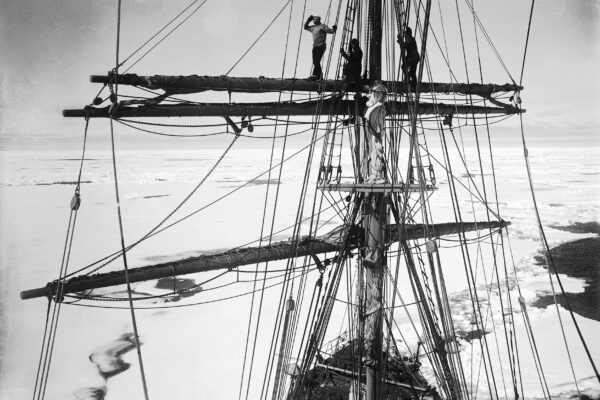
During the rigours of hard sledging and the cloisters of the polar winter, the differences between Scott and Evans became untenable. The other men noticed Evans cadging more than his share of food, wasting fuel, and not pulling his weight while hauling sleds. Scott realised he had made a grave mistake in his choice of second in command. He decided to demote the man and send him home early. Just 160 miles from the South Pole, Evans was told to head back to base and board Terra Nova for New Zealand.
It was a terrible struggle. Two weeks into the six-week trip, Evans became snowblind and had to be led by his companions. A week or so later, he was sick with scurvy. His legs swelled and turned green; the other men strapped him to a sled and hauled him home.
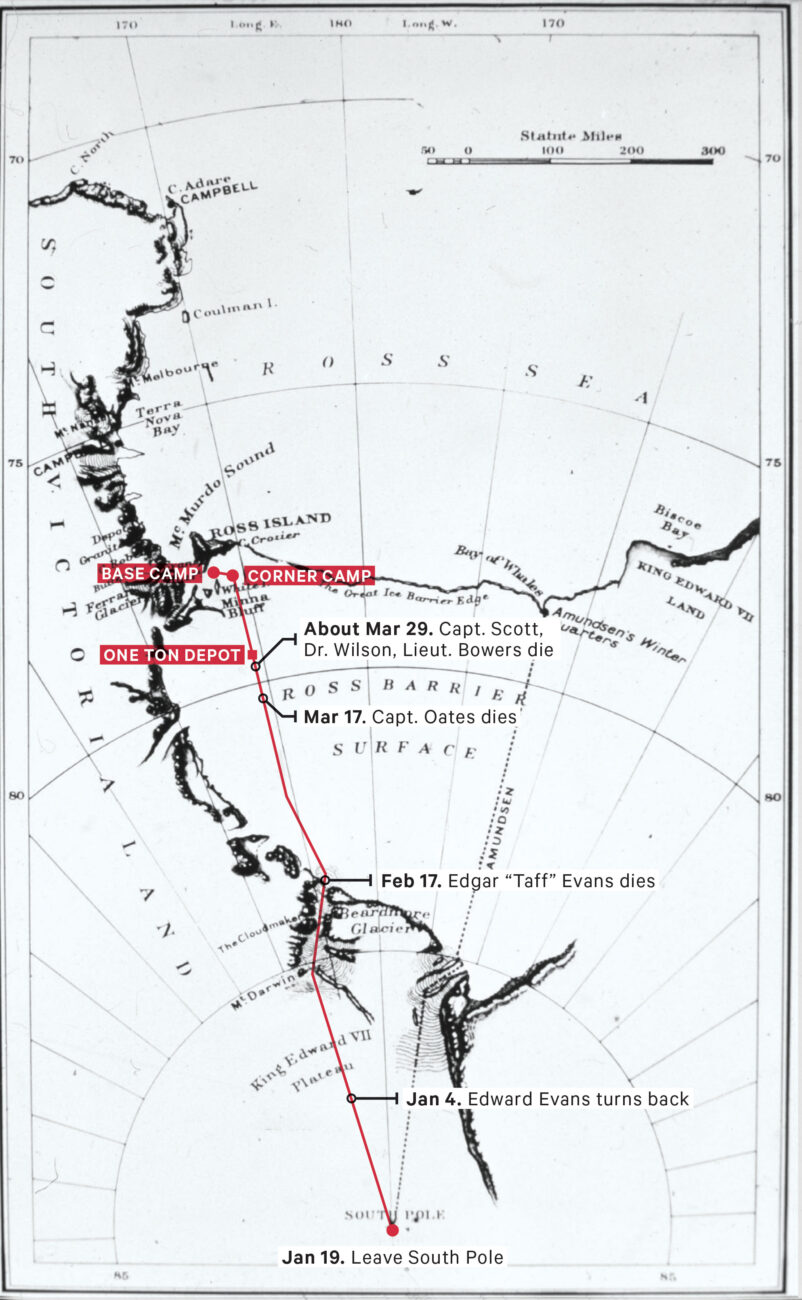
On January 19, while Evans was being led blindly down the Beardmore Glacier, Scott and his four companions were beginning their return journey from the Pole. It was a relief to turn north. Scott found it was warmer and less tiresome to march with the wind at their backs. Sometimes the southerly caught the sail on his sledge and helped it along. But the days were only getting shorter and colder.
Lawrence Oates, a British army officer, was struggling to keep his feet warm, and his nose and cheeks were a dead yellow. Edward Wilson, a doctor and natural historian, was snowblind and regularly dousing his eyes in cocaine. For Petty Officer Edgar Evans, known as “Taff”, the trouble was his face; four days in, Scott was forced to stop the march slightly early when he noticed that the seaman’s nose was white and frostbitten.* Scott and the powerfully built Scotsman Henry “Birdie” Bowers were faring much better, but they were beginning to feel hungry all the time. Their daily Summit Rations consisted of 35 ounces per man of biscuit, pemmican, butter, cocoa, sugar and tea, yielding some 4500 calories. It was the biggest food allowance that Scott had ever brought on a sledging journey, but it still wasn’t enough. In the thin, cold air of the Polar Plateau, Scott and his men were expending far more calories than they were consuming.
On January 24, they had a scare when a blizzard came up, threatening to halt their progress to their first cache of supplies, One and a Half Degree Depot, 16 miles distant. They marched anyway and managed to cover eight miles. They reached the depot the following afternoon, while the gale was still howling, and marched on with their new provisions. The unsettled weather did not augur well, and Oates and Taff were becoming more and more susceptible to frostbite.
They followed their outbound tracks, zig-zagging through the sea of windblown snow dunes called sastrugi, and picking up items accidentally dropped from their outbound sledges: mitts, boots and Oates’s pipe. Now they passed the point where Evans and his team had turned back, and carried on towards Three Degree Depot. They talked constantly about food. The provision bag contained enough rations to see them to the depot, but their lunch meal no longer satisfied them.
They reached the depot on the 31st and picked up their provisions. By now, Taff was no longer his usual cheerful self, making jokes or regaling his tent mates with tales of his misspent youth. His hand was getting worse, the nails beginning to detach from his fingers. Oates’s big toe was turning black, and Scott joined the sick list when, on February 2, he slipped and fell down a slope, jarring his shoulder.
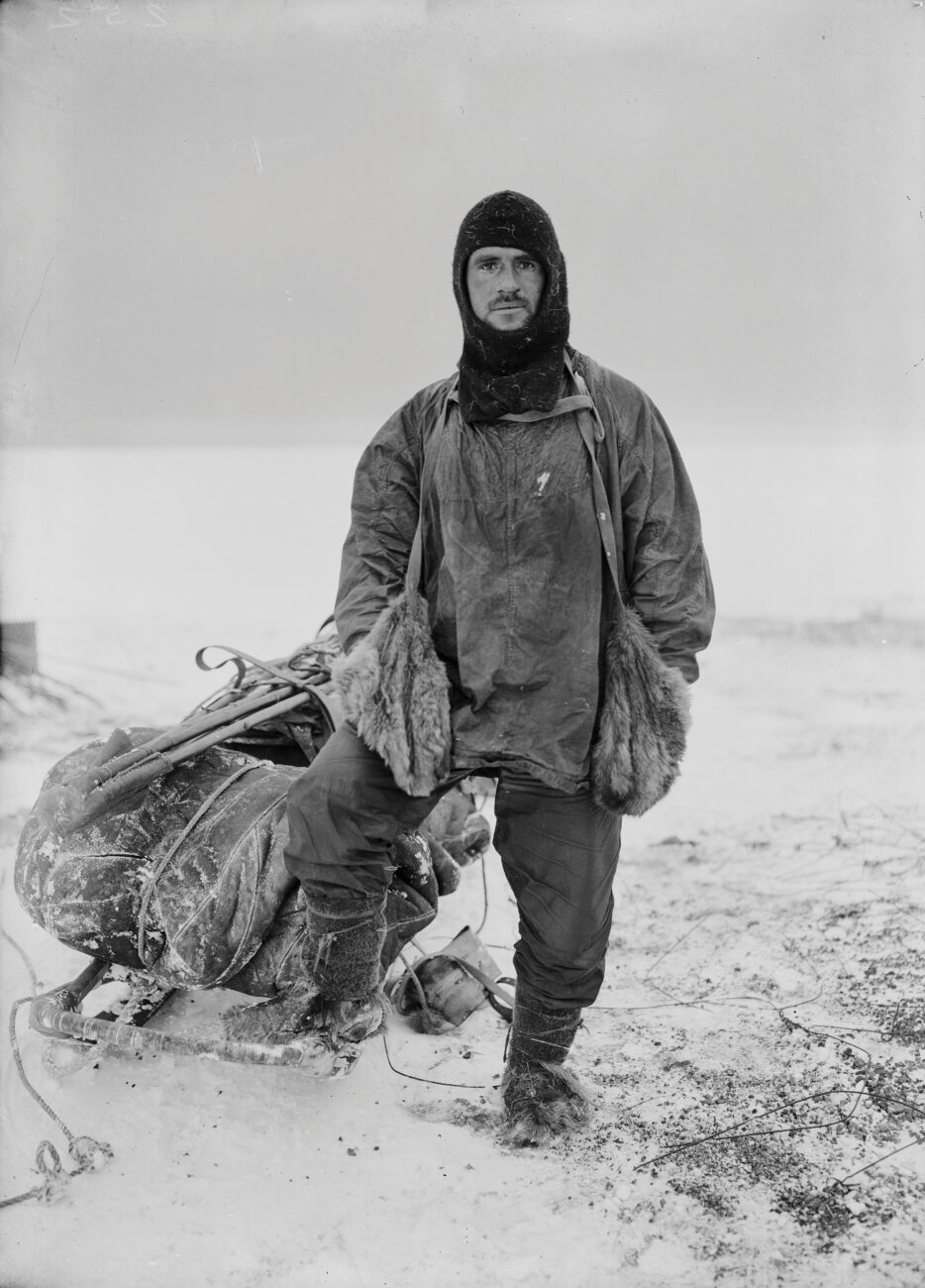
It was time to get off the plateau. They pushed on to the head of the Beardmore, heartened by the sight of the mountain peaks which rose on either side. As they entered the disturbed ice, Taff fell into a crevasse and hit his head before he could be pulled out. It was the last thing the seaman needed: his fingers and nose were already covered in weeping sores. Scott had once considered Taff “the most invaluable asset to our party”, but he had become slow and clumsy, no longer capable of helping with the camp work.
Scott picked through the maze of crevasses at the glacier head as Evans had done. On the morning of February 7, they began their day in a panic. One of the biscuit tins they had picked up at Three Degree Depot was inexplicably short. “Great doubt as to how this has come about, as we certainly haven’t over-issued allowances,” Scott wrote. “The shortage is a full day’s allowance.” That evening, they reached the Upper Glacier Depot and found a note from Evans saying his party had passed through safely.
They glissaded down the glacier: Scott and Bowers leading on ski, Wilson and Oates on foot beside the sledge and braking it in the snow, and the ailing Taff detached from the traces. It was a relief to hit warmer temperatures, and to put their feet on the solid rock which fringed the glacier ice.
There was another scare as they made their way down the Beardmore. Snow and fog closed in around them and, like Evans’ party before them, they became lost in the turmoil of broken ice in the middle of the glacier. On February 13, they had only one small meal of pemmican left in their provision bag as they tried to find a way out of the icefalls. It was an immense relief when Wilson spotted the black flag of the Middle Glacier Depot through the fog. They picked up three and a half days’ food and marched into the afternoon. It had been “the worst experience of the trip and gave a horrid feeling of insecurity”, as Scott recorded. “We mustn’t get into a hole like this again.”
In the morning, Taff revealed a huge blister on his foot. The morning march was delayed as his teammates helped him to adjust the crampons on his feet. They had a fine day with the wind behind them, but covered less than 10 miles, and that night, Scott talked to the team about delays and slackness around the camp. They had three days’ food to cover the 30 miles to the next depot, so they must make 10 miles a day. As cook, Scott was serving a little under full allowance, so that the provisions could be stretched if need be. The weather remained snowy and hazy, and Taff was slowing the party down. Every morning, he would declare that he felt perfectly well and up to the march, but he was clearly done.
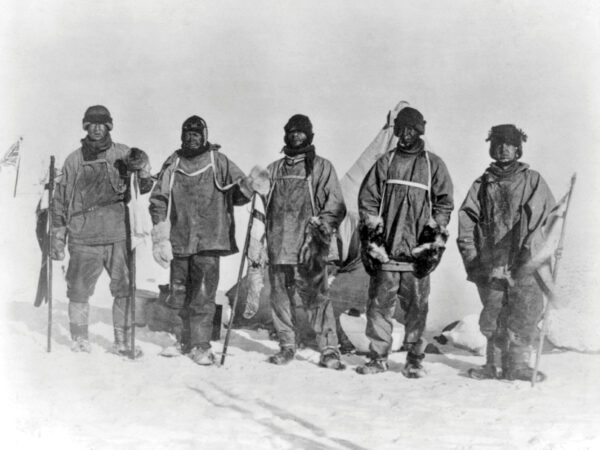
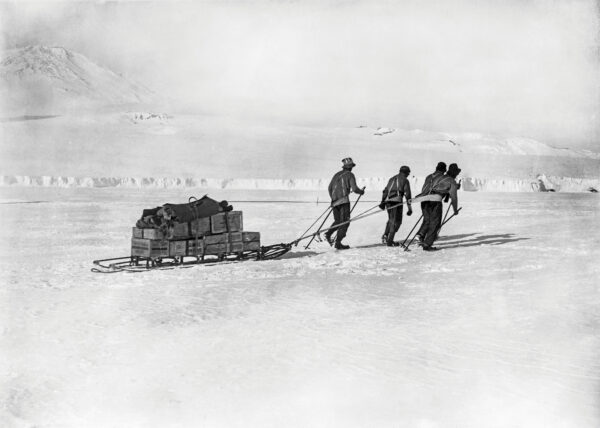
As they pulled on February 17, Taff kept having trouble with his ski shoes. Scott detached him so that he could fix the problem and catch up. Scott, Birdie, Wilson and Oates could see Taff in the distance when they camped for lunch, but after their meal he still hadn’t appeared. “By this time we were alarmed,” Scott wrote. All four turned back, and found Taff on his knees in the snow, his hands uncovered, his speech slow and confused. Taff was unconscious by the time they got him in the tent. Wilson was convinced he must have injured his brain in his crevasse fall at the glacier head. The seaman died at 12.30am. It’s unclear what was done with Taff’s body, but any ceremony must have been brief: the team was at the end of their three days’ food and had to press on to the Lower Glacier Depot, which they reached in the early morning hours. Before them lay the barrier and all its whims of surface and weather.
At Shambles Camp, where the last of the ponies had been slaughtered, they were able to add horseflesh to their evening meal, and on the morrow they dried out their sleeping bags in the sun.
They reached Desolation Camp on February 20 and found it mysteriously lacking in pony meat. A pony, Michael, had been killed and butchered here, but there was no sign of the polar party’s share.
Several support parties had passed through this camp before Scott, most recently that of Evans, and Scott was relying on them to have left enough food cached for his own party. This was the second time the depots had come up short.
They managed eight and a half miles the next day; not a sufficient pace to reach Hut Point before the end of March. Temporarily they veered off course, missing the cairns and pony camps they had expected to see. But on February 23, they picked up the cairns again, and during the next morning’s march they reached the Southern Barrier Depot. Rifling through the provisions, they were concerned to find a shortage of paraffin. “Shall have to be very saving with fuel,” Scott noted. The customary note from Evans was not as cheerful as usual, saying he had encountered a bad surface and high temperatures at this stage of his journey. The note seemed shot through with anxiety and offered no explanation for the missing fuel.
At any rate, the polar party had 10 full days’ food to see them the 70 miles to the next depot. They managed two consecutive 13-mile marches, then a 14-mile day, the mountains receding behind them. But their fuel was “woefully short” and wintry temperatures were setting in.
By now they were looking forward to meeting Cecil Meares and his dogs. In October, Scott had ordered Meares to come and meet him with food and fuel in latitude 82 or 82.30, around March 1, to “hasten the return of the third Southern unit and give it a chance to catch the ship”.
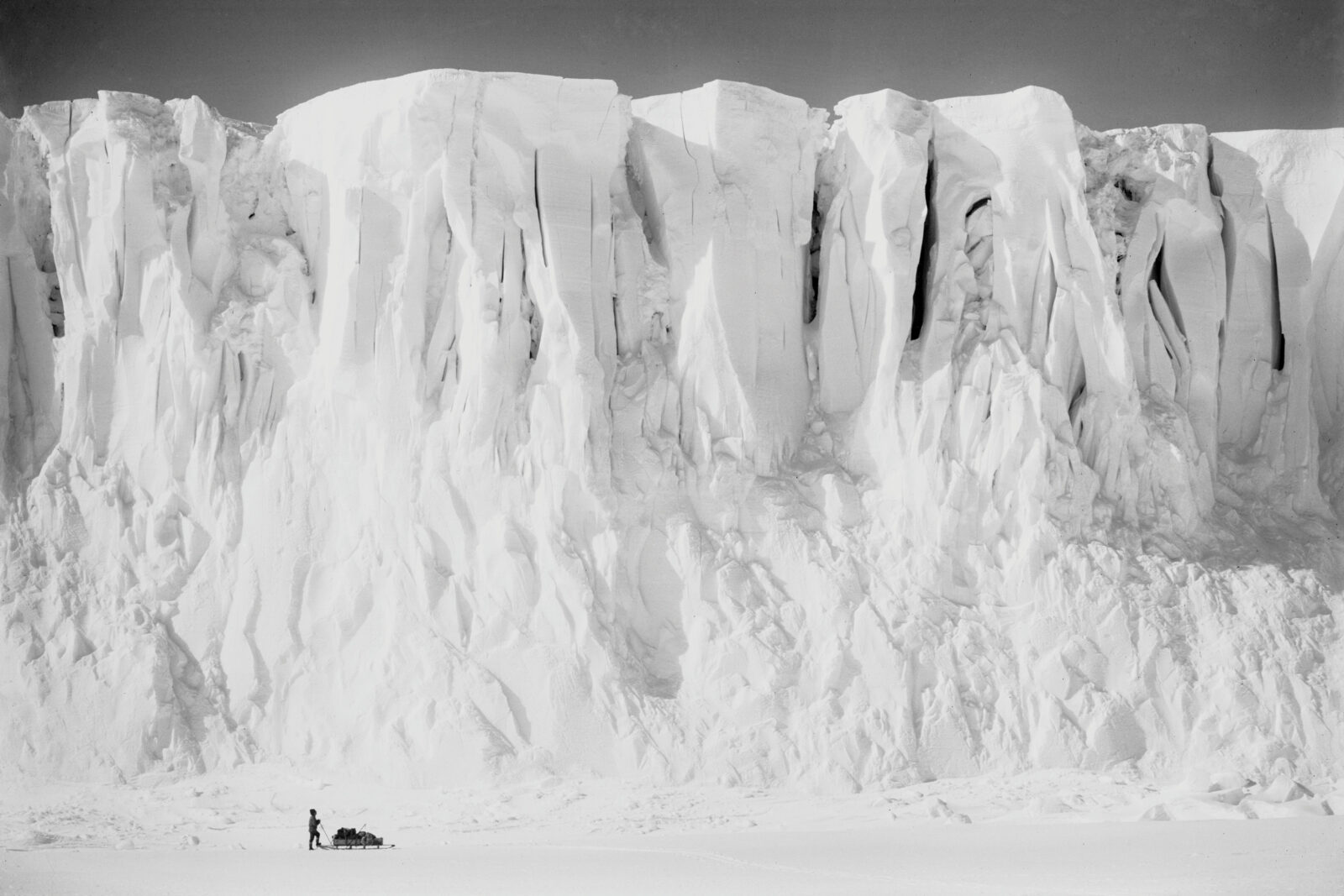
It was February 27, and Scott was right on schedule, and in line with the trail of cairns and snow walls that led all the way to the barrier edge. He was at latitude 82.15, roughly 35 miles south of the Middle Barrier Depot. Given the date and his position, Scott eagerly scanned the horizon for the little black dots which might resolve into dogs in harness. It was a frightening game he was playing. The window of sledging weather on the barrier was closing fast. To beat the weather, the polar party had to make long, hard marches, further weakening their cold and calorie-starved bodies. There was some fine threshold the party would cross where they would no longer have the strength to get off the barrier under their own power. Perhaps they had already crossed it. Meares was becoming their best hope of survival, and yet there was no sign of him.
That night, the temperature fell below -40°C. After supper, Wilson carefully dressed Oates’s feet, now a nightly ritual. The Soldier (as he was nicknamed) had pushed his body beyond its limits. His feet had been deteriorating for months—he said in a letter to his mother that they had been wet ever since he left Cape Evans—but for much of the journey he had kept the trouble to himself.
Wilson and Bowers had both ceased writing in their diaries, probably to conserve energy and warmth. The best policy was to climb straight into their sleeping bags after supper. Scott’s own diary entries were running shorter, and he had taken to writing only at lunchtime. It was too difficult to write at night; the pencil slipped on the icy film created by his breath, apart from the need to constantly restore the circulation to his bare fingers.
On the afternoon of March 1, they staggered up to the black flag over the Middle Barrier Depot and found another shortage of oil: half a gallon instead of the gallon expected. Even with the most sparing use, that amount would barely see them to the next depot. And there was still no sign of Meares and the dogs.
It was another night below -40°C. In the morning, it took them an hour and a half to work their feet into their reindeer-hide finnesko.
Early March found them hauling over a surface of woolly ice crystals which caused friction on the sledge runners and made progress disturbingly slow. The cold snap continued. They were on full rations—they could not afford to go hungry in the cold—and had enough food to see them to the Mount Hooper Depot, but their fuel was nearly exhausted. The Soldier’s spirit was waning as he experienced terrible pain in his feet, which were turning gangrenous. The smell of decomposing tissue would have filled the tent as Wilson tended to Oates. The doctor was putting his own health at risk; he was baring his hands and working when he should have been keeping warm.
Oates limped along beside the sledge, and when the party stopped to look for tracks, he sat quietly resting. It was an awful thing to consider, but like Taff before him, Oates was becoming a drag on the party. They lost precious time waiting for him in the mornings while he wrestled with his footgear. Scott noted the others were outwardly cheerful and talked of all sorts of subjects in the tent. Wilson and Bowers were both staunch optimists—it was difficult to know what they really thought.
“Providence to our aid!” Scott wrote on March 4. “We can expect little more from man now except the possibility of extra food at the next depot. A poor one. It will be real bad if we get there and find the same shortage of oil.”
“Regret to say going from bad to worse,” ran his diary the next day. “Our fuel dreadfully low and the poor Soldier nearly done.”
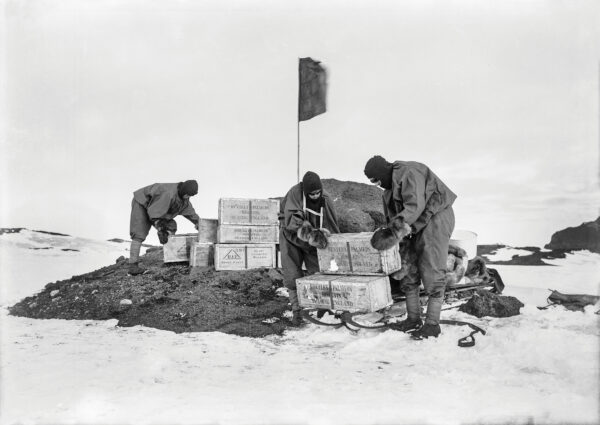
As they neared Mount Hooper, covering less than a mile an hour, the shortages at the depots weighed on Scott. He was relying on the consideration of his aggrieved lieutenant, Evans. He prayed that the next depot would hold “the correct proportion of food”, and an ample supply of fuel. He reached Mount Hooper on March 9 and was devastated to find “Cold comfort. Shortage on our allowance all round. I don’t know that anyone is to blame but generosity and thoughtfulness have not been abundant.”
The party was now well past the latitude and date at which Meares had been ordered to meet them. “The dogs which would have been our salvation have evidently failed,” Scott wrote. “It is a miserable jumble.”
Next day, they could only march for half an hour before a gale halted them. They spent the rest of the day in their tent. The Soldier, his face jaundiced and the light gone from his eyes, earnestly asked Wilson if he had a chance, and the doctor had to say he didn’t know. “In point of fact he has none,” Scott wrote frankly. It was obvious that Oates was near the end.
In the morning, the wind had fallen enough to allow a march. After breakfast, Oates asked Scott for advice, and the chief could only urge him to march for as long as he possibly could. Then he ordered a reluctant Wilson to hand over the means for ending their lives, if it came to that. The doctor doled out 30 opium tablets apiece from the medicine case and kept a tube of morphine for himself.
They managed eight miles for the day, but according to Scott’s calculations they would not reach One Ton Depot before running out of food.
On March 14, they awoke to a strong northerly wind in their faces and a temperature down to almost -40°C. It was all they could do to eke out six miles, and it took them a long time to make camp and prepare supper. It had fallen to Scott and Bowers to do the camp work: Oates’s hands and feet were useless; Wilson, too, was feeling the cold, and took a long time to get off his skis.
Scott’s diary now fell silent for several days. When he took up his pencil again on the 16th or 17th (he was unsure, but thought the 17th correct), it was to relate the loss of another member of his party.
After lunch on the 15th the Soldier had said he could not go on and asked to be left behind in his sleeping bag, but the others refused. He struggled on and they made a few miles in the afternoon. That night, Oates asked Wilson to send his diary to his mother and write a letter on his behalf. Wilson said he would be happy to. Oates slept, and woke on the morning of the 16th to find the canvas shuddering in a blizzard wind. He said, “I am just going outside and may be some time.” Scott, Wilson and Bowers tried to dissuade him, but the Soldier had made up his mind.
Within a matter of minutes, Oates must have lost consciousness and become entombed in the drift. His comrades remained in the tent all day, waiting out the weather and knowing they would never see him again. “We all hope to meet the end with a similar spirit,” Scott reflected, “and assuredly the end is not far.”
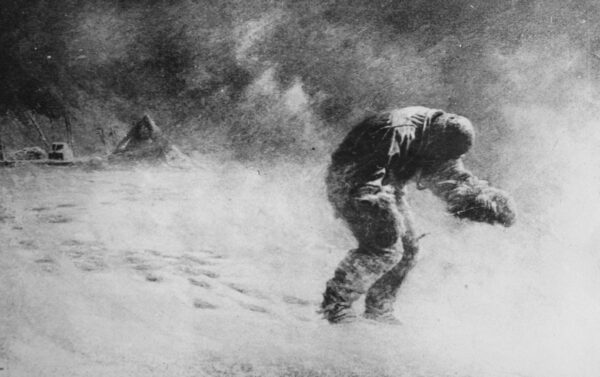
At lunch on March 19, they were 15.5 miles from One Ton Depot and Scott thought they should get there in three days. But they had only two days’ food and barely a day’s fuel. To conserve the dwindling paraffin, they had taken to eating their suppers cold and using a tiny quantity of spirit in a makeshift lamp to heat up their cocoa. For the past two days they had talked confidently of pulling through, but Scott wondered whether anyone believed it.
Along with the problem of fuel was their deteriorating physical condition, which they were forced to ignore as they plodded on.
Only two days earlier, Scott had been the “proud possessor of best feet”—now all the toes on his right foot were beyond help, and the best he could hope for was amputation. That day, the wind was still blowing from the north, the temperature -40°C. Still they managed to march to within 12.5 miles of the depot.
Next day, Scott did not write in his diary. The party was laid up in a blizzard. A gale blew furiously from the south-west, and the tent was surrounded in whirling drift. The canvas shook as though in the grip of some vindictive animal.
The party used the last of their oil to make cups of tea, and to cook their last hot meal.
Wilson and Bowers made plans for a last-ditch march to the depot to obtain more fuel (Scott could barely walk on his frostbitten foot), but the blizzard kept them in the tent. They managed to stretch the food allowance across March 21 and 22, eating it cold, and then the provisions were no more.
On the 23rd, when Scott could get his fingers to work, he was hunched over a sheaf of farewell letters. Writing bravely on a forlorn hope—there was no knowing whether the expedition would find his grave, let alone his letters—he squared himself away with his family, friends and supporters, and the public at large. He wished for the happiness of Kathleen and Peter—he hoped his wife would remarry, that his boy would be interested in natural history—and mustered what religious feeling he could to console his mother. He emphasised the courage and endurance of his companions, and said he did not “regret this journey, which shows that Englishmen can endure hardships, help one another, and meet death with as great a fortitude as ever in the past”.
“My thoughts have been with you often,” he wrote to his friend and agent in Christchurch, Joseph Kinsey. “You have been a brick—you will pull the expedition together I’m sure.” Then, realising with dread that it would be Evans who took command of the expedition in his absence, he added: “Teddy Evans is not to be trusted over much though he means well.”
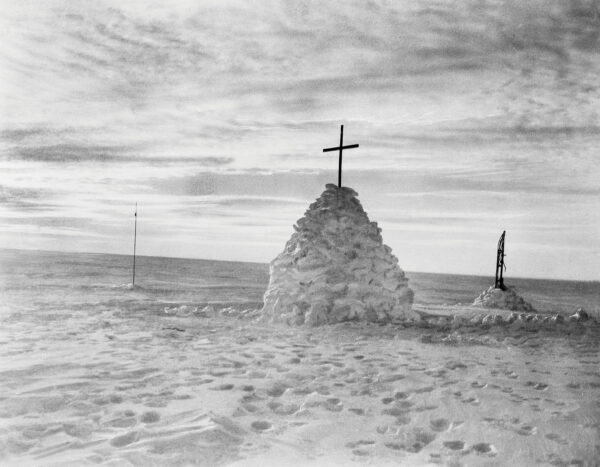
Every morning, Wilson and Birdie were ready to march the last 12.5 miles to One Ton Depot, but even when the blizzard ceased they could not bring themselves to abandon Scott. It was nine days later—nine days without fuel, with only spare rations of cold food—that Scott made the final entry in his diary. Much of the time he must have been sealed in his sleeping bag in a state of half-consciousness.
“I do not think we can hope for better things now,” ran his large scrawl on March 29. “We shall stick it out to the end, but we are getting weaker, of course, and the end cannot be far. It seems a pity, but I do not think I can write more. R. Scott.”
An indefinite amount of time later, perhaps after Bowers and Wilson had already passed, Scott did manage to write a final sentence: “For God’s sake look after our people.” In death’s approaches he made one last struggle, throwing open the flaps of his sleeping bag and opening his coat. His arm fell across Wilson’s sleeping form.
Postscript: An alarming casualness descended on the base camp in Scott’s absence. Evans, bedridden after his own trip back, had forbidden any search parties, including Meares and the dogs, from going out to meet the captain. Evans and his comrades survived to carry the shocking news back to New Zealand on Terra Nova—some with more guilt on their conscience than others.