World building: The story of kōura
Crayfish are the great creators and cleanup crew of their freshwater homes. They burrow into banks, unstick gummy sediment, and deal with anything that ends up dead in the water. Plus, they’re delicious. Hundreds of years ago Māori spread these tasty all-rounders from place to place. Can doing the same now help save the species?
It’s a superhighway,” says Riki Parata, over the roar of water pounding concrete. “It sustained a culture.”
Most of Southland knows this spot as Mataura Falls. To Parata, it’s Te Au Nui Pihapiha Kanakana. He has brought me here to feel the power of the awa his ancestors knew, to imagine their lives alongside this river that once ran thick with tuna, eels, and kanakana, lampreys.
He invites me to envision the wetlands, clogged with bird and fish life, that once stretched across these plains—all now green grass, dairy sheds, cows and mud.
Moving with the seasons, Parata’s Ngāti Māmoe, Ngāi Tahu and Waitaha ancestors followed the river to the coast in waka, gathering food from the sea and the tītī/muttonbird islands. And they followed the river inland, linking up with ara tawhito—traditional pathways that mapped centuries-old networks of trade into the forbidden interior.
The tīpuna hunted weka and wildfowl from the high-country lakes of Central Otago and navigated treacherous mountain passes to collect pounamu on the West Coast, lugging their heavy loads home along those same routes.
Wherever they went, they carried living plants and animals, rehoming them as a resource for future travels. Harakeke, bullrushes and cabbage tree provided the raw materials the people needed to stay alive in that brutal landscape.
And tucked into shouldered kete, kept alive on nests of wetted bracken fern, were kōura, freshwater crayfish, to be deposited in streams and ponds along the way as a source of food.
Just like the people who carried them, kōura would shape the new environments they found themselves in.
[Chapter Break]
In a freshwater ecosystem, crayfish are both crowd control and cleanup crew.
They hunt smaller creatures like fish, snails and insect larvae, keeping populations in check and maintaining balance in the food chain. As scavengers, they clean up organic matter sifting off the land and swarm the waterlogged carcasses of dead animals, helping decompose them.
The rising of the Southern Alps over 12 million years shook kōura into two species—the southern kōura, found in the southeastern part of the South Island and on Rakiura, and a northern species found in the North Island, Marlborough, Nelson and the West Coast.
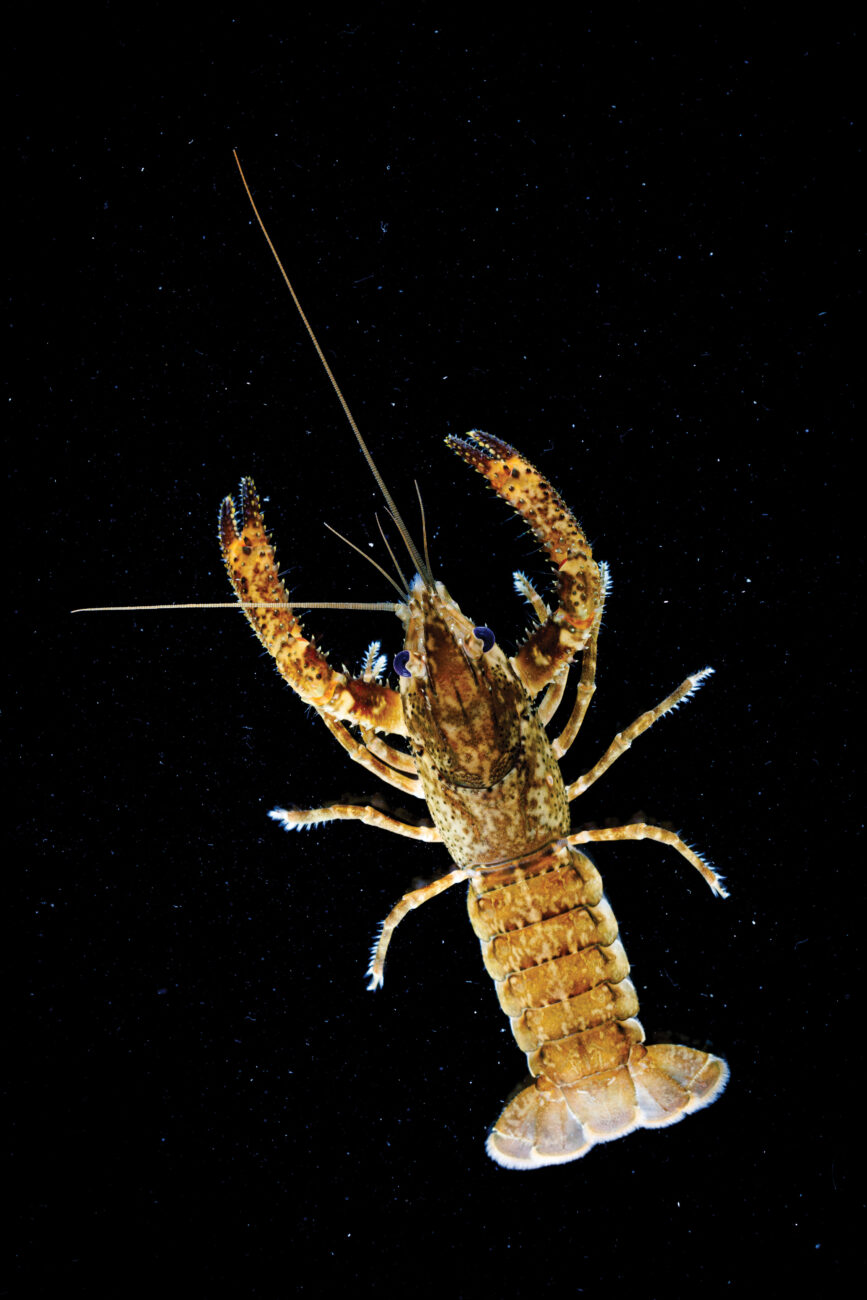
Then came an Ice Age. Glaciers filled mountain valleys. Some kōura survived, staying out of reach in lowland areas. But when the ice retreated, they were unable to recolonise the rugged heart of Te Waipounamu—moving upstream is not one of their strengths. So as a rule, there are no crayfish deep in the Southern Alps.
Except, in places, there are. A single, isolated stream in Te Awa Whakatipu/the Dart River has kōura—to anyone’s knowledge, they’re the only crays in the entire Kawarau catchment. There are also outlier populations of crayfish in South Westland and Fiordland. Up north, there is a strange, lone population on the East Cape.
How did they get there? People. It’s both the most plausible explanation, and a story kept alive for many generations, Parata tells me. There is even a theory that all the kōura on the West Coast are descended from crayfish carried over the Alps.
For Māori, shifting kōura around was about more than shoring up the food supply; it was part of kaitiakitanga, stewardship of the land and the species they shared it with. When, for example, Māori found waterways that had been overfished or cleaned out by a flood, they’d top them up again with kōura from elsewhere in the catchment.
Channell Thoms (Ngāi Tahu, Ngāi Tūhoe, Ngāti Kahungunu), a freshwater ecologist with Environment Canterbury, researched kōura for her master’s thesis, recording many hours of kōrero from elders about the old ways of managing kōura.
“We did set up these places where we did move things around,” she says. “From a mātauranga perspective, we are one of the organisms in the environment. We are not observers of the ecosystem, we’re part of it.”
But Māori, of course, weren’t the only ones with a taste for the sweet, succulent flesh of crayfish. And they weren’t the only ones who shifted them around.
[Chapter Break]
Photographer Richard Robinson and I follow Terressa Shandley Kollat deep into regenerating forest on the Longwood range, near Colac Bay in Southland. Once, 500 Chinese gold miners lived here, in a village complete with opium dens, gambling parlours and boarding houses. The bush has reclaimed it all.
Abandoned mine shafts plunge to mossy voids, while water races chuckle beneath broadleaf and silver beech. A place of peace and plenty, this is one of Kollat’s favourite spots to gather kōura, or kēwai as she knows them (another of the old, resurgent Māori names is kēkēwai).
Kollat, whose Māori roots lie with the Ngāti Porou people of East Cape and with Ngāpuhi in Northland, has been collecting kōura all her life, ever since she was a child growing up on the remote lighthouses her parents maintained (page 26).
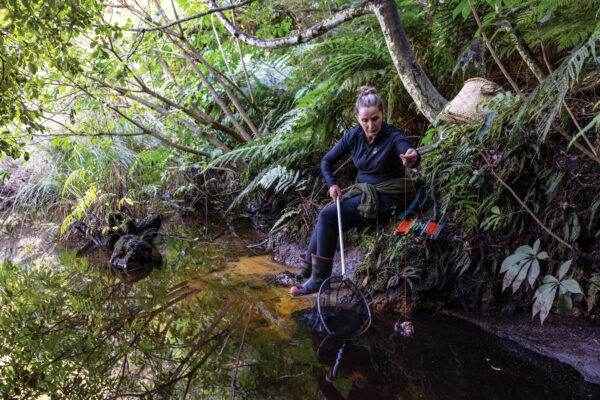
When we reach her preferred fishing spot, a tea-dark pond ringed with trees, we crouch on the bank and lower chunks of venison from a hind she shot into the still water. Hunting, says Kollat, is all about understanding your quarry.
“If you know their habitat and feeding preferences, you’re halfway there.”
Soon, the meat is bristling with crayfish. Kollat gently lifts it from the water and lets the clinging kōura drop into her bucket. She immediately returns one to the water—the first catch always goes back.
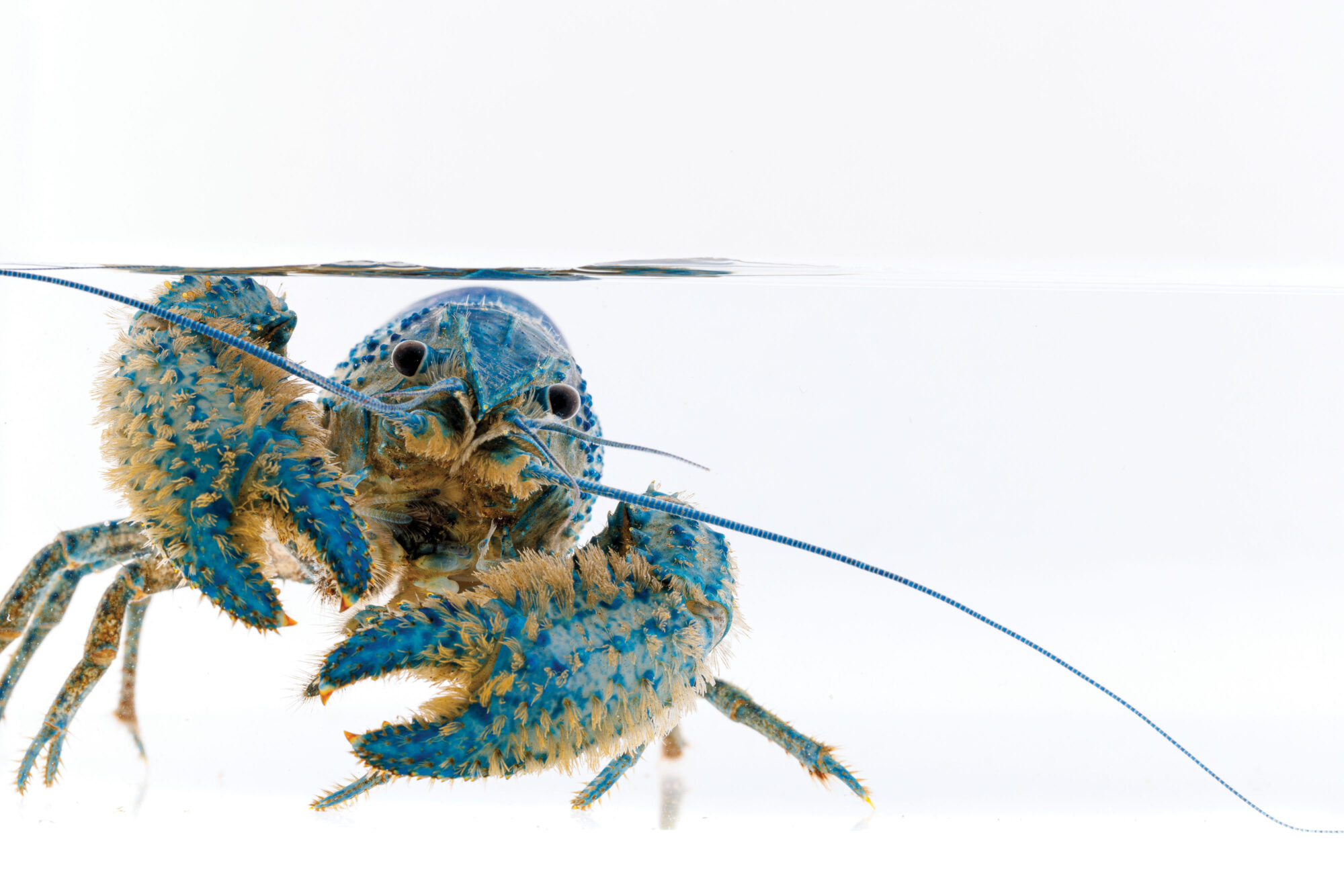
She passes me one of the kōura for a closer look. Its pincers are covered in fine hair, a woolly coat worn only by the southern species. Its antennae are two wandering probes, twitchy and reactive with crustacean intelligence. Black eyes top a thorny maw. Underneath, the animal is a jumble of plates and segments—an armoured knight of the Permian swamp, both alien and endearing (see sidebar, page 43).
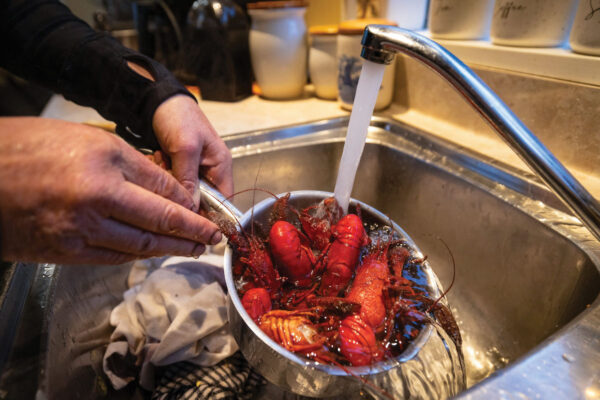
The bush deepens with the late afternoon. Birdsong peals through the branches as Kollat pulls up more kōura. After an hour, we have enough for a meal. Kollat throws the rest of the venison into the pond, to feed the crayfish left behind.
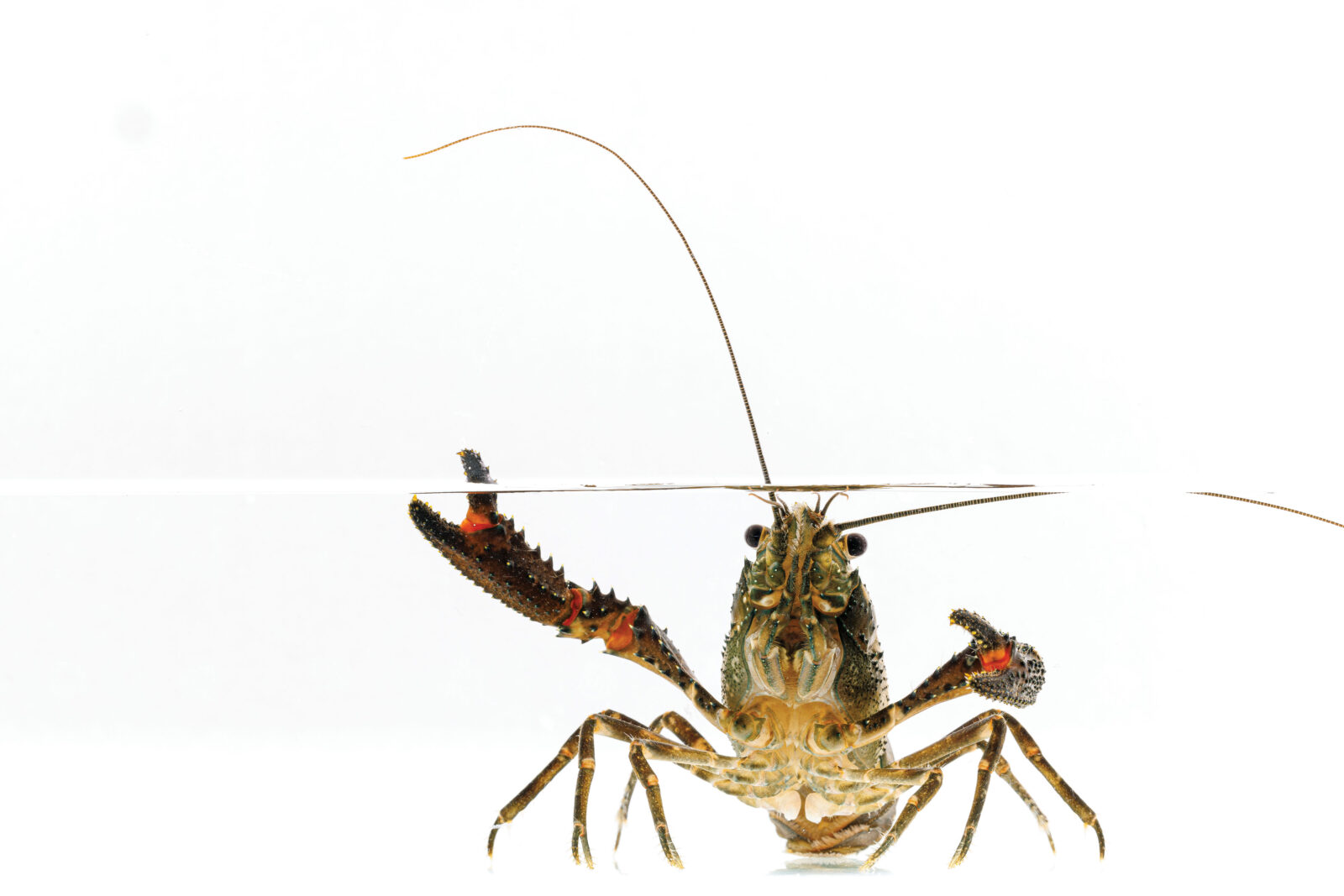
As we walk back through the bush, Kollat tells me the miners almost certainly moved crayfish around this area, stocking races and ponds near their settlement. Anecdotally, it’s a common, albeit illegal, practice to this day—hunters occasionally tip buckets of live kōura into waterways at their favourite hunting spots.
Researchers are now beginning to see genetic evidence for these movements. Recently a group led by Aisling Rayne, who was a PhD student with the University of Canterbury at the time, sampled DNA from kōura across the southeast of New Zealand.
A population of kōura in Canterbury were genetically “very closely connected” to others hundreds of kilometres away in Otago. Rayne found similar links in Southland, between waterways so disconnected and far apart “it is very unlikely [the kōura] got there by themselves”, she says. The movements appear to be relatively recent—perhaps facilitated by hunters or fishers.
[Chapter Break]
The Te Arawa people of the Rotorua region have a long tradition of shifting species, going right back to their ancestor Hatupatu, who was well known for transplanting tree saplings around the place.
Hatupatu also moved tuna, or eels, and once reportedly attempted to bring 70 tāmure, or snapper, from the sea to Rotorua. (Only one survived the journey and not surprisingly, it expired soon after being released into the fresh water.)
Te Arawa people likely brought kōura to the region’s 18 lakes, too, as any crayfish here would have died when the massive Taupō eruption of 250 AD blanketed much of the North Island in ash.
The featureless lake floors of Rotorua, Rotoiti and Tarawera provided little shelter for kōura, so there, the creatures adapted—living out in the open, but using the darkness of the deeper waters as shelter from birds, particularly shags, which would dive down to eat them.
At night, under the cover of darkness, they ventured into the shallows to feed.
Te Arawa hapū harvested crayfish by dredging and diving for them, but their favoured method, called tau kōura, involved stringing bundles of bracken fern onto supplejack lines and lowering the bristly bundles to the lakebed.
The bracken provided refuge for kōura, so when the fishers pulled the bundles up, they would usually be covered with crayfish. At the industry’s peak, thousands of tau kōura lines stretched into Rotorua and surrounding lakes.
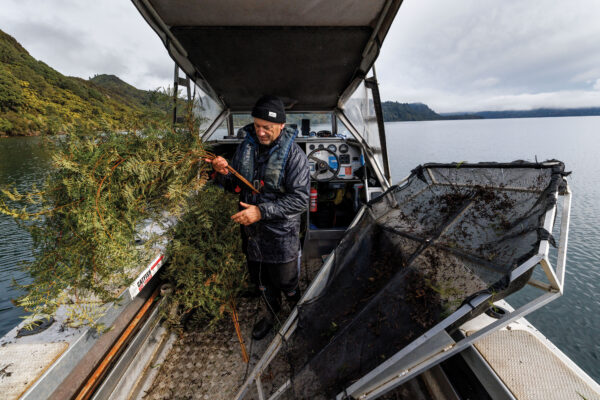
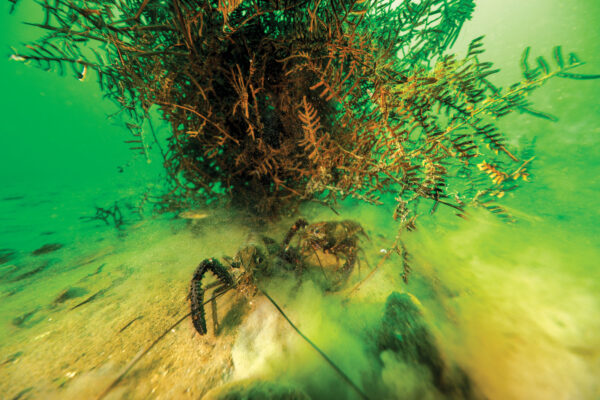
Rotorua, says freshwater biologist Ian Kusabs (Te Arawa, Ngāti Tuwharetoa, Ngāti Maru), “was one massive kōura farm”. Fishing grounds within the lakes were fiercely guarded, and the punishment for trespassing on one could be death.
But when trout arrived with Pākehā they had a taste for crays. And as settlers felled the forests, boaties ferrying logs across the lakes lost patience with dodging the long fishing lines. The invasion of oxygen weed, which snagged the lines, was the final death knell for the industry. Disconnected from their fishery, Te Arawa people quickly began to lose these ancient skills. By the turn of the 21st century, the knowledge of tau kōura was retained by just a few whānau of the Te Arawa-descended Ngāti Pikiao iwi.
[Chapter Break]
Twenty years ago, Kusabs started working with the National Institute of Water and Atmospheric Research to investigate the plight of kōura in these lakes. First question: how many were left?
Catching kōura to answer this question, however, proved difficult. “We went out and tried all the different Western methods,” says Kusabs. Scuba diving, trapping—“none of them were much chop, really.”
Then an uncle of his said, “‘Why not try the tau kōura method?’” A highly respected kaumatua called Willie Emery was still using the technique at Rotoiti.
Kusabs paid a visit. “Willie and them had come up with sunken tau kōura,” he says. “They were using old powerline wires, which sink to the bottom, and they had a tyre filled with concrete at the back.”
With the iwi’s backing, Kusabs adapted the techniques to start monitoring crayfish in the lakes. That meant they already had a good baseline of data when, a bit over a decade later, catastrophe struck.
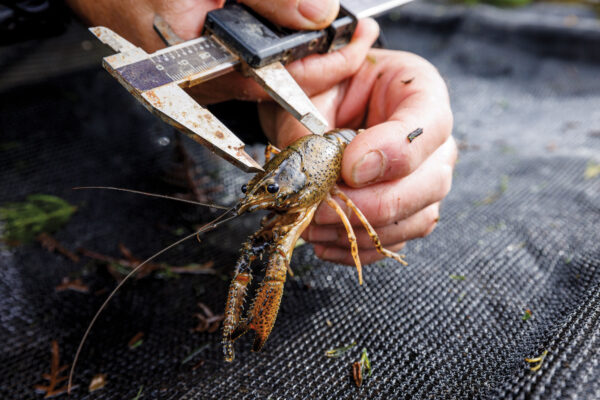
Brown bullhead catfish, native to North America, were first found in Rotoiti in 2016 and Rotorua in 2018. Netting campaigns now haul in tens of thousands of these predators from the lakes; eradication is off the table. They are rapacious devourers of kōura.
And increasingly, the crays are easy pickings—declining water quality is resulting in less oxygen in the deep, safer water. Kōura are forced into the shallows where, as Kusabs puts it, “the catfish just hoover them up”.
“They’ve got a lot of things hammering them now.”
Since the arrival of catfish, Kusabs and his colleagues calculated, kōura have declined by as much as 99 per cent in Rotoiti and 85 per cent in Lake Rotorua.
Kusabs now spearheads efforts to restore water quality and kōura habitat here. He’s also sharing the tau kōura skills with hapū, community groups and schools throughout New Zealand.
Kōura are highly sensitive to chemical pollution, and I’m told they have vanished from many waterways around Aotearoa.
“They’re just holding on,” says Jack Mathieson (Ngāi Tahu), a freshwater ecologist with the Otago Regional Council. “They like shaded streams with lots of overhanging vegetation, and pools and runs and riffles.
“But the second you head out into open farmland that’s grazed right to the edge, and where rivers have been straightened, you lose that habitat.”
Crayfish like to burrow into riverbanks. But where vegetation has been removed, and cattle graze to the stream edge, banks are collapsing, spilling tonnes of fine sediment into the water. Sediment destroys habitat and lowers oxygen levels in the water.
Kōura, like every other freshwater taonga, are right up against it. Could tapping into ancient Māori knowledge be the key to saving them?
[Chapter Break]
Mataura Falls is a place of deep sadness. Dynamited in the 1800s, the river here is a fraction of its former width, wedged between two enormous industrial buildings—a freezing works and a decommissioned, Dickensian, paper mill.
Once, kilometre-long schools of kanakana spilled up the river towards their breeding grounds. For weeks, the falls writhed with the eel-like lampreys, and Māori travelled overland from as far away as Kaiapoi to gather them.
The Mataura is now one of the most degraded rivers in New Zealand. There are not enough kanakana to sustain any kind of harvest. Tuna, too, have suffered, along with kōura, kākahi, kōkopu, and the entire freshwater ecosystem.
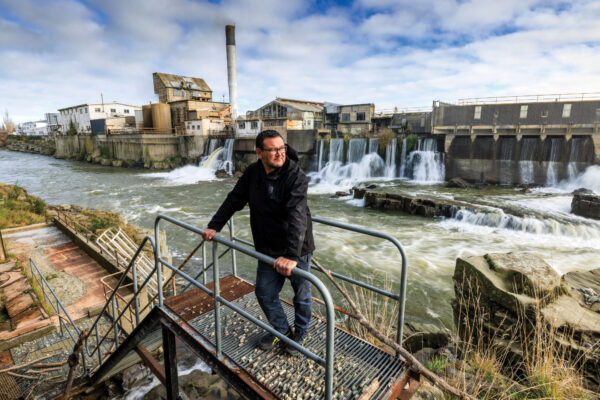
This year, with cameras mounted on the falls’ rusting steelwork, Riki Parata and his Hokonui whānau hope to intercept a few kanakana when they appear on the falls. (During the kanakana run, someone will sit down daily to review hours of footage, but the rūnanga are developing artificial intelligence they hope will soon do the job for them.)
Any kanakana they catch will be kept alive in tanks back at the rūnanga office. The plan is to breed the fish, then take juveniles to tributaries of this river, in the hope the pheromones they produce will attract more adults up from the sea. It’s a technique the team learned from the Yakama Nation people of North America on a recent visit there.
The rūnanga are also experimenting with farming kōura in specially dug ponds—for eating, but also, perhaps, for translocating throughout the Mataura catchment.
Parata is adamant his generation will not stand by while precious freshwater taonga disappear from their waterways. “We know our people traditionally moved species,” says Parata. “So what we’re doing now is a modern-day form of it.”
But doing so, legally, hasn’t been easy. The process of getting a permit to move any freshwater species is expensive, arduous and difficult to navigate. “It’s really frustrating,” says Parata, “especially when you know people are just doing it anyway.”
For iwi, translocation is about more than just restoring fishing sites to productivity. It’s also about reconnecting with their traditional culture. For many hapū, restoring mahinga kai sites is a crucial step towards rebuilding their connection with the land and rekindling ancient skills among young people.
Jane Kitson (Ngāi Tahu, Ngāti Māmoe, Waitaha) is part of another group working to restore kōura to a traditional mahinga kai site in Southland. “It requires a lot of permitting,” she says—from the Ministry for Primary Industries (MPI) and from the Department of Conservation (DOC). “And that particular system has been underfunded for ages.”
Kitson would like to see the responsibility for managing translocations passed back to iwi who, she points out, have been successfully managing ecosystems in Aotearoa for hundreds of years.
“Mātauranga is often talked about as being historic or ‘in the past’,” she says. “But it’s actually a way of knowing currently and is adaptive, and changes over time.”
Iwi, Kitson points out, already control permitting for many customary sea fisheries and for the annual tītī harvest, just as they have for hundreds of years.
“We’ve been administrators for a very long time.”
[Chapter Break]
Māori have long understood the dangers, as well as the benefits, of translocation. While kōura and a few other food species were frequently translocated, mixing the whakapapa of species from one waterway to another is, in general, frowned upon, just as artificially mixing water from separate freshwater bodies is considered to harm the unique mauri, or life force, of those waterways.
Modern laws aim to prevent disastrous introductions of invasive species, but they can’t block everything. In 2023, super-invasive gold clams were discovered in the Waikato river—uncontrolled, they would wreak a watery havoc. Meanwhile, Ian Kusabs lies awake at night worrying about the possibility of catfish escaping Rotorua and Rotoiti into other lakes in the region.
The threat of foreign crayfish species getting established in New Zealand is equally chilling. Invasive crayfish from North America and Australia have infiltrated waterways throughout Europe and Africa, overturning entire ecosystems, and while our remoteness provides some security against that, there is a frightening precedent.
In 1986, a Warkworth farmer was granted permission to farm more than half a million marron, a West Australian crayfish species that grows to more than two kilograms. In 1990, the farm was shut down and all the crayfish destroyed. Or were they?
In 2005, a boy wandering through West Auckland discovered a live marron on the footpath outside a disused petrol station. A subsequent investigation led to the Kaipara heads, where officials discovered more than 500 marron being illegally farmed in a large pond.
The idea that there might be more marron out there in the backblocks of Northland is enough to give freshwater biologists the cold sweats. Then there’s the spectre of disease: one in particular—the crayfish plague carried by invasive American crayfish—has driven a number of native European species almost to extinction. According to MPI, the arrival of crayfish plague here would be “Armageddon” to kōura.
Scientific ethics also come into play when moving animals around. For example: do we strive to maintain the genetic integrity of kōura populations, or, in the face of a highly degraded environment, instead look to build resilience by expanding diversity?
Tammy Steeves is a conservation geneticist with the University of Canterbury who has extensively studied the science of translocation. She points out that when a species or population is on the brink of collapse, choosing to do nothing, for fear of the consequences, has its own consequences. As she puts it, “inaction is a decision”.
So far, she says, freshwater conservation has been too focused on mitigating “every single risk”. “That’s an impossible task. We want to minimise a lot of those risks, but not be paralysed by the fact that risks exist.”
It’s also about weighing up the benefits. Crayfish are ecosystem engineers. They shape freshwater worlds—perhaps, they might also repair them.
[Chapter Break]
Consider Potamopyrgus antipodarum. The New Zealand mud snail doesn’t get a lot of press, but it has arguably made more of a mark on this world than any kiwi or kākāpō.
The snail is, says University of Canterbury freshwater ecologist Helen Warburton, “New Zealand’s claim to invasive fame”.
The snail has invaded Europe and much of North America, including the Great Lakes. In some places, more than half a million of them are packed into each square metre.
Part of their success is down to sheer resilience. Mud snails can survive for up to two weeks out of water, and can even survive being eaten and excreted by a fish or bird. Fish that do manage to digest the shells get very little sustenance from the animal inside. Mud snails, says Warburton’s colleague Angus McIntosh, are a “trophic dead end”.
“They’re the last thing any fish wants to eat.”
[sidebar-1]
In a healthy New Zealand stream, mud snails are kept in check by, among other predators, crayfish. “Kōura are one of the few predators which have grinding mouthparts,” says McKintosh. “Their mandibles are pretty amazing. They are capable of grinding up snails.”
But in severely damaged waterways, kōura have usually vanished. And that’s when mud snails take over.
Many of our streams and ponds are now overrun with them and that, says Warburton, is why cleaning up waterways is only the first part of the job.
“When an environment becomes stressed or degraded, it selects for organisms that can tolerate that environment. They tend to be extremely competitive organisms, and they tend to stick around.”
So as well as fixing pollution problems, says Warburton, re-introducing kōura could help restore balance.
The crays could also be a tool for tackling what McIntosh considers the most damaging substance in our streams. Fine sediment, a legacy of mining, urban development and poor farming, can gum up waterways for decades, perhaps centuries, especially in sluggish streams or springs.
But kōura can act as agitators, stirring up the sediment and keeping it flushing downstream. “By getting into banks and moving stuff around, eating and just doing crayfish stuff, they could actually provide a really useful restoration tool.”
[Chapter Break]
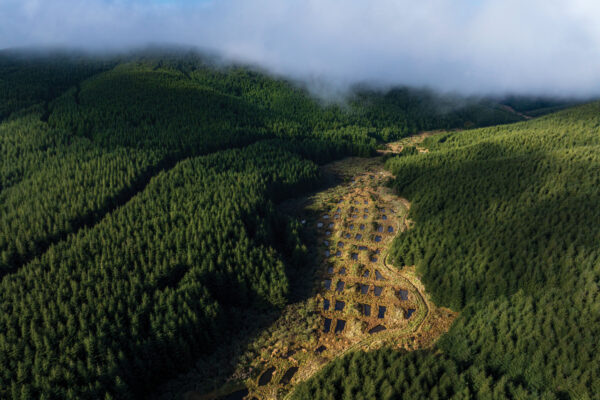
“Light vehicle down Link Road to Tramway.” John Hollows radios in our movements as we plunge into a huge Douglas fir plantation near Winton. After splashing through a few fords, we emerge into an extensive wetland, lush with harakeke, toitoi and red tussocks higher than my shoulder. Scattered throughout are artificial ponds, teeming with kōura.
We peer into a murky pond fringed in carexes and flax. Under the overhanging banks, Hollows tells me, will be a forest of antennae—hundreds of crayfish holding fort, playing out their internal local pond politics, feeding, defecating, moving stuff around.
The water looks mucky, but Hollows says it’s actually very clean—the murkiness is a result of the crayfish stirring up the pond floor.
Hollows is New Zealand’s only professional kōura farmer. In the early 2000s, a slump in timber prices led forestry company Ernslaw One to look for other revenue streams. Or ponds, as it turned out. Forestry blocks dig ponds for firefighting. Why not use those?
Hollows is quietly spoken and keenly curious. He struggled academically at school—later in life he would be diagnosed with dyslexia—but found solace in observing nature. Freshwater crayfish fascinated him, and he went on to do a master’s investigating their favoured foods and habitats. When Ernslaw One asked him to lead its crayfish farming venture, he was all in.
There was no manual on how to farm kōura (after figuring it out by himself, Hollows wrote one).
He took to suiting up in scuba gear and sinking himself for hours in half a metre of frigid water, watching crays. Eventually, the long, cold days caught up with him, and he was hospitalised with pneumonia.
He emerged, however, with a hard-won understanding of everyday crayfish life. He learned how big kōura dominate smaller ones, and often eat them. He saw how kōura interact with other species, like predatory insect larvae—he says they maintain an “arms race”, until the kōura grow big enough to annihilate their insect foes and completely dominate the pond.
He even learned to read their antenna language—angled back over their body means they’re scared; forward means they’re pretty happy with life—and their homebody habits.
Take a crayfish out from under a rock, he tells me, and put it on the other side of the pond, it’ll find its way back to that rock. Come back in five years and chances are it’ll still be there.
The farming operation now has almost 2000 kōura ponds scattered around forests in Southland and Otago. The breeding operation is ticking along. The challenge is to scale up to the point where the money makes sense. The potential, Hollows believes, is enormous, both domestically and internationally—these kōura are grown with no artificial inputs or feeding, just clean water and time. (They find plenty to eat all by themselves—algae and zooplankton, fungi, bacteria and invertebrates.)
Crayfish can filter-feed, but also chew hard food with their stomachs, using three grinding surfaces called a “gastric mill”.
Not much fazes them when it comes to food. “You don’t want to fall in a pond and not move,” says Hollows. “You might get eaten.”
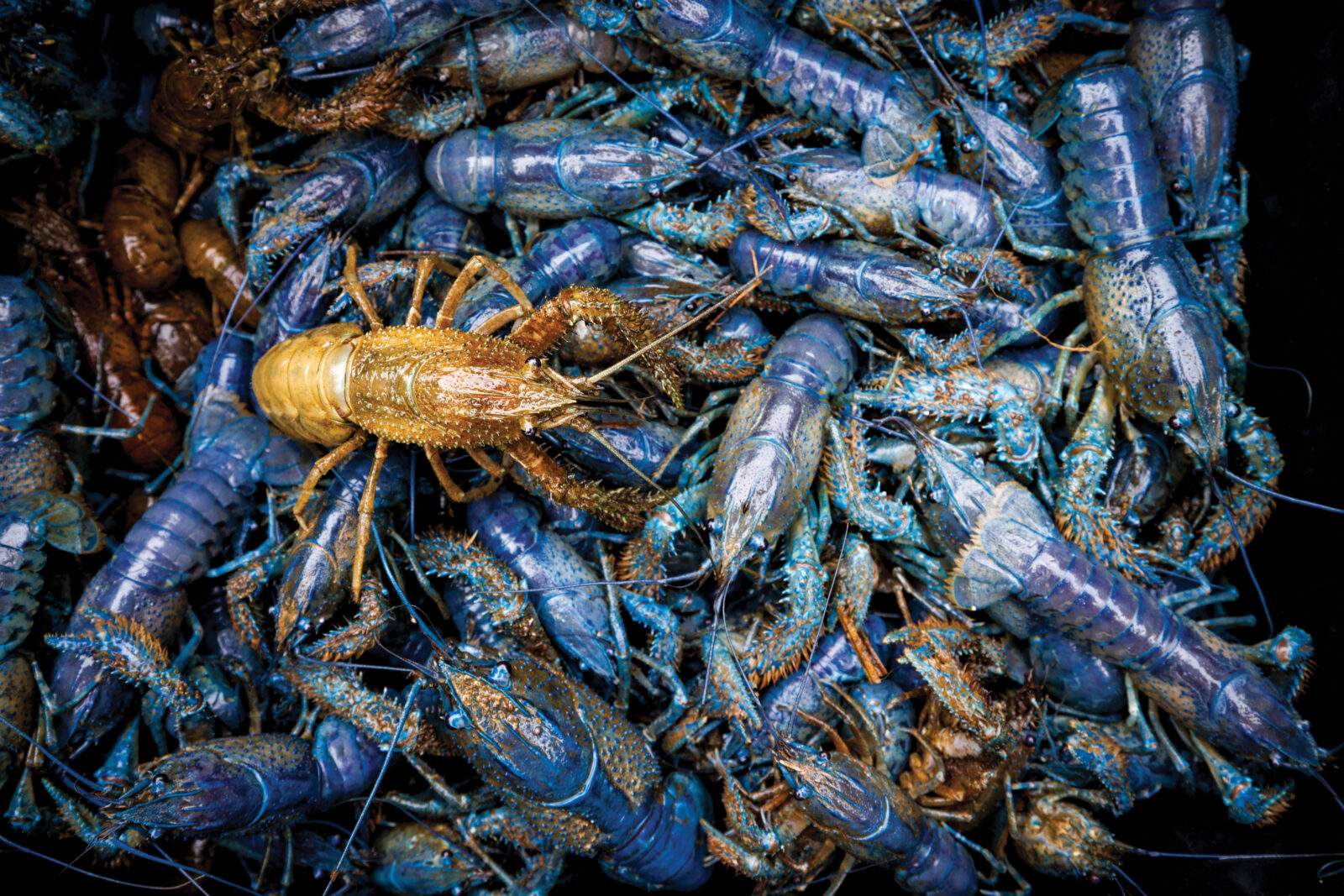
We pull up a net that Hollows set the previous day. There are 50 or more crayfish in the net, a clatter of claws and carapaces. The colours are extraordinary—while most kōura are a dull greeny-brown, a natural genetic line of vivid blue has been deliberately selected for in this pond.
Hollows is breeding the blues for the aquarium trade—they’re not great as a table item because they turn an unappealing grey when cooked. Others in the net are a stunning pale gold. “I don’t ever get sick of catching crayfish,” says Hollows. “I don’t know what it is about them. They’re just so cute.” He can no longer bring himself to eat them.
Decades into this work, Hollows probably knows kōura better than anyone else alive. “They’re all different,” he says. “Some can be quite angry. Some will be quite chilled out. The warmer the water, the more aggressive they are.”
For Hollows, a conservationist at heart, farming kōura is one of the best ways of protecting them.
He’d like to see others taking up the baton. Around the country, there are thousands of ponds and lakes on farmland not being used for anything beyond water storage. Why not farm kōura in them? It would be a moneymaker, and an incentive for farmers to look after their freshwater.
And in the long run, farming kōura might help save them, too—no species that is farmed, points out Hollows, will ever go extinct.
[Chapter Break]
Kōura farming could also offer a road to food security for mana whenua. It’s something Kāti Huirapa, a rūnanga on the north Otago coast, has been taking seriously for a long time.
These people once had millions of acres of the Otago hinterland to gather food in. Colonisation whittled their traditional fishing reserves down to remote, gorsy fragments tucked away in the back of farms—places they often need to ask permission to access.
While the hapū is slowly working towards reconnecting with these traditional sites, opportunities have also been created by recent Ngāi Tahu land purchases in their area.
One such place is in the headwaters of the Hakapupu river. It’s a weedy flat surrounded by Ngāi Tahu-owned pine forest, but the rūnanga has a vision to turn this into a productive place where whānau can go to harvest food and learn about living off the land.
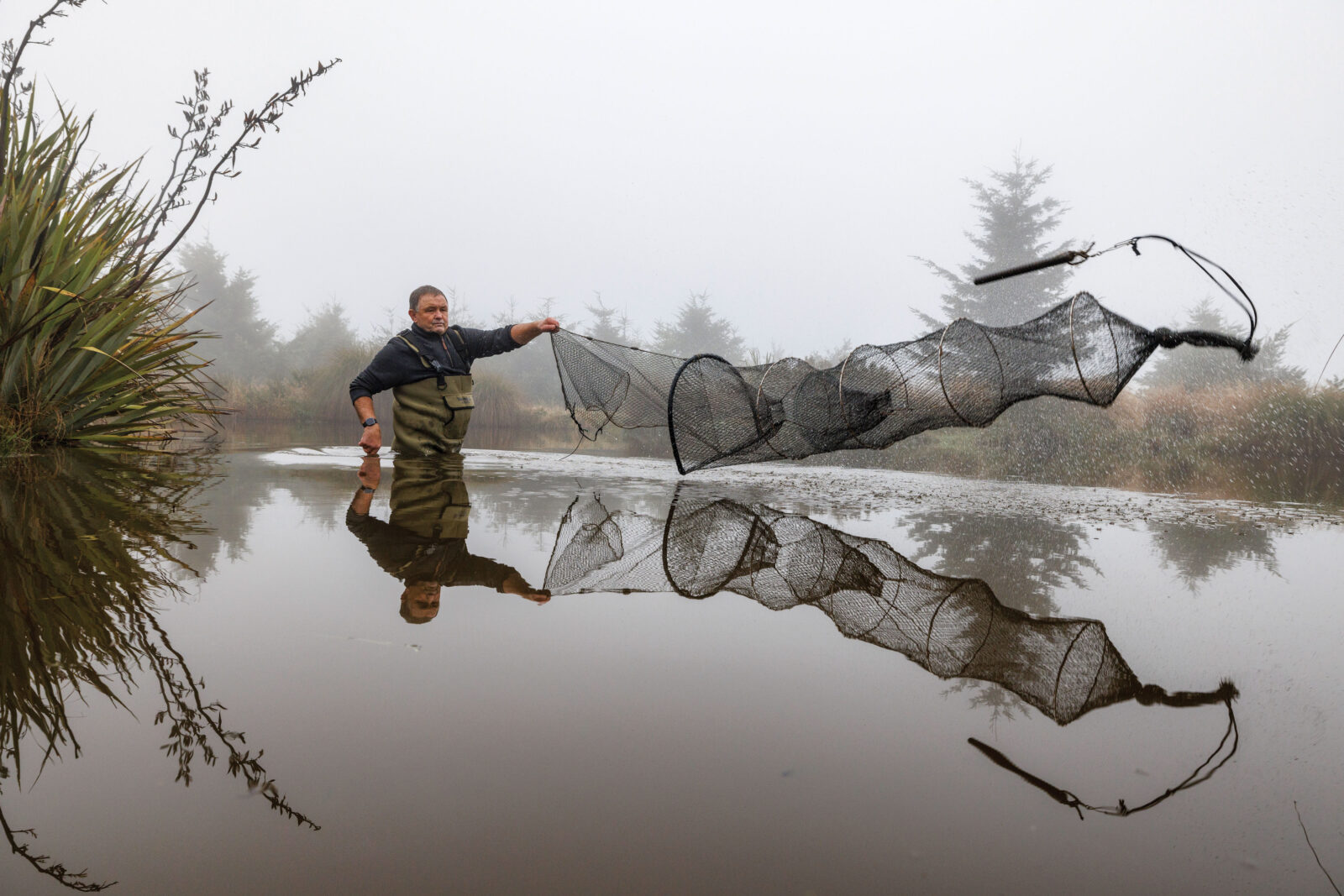
One winter’s day, I follow hapū member Jack Mathieson, rūnanga environmental manager Matt Dale and John Hollows into the small stream that runs through the site, where they start turning over rocks. The kōura they uncover are sluggish in the cold, and don’t look too pleased to be plucked from their repose. We quickly return them to the water, where they scurry back to their hiding spots.
Mathieson worked with Hollows to set up the forestry kōura farm. Now the pair are carrying their knowledge to this unlikely spot. The plan is to grow kōura in ponds here to provide a renewable food source for whānau. Kōura will also be brought in to give the local crays a boost.
Historically, says Mathieson, kōura were an important food. Like Te Arawa up north, his hapū fished for the crays with bracken-fern bundles. “People are missing out on that,” he says. He worries that the threads connecting his people to this knowledge are snapping. “It’s one generation to get rid of it and one to forget it.”
But while kōura quietly get on with restructuring their hidden water worlds, Kāti Huirapa have been working for years to reshape the convoluted permitting system around translocating. They are now on the brink of finalising a groundbreaking agreement with DOC that would give them control over kōura translocations in their rohe. It is hoped the agreement will set a precedent for other rūnanga around the country.
One day soon, Mathieson hopes, rangatahi will camp here and catch kōura on fern bundles. They’ll know what it’s like to sit out on a frosty southern night, the Milky Way turning above, and eat roasted kōura tails straight off the coals, just as their tīpuna did centuries earlier.