A bird in the hand
Huia were last seen alive in 1907, according to official records. But the New Zealand bird artist Raymond Ching tells another story. A Wellington taxidermist killed a trio of the birds in 1912, Ching believes—and surreptitiously stuffed them.
There is a recording of the huia’s song. It captures a series of chirps and trills. It is melodical and, yes, it is haunting. The more so because this recording was made decades after the huia’s extinction and is not of the bird, but of a Ngāti Awa man, Hēnare Hāmana, who had been a part of expeditions to find it in the late 19th century. It is the closest thing to a recording of the huia itself that we have. The last authenticated sighting of a huia alive occurred in 1907. Their extinction was the result of habitat destruction and hunting by both humans and four-legged predators. Hāmana’s recording is an act of memory, like so many other artefacts relating to our extinct species—the artists’ impressions, the dioramas, all with their sense of empty hands.
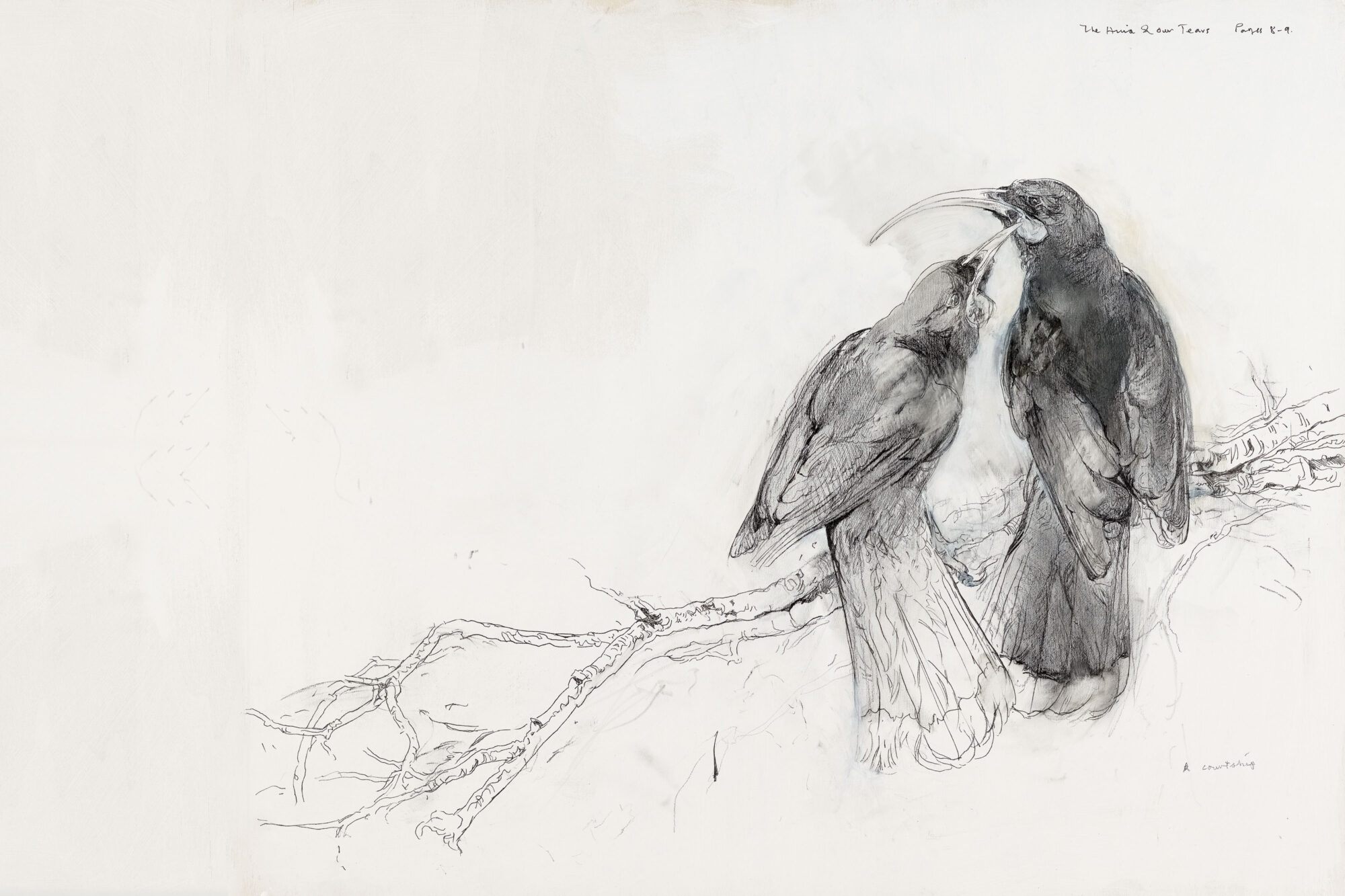
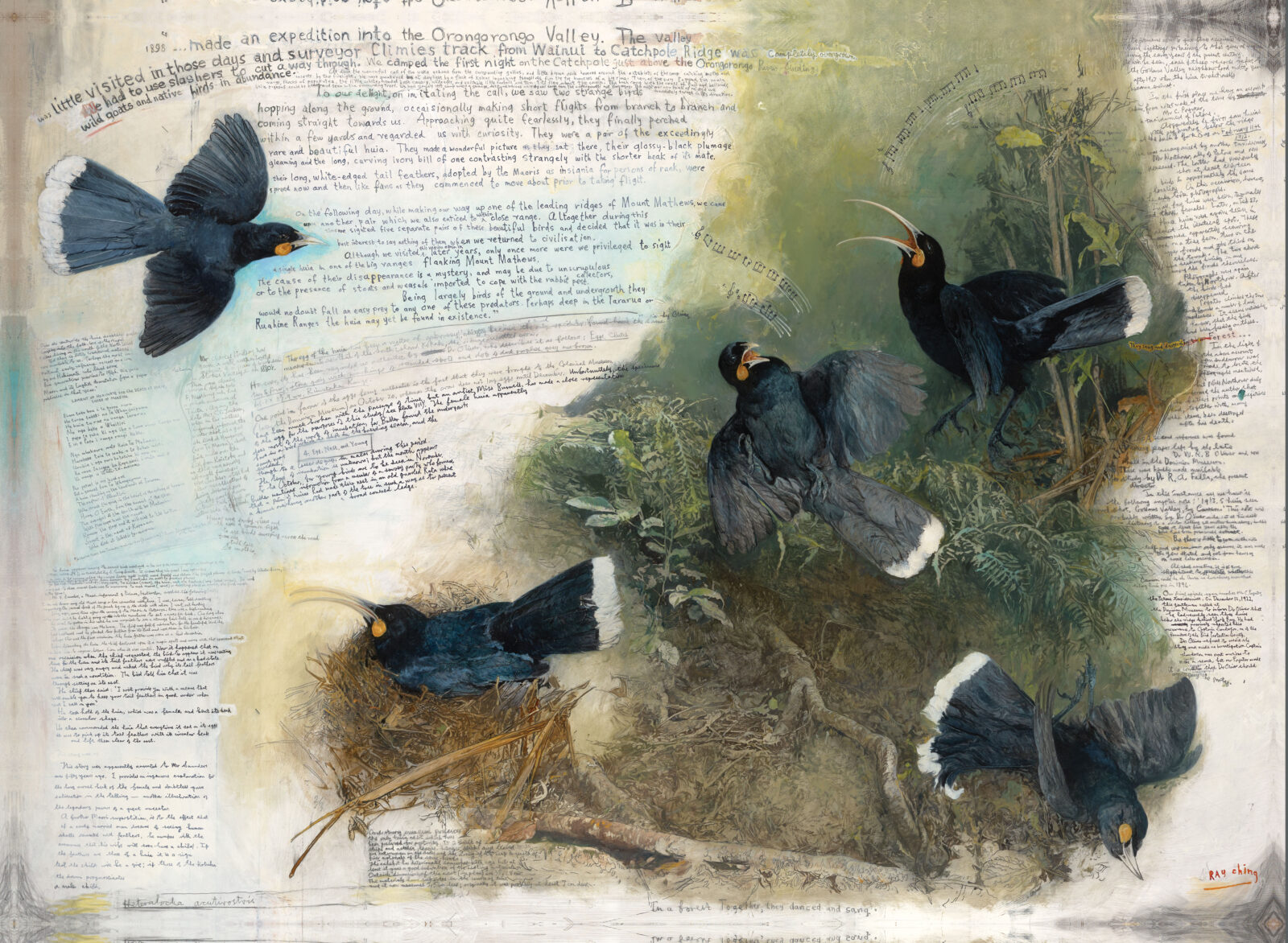
We can now add one more item to this list, The Huia & Our Tears, a book by artist Raymond Ching, which documents in both words and images a life of painting huia. This is an obsession within an obsession. Over a career that began about 60 years ago, Ching’s recurring subject is birds. He has made a study of feathers and flight. His birds are busy, poised for take-off, hopping from branch to branch, calling to each other, ignoring the painter.
[Chapter Break]
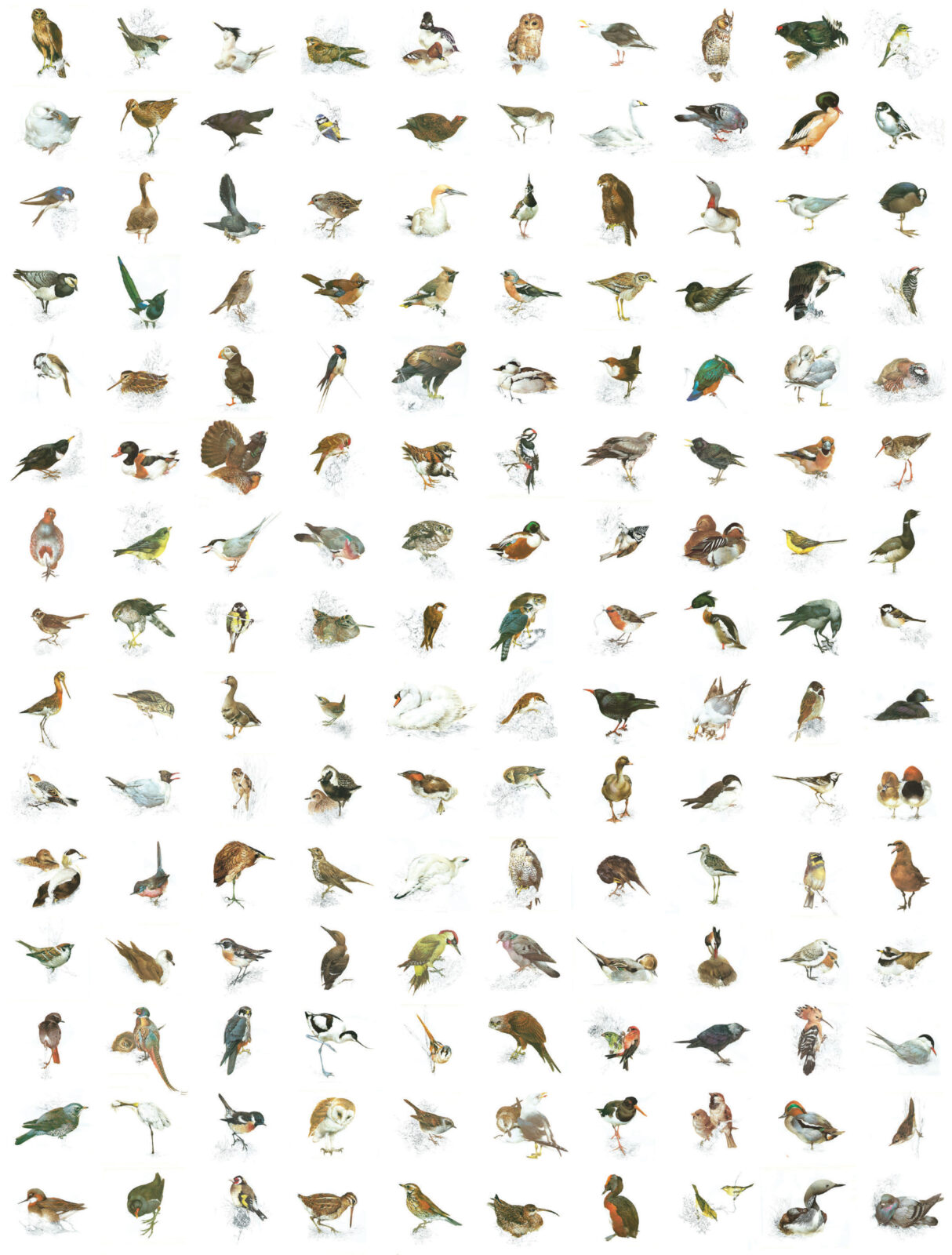
Born in Wellington in 1939, Ching moved to the UK in the 1960s, the fulfilment of a childhood dream. There, he was commissioned to illustrate the Reader’s Digest Book of British Birds. He worked furiously to paint 240 birds in 10 months, a deadline based on his own underestimate of the time needed. The results stood apart from the usual po-faced field book style where birds would be presented formally, side on. Instead, Ching’s birds were lifelike, captured as if spotted in nature.
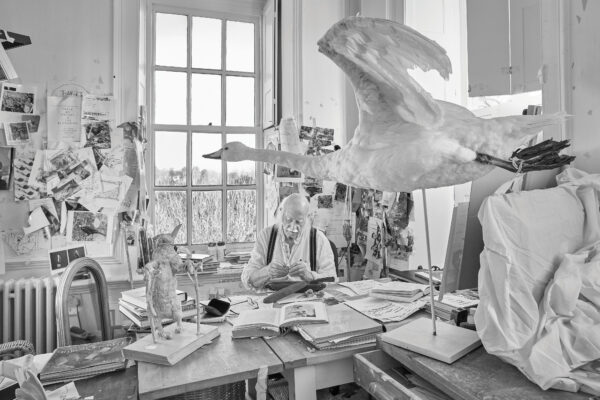
But the origins of his interest lay not in life but in dead things. “From quite an early age, for some reason, I got into my head that I wanted to have a stuffed bird,” he tells me on the phone from his home in Bradford-on-Avon. He has a way of emphasising the words “stuffed bird”, pronouncing every letter, and he recalls a primary school visit to the Dominion Museum. While the rest of his class were admiring an Antarctic diorama, Ching discovered a button that opened a storeroom door. There among the mops and buckets was a fake tree festooned with stuffed hummingbirds.
“I’m ashamed to say I put my hands in and I picked off about six or seven of these little treasures and stuffed them up under my jersey. And that night back home, up in Brooklyn, with my torch under the blankets, I looked at these little creatures, and they just took my breath away. The iridescence in the light under there was just amazing. But I felt so dreadfully guilty about this that, first thing in the morning, I went down into the backyard, and I wrapped them up all in cotton wool, and I put them in an old biscuit tin. And I buried them under the floorboards of my dad’s shed, and I never went back.”
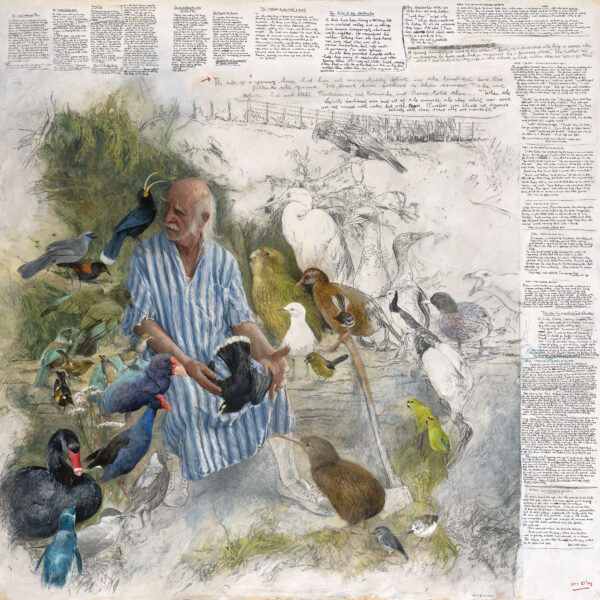
Later, as a teenager working as a studio junior at a Marion Street advertising agency, he returned to the museum, this time to borrow a bird. He took two of his bird paintings to show the curators as proof of his interest and left with a taxidermized gannet. Three weeks later, after painting the gannet, he returned it and borrowed a white heron. Each was beautiful, but returning them was no problem because he’d made a discovery. “The act of drawing it had meant that I now possessed this thing. And I had it for forever in my head, so I could easily just return it and get another one, draw that and possess it.”
It was then that an interest in painting birds began, “and indeed, never really left”.
[Chapter Break]
Ching’s obsession with stuffed birds and huia would later intersect, and with this comes a mystery. In 1965, then a young man living in Auckland, he read W J Phillipps’ 1963 The Book of the Huia, which referred to three huia in the possession of Clarence Poynter, a Petone taxidermist. Phillipps described Poynter’s specimens as “exceptional in the beauty of the greenish-blue colouring on the head, wings and breast, with the original sheen still present”. Again, something grabbed hold of Ching. He finished the book and took the next night train to Wellington. He went to see Poynter. “I knew that I wanted to see those birds and that blue sheen.”
Ching became a regular visitor to Poynter, one of the few the old man had. He saw those three birds, as well as his other huia remnants: skulls and taxidermied heads, the bodies having fallen to pieces. Poynter told Ching the same thing he’d told Phillipps: he had inherited all this from an uncle, a fellow taxidermist who had collected them in the late 19th century.
But Poynter made another intriguing claim, saying that in both 1912 and 1922, he had seen live huia in Gollans Valley on the eastern side of Wellington Harbour. Both occasions are well after what is officially considered the last sighting.
Ching was sceptical of the 1922 claim. In that same year, Poynter was in trouble with the police for shooting deer out of season, and Ching believes the story was somehow part of a ruse to get his rifle back.
Even so, Ching does believe the 1912 claim. Poynter told him that in that year, he and his uncle rode their bicycles from Petone to York Bay. They tramped over the hills and into Gollans Valley to hunt pigs, and there they encountered five or so huia scratching about the forest floor. Handily, the men had brought a camera and they photographed the birds, Poynter said. These would have been the only photographs of live huia—except, as Poynter would later claim, the images were somehow destroyed.
Poynter said that he and his uncle returned to the site a few weeks later, and this time, they saw huia foraging in the top of a tree fern. Poynter climbed the tree and at the top discovered the leftovers from the birds’ meal, the shells of giant snails. He put one of the shells in a matchbox, his only souvenir of this sighting. Or so he claimed.
Ching has come to think that not only did Poynter see huia, but that he also killed them—a crime since 1892—and these were the stuffed birds he owned.
Only this later date, Ching argues, could account for the quality of those three specimens. They were preserved more carefully than any of the others, suggesting the work of a master taxidermist such as Poynter himself, and arranged in a more modern style than was common in the 19th century. Ching regarded the snail shell as proof, too. Poynter had even given him the shell, but on the train home, Ching went to light a smoke. He reached into his pocket and retrieved what felt like an empty matchbox and threw it out the window. The shell was gone. Like Poynter’s destroyed photographs, this feint and parry of evidence produced and lost seems to be a feature of these stories.
Perhaps most convincing was that iridescence. The blue sheen of Poynter’s birds was unlike that on any of the older birds held in museums. One, a young male, was especially beautiful. Ching writes that it was easy to imagine those three, “held then in my hands, to have been those very last huia ever taken from our ancient forests”.
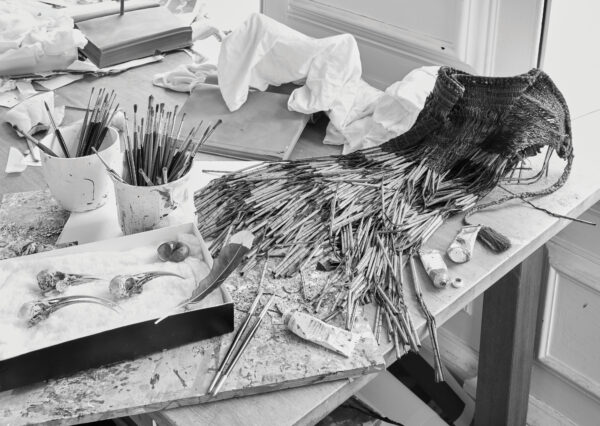
Ching bought Poynter’s specimens. He acquired another from an elderly taxidermist in Nelson, and he took the lot with him when he moved to the UK. There he would add to his collection. He roamed London’s Bermondsey market before sunrise—until 1995 it operated under a medieval law that allowed for goods to be sold pre-dawn with no questions asked about their origins. On a stallholder’s table, he found a box containing, among other things, the perfectly articulated bones of a human hand and a huia wrapped in newspaper.
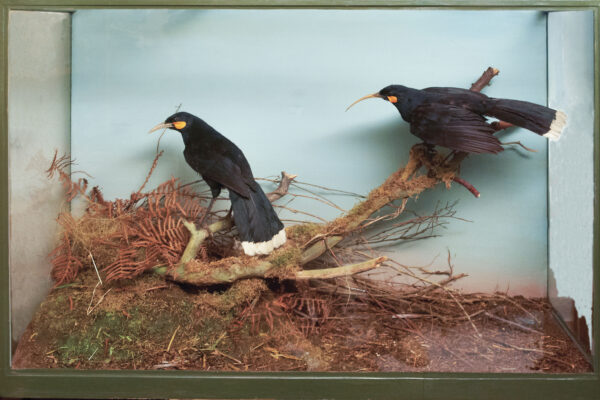
He attended an auction of mounted birds and natural curiosities held by Sotheby & Co and spent every penny he would ever be paid for his work on The Book of British Birds. In fact, he spoke of needing to use the auction house phone to call his publishers to ask to be paid in advance. Among his purchases was a Victorian collectors cabinet containing the skins of a number of extinct birds, a single huia among them, as well as a cabinet of mounted New Zealand birds which included two huia.
[Chapter Break]
In a review of one of Ching’s earlier books, Keith Woodley writes that when talking to acquaintances of the artist, “two words seemed to recur in conversations: obsessive and eccentric”. The Huia & Our Tears would offer them another data point. It is his Moby Dick, chronicling his obsession while grabbing hold of everything about the huia he can find, a catalogue of fact and fascinating anecdote, surrounded by Ching’s own detailed art. It contains poems by A R D Fairburn and Eileen Duggan, maps and newspaper articles, and even the complete text of The Book of the Huia. He discusses other artists who have painted the huia, comparing the approaches of Charles Goldie and Gottfried Lindauer to the huia feathers held or worn by their subjects. While Lindauer does them justice, Goldie is prone to shrinking the feathers so they are a better fit in his paintings. Once you see it you can’t not see it.
The book is all this, and something else, too. Ching wonders whether there is a connection between The Huia & Our Tears and his attempts to return to New Zealand. During the 60 years that Ching has lived in England, he has come back here more times than he can remember. On three of these occasions, he sold up his UK home and shipped everything back across the world. But it’s never worked. The old world, with its great galleries and libraries, has its hold on him. “Each and every occasion, I lasted only about six months, and I just, I just had to get back,” he said about those attempts to return. Once, this realisation hit as early as the taxi ride from Auckland Airport into the city. “By the time I got into Queen Street, I went straight to the agents and booked the next flight out. It took 20 minutes for me to turn around and go home. I couldn’t get a flight out for three days because there weren’t that many flights in those days, but I was back home again. You see, it’s a kind of, it’s a madness, isn’t it?”
And so, his only tangible connection to New Zealand over these years has been “my interest, my obsession really, with huia, with this bird, with this beautiful bird”.
[Chapter Break]
In May 2024, a single huia feather sold in Auckland for $46,521, making it the most expensive feather sold at auction anywhere in the world. In 2022, a man wrote to Forest & Bird, threatening legal action if the society didn’t allow the huia to be a candidate in its annual Bird of the Year competition. These are recent incidents in a long history of human obsession. For Māori, the white-tipped tail feathers of huia were tapu, worn by the high-born and kept in the intricately carved boxes called waka huia. A mareko, the 12 tail feathers still joined at the base, was worn by rangatira into battle.
Europeans would also come to feel a fascination. Pākehā men tucked feathers into hat bands, an approximation of Māori custom. A trade developed in stuffed and mounted huia of the kind Ching would later find in auction houses and taxidermy studios. His book includes, as an appendix, a list of the huia skins and mounts held by the museums of the world. In this form, huia have flown as far as the UK, Belgium, Poland and the US. The National Museum of Qatar has two.
Huia were traded in other forms. In the 1890s, two huia, slightly cartoonish to my eyes, appeared on a threepence stamp. From the 1930s until the introduction of decimal currency, a single huia perched on the reverse of our sixpence piece. “I sang upon a postage stamp/I sang upon your coins/but money courted beauty/you could not see the joins,” writes Bill Manhire in a poem simply titled ‘Huia’.
[Chapter Break]
Ching no longer owns any complete huia specimens. Of the three Poynter birds, with their blue sheen, he writes, “They were with me in the studio for many years until parting with them, probably to pay rents due at some lean time or other; I forget now.” While Ching says he doesn’t recall where one of these birds went, two, including the beautiful young male specimen, now belong to his longtime friend the English writer Errol Fuller, an authority on extinct birds and an avid collector. Ching has tried to convince Fuller to return the huia to this country, but says that like most collectors, his friend is “protective of the items that they’ve secured”. The birds are well looked after, Ching tells me, “safely curated in museum-quality conditions”.
Fuller, when we emailed, wrote back: “As far as sending the birds back to New Zealand is concerned, I believe it would be pointless. New Zealand already has so many of them—and many are overlooked in various ways.”
Still believing that to draw a bird is to know and own it, Ching doesn’t regret that these huia are no longer his, but does feel strongly about having taken them out of New Zealand. “It’s outrageous, isn’t it?” he says.
It never occurred to him at the time that he might have been doing something wrong; the law then was concerned with live birds, not dead ones, and few seemed interested. “I deeply regret it now.”
In 2023, he gifted the three huia skulls, passed to him by Poynter, to Te Papa. The only part of a huia he now owns is a single tail feather, which is kept in his studio.
When I ask Ching what it is about the huia that has obsessed him, he is taken aback. “Goodness sake, man! Don’t you see the glory in this bird,” he says, his voice rising. “I mean, look, it’s not for no reason that everyone who’s come in contact with this bird has been entranced by it, and it starts with Māori, collecting, treasuring them, valuing those feathers.” There is something to it that is greater than description allows, he believes, something that goes beyond bare facts of what it is. “The huia is a vehicle that brings the glory that we find, this glory that just got into my head, and I’m not the only one.”
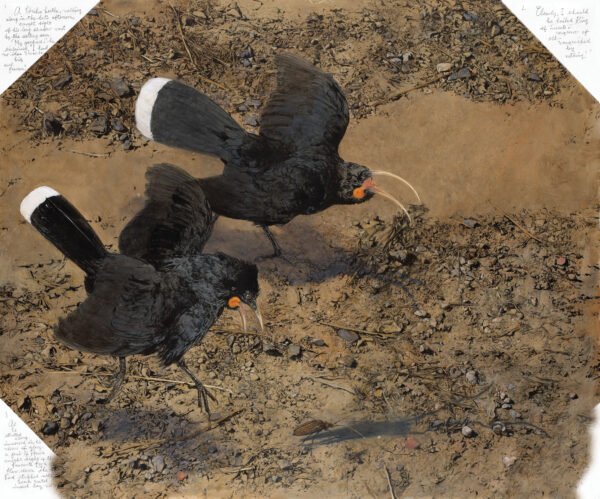
To paint them, he created models, arranging the body of a rook, combining a dead crow and a magpie wing to give himself the details he needed to get the sense of a bird moving about the forest floor. “We should believe that they really were there,” he writes, “and this kind of reality could only be gained by my finding just the moment when, perhaps, the bird’s feathers chance to be disarranged by a gust of wind, caught in a moment that somehow will identify the bird as individual and allowing us, for just that moment, to enter its world.”
There is no way to know whether his works are entirely accurate—there is no footage of the huia in movement, no photos of the bird alive. But for all the beauty in the pages of his book, Ching feels he has not entirely succeeded and that his huia work is lacking in some way. “I feel I’ve let them down.” And so, he continues to paint huia, to put it right, he said. He spoke about a large painting, six feet long, in which huia will appear life sized, and which will tell the stories of people who encountered and remembered them. It is a work in progress. This bird has left our hands. We are unable to let go.