Washed up
At Auckland Zoo, a rising tide of critically ill marine patients is inundating the Vet Hospital.
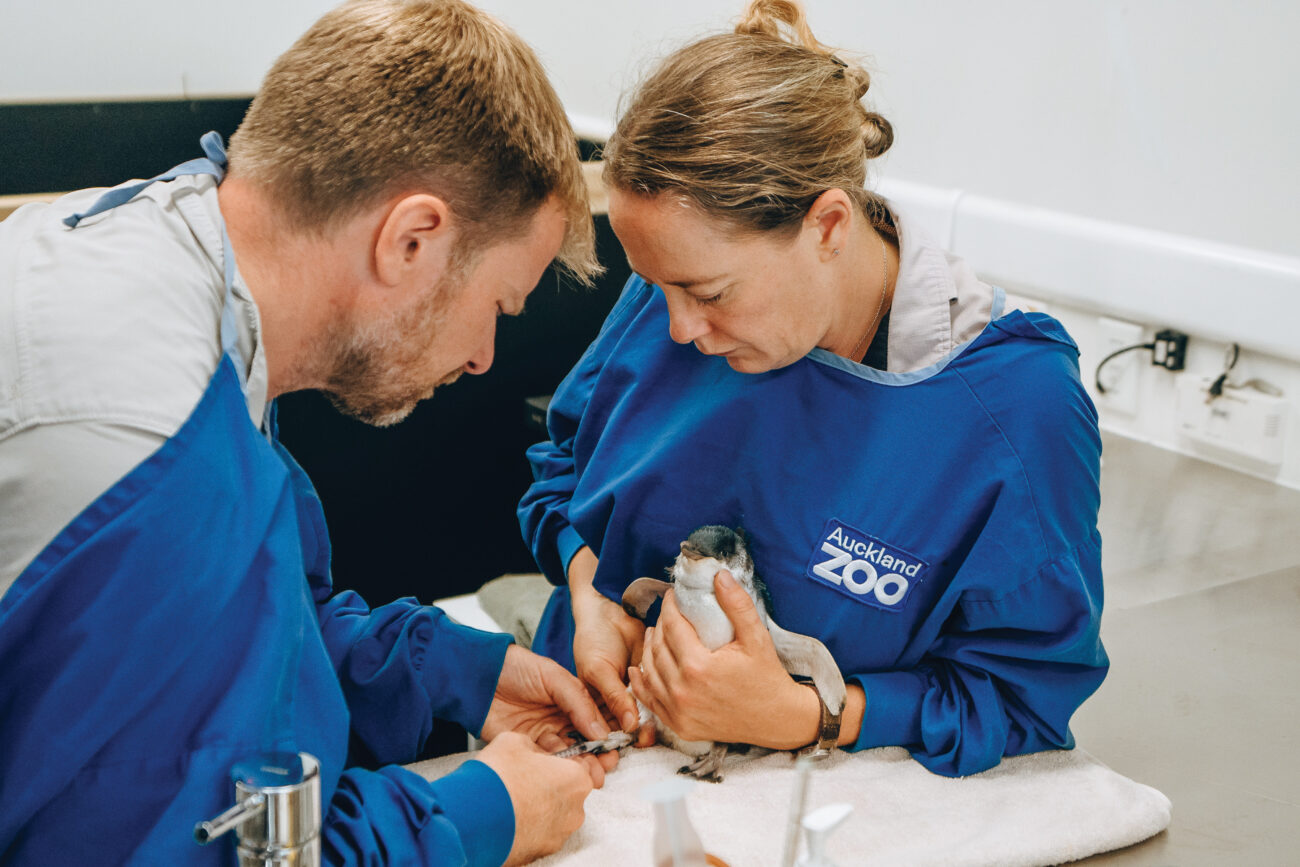
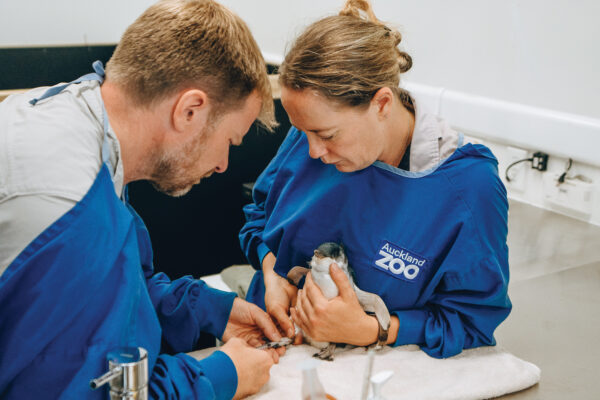
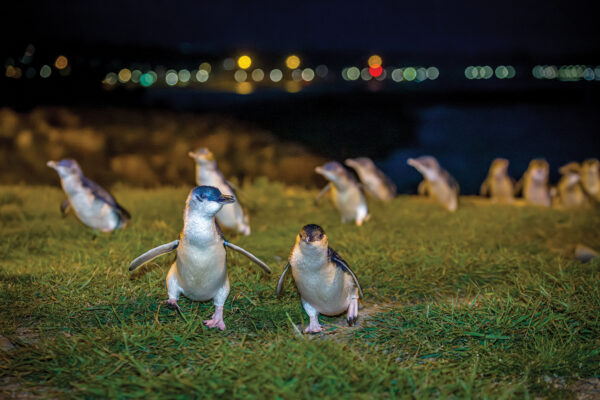
When the kororā arrives at the Auckland Zoo Vet Hospital, she is frail and thin. The little penguin has multiple fractures across her chest and shoulder, and a dislocated wing. A newly fledged chick, just three months old, she was picked up on a rocky shore near Thames in the wake of a storm. Perhaps her tiny body had been dashed against the rocks as waves pummeled the shore.
The zoo’s Veterinary Services Manager James Chatterton and the vet team immediately get to work. Time is critical. She is one of 13 emaciated kororā to turn up at the zoo in the first half of 2026, and the prognosis for a starving penguin isn’t good. About 90 per cent of these severely underweight kororā won’t make it past 24 hours.
Three things are top of the vet’s priority list for a starvation case: warmth, fluids and energy. The penguin is placed in an incubator—“like what you have in a human hospital for a little baby,” Chatterton explains. Fluids go into a vein, or under the skin if the circulation is collapsed. Glucose is provided by mouth if the kororā can still digest food, or by injection if they cannot swallow. A gut that’s still moving suggests a better chance at survival, Chatterton says.
“It’s all hands on deck to see if we can stabilise them and keep them alive while we get food into them and address their other issues.” Next comes a physical exam, blood sample, x-rays and, slowly, food—first a fish smoothie and eventually, whole fish. For some, surgery may be on the cards.
It can take weeks of intensive care to restore a penguin to a robust weight and full health. At that stage, some kororā will be transferred to the Native Bird Rescue on Waiheke Island for further rehabilitation and eventually, release.
But some, like our little Thames kororā, can’t be released—although she is pain-free and stable, a faulty flipper means she wouldn’t survive in the wild. She is settling into her new life with Auckland Zoo’s resident kororā colony.
When Chatterton first started with the zoo in 2013, a handful of kororā would trickle in each year. Now, flurries of penguins in peril are a regular fixture—and climate change is thought to be one culprit.
The ocean has absorbed the bulk of the global rise in temperature. A La Niña weather pattern exacerbates this situation locally, causing an even warmer ocean with wet and stormy weather. That changes where the small fish hang out, making it harder for kororā to find a feed. The result is hungry adults and underfed chicks. “Of the chicks that are surviving, they’re smaller, stunted, and their weight is probably three-quarters of what we would normally expect,” Chatterton says.
His first penguin influx came in 2017, when New Zealand’s coastlines were hit by the most extreme marine heatwave in a century, and hundreds of kororā washed up dead around Auckland and Northland. We’ve seen similar heatwaves in the past two summers; this summer the zoo admitted 18 kororā.
It’s not just climate-induced food shortages that kororā have to contend with. There’s also plastic pollution and overfishing, dog attacks, increasingly frequent storms, and the generally poor state of the Hauraki Gulf/Tīkapa Moana. One penguin treated at the zoo this March had fishing line tangled around its leg.
And it’s not just kororā. Other ocean-faring species from across Auckland and beyond are winding up at the zoo hospital—casualties of an ocean in dire straits. Chatterton has observed an uptick in the small number of storm-wrecked albatrosses landing in their care—from one every few years, to three or four every year. Strandings of honu/sea turtles have exploded the last two summers, too.
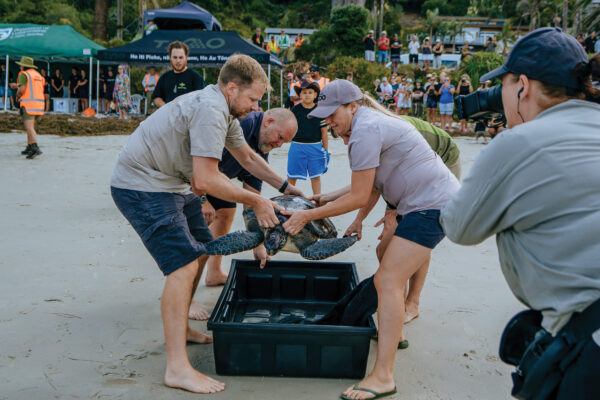
More than a decade ago, Auckland Zoo joined forces with the Department of Conservation, Sea Life Kelly Tarlton’s and mana whenua in “Team Turtle” to help rescue and rehabilitate sea turtles, which are native in northern New Zealand waters. Most are juveniles, which spend a few years hanging out in New Zealand coastal waters before heading back to the tropics, where they breed.
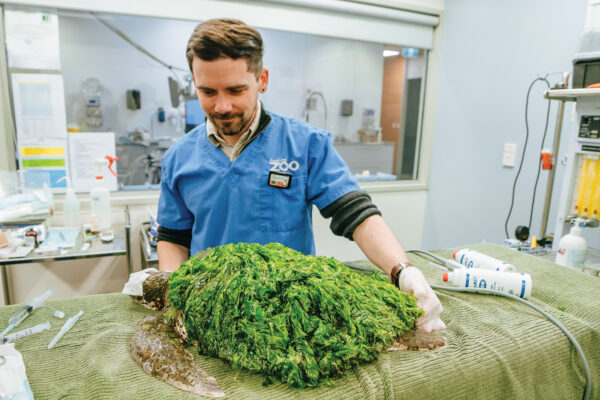
Any sea turtle spotted on a New Zealand beach is unwell and needs help. Often, their shells will be blanketed with barnacles and weed. “They look like a ship that hasn’t moved for a few months,” Chatterton says. Some turn up with fishing hooks in their mouth, or gashes in their shells from boat propellors. Others have flippers missing—“we’re never sure if that’s boats or sharks.”
“We don’t often know why green sea turtles end up on a beach in New Zealand,” Chatterton says. “But we know that we can make two-thirds of them well enough to go back to the wild.”
Over the 10 years to mid-2024, Auckland Zoo and Kelly Tarlton’s cared for 110 honu. Then, in just three months in late 2024, 13 sea turtles washed up on two beaches in Northland, with more stranding in late 2025. DOC is investigating what might be behind this recent spate of turtle strandings—which, unusually, have included a large female weighing 94 kilograms.
Caring for critically ill marine animals isn’t easy, but rather than despairing, Chatterton chooses a pragmatic outlook. “The reality is that it’s happening. So, you can either bury your head in the sand, or you can try and do something about it.”
Chatterton began his career as a vet in the UK and always aspired to contribute his skills to wildlife conservation. Working in Aotearoa has given him the opportunity to directly contribute to saving endangered species such as kākāpō, takahē and tara iti. But even if the survival of an individual isn’t make-or-break for the future of a species, it still feels important.
“The 10 or 20 penguins that we look after every year are advocates for their species. Their stories make people listen and care—and if they care, they can do things differently in their own life, to help all the rest of the kororā,” he says. “To help the fish and the sea slugs and the seaweed and the mussels, and all the other things in the ocean.”
“We didn’t get to the state we’re in now by doing one big dumb thing once,” says Chatterton. “We got here by doing lots of little things badly over the years.” That means part of the solution is little good things over time: picking up rubbish, cleaning up your fishing gear, and keeping your dog on a leash at the beach. Multiplied by 5.3 million New Zealanders, it all makes a difference for marine species.
Imagine an Auckland where we can sit on the beach as the sun goes down, Chatterton says, and watch loads of little penguins wander up to their nests. “Wouldn’t that be amazing? Seas full of fish and full of penguins and full of seals and full of sea turtles…”