The true cost of this magazine
Every business has an environmental impact. We decided to calculate ours, using a new and comprehensive standard called planetary accounting. We are the first media outlet in the world to complete a full product lifecycle assessment against scientifically accepted planetary boundaries.
We know a lot about our products—both the website you’re looking at now, and the print magazine. The website we’ll get to later (for reasons I’ll explain later), but turning to the magazine: The paper was milled from Forest Stewardship Council certified forests and printed by Webstar, the only publication printer with a Toitū Enviromark Diamond certification. The inks are non-toxic and vegetable-based, and the printing process produces no waste at all. It’s mailed wrapped in recycled plastic that was once on its way to sea, developed last year in partnership with Better Packaging.
But while we have carefully tuned each part of our business activities, we have never looked at our entire footprint at once. A year ago we decided to do that, and were confronted with some immediate questions: Do we consider only carbon? What about waste, land use, the impacts of forestry on biodiversity? And do we consider only the production of the magazine, or follow the whole story, from the twinkle in the eye of the editor to the moment, 30 years from now, when the archived magazine gets pulled from the shelf and tipped into a recycle bin?
[Chapter Break]
In 2009, Johan Rockström and 28 co-authors published a paper in Nature called “A Safe Operating Space for Humanity”. The paper went beyond just carbon, proposing nine planetary boundaries threatened by human activity: climate change, biodiversity loss, nitrogen and phosphorus cycles, ozone, ocean acidification, freshwater use, land system change, atmospheric aerosol loading, and chemical pollution. It became one of the most cited papers in environmental science.
This idea caught the attention of Kate Meyer, then a PhD candidate at Curtin University in Australia. If you know the maximum impact the planet can sustain, she figured, you could divide it by population, and have a sort of per capita budget for safe consumption.
If everyone stays within budget, we’re all okay. If we blow the budget, we all suffer.
Meyer’s PhD framed this as ‘planetary accounting’, but she wondered if we could go a step further; calculate the planetary impacts of each product and include it on a label, as we do for nutrition: Go ahead, eat this chocolate bar, but it amounts to 8% of your safe daily planetary impact, so you might choose to compromise somewhere else in your day.
No one expects consumers to tally every product they consume, but transparency creates a market for producers to improve their products, and for consumers to make side-by-side comparisons between similar products, even compare apples with oranges… or magazines for that matter.
Last year we engaged Meyer and her new charity, the Planetary Accounting Network (PAN), to conduct an independent review of New Zealand Geographic’s products, both the physical magazine and our website. We had to submit details of all our activities—from travel costs for journalists and photographers to office power bills and water use, where our paper comes from and where the power came from to make that paper, environmental statements from Webstar and our distributor AreDirect, as well as kilogram-per-kilometre measurements of carbon consumption from the NZ Post network. All of our suppliers record what they consume and how far they travel, and the analysts at PAN (Gabriella, Lauren, thanks for your patience) were able to incorporate and harmonise all these datapoints, or substitute known measurements from peer-reviewed studies and datasets where hard data didn’t exist.
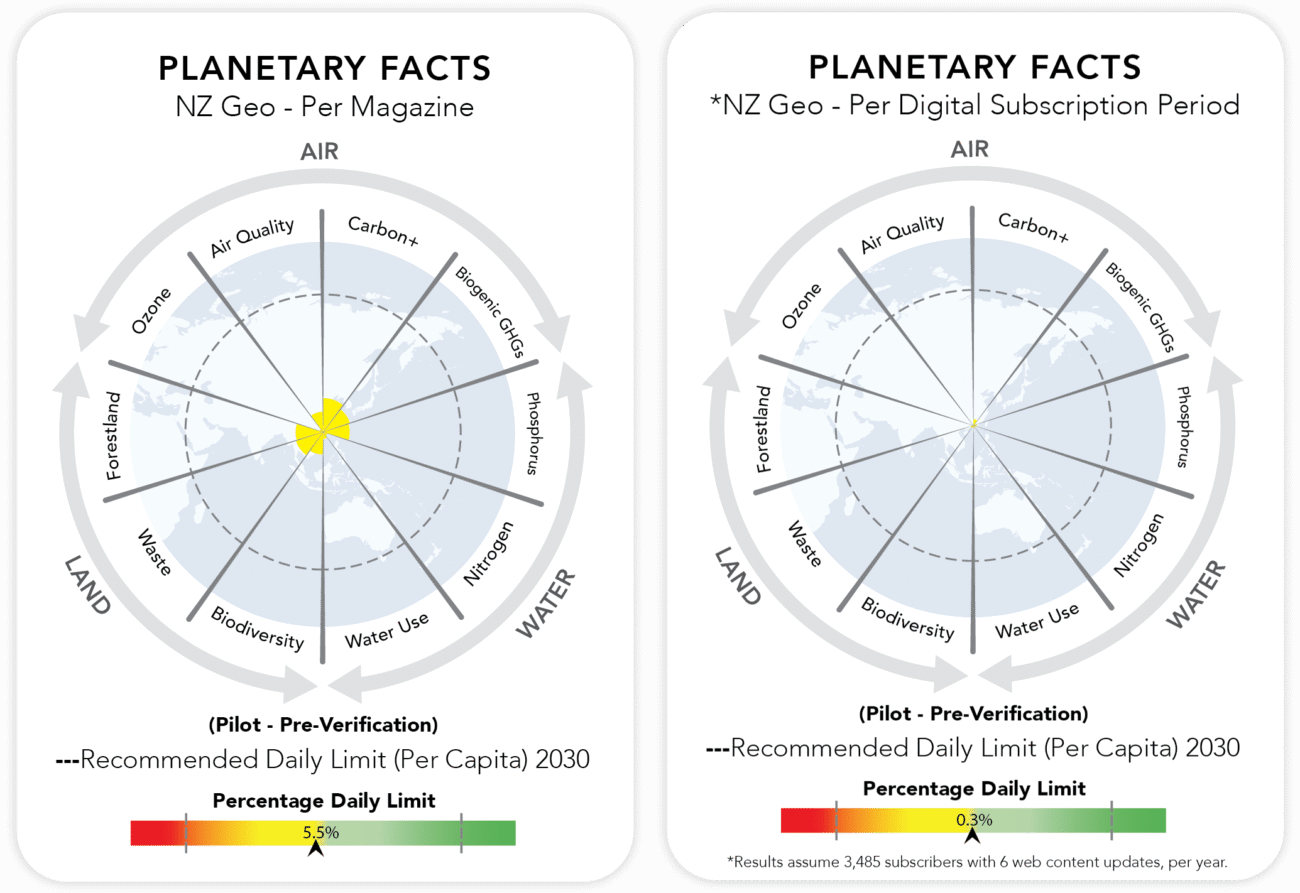
The result: one copy of NZGeo represents 5.5% of a person’s recommended daily environmental limit. Put another way, buying a magazine leaves roughly 94.5% of a reasonable environmental budget intact for everything else you do that day. (Driving 20 kilometres in a petrol car burns up 17% of your budget, for instance.)
Most copies of NZGeo are shared among multiple readers (consumer media insights company Nielsen says we have 407,000 readers in total), shrinking that figure to just 0.2% of a reader’s daily budget—a third of the environmental footprint of an apple, or a glass of wine.
[Chapter Break]
Knowing the total impact of a product, however, is only the start. The magic of planetary accounting can also reveal where those impacts occur in the product chain, allowing us to reduce or mitigate our emissions.
The results can be surprising. The carbon consumed in the process of making paper is offset to a degree when it is stored again in the paper itself, leaving phosphorous discharged from the mill as the main environmental pollutant. (Unlike carbon, phosphorus has no natural atmospheric cycle—once it’s in waterways it cannot be recovered and returned to productive use.)
Sourcing pulp from sustainable forests is a choice we made a decade ago, but it means milling paper in Finland rather than Asia. Finnish mills run on a mix of renewable hydroelectric power and process heat generated from their own wood waste, so there’s a double benefit, but the 16,900-kilometre shipping route to New Zealand erodes some of that advantage.
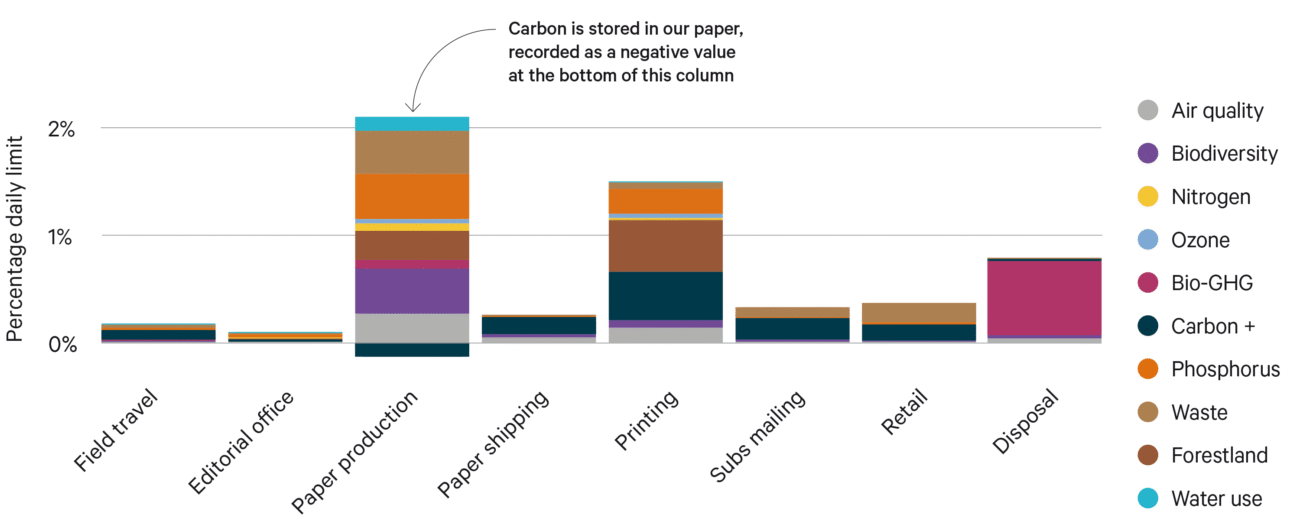
The second largest impact occurs much later, when you’re done with this magazine. If you recycle it, the impact is relatively low, but Ministry for the Environment data suggests only two-thirds of Kiwis recycle paper products. The other third biff it in the bin* where it decomposes in landfill and releases methane, a potent biogenic greenhouse gas.
The last big factor is magazine distribution, both to subscribers and retail. NZ Post have good data on the kilograms of greenhouse gases per kilometre travelled, but it’s the air freight required to reach international subscribers in Australia, North America and Europe that seems to have the greatest bearing here.
The digital edition tells a very different story. A full two months browsing stories on the website represents just 0.3% of a daily limit. Most of those impacts come from the share of field travel to report the stories, not the website itself. Servers, it turns out, are not really the problem, at least not at the scale we’re using them.
New Zealand Geographic is the first media outlet in the world to have completed a full product-level life-cycle assessment across all planetary boundaries. It feels a bit like hanging the dirty laundry out on the line, then inviting the public to analyse every stain. But as the US-Iran war spirals and the cost of fossil fuels soars, economic and environmental incentives to change have snapped into alignment. As always, it’s about seeing the situation as it is and making the best of it. As the adage goes, “Never let a good crisis go to waste.”