Flight plan
How the animal kingdom first grew feathers—and got off the ground.
In May, a single white-tipped huia feather sold at Webb’s auction house in Auckland for $46,521—an astonishing sum that seems to reflect both our fascination with artefacts of extinction and the allure of plumage itself.
Humans have coveted feathers for aeons. We’ve fletched our arrows and written masterpieces with feathers, made them the centrepiece of ceremonial and military headdresses, stuffed them into jackets and pillows, and woven them into boas and kahu huruhuru, feather cloaks.
We’ve assigned feathers a vast array of meanings, too. Native American warriors were awarded eagle feathers for bravery in battle; conversely, during World War One women handed white feathers to men who had not enlisted. Feathers have been deployed as symbols of masculinity and femininity, camp gay pride and Britain’s Prince of Wales.
Our dear kiwi, kākāpō and takahē aside, perhaps it is also feathers’ association with flying that captivates us. Some two-thirds of us fly in our dreams, and many of our foundational stories—angels, witches, fairies, Icarus, the bird woman Kurangaituku—flock with flight. Yes, we build machines to fly us all over the world. But unlike bats, most birds, and myriad flying insects (the flies alone number 120,000 species), we cannot simply flap our arms to launch ourselves into the skies.
Insects got off the ground first. Around 325 million years ago, the fossil record shows, two sets of wings unfurl simultaneously. One arrangement is flat and outstretched, like those on dragonflies; the other is a pair of wings attached to an early grasshopper, which could twist them and fold them away over its back. These two designs endure: they’re still the main models of insect wing construction.
“And then right after that, we see an explosion,” says Sandra Schachat, a palaeontologist at the University of Hawaii. Winged insects go from not existing at all to suddenly being everywhere, in a flurry of different forms.
The innovation was revolutionary, Schachat says, allowing these first fliers to escape from spiders and centipedes and to colonise new lands. “Flying gets you into the air, and then a gust of wind can take you anywhere.” It also beats spending hours crawling up and down trees to access fruits, flowers, and fresh leaves.
[Chapter Break]
Powered flight—as in flapping, not gliding—took off in reptiles during the Mesozoic Era, 228 to 66 million years ago. It evolved separately at least two more times, and possibly several more, beginning with the pterosaurs, flying reptiles closely related to dinosaurs.
Pterosaurs’ wings were made of membranes stretched between their elongated fourth fingers and their body and hind legs. These bizarre creatures ranged from the cartoonish, bat-sized Anurognathus to giraffe-sized behemoths like Quetzalcoatlus, which had a 10-metre wingspan (though whether it could actually fly is up for debate).
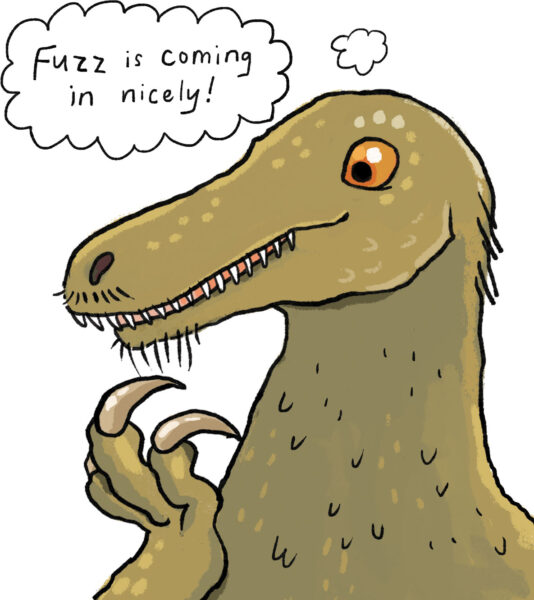
Pterosaurs also had feathers—a hint that these structures originated before dinosaurs, in an even more ancient animal that was an ancestor to both of them, says Jingmai O’Connor, a palaeontologist at the Field Museum of Natural History in Chicago. But those feathers didn’t help pterosaurs and early dinosaurs fly, she says—instead, they likely provided insulation. Each of these feathers was just a single filament; en masse they would have looked more like fur than plumage.
“We call these things proto-feathers, or sometimes we call them dino fuzz,” says O’Connor.
A few groups of dinosaurs developed the pennaceous feathers inherited by today’s birds. Like a fern frond, these complex feathers have an ingenious fractal structure—the branching shape of the whole is repeated in miniature in each barb, again in each barbule, and yet again in each hook-like barbicel. (Ratites like New Zealand’s kiwi are an exception, as they are to so many rules: they lack barbicels, so the barbules do not lock together, making the feathers look like hair.)
In 1861, a beautifully preserved 150-million-year-old skeleton of a “pet-sized” dinosaur with feathery wings was found in Germany. Archaeopteryx—the name means “old wing”—became the most famous feathery fossil of all time, and revolutionised our understanding of the relationship between birds and dinosaurs. More than 160 years later, palaeontologists are still debating whether Archaeopteryx is the oldest known fossil bird, and whether it could flap or merely glide, like a flying squirrel.
Over the past few decades, dozens of other dinosaurs with pennaceous feathers have been unearthed in China, Madagascar and elsewhere. These spectacular fossils have revealed a mind-bogglingly complex feathered family tree.
Curiously, many of these early bird-like dinosaurs arranged their fancy modern feathers on their forelimbs, “forming a structure that looks like a wing, but it’s proportionately too small to be used for flight”, says O’Connor. We don’t really know why these wing-like structures first appeared, she says—possibly they were used to impress mates or take care of chicks. “But we know that these proto-wings evolved for some other purpose and then evolution hijacked them for a new function—which became flight.”
Scientists in the USA derived the leading theory for how that might have happened by taking chukar partridges at one, four, and 12 days old and totally freaking them out. “They took these baby birds and they chased them up inclines,” says O’Connor. (She wasn’t involved in this study—unfortunately, as it would have been karmic revenge for the time a rooster repeatedly chased her in China’s Inner Mongolia, where she was doing fieldwork.)
The little chukars started flapping their tiny naked wings, which helped them gain traction and climb the steep slope. Researchers later identified this same behaviour—dubbed “wing-assisted incline running”—in many other bird species. “And then they were like, ‘Well, wait a minute, let’s take these baby birds and let’s drop them,’” says O’Connor.
Sure enough, the baby birds also flapped their stumpy little wings in an attempt to slow their descent. “Like wing-assisted stopping-yourself-from-dying.” The fact these proto-wings probably helped micro dinosaurs escape from predators, chase prey and slow their falls gave evolution a lever to work on, favouring larger wings, powerful chest muscles, lighter bones, and smaller bodies. The barbules that had initially helped to trap air and insulate the animals were modified to lock the feathers together and give the wing a smooth, aerodynamic shape.
And once the lift generated by the wings trumped the body mass of the animal—liftoff! This evolutionary process possibly happened more than once in different groups of feathered dinosaurs, O’Connor says, taking different forms: crow-sized Microraptor, for instance, had feathers fringing both its arms and legs, and may have flapped all four wings to get aloft.
[Chapter Break]
In the Mesozoic there were two great families of birds. One group went on to evolve into modern birds. The second, much bigger group was called the enantiornithes (the name means “opposite birds”).
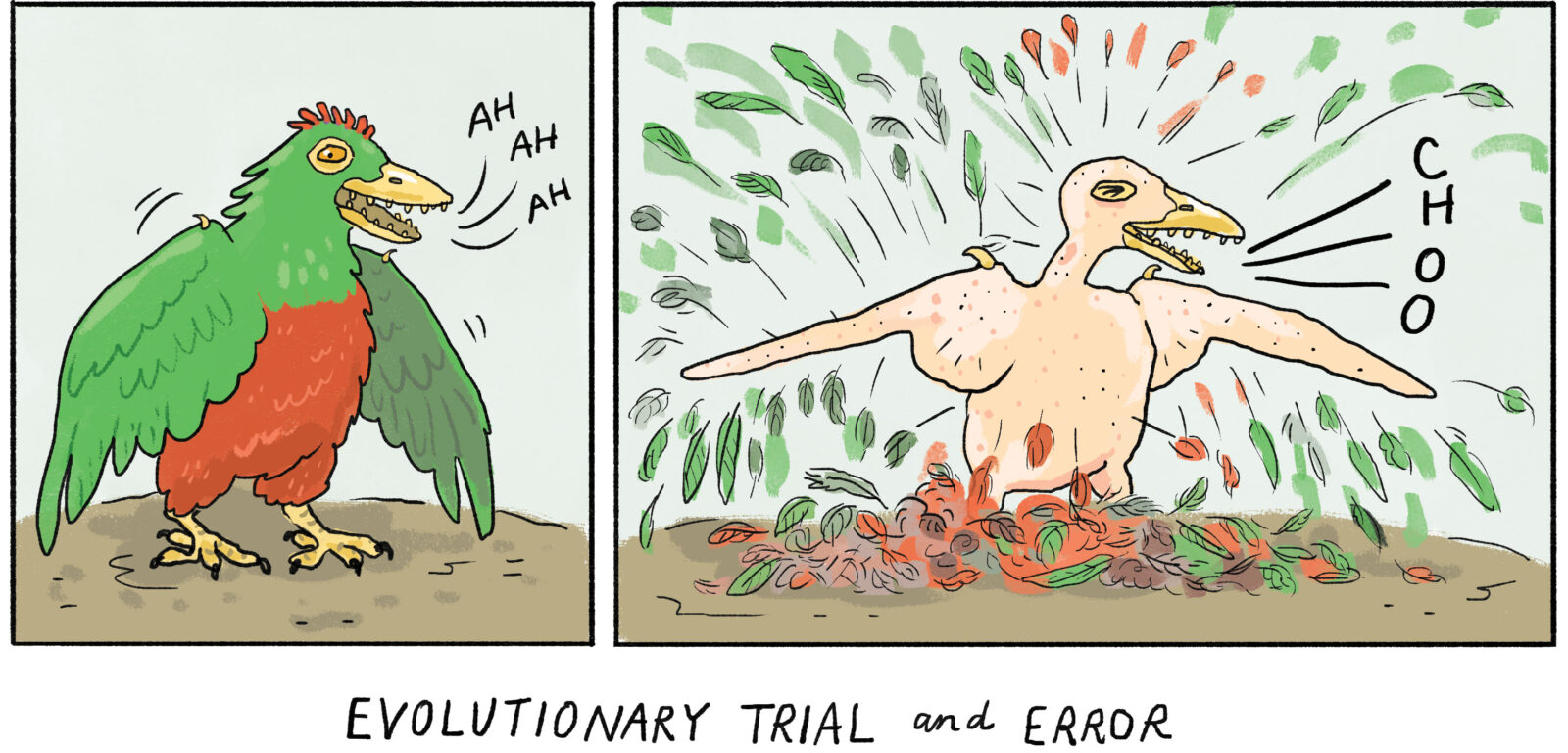
Though they looked pretty similar to modern birds, there were a few key differences: the enantiornithes had teeth in their beaks and claws on their wings. Juvenile enantiornithes also moulted all their feathers at once. That might not sound like a big deal, but O’Connor suspects it might have contributed to the family’s doom.
Today, even for adult birds, moulting is a critical time—necessary, to replace worn and damaged feathers, but risky, since it takes extra energy both to grow the new plumage and to stay warm. (This is why chooks don’t lay while they’re moulting.)
In order to stay cosy and capable of flight, most modern birds moult patches of feathers in sequence once a year. It’s a practical solution, if not an aesthetic one—moulting birds tend to look like they’re having an extremely bad hair day. (Again, kiwi are weird: they continually shed and grow their shaggy feathers throughout the year.)
Baby birds moult, too. Ducklings and chickens never go through a naked stage; they hatch feathered and fairly capable, don’t get much parental care, and moult sequentially like adults do. Young parrots and songbirds, on the other hand, hatch naked and helpless, drop all their baby feathers at once, and rely on their parents for warmth. In these species, nesting adults will often develop a bald spot called a brood patch—a built-in hot-water bottle for chilly naked chicks.
Signs of moulting in the fossil record are rare, but a tiny cluster of baby bird feathers discovered in a chunk of 99-million-year-old amber from Myanmar hints at an intriguing possibility. These feathers seem to belong to an immature enantiornithes, O’Connor says, and it appears they all started growing at the same time—meaning the young bird would have had a naked stage, like a baby kākāpō or blackbird.
But O’Connor’s previous work has shown that enantiornithes were absentee parents, unavailable for snuggling, and their chicks had to be able to fly and feed themselves from day one. “Maybe that was fine in the Mesozoic when it was warmer,” says O’Connor. But when the asteroid hit at the end of the Cretaceous, 65 million years ago, Earth was frigid and food was scarce. Maybe being naked and afraid while also having to find food and keep warm was a key factor in pushing the enantiornithes over the edge.
Without them, the stage was set for the ancestors of today’s birds to take wing—to diversify rapidly and conquer the world, says O’Connor. “Like, ‘Oh, everybody else is dead, boom!’’’
Flight itself was diversifying, too: around 50 million years ago, flight evolved yet again, this time in mammals. Bats, O’Connor points out, are now the second-most-diverse group of mammals after rodents. “It’s their ability to fly that’s allowed them to spread across the world and utilise different resources. Once you figure out how to do it well, flight gives you so many benefits.”
[Chapter Break]
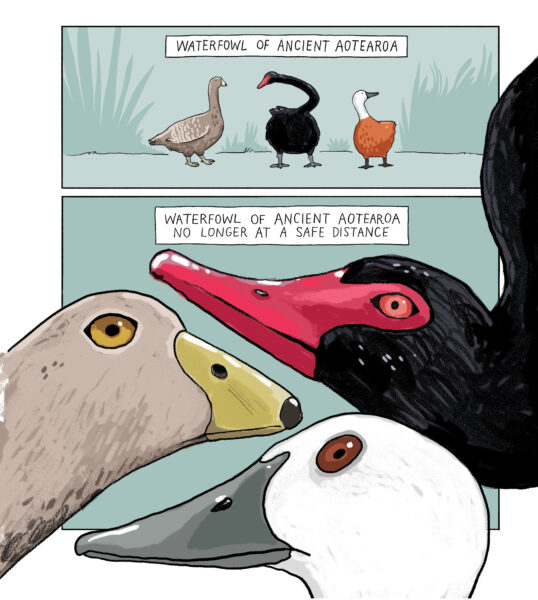
When they got to Aotearoa, though, some birds decided they could no longer be bothered with flying. If it’s so beneficial, why would you give up getting air?
Flying is tiring—it’s the most energetically demanding way of getting around. And if a costly adaptation no longer benefits an animal, it tends to get lost: a theory of evolution dubbed “use it or lose it”. That’s why, in the absence of predators, so many of New Zealand’s iconic native birds famously ditched their powers of flight.
But so have some of our insects, and that change is happening right now, for an entirely different reason.
New Zealand has more than 100 endemic stoneflies. There’s a beautiful bright green one called ngarongaro wai, and a cyanide-flavoured poisonous one, helpfully striped in warning colours. Our stoneflies spend much of their lives as aquatic nymphs—and at this stage they are often used as indicators of freshwater quality, since they only tolerate clear, pristine environments.
In other ways, though, stoneflies are incredibly adaptable. For nearly two decades, University of Otago biologists Jon Waters and Graham McCulloch have been studying Zelandoperla fenestrata, a long-tailed stonefly that is abundant in steep, stony streams from sea level to the tops of mountains throughout the country.
Though its Latin species name refers to the window-like rectangular patterns on the adults’ wings, the interesting thing about Zelandoperla fenestrata is that it sometimes doesn’t have any wings at all.
To understand why, Waters and McCulloch and their team rock-hopped up a series of forested streams on Otago’s Rock and Pillar Range. Every 100 metres they’d turn over a few rocks, and more often than not there’d be a stonefly nymph gripping the underside. “You can just pluck them off,” says McCulloch. It was immediately obvious whether each nymph would turn into a flying or flightless adult, adds Waters. “They’ve either got these big wing buds that are ready to become wings, or they don’t have anything at all.”
As the researchers moved up the mountain, a clear gradient emerged. In the forest, almost every single nymph had wing buds. Above the treeline, the nymphs were almost all wingless.
“You walk another 50 metres above the trees and it’s like, ‘Where have the wings gone?’” says Waters. “It’s some of the most exciting stuff we’ve done because it had never been reported to be like that before, and there it was, this amazing ecological pattern.”
When they made similar treks in Fiordland and the coastal Clutha Valley, the pattern was the same: the change happened precisely at the treeline rather than a certain altitude. It’s not that these are two separate species; when the researchers brought the nymphs into the lab and raised them, the adults displayed no prejudice. “We see a winged one mating with a non-winged one quite happily,” says Waters.
So why are stoneflies losing their wings? Waters and McCulloch think this is a rare example of extremely rapid anthropogenic evolution. Like the peppered moth in the UK—which changed from white to black over just a few decades as the pale trees they lived on were coated in soot (see Just So, issue 175)—the stoneflies are responding to a human-driven change, in this case the forests Māori burned and Europeans cleared when they arrived in southern New Zealand.
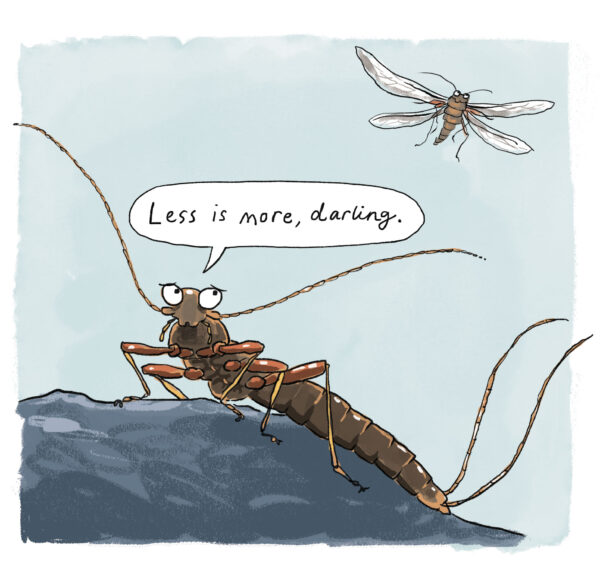
Once the trees were gone, flying suddenly became “a bad strategy”, says Waters. Out of the protection of the forest, strong winds can quickly whip a small insect far from the stream that’s essential to its life cycle. Within just a few hundred years, it seems, the long-tailed stoneflies living above the treeline got larger, lived slower, laid more eggs—and lost their wings.
“This is one of the best examples I know of evolution happening before our eyes,” says McCulloch. What makes it so fast, the researchers suspect, is that a single gene regulates whether the wings grow or not. The species is “obviously very prone to wing loss when the conditions are right”, he says. “If there’s one magic gene which controls the whole thing, then natural selection can drive it really quickly and efficiently.”
The Otago researchers have spent 15 years trying to pin down that “magic gene”—the one tiny genetic change among a billion bases of DNA—and are now confident they’ve found it, at least in the stoneflies from the Rock and Pillar Range.
Having this gene has given the long-tailed stonefly a huge advantage, Waters says. “This is an incredibly successful species. Everywhere there’s rocky rapids, you find it. It’s this hyperadaptable, flexible thing, and I think that allows it to survive where other things might just fall over and go extinct as the environment changes.” In other words, the ability to ditch its wings has allowed the stonefly to soar.