Pick a side
Bees and cockatoos, walruses, spider monkeys, pūkeko—throughout the animal kingdom, individuals often favour a certain hand (or eye, or antenna). But how did so many humans end up right-handed? And why, historically, did we give lefties the side-eye?
Raise your hand if you’re right-handed. Ninety per cent of us are. And while a tiny handful are ambidextrous—equally capable with either hand—most of that remaining 10 per cent are lefties. It’s a pattern that holds across human cultures and countries, despite some historical efforts to convert left-handers to righteousness.
Like many minorities, left-handed people have frequently been viewed with suspicion. Left-handers in medieval Europe risked being accused of witchcraft. In French, gauche means left; it also means awkward. Arabic words for left-hander translate as loser, difficult, or insincere, and in many Muslim cultures, using the left hand for eating or shaking hands is a no-no (it’s strictly for wiping your bum). In Irish Gaelic, ciotóg means left-handed, but has echoes of both clumsy and strange—perhaps even touched by the Devil, thought to be a lefty himself. And English has a plethora of derogatory nicknames of its own: cow-pawed, gibble-fisted, mollydooker, goofy.
Scientists, on the other hand, call our preference for using one side of the body over the other “lateralisation”. It’s most noticeable when we hold a pen, sword, or cricket bat, but it goes beyond just hands—we also have a preferred foot, eye, or ear for processing certain information, or a preferred direction to spin when dancing or flipping. So do many other species.
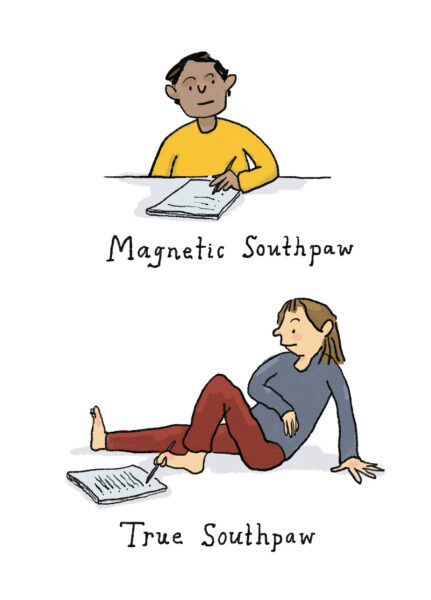
Walruses are thought to be right-flippered, for instance, while 95 per cent of kangaroos are southpaws—using their left paw for grooming, bringing leaves to their mouth, or leaning on while grazing. Anecdotal reports suggest pūkeko may be lefties, too. Some social insects have a preferred antenna.
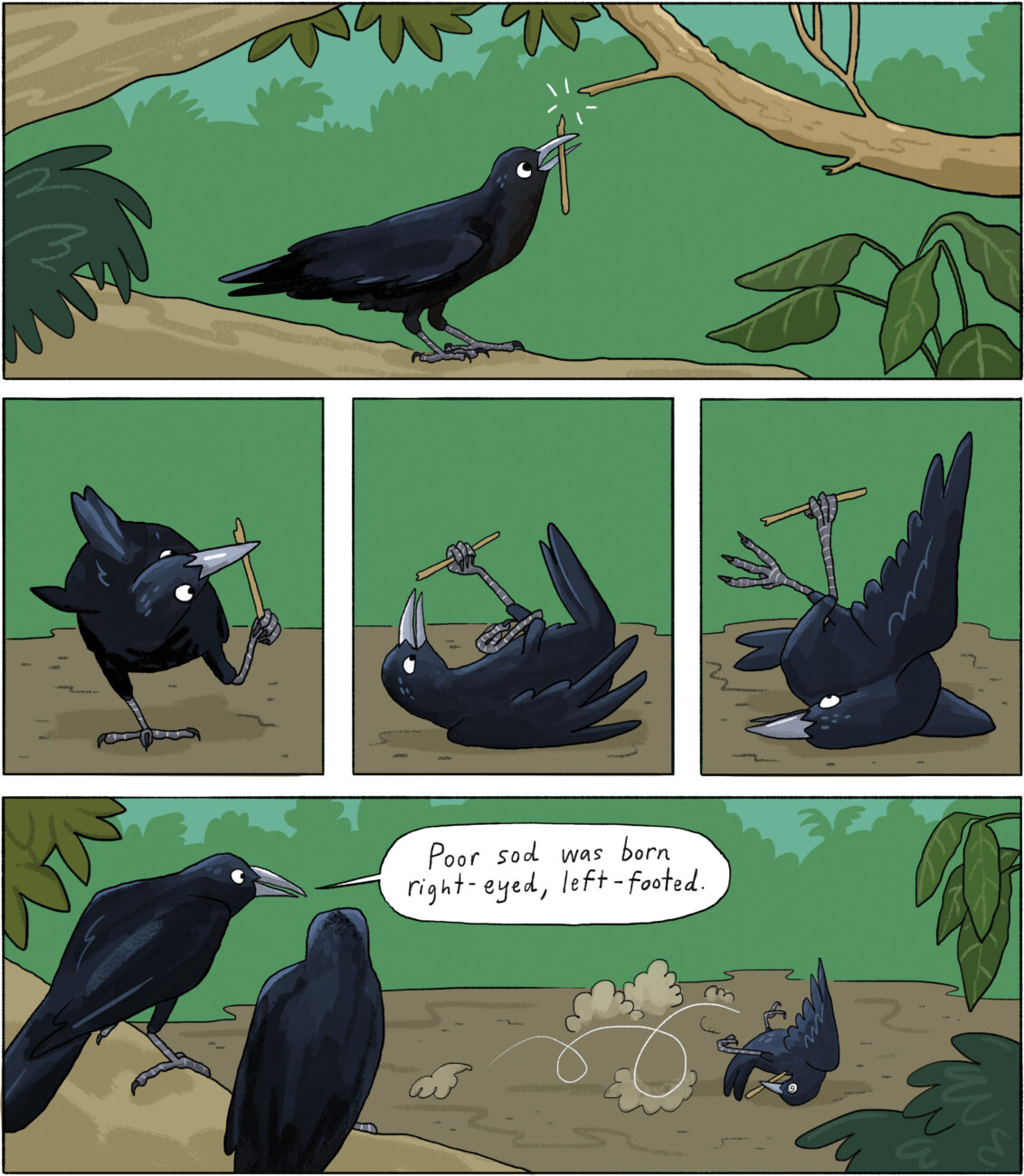
And since birds’ eyes are located on either side of their heads, for them, foot preference seems to be connected to eye preference. Young sulphur-crested cockatoos experiment with using either foot and eye to pick up and examine food, but all eventually settle down to become left-footed, left-eyed adults. New Caledonian crows, meanwhile, favour their right eye and foot when whittling twigs into fishhooks.
Humans are odd in several ways, though. We’re especially strongly lateralised—almost all of us are born with an innate preference for using one hand over the other for complex tasks. One study showed that fetuses that sucked their right thumb in the womb all grew up to be right-handed.
And as a population, we are unusually skewed towards the right. In this regard, our species is an “unmatched extreme” among other apes and monkeys, scientists report. So why the 90-10 split? Why don’t we all lean one way, or fall into two roughly equal camps? Why do right-handers rather than lefties dominate? And why does laterality exist at all?
[Chapter Break]
That last question is the easiest to answer, says Kai Caspar, a zoologist at the Heinrich Heine University in Düsseldorf, Germany. Hand (or eye or foot or antenna) preferences are the result of asymmetries in the brain: in general, the left hemisphere of the brain controls the right side of the body, and vice versa. The brain is expensive real estate, and specialising with a particular hand—and thus just one side of the brain—saves energy and space inside our skulls. It’s more efficient to have just one set of neurons that know how to thread a needle, knap a flint stone tool, or draw a face.
But why are so many of us drawn to the right?
One theory, inspired by South African galagos, or bush babies, is that our tree-living ancestors were left-handed, supporting themselves on branches with their right hands while using their more dextrous left to grab prey, fruits, or leaves. (With typical bias, the word “dextrous” derives from Latin for right.)
When ancient primates emerged from the trees, this theory goes, they were free to switch to their right hand for complex tasks like making tools. But this does not explain why they would switch.
Another hypothesis predicts that the larger the brain, the stronger the lateralisation. Big brains need to use more energy to send information between more distant hemispheres—so there’s greater benefit in picking a side. Perhaps as our human brains grew, they got more lateralised, and more strongly right-handed?

Caspar and his team set out to test these theories. They visited dozens of zoos around Europe to put 38 species of monkeys and apes through their paces: 1786 individuals in total. The researchers filled a plastic tube with a tasty treat—oatmeal for the gibbons, boiled carrots for the geladas, rice and nuts for the South American sakis, banana mash for the golden lion tamarins—and handed it over, recording which hand each animal used to hold the tube, and which it used to extract the food.
“Sounds simple, but it’s essentially a window into the brain of these primates,” Caspar says. Think of opening a bottle, he says. You’ll typically hold the bottle still with your less-dominant hand and twist the top off with your preferred one. Likewise, for the monkeys, the tube task was just complex enough to reveal their hand preferences.
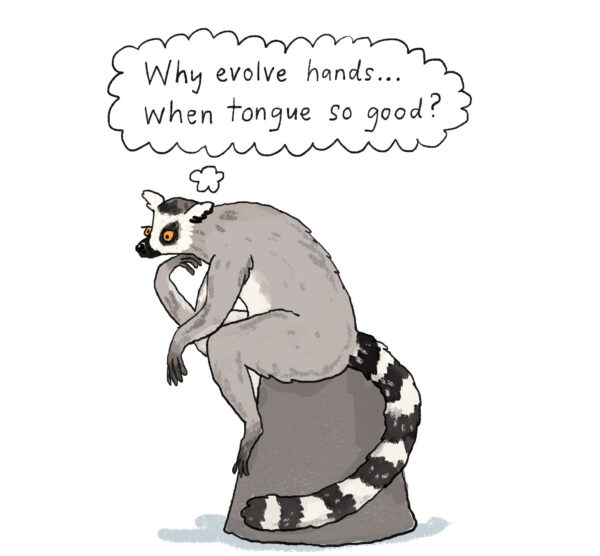
Except for the lemurs. “The lemurs had trouble with the task,” says Caspar. “They were very motivated to get to the food. But very few had the idea to reach into the tube.” Instead, they tried to lick it out with their tongues, almost dislocating their jaws in the process. It’s not clear whether they’re less coordinated or less smart, says Caspar—the scientists cut their losses. “The lemurs were just slowing us down.”
Results from the remaining 35 species were diverse and surprising. Around 70 per cent of the golden snub-nosed monkeys were left-handed. The majority of chimps and gorillas were right-handed, but much less strongly so than humans. Most geladas—a type of grass-eating baboon from Ethiopia—would happily use either hand.
And the spider monkeys disproved a bunch of the main theories all by themselves. They swing through the rainforests of South America on their long arms and lack opposable thumbs. If the hypothesis based on bush babies was correct, you’d expect spider monkeys to still be left-handed.
But they’re fairly equally split between left and right, and individuals are just as strongly “handed” as humans—a blow for the brain-size theory as well, since spider monkeys don’t have especially large brains.
Another theory holds that animals that make tools have stronger hand preferences, but the spider monkeys countered this idea, too—they don’t make tools, despite very much preferring one hand over the other. Caspar’s team also found little to support the theory among the great apes and capuchins, the only other species to use tools.
So we’re basically back to the drawing board. That’s fairly typical in science, Caspar says—“in most cases, the simplest explanations are just weeded out after a while”, and we realise everything is even more complex than we thought.
“I’m convinced that there is a very exciting evolutionary story behind handedness, but we are still a few steps away from unravelling that.”
[Chapter Break]
Sometimes studies of other animals reveal unexpected things about ourselves. When Kelly Jaakkola and other scientists at Florida’s Dolphin Research Center went looking for evidence of handedness and other asymmetrical behaviours in bottlenose dolphins, they stumbled instead on a quirk in human perception.
The researchers spent four years observing 25 captive dolphins. Recording which fin they waved or slapped the water with was straightforward enough (the animals did not display any strong preference).
But agreeing on which way the dolphins were spinning? That was controversial, Jaakkola says. Two team members would look at the same dolphin swimming and one would record it as spinning left, the other right.
“It was like, ‘What are you talking about?’ And what we discovered, after lots of arguing, is that what we’re calling left or right when you’re talking about a spin depends on the orientation of the animal”—in other words, whether it is swimming horizontally or vertically.
Why should this matter? Jaakkola had a theory, and she enlisted her daughter to test it (do try this at home!). “I said, ‘Hey, don’t ask any questions. I need you to do something for me.’” She asked the girl to lie on the ground and roll to the right. Then Jaakkola told her to stand up wand turn right. The movements were exactly opposite. “It’s crazy, right?”
When you’re horizontal and you roll right, your left shoulder moves towards your back. If you’re standing up, to turn right you bring your left shoulder forwards. (If you don’t feel like rolling on the ground you can just try turning a pencil.) Because no-one had noticed this before, Jaakkola realised previous studies suggesting dolphins preferred to spin to the right may not be reliable.
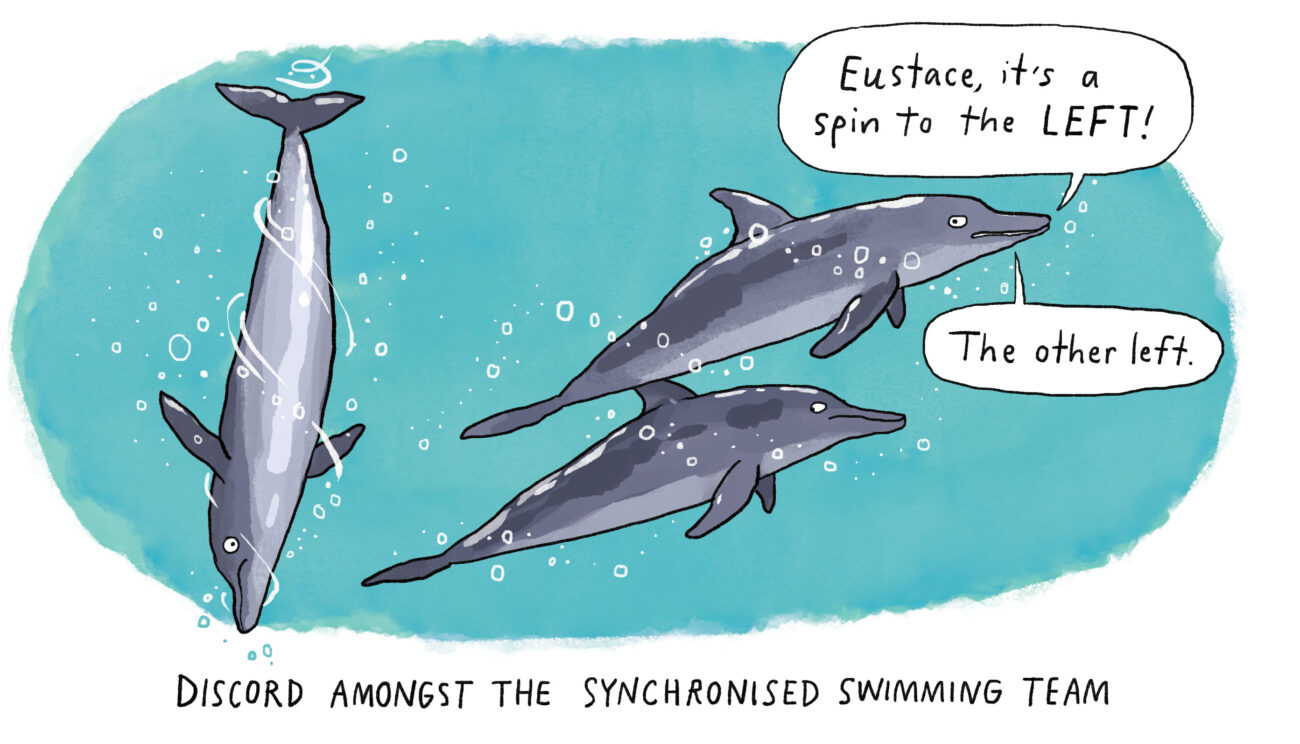
Eventually, her team hit on a way to make sure they were consistently recording the dolphins’ spins. Pointing their thumbs towards an animal’s head, they observed whether it was spinning the way our fingers curl on our left hand, or on our right. And when they did that, they found that dolphins spin every which way. They don’t show a bias for turning left or right, either as individuals or as a population.
There was just one way they did show lateralisation. When the dolphins swam in circles around the centre’s circular lagoons, they almost always went counter-clockwise. Jaakkola points out that many social animals prioritise their left eye for social interactions—she thinks these dolphins were keeping their left eyes glued to the rest of the pod, not the gawking crowds.
[Chapter Break]
In 2016, a retired scientist from the UK’s Natural History Museum found a left-coiling garden snail (Cornu aspersum) in his London compost heap—a rare, one-in-40,000 discovery. “He mailed it to me by snail-mail, of course,” says Angus Davison, a geneticist at the University of Nottingham. Davison was thrilled; he’d never seen a lefty snail in his life, and here was a chance to study the genetics of chirality—mirror images in animal bodies. How do the left and right sides of the body develop in the first place? Is there a left-coiling snail gene? Or is it simply an accident, a chance birth defect?
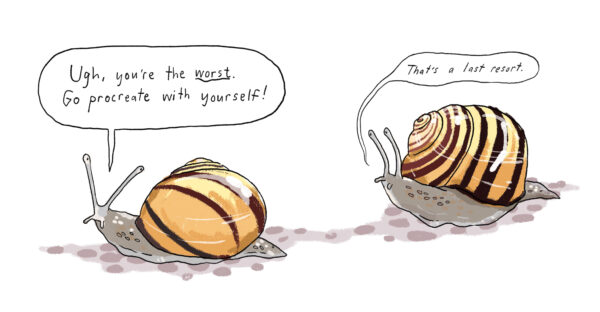
To find out, Davison needed another lefty snail. All snails are hermaphrodites, sporting both male and female genitalia on the side of their heads, but they need to mate with another snail to make babies. And most of the time, opposite-coiling snails “simply can’t get it together”, Davison says.
He named his oddball snail Jeremy, and organised a #snaillove publicity campaign. “The amazing thing is, it worked.”
Over the following year, two more lefties turned up—one found by a British snail enthusiast, the other by a French snail farmer who was breeding the molluscs for the restaurant trade. Unfortunately for Jeremy, neither seemed interested in him; instead, they mated with each other. Gastropod Love Triangle Tragedy, screamed a British broadsheet. Davison tried to maintain a scientific detachment.
Jeremy did eventually mate. But every single one of the lefty snails’ offspring was right-coiling. That tells Davison that in this trio’s case, leftiness was not genetic—instead the result of a fluke during early development. “Some accident, something in the way.”
In other snail species—even, he later discovered, in other populations of garden snails— there is a left-coiling gene, but still, the majority of snails worldwide are right-coiling. Davison hopes one day to figure out why: is it simply that the first snail was a righty, or do the tiny molecules that make up a snail themselves twist right, making it easier to make a clockwise shell?
By the end of Jeremy’s short life, the sinistral snail was a shellebrity, starring in more than 1000 news articles. “Ironically, the same scientific advances that had only been of limited wider interest some months earlier were headline news when introduced by a lonely snail,” Davison wrote in a scientific paper. Why? “People could empathise with a lonely snail,” he reckons. “They went, ‘Ohh, poor snail, no one to mate with, all on its own.’”
Last year, Davison was amazed to discover his own left-coiling snail on a wall near his Nottingham home. It was a different species, the pretty striped grove snail (Cepaea nemoralis). After a naming competition, it was christened Coily Minogue. Coily is about to emerge from hibernation in Davison’s fridge—another lonely lefty snail, awaiting its chance to breed.
[Chapter Break]
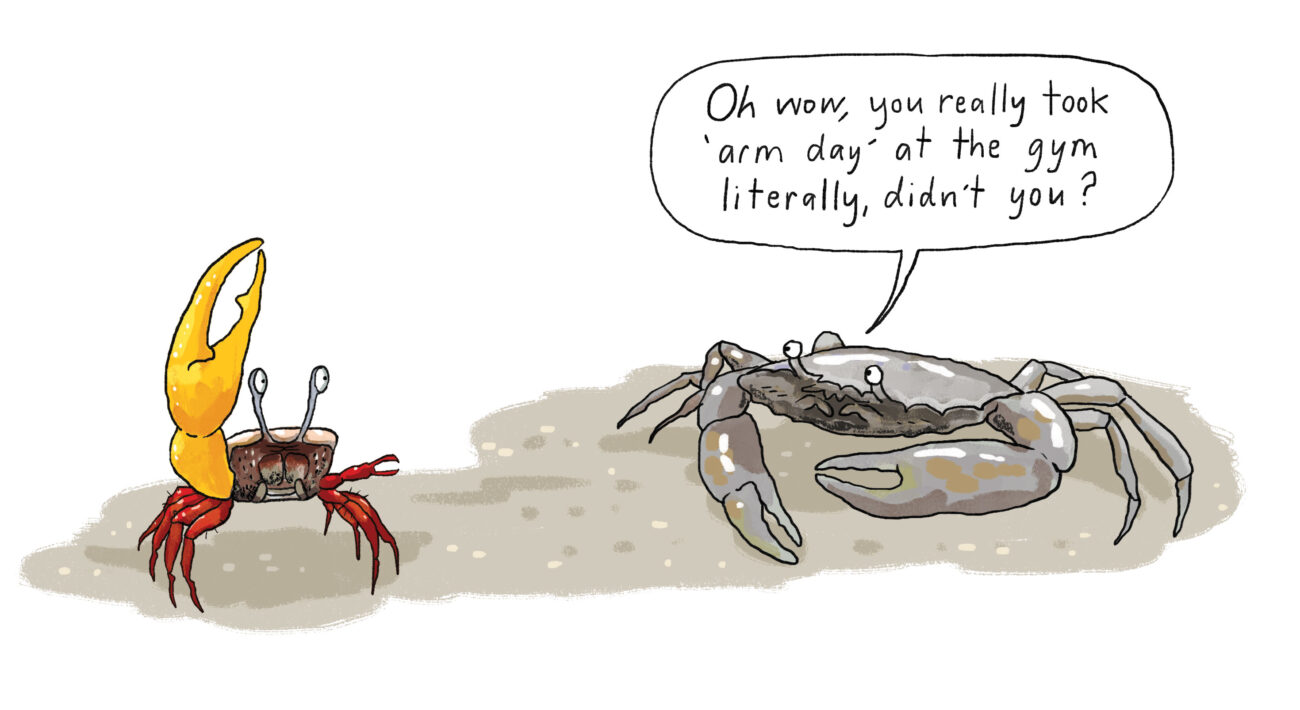
Most of us will have plucked snails from our lettuces without ever noticing which way their shells coiled, and until we watch a friend sign their name, we might not realise they’re a lefty. But other animals’ handedness is right in your face. Male banana fiddler crabs crowd the mudflats of northern Australia, waving their bright-yellow oversized claws to attract a mate in a kind of synchronised, beefed-up come-hither.
“Females like tall waves, they like big claws, they like faster waves, and they like leading waves—the one that is breaking up the synchrony, that is starting first,” says Daniela Perez, now at the Max Planck Institute of Animal Behavior in Germany. She has spent years on mudflats in both Australia and Brazil watching tiny crab dramas unfold at her feet and trying to avoid getting nipped.
Females also appreciate a good burrow, she says. And the quick way to get one is to steal it, claw-to-claw. Half the males have a big right claw, and half are lefties. The argy-bargy starts with pushing, forearm to forearm, then the crabs lock pincers and grapple.

Perez and her colleagues observed 156 of these fights and found that they are tamer when two crabs of the same “side” square off. When left- and right-handed crabs fight each other, conflict is more likely to escalate to grappling. For now, since the population is split 50:50, this gives no advantage to either right- or left-handed crabs.
But Davison points out that if a chance event were to skew the population, it would quickly become advantageous to be in the majority group. It’s possible this is what happened millions of years ago in a group of fiddler-crab species where now, around 99 per cent of males have an oversized right claw.
Say, for some reason, one day there are slightly more right-handers than left-handers. Lefties will have little choice but to enter more often into costly, tiring fights with right-handers. They’ll be more exhausted, more injured, more likely to lose fights, burrows, and mates. And that’s the kind of disparity evolution can sink its teeth into.