The Pā Builders
Five hundred years ago, people starting building pā all over northern New Zealand—fortifying their settlements with rows of pointed palisades, cut from the surrounding forests. Why? What were pā defending—or trying to say? The trees themselves—combined with mātauranga Māori—tell a story.
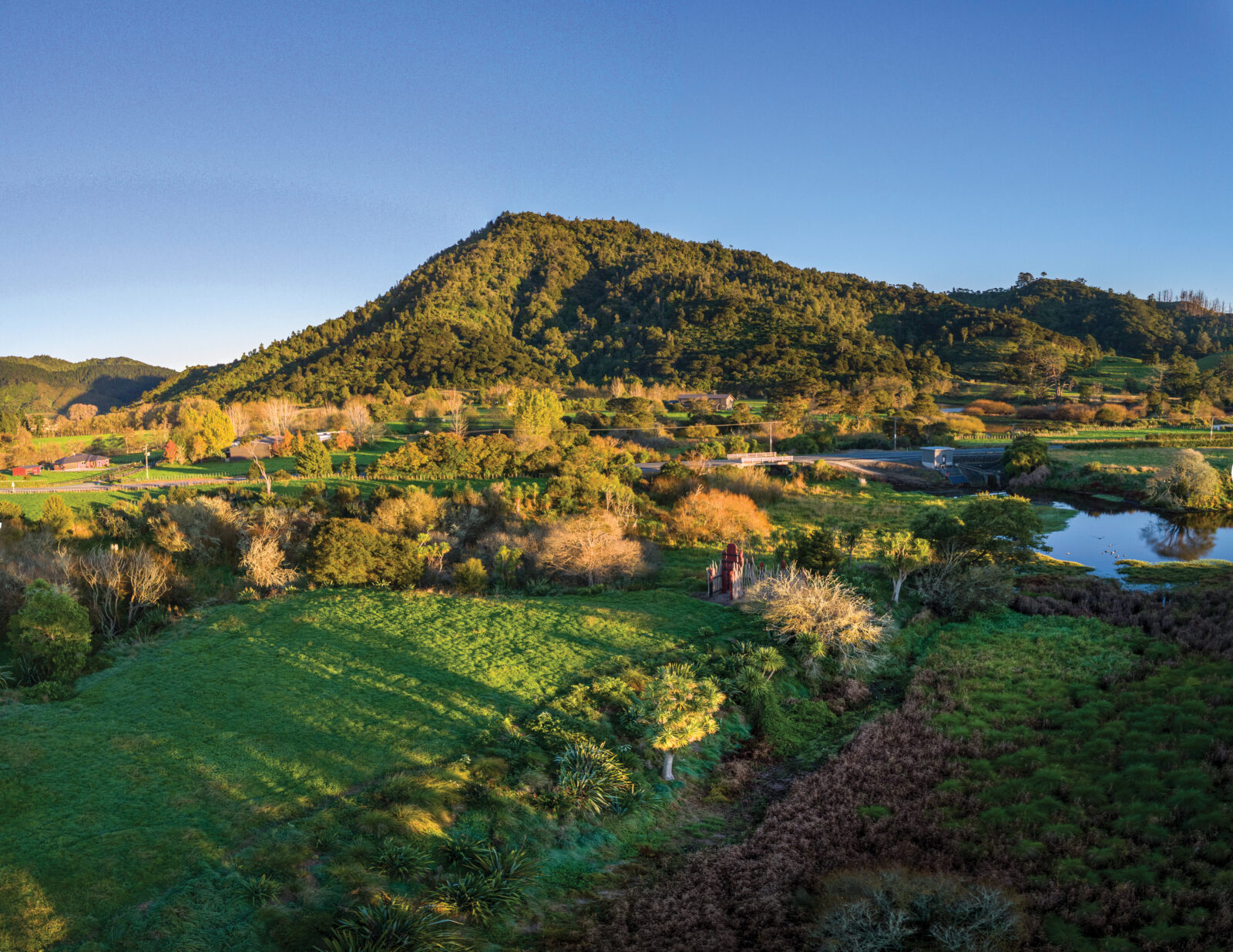
Beneath the fern-starred slopes of Taupiri maunga, between the twin arteries of the Waikato River and the Waikato Expressway, there is an ancient pā.
Tukukino George, carver, kūmara gardener, member of the Waikato iwi and father of many, knows this place and its stories as well as anyone. One bright March morning, we stand together looking across a silty wetland at the home of his ancestors.
Ducks rise into the sky as we approach, and later, a heron perches among flood-cast logs. A long fin slicing the water could be a tuna—or maybe just a carp. Behind the swamp, the old pā site rises above the raupō, its crest crowned by ancient tōtara and a row of palisades, recently carved and erected here as a reminder of the defences that once encircled the settlement.
Though the water route from the Mangawara Stream behind us is now choked off by weir and road, it’s still possible to imagine people arriving here by waka, skirting the eel traps, pulling the canoes ashore.
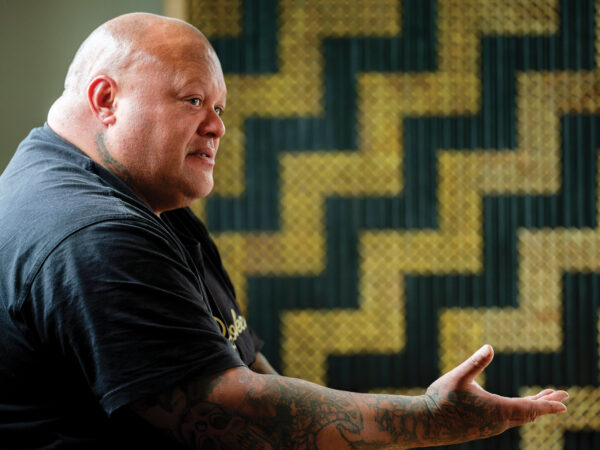
Almost half a millennium ago, George tells me, his ancestor Mahuta made the decision to leave Kāwhia, the landing place of the Tainui waka and by then a well-established settlement, and make the 100-kilometre journey here, to Te Uapata. Another Kāwhia chief, Te Wehi, mocked him about it—and their verbal sparring was immortalised in a haka.
“I think of that haka every time I come here,” says George, leaning on the weir’s metal barrier. “E Mahuta, E Mahuta, ka hoki koe ki Te Uapata. Hey Mahuta, you’re going to Te Uapata where there’s no food—or where the food is shit.” The haka records Mahuta’s counter-sledge that he was in fact heading to a place of healthy springs and abundant pikopiko, the delicious coiled koru shoots of ferns.
The narrative doesn’t say if there was a pā here already. Perhaps Mahuta established one himself, having heard about the site’s prospects from his own grandfather Pikiao, who had previously roamed the Waikato in search of a wife. The kōrero, told and retold down the centuries, illuminates a moment, a portion of a life. But much is missing, too.
In the years since Mahuta, this place has seen many human dramas—some momentous, some domestic, some memorialised, others forgotten. Now, another story unfolds at Te Uapata.
[Chapter Break]
Across Polynesia, pā are extremely rare. They’re found on only a handful of islands in all that vast ocean. When people first arrived in Aotearoa sometime around the start of the 14th century, they did not bring a pā-building culture with them. But around 200 years later, Māori began constructing fortified settlements, especially across the northern two-thirds of the country.
These pā became an integral part of Māori culture, an answer to problems unique to this place and these people. As the problems changed, so did the pā: one of the most famous, Te Ruapekapeka, north of Whangārei, was purpose-built to withstand British artillery—not to protect terrified whānau, but to hassle and delay the enemy. Inside its network of tunnels and bunkers, and a double palisade of huge pūriri logs, 400 Ngāpuhi and Ngāti Hine warriors held off 1600 heavily-armed British for more than a week. Some historians have argued (although others disagree) that the earthworks and ditches of pā were the inspiration for the trenches that later scarred European fields during World War One.
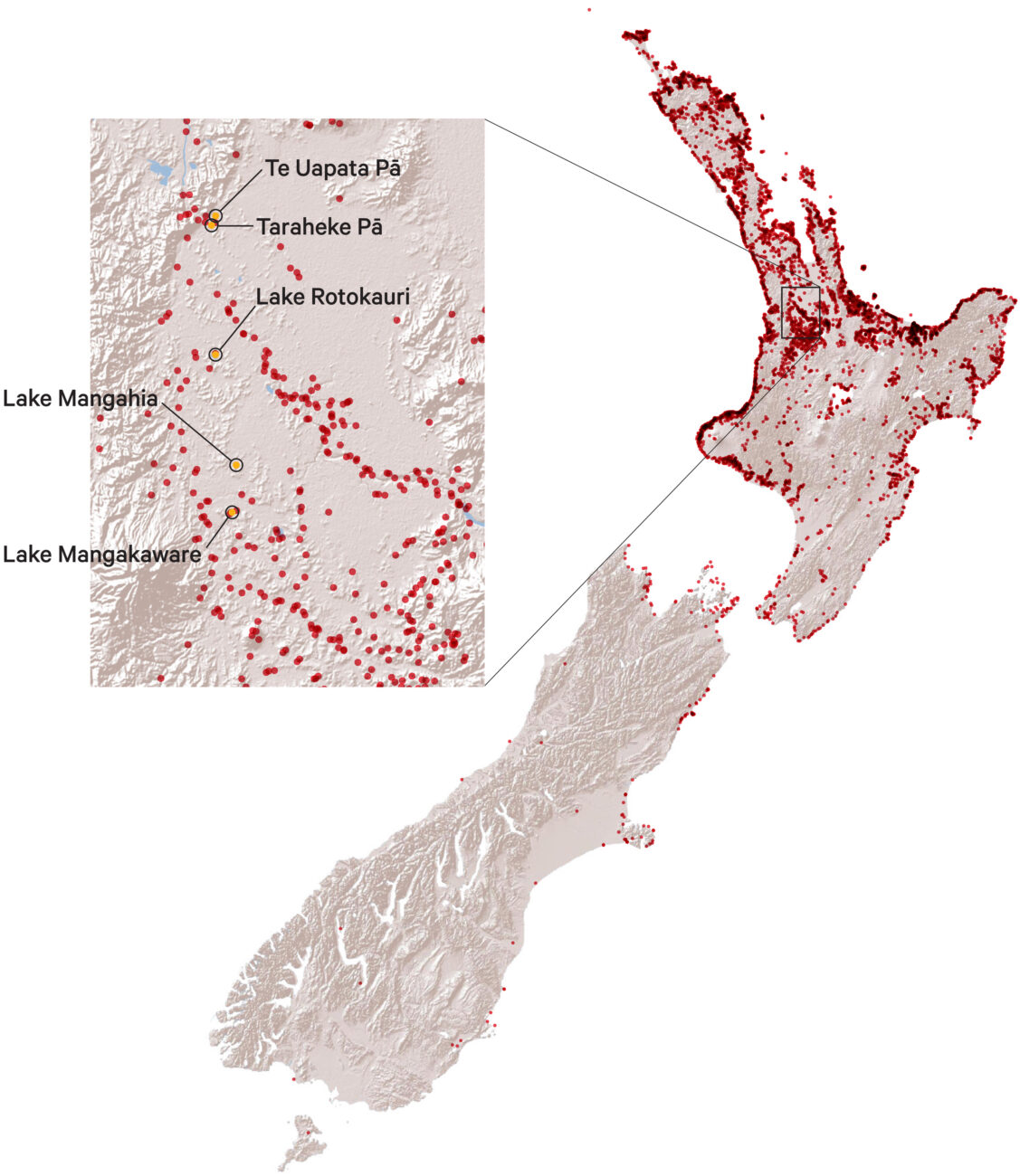
But who built the first pā, and why? Was the innovation driven by changes in climate, agriculture, or war weaponry? Oral histories record some kōrero about individual pā and the people who lived there—like the story of Mahuta—but they don’t stitch together the 7000 pā we know about so far, nor their evolution over time. And until recently, this wider, overarching story has received little attention from archaeologists.
In the early days of academic archaeology in New Zealand, the 1950s and 60s, some researchers got permission from local communities to work on pā. But a few cowboys started digging up sites without any involvement of mana whenua. Unsurprisingly, Māori were not impressed. Research dried up for a generation.
Now, a team of archaeologists, historians, and radiocarbon dating experts, working with Waikato mana whenua, have pinpointed key moments and long-term trends in pā construction in the region.
“I think it’s been the most successful piece of archaeological research in New Zealand,” says the project’s lead archaeologist, Warren Gumbley. He’s not the bragging type—he’s just proud. “One of its strengths is that it’s using two different knowledge bases to approach the same problem.”
[Chapter Break]
My own first encounter with Te Uapata takes place five years ago, in March 2021. The scent of silage wafts from adjacent farms, and the air hums: paper wasps, the nearby motorway.
Alan Hogg, an expert in radiocarbon dating, is lying on his stomach in a reedy ditch. Though at least a generation older than his PhD students at the University of Waikato—such as Rowan McBride, currently leaning on his spade nearby—Hogg has taken enthusiastically to the rigours of archaeological fieldwork. “I’m 27 and he’s fitter and more gung-ho than I am,” says McBride.
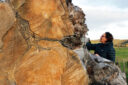
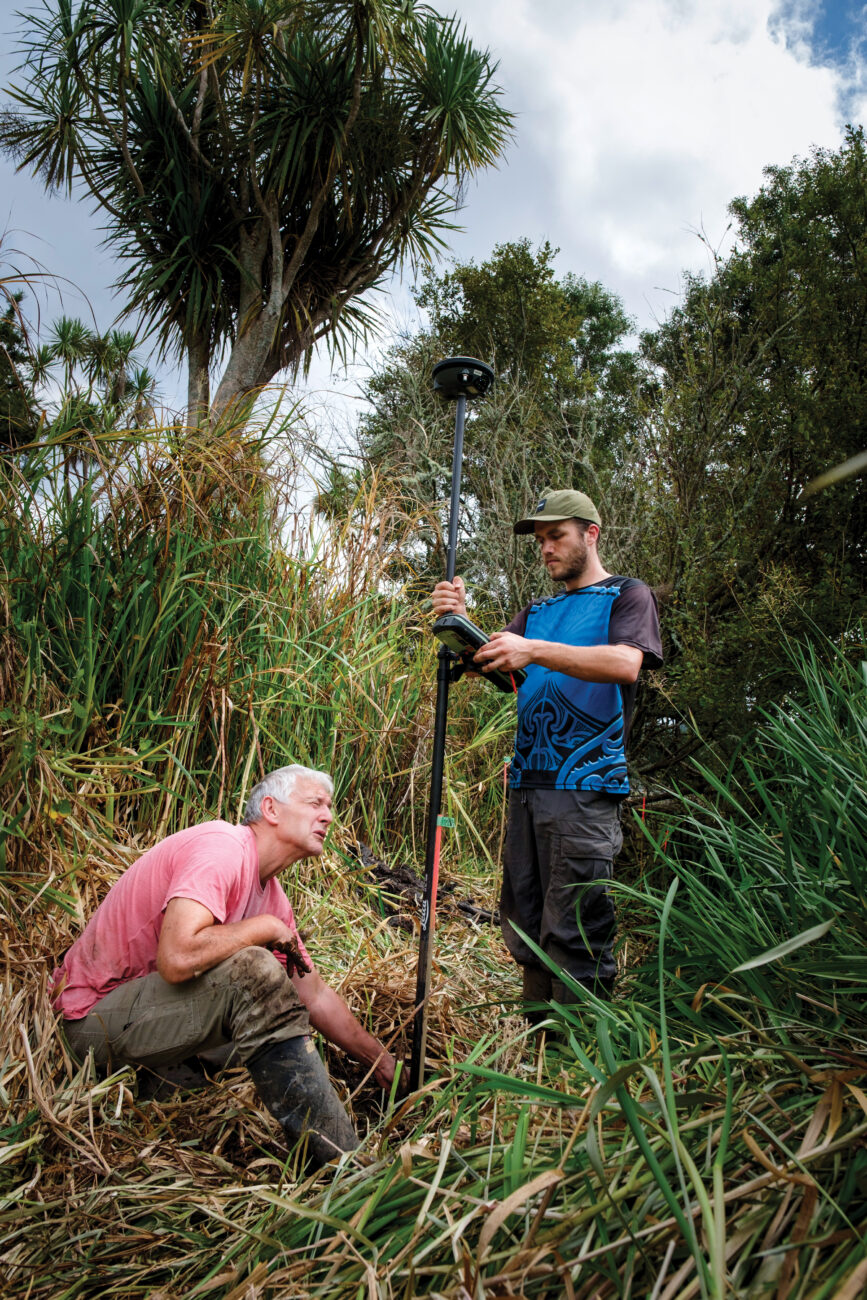
Mud coats Hogg’s arms to the elbows as he scoops deep brown peat—the colour of dark chocolate—out from the base of an ancient palisade. It’s a foot-square hole, the post sticking proud from the centre, eroded at the tip like a rotten tooth. “That’ll be a good one,” Hogg says. It’s well preserved, a decent size, and it’s still cupped in bark—crucial, for reasons we’ll get to soon. “Can you push my glasses back on?” Hogg asks McBride. They’ve slipped down his sweaty nose, and his hands are filthy.
If you’re from Auckland, you might imagine pā belong on hilltops, thanks to the echoes of stepped terraces that score so many of the volcanoes dotting the city. But in the Waikato, wetland pā are much more common—they’re built on lakesides, or the low peninsulas that extend into loops of the region’s rivers, their edges boggy and weed-infested.
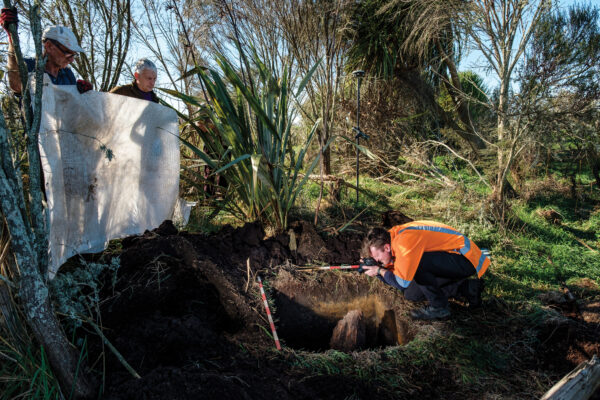
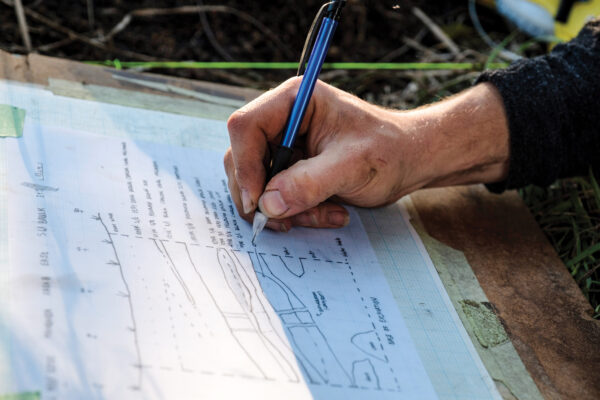
For archaeologists, though, these quagmires are goldmines. The peat soils found in wetlands harbour barely any oxygen, so wooden objects don’t rot. Nationwide, the vast majority of our swamps have been drained, paved over, or otherwise destroyed. But the Waikato is home to at least a dozen partially-preserved wetland pā.
“These wet sites provide a record that’s irreplaceable,” says Gumbley. “They’re like a super-museum, because things are actually where people left them.” Only a tiny fraction of these pā have been excavated, but all kinds of things have turned up in them—adzes, waka, paddles, gardening tools, weaving sticks, spears, equipment for fishing and eeling, kitchen implements, even the woven flax and bark mats used as flooring in whare.
The day I visit Te Uapata, Hogg finds half a pumice bowl, its everyday curve so familiar, like it could almost still hold soup or breakfast cereal. Except—“it’s broken, so someone’s probably just thrown it away,” says Gumbley. “Chucked it over and it came to rest at the bottom of the fence.”
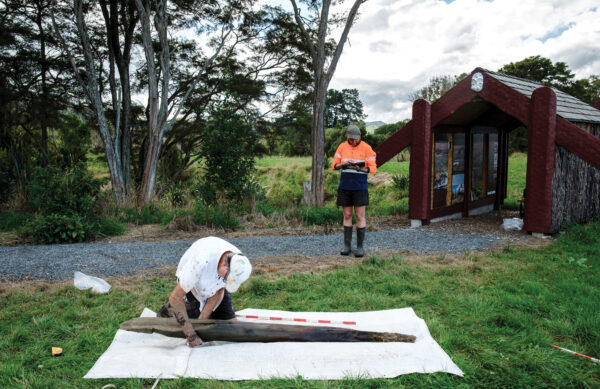
Dug metres deep into the peat, some of the pointed palisade posts have been preserved unchanged for centuries. And if you have wood with plenty of visible rings and bark still attached, you can precisely date it. Hogg has spent his 47-year career dating tree rings and soil in the University of Waikato radiocarbon dating lab, trying to improve the accuracy of carbon dating and to answer questions about past climates and volcanic eruptions. Talking with Gumbley, he realised no one had ever precisely dated palisade posts before.
You might have to hack through overgrown weeds, crawl among the raupō, and immerse yourself up to the armpits in black mud, but if you could find a post that was once a whole tree, you could calculate—to within a handful of years—exactly when that tree was felled with an adze, hauled across the swamp and raised up again, ready to protect a pā.
[Chapter Break]
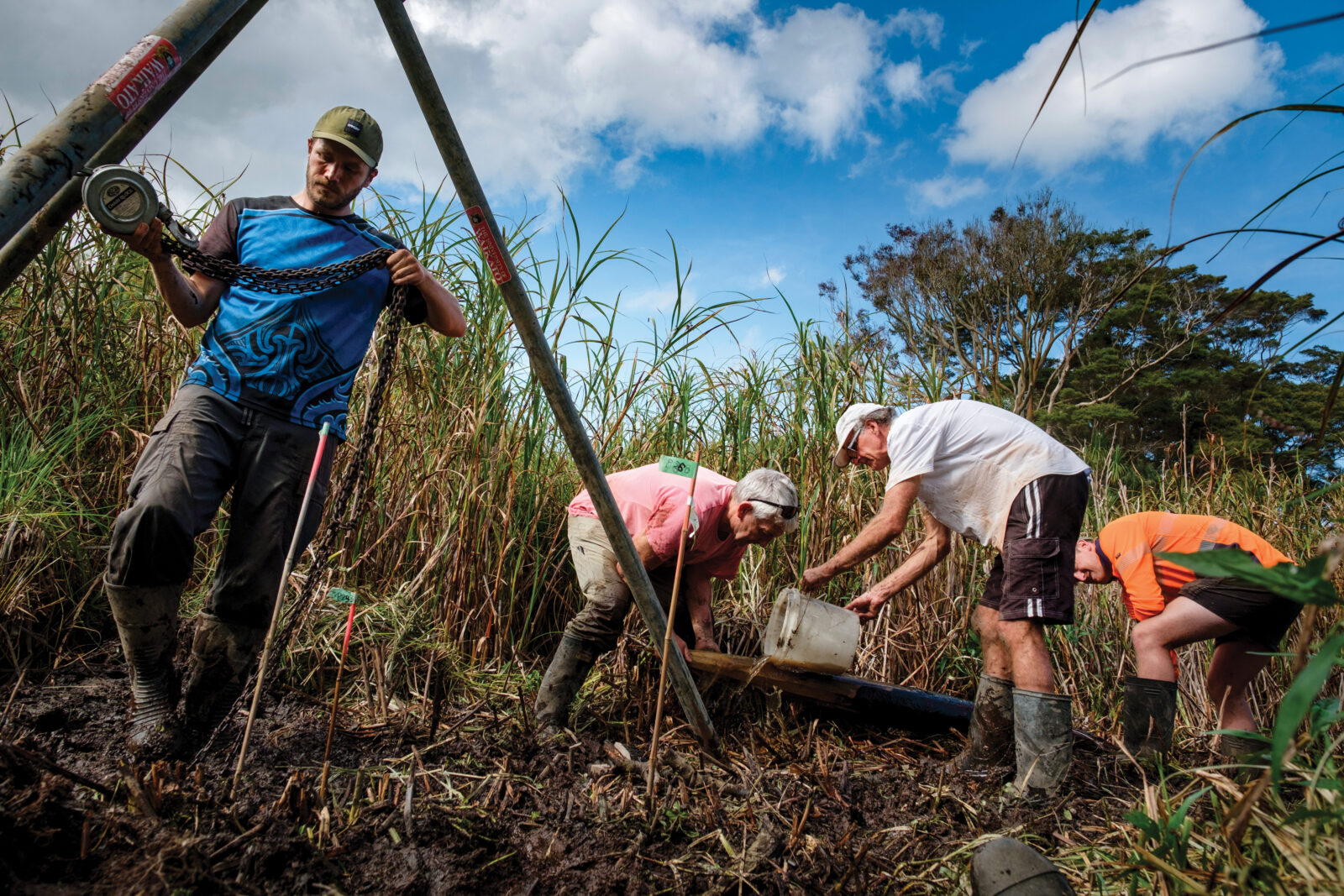
The next part of this story plays out over several years, stalled occasionally by the pandemic and other disruptions. At Te Uapata, and at five other wetland pā sites across the Waikato, the team—Gumbley, Hogg, McBride, and a second doctoral student, Zac McIvor (like George, his iwi is Waikato)—locate 350 intact palisades. They select the best ones, and use metal tripods fitted with pulleys to extract each post from the sucking mud.
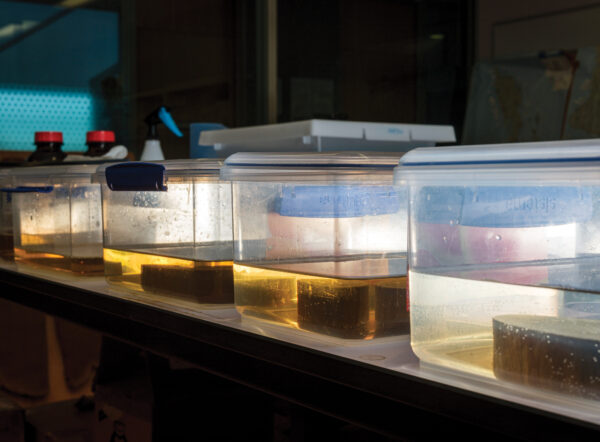
They measure each post, GPS-tag its location, photograph it, and chainsaw two round, inch-thick “biscuits” from the end. Then they ease the posts back into the holes where they found them.
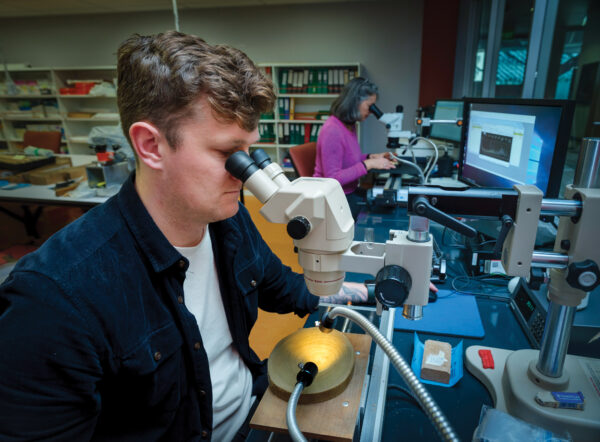
In the lab, with another supervisor, University of Auckland dendrochronologist Gretel Boswijk, McBride cuts extremely thin slices from each sample and analyses them under a microscope. The pā builders used a wide variety of wood for their defences, depending on what grew nearby: mataī and miro, pukatea and pigeonwood, tānekaha and tawa. In extreme close-up, the cell structure of each species differs, and McBride can compare their blobs and streaks to a collection of reference images to identify the tree type.
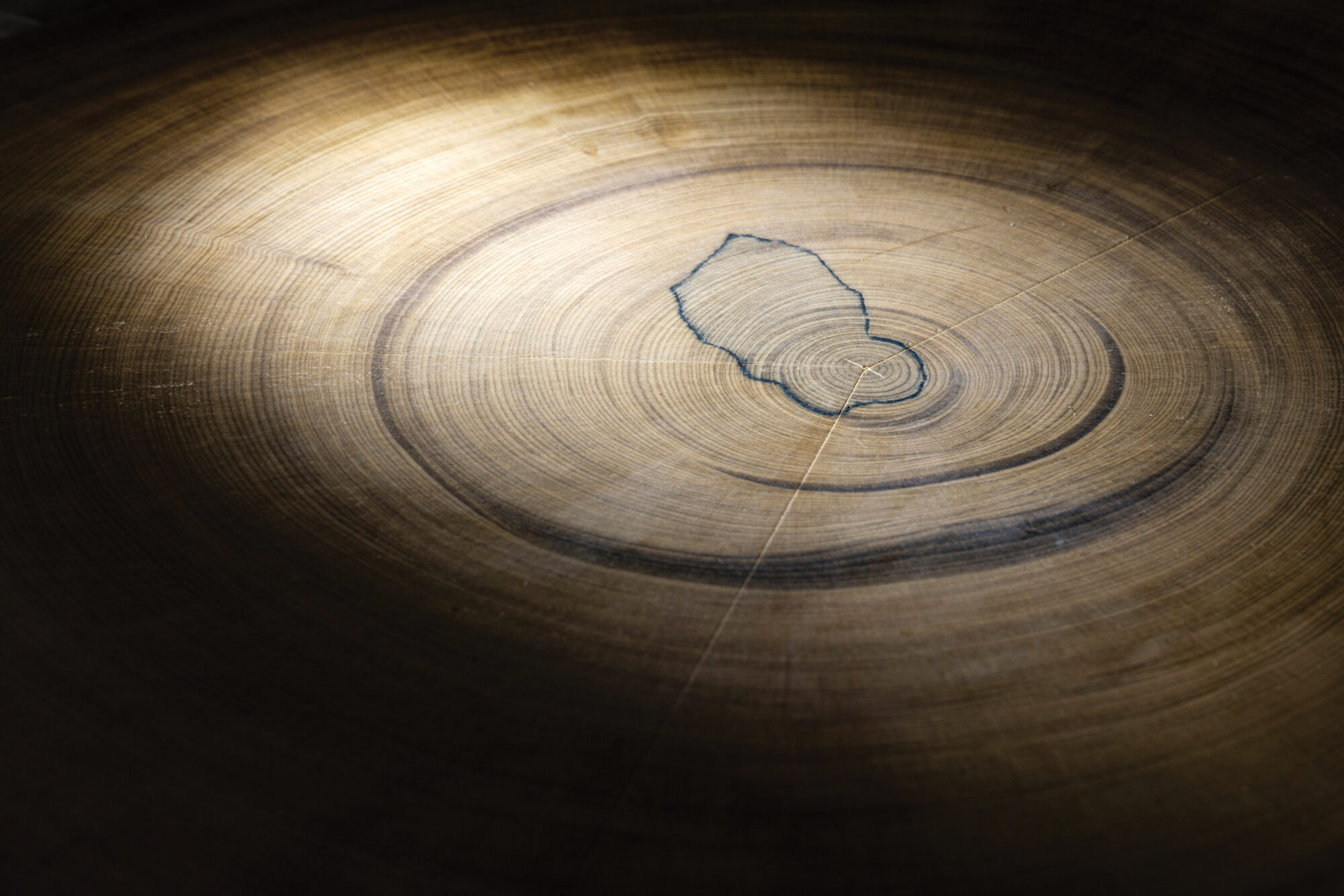
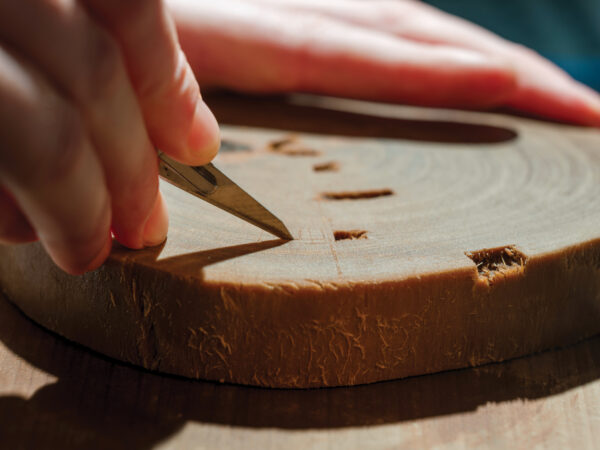
Next, he bleaches, sands and polishes the biscuits of wood to reveal their concentric growth rings. Then, with a scalpel, he delicately chips out tiny blocks from the centre to the edge of the sample, each block comprising exactly five rings—“it’s every bit as tedious as it sounds”—and prepares them for radiocarbon dating.
All living things—bacteria, people, pūriri—absorb a form of carbon, called carbon-14, from the atmosphere. After they die, this stash decays very slowly, at a predictable rate. So you might think radiocarbon dating would be a cinch: simply measure the remaining carbon-14 and count backwards. Unfortunately for scientists, the amount of carbon-14 in the atmosphere has not been constant over time—it wiggles up and down, meaning one radiocarbon date could correspond to several calendar ones. And long-lived trees are tricky—a chunk of preserved wood might be a time capsule from the date the tree was cut down, or it might have been formed hundreds of years earlier, when that tree was a seedling.
For both problems, tree-rings come in handy. Each year, trees build up a new layer of wood, and that ring stores a record of how much carbon-14 was around at the time. So McBride measures the carbon-14 across the dozens of rings of each palisade sample, and compares that pattern to the radiocarbon calibration curve—a timeline of carbon-14 changes that scientists around the world, including Hogg, are working to refine.
Sliding the tree-ring pattern along the curve, McBride can see where the wiggles match up—a technique scientists very seriously call “wiggle matching”. Because of the bark, he knows exactly which ring represents the tree’s last living year. This makes for extremely accurate and precise calendar dates. At best, it can point to a six-year window several centuries ago.
“That puts events on a generational timescale, and allows for interaction with whakapapa,” says McBride. Now, these two very different forms of knowledge can start talking to one another.
[Chapter Break]
If trees are tricky, family trees are even more so. The spaces between human generations can vary wildly; every lineage has its teen mothers, its grandfathers having a second family in their 60s, the aunts who are younger than their own nephews. To roughly date historic births and events, ethnographers have traditionally ignored these complexities and counted back through the great-great-greats in neat steps of 20 or 30 years.
Instead, Zac McIvor tries out a brand-new, much more precise technique. His part of the project starts with building a database of genealogies. He interviews eight Tainui kaumātua, kuia and kaitiaki and combs published tribal histories and 19th-century Māori Land Court manuscripts. “Whakapapa connects from today to the time of the earliest kōrero about pā construction and conflict, back to the first voyages on the Tainui to Aotearoa, back to Kupe, back to lives and events that occurred back in Hawaiki,” he says.
The map that results shows the familial relationships of almost 1000 named individuals, as well as around 100 events associated with the pā in the study. McIvor uploads the database into a new type of software, and inputs a set of careful assumptions: a son can have been born only between 16 and 40 years after his mother, or between 18 and 60 years after his father; siblings who are not twins are born a minimum of one year apart; humans live between 0 and 90 years, and so on.
Do this for enough people, and the software can spit out an ancestor’s likely birthdate, or the timing of a specific conflict or event, with much more precision than traditional ethnographic methods—a window of about 40-60 years. The two strands of the pā project now bring together “the very best, most precise forms of dating time in both archaeology and whakapapa”, McIvor says—not to pit one against the other, but to see what might fruit.
It’s not just that historians like to know the dates of things. Oral history brings individual human lives into focus—their personalities and foibles, the pressures they faced and the decisions they made.
“The archaeology is no longer anonymous,” says McIvor’s supervisor Tom Roa, a Tainui leader and professor of Māori and indigenous studies at the University of Waikato. “It tells us about the space that we’re living in, the space that our ancestors have lived in, and what we might leave as a legacy for those to come.”
[Chapter Break]
On a squinty Saturday morning in March 2026, the research team gather at Taupiri Marae to share their findings. McBride is now working as an independent archaeologist in Auckland, and McIvor recently landed a job as a lecturer at the University of Otago. Everyone’s catching up in the carpark, happy to see each other again.
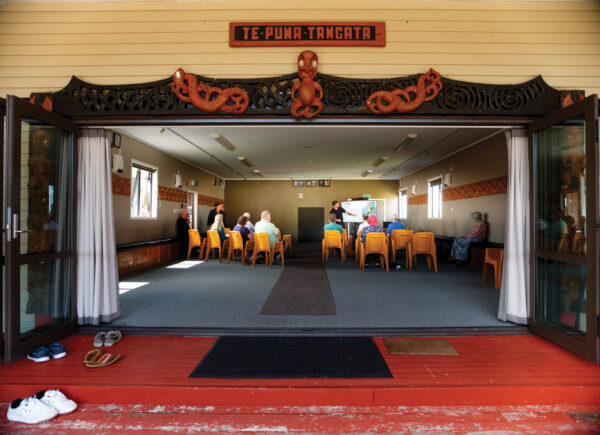
Kaumātua and kuia call us into the bright forecourt of the wharenui. For a moment, a passing goods train drowns out the pōwhiri, but then the waiata rise into the cloudless sky. Tukukino George is here, too, among the hosts, leaning with gravitas on a carved kō, a kūmara digging stick. His wheezing boxer dog Fat Man sits at his feet. Behind him are two Pākehā landowners with long, deep relationships to both this place and this hapū. They’re involved with many projects, including protecting and restoring another local pā, Taraheke.
I join the researchers and other visitors. Tom Roa is with us, and two smartly-dressed older Māori women. One of them is Hazel Coromandel-Wander, in a red hat adorned with a rose. Over morning tea, she tells me her great-grandmother Wikitoria grew up among wetland pā near Lake Ngāroto, and narrowly survived a dark day in New Zealand’s history.
Wikitoria was in her early teens on February 21, 1864, when British troops attacked her village, Rangiaowhia—not a pā at that stage in its history, but an undefended settlement, a refuge for families and elders. The people sheltered in the raupō church; the soldiers fired hundreds of shots into it, and burned it to the ground with the women and children still inside. Wikitoria, who had been washing at the river with her cousins, escaped by hiding in the swamp. She and her mother were the only members of their immediate family to survive.
For Coromandel-Wander, pā sites hold both joy and trauma. Her ancestors left mauri in their footprints in these places, she says, echoes she can still feel—particularly those of her female tūpuna. She’s made a conscious choice for the good vibes to outshine the bad ones. “That’s your identity, that’s where you come from.”
[Chapter Break]
We move into the wharenui, introduce ourselves, and McBride and McIvor present their findings. “One of the major things that fascinates archaeologists is evidence of change,” McBride begins. “And in New Zealand, there’s no more visible representation of change than the emergence of pā around 1500 AD.”
From the palisades excavated at Te Uapata, McBride managed to get three high-quality radiocarbon dates, from the late 1700s and early 1800s. That’s well after Mahuta’s time, he notes—McIvor’s most precise modelling places Mahuta’s birthdate at between 1596 and 1612. The posts I watched the team wriggle from the mud mark a later moment in the layered history of the place. That doesn’t mean Mahuta never built a pā at Te Uapata. Three posts is a small sample size, McIvor points out, and “absence of evidence isn’t evidence of absence”. Any earlier posts could be buried deeper, or in different spots, or could simply have rotted away.
At other sites, the kōrero and radiocarbon line up much more neatly. Two palisades extracted from nearby Taraheke—a pā associated with Mahuta’s grandfather Pikiao—dated to the early and mid-1500s. According to McIvor’s research, Pikiao was born around the late 1400s or early 1500s—an almost perfect match. “There’s been so much agreement between the two data sets,” says McIvor.
Taken together, McBride explains to the group, the palisade dates suggest three distinctive eras in the history of the central Waikato, of these farms and roads and suburbs of Hamilton that sprawl from Waipā in the south to Taupiri, some 50 kilometres north. It was the 1500s, the trees tell us, when pā started to spread across this landscape. This was a time of growing populations, and of conflict. The climate deteriorated. Europe was in the grip of the Little Ice Age; the North Island was unusually cold and wet. Kūmara crops failed, and people moved on, looking for a place they could stay.
“What we’ve started to interpret is that this early period of pā construction is related to populations moving into contested spaces and setting up zones of influence and control,” says McBride. “Stamping their identity on a space and saying, ‘We are here. This is us. We want to control these areas, and we want to make a home.’”
By the following century, the dust-ups had settled. “I didn’t identify a single radiocarbon date that falls within that period,” says McBride. “There’s no evidence of palisade construction.” Consistent with other lines of evidence, McBride thinks that’s indicative of a century of relative peace and stability in the Waikato.
Then, in the early 1700s, “everything kicks off again”. There’s conflict, McBride says, stress and fear; people start refortifying their pā or repairing palisades. Like any good researcher, he’s now left with more new questions. “What we’d really like to do is take this chronology that we’ve developed in the Waikato and then compare it to other regions of New Zealand that have pā, particularly Taranaki and the Bay of Plenty.”
[Chapter Break]
That will be a race against time. While pā have preserved their secrets for centuries, the past few decades have seen dramatic degradation, Gumbley tells the hui. In the late 1960s, archaeologists excavated a pā site at Lake Mangakaware, near Te Awamutu. The maps, objects and photographs they recorded then, just half a century ago, reveal a significantly more pristine environment than Gumbley and his team encountered during their work in 2021.
The earlier team found 630 posts, Gumbley says. “We found 132, and we were deliberately trying to find them.” In the 60s, one post stuck up three metres out of the mud. A waka was preserved beneath the willows on the lake edge. All that is now gone. The widespread drainage of wetlands is one explanation—when peat dries out, it rapidly breaks down. More extreme weather associated with climate change—alternating droughts and floods—will accelerate that process.
And the huge expansion of dairy farming is to blame, too. Leaching nitrates change the chemistry of the lakes, making them less preservative, and grazing cattle can break off a palisade to the ground. “You get half a ton of cow rubbing up against it often enough and it gives up the fight,” says Gumbley.
“What we’re learning is that these sites are very fragile, and it’s beyond our ability to protect all of them,” he says. Without coordinated effort, we face “the disappearance of these completely irreplaceable places”.
He sees a parallel with the loss of knowledge and connection to place that many Māori have endured over two centuries of colonisation—and the loss to all of us of these parts of our own national story.
“There’s a real absence of readily available and understandable versions of these rich histories,” he tells the group. “They’re hidden from most of the population—even a large part of the Māori population. It seems to me that if we could overcome that challenge it would do a great deal for the spirit of the country.”
Outside on the mahau, the porch at the front of the wharenui, Fat Man’s claws click on the red timber boards, and a rising karanga from the kuia calls us to the wharekai.
[Chapter Break]
At the generous lunch, the hapū serve roasted kūmara—an array of colours and sizes. My favourite is a small pale-yellow one, especially sweet. “I grew them,” Tukukino George tells me afterwards. I follow him outside as he disappears with Gumbley, wanting to show the archaeologist his latest kūmara garden.
The pair met around 20 years ago, when George was a young rangatahi himself, working as a kaitiaki during the construction of the expressway. Gumbley kindled his interest in history; George began questioning elders and combing through the Māori Land Court records, looking for the stories of his people. They also share an interest in kūmara: Gumbley did his own doctorate on “garden archaeology”, the horticultural history of the Waikato.
To grow the subtropical vine, Māori had to figure out how to create warm, well-drained soils at a massive scale, the traces of which can be read in the earth today. And the wandering vines of kūmara are intimately intwined with the history of pā, Gumbley says. The need to protect vital kūmara stores through the chilly, damp winters—as both food supply and seed stock for the following season—is one possible explanation for why people started to defend their villages with fortifications during times of conflict.

A decade ago, Gumbley helped George set up a test garden next to the marae, where he’s been using traditional techniques to grow and store the crop. The one I liked best at lunch is an ancient pre-European cultivar called Taputini, George says.
“Every year I ask a new question,” he tells me. This year, the question was how the time of planting influences the ultimate yield. (So far, it seems that it doesn’t.) Growing kūmara, caring for these ancestral places, knowing the stories of his tūpuna, and teaching them to his own 11 children and many other rangatahi around the region—it all gives George a sense of connection and meaning, he says. Especially since so much of it came close to disappearing. “It’s beyond emotional knowing that for a good 100 years, that knowledge has been lost—and now it’s resurfaced. It’s an honour to be that person that brings that out.”
In McIvor’s mind, archaeology is a palimpsest. The word, the idea, originally referred to a recycled sheet of papyrus or parchment on which ancient scholars, short on writing materials, scraped the old text off and wrote over it, leaving traces of the original writing showing through.
The landscapes of New Zealand are palimpsests themselves, McIvor says, recording layer upon layer of lives in their soils and surfaces. We have paved over them, flattened farms into their contours, drained their swamps and forgotten their gardens. But beneath all that are rich histories of love, and of war. Of violence, and of care. They survive as kōrero that have endured against the odds, in the trees felled and held still in the wetlands, and in a sandy pile of freshly harvested kūmara in the late-summer sun.