The garden of life
Nine years ago the people of Tāneatua saw that their tamariki were hungry, and bored. The people had no idea how to garden. They made a garden anyway.
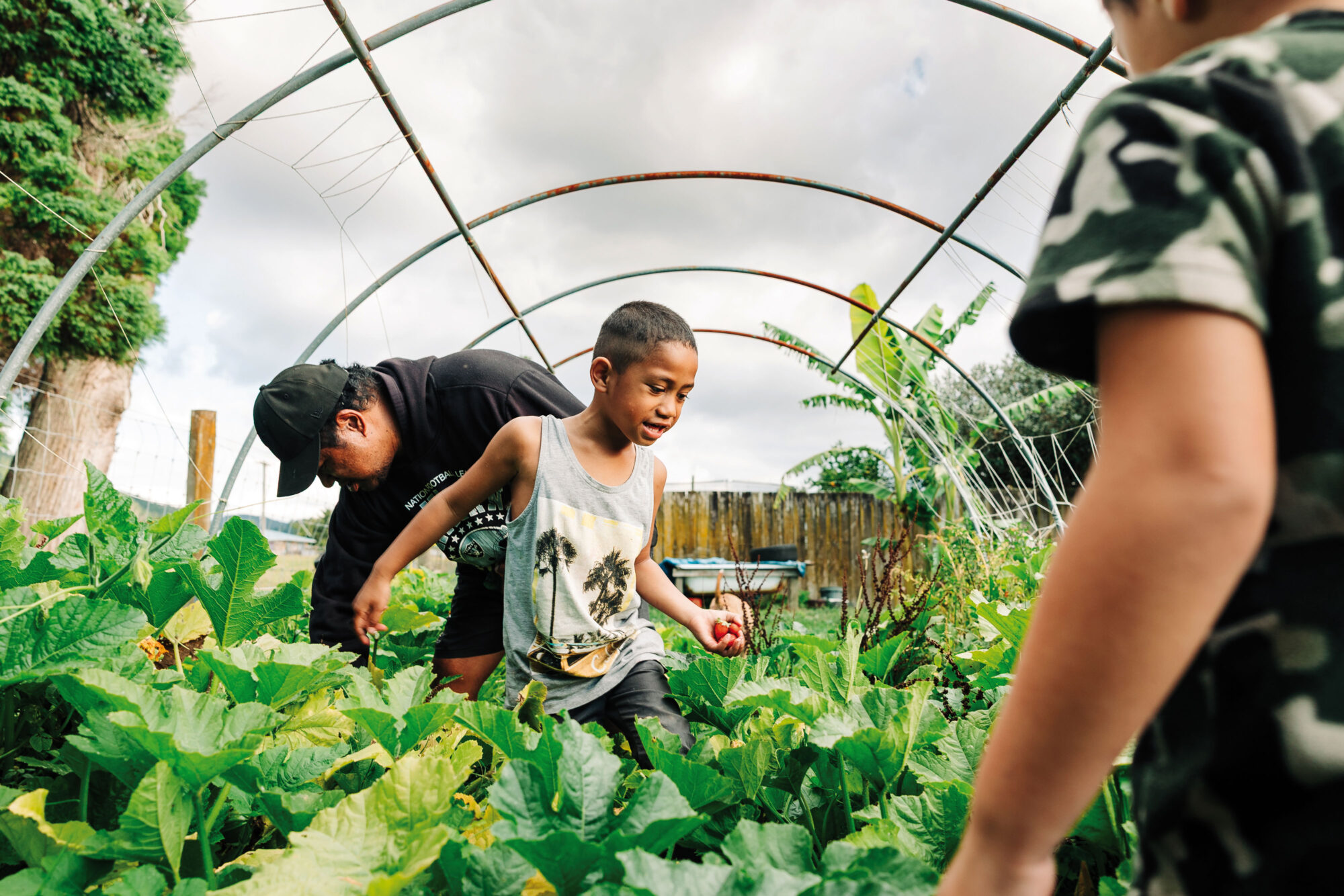
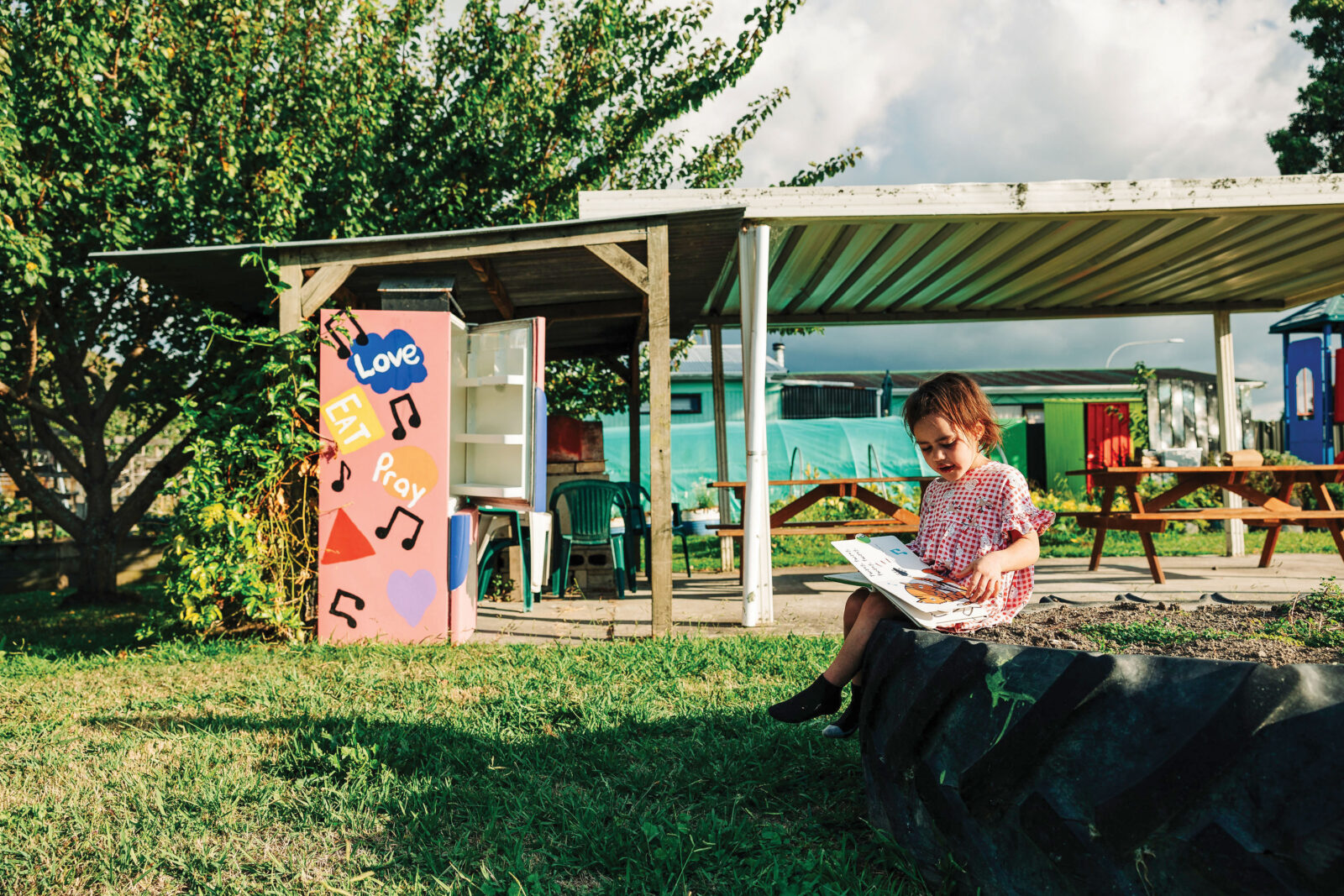
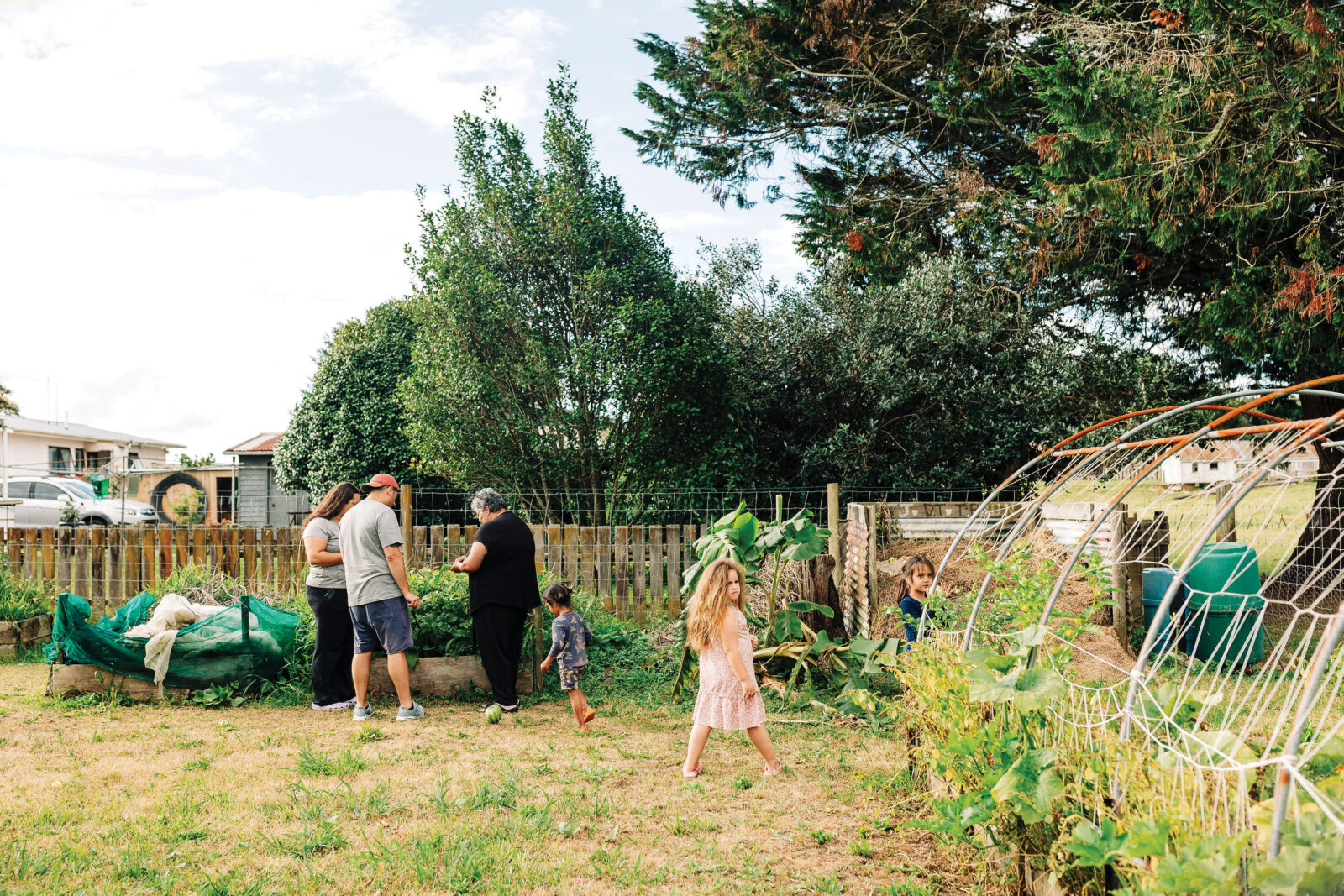
Rhubarb is a thirsty plant. As the sun drops low and golden in the garden, I turn the hose on. A child says hello through the spray. “My name’s Hayley,” she tells me. “You can call me Hayley Green if you like, because green’s my favourite colour.” Hayley Green skips to an old fridge, opens the door and rummages through a pile of books. Having picked one about dinosaurs, she wedges herself into a picnic table and begins to read aloud, legs swinging energetically.
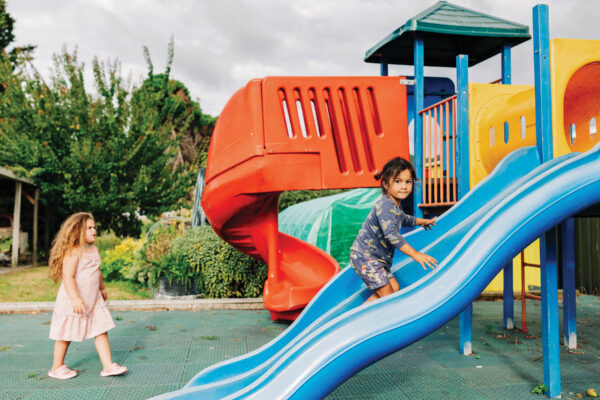
A second small figure emerges from a neighbouring house. “My friend!” Hayley Green calls, running to hug her. Other kids arrive at the garden by bike or bare foot, one boy clutching a Spider-Man action figure, another munching a lolly. Suddenly, there are six. They start with a classic—lifting each other up to test their strength—before settling into the swings and slides.
The garden basks in the last hour of light. The branches of a damson plum bend toward the ground, laden. Cobs of corn fatten almost audibly, and pumpkin, beans and kamokamo run untidily from their wooden beds. The noise of the kids’ play mingles with the occasional barking of nearby dogs and rattle of distant trucks.
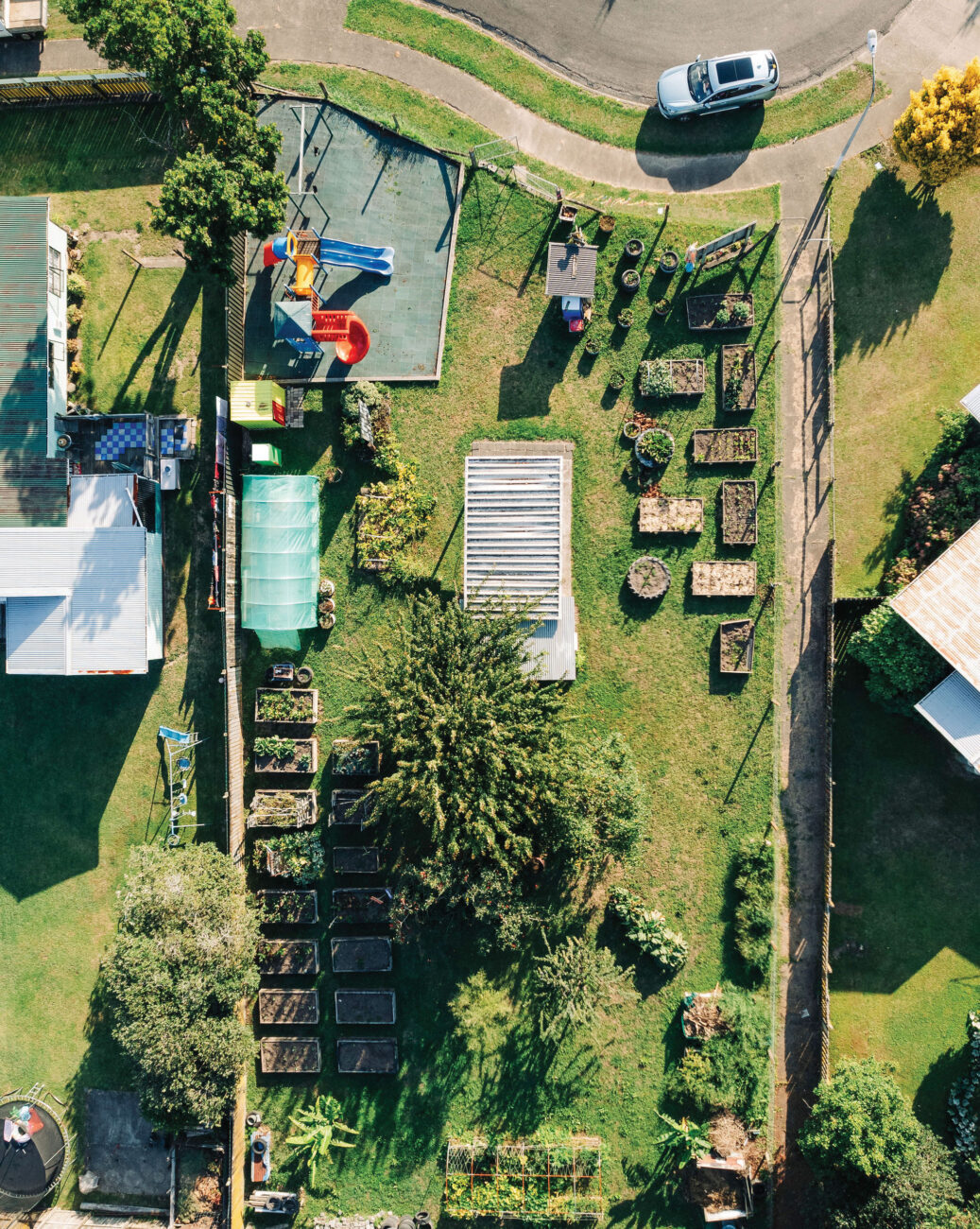
I show a New Zealand Geographic to one of the kids and explain that I’m writing about the street and its garden. “Why? What’s so special about it?” she asks politely. Fair question—for her, the garden has always been there. Well, not everyone has a place to play like this, I say: within sight of home, fully enclosed, chock-full of produce and furnished with a pizza oven and library.
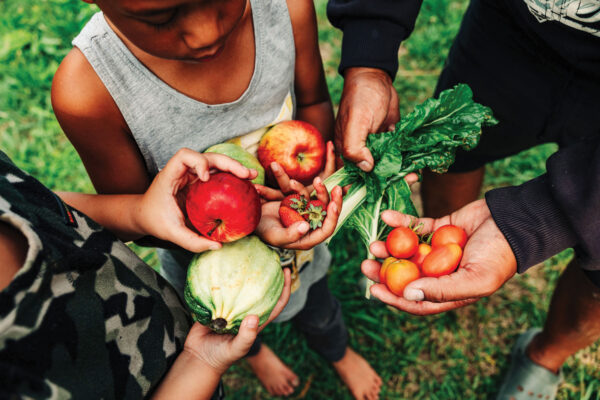
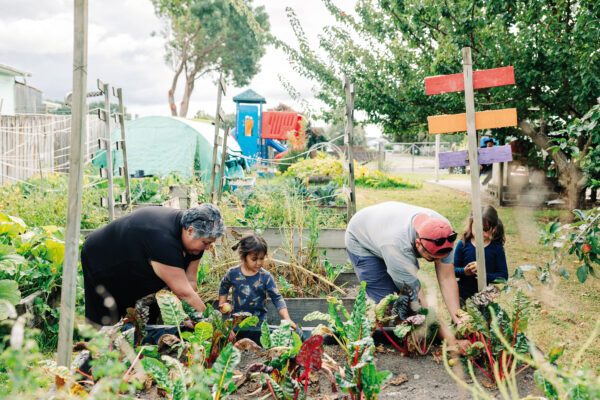
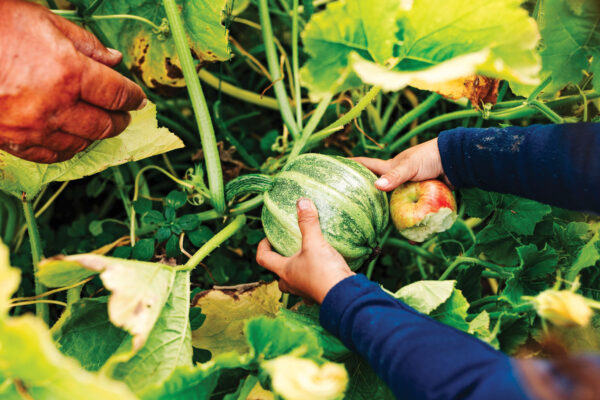
Another girl helps me water. “My dad likes watering, too,” she says. They grow corn and pumpkin at home. She picks an apple, takes a bite. A grimace. “It’s a bit sour, but it’s still good.” She warns me not to eat apple pips; gives me a primer on pruning. Seeds of gardening nous she’ll carry all her life.
A car pulls into the cul-de-sac. “Mum’s home!” The garden empties. Mum pulls into a nearby driveway, dispensing cuddles and hearing news of the day from her tamariki and their friends. “I’ve gotta go,” my fellow grower says as she runs to join them. “Don’t forget to close the gate, so the dogs don’t get in,” she calls over her shoulder.
[Chapter Break]
You’ve driven through Tāneatua if you’ve taken the inland route from Whakatāne towards Ōpōtiki or Gisborne; it’s tucked into a right angle of State Highway 2 and subject to the near-constant rumbling of logging trucks and tankers.
You might have noticed a mural near the dairy, the lined face and guarded expression of a white-haired kuia staring evenly from a deep black background. You might have noticed horses tied to porches; a shed painted with the words We Are Still Here. Harakeke and mānuka screen the new $15 million Tūhoe headquarters, Te Uru Taumatua—a sustainably built “living building”, and flagship for the iwi’s housing and building initiatives.
Town size: 0.69 square kilometres. Population: 1000. Half the people here speak te reo Māori; some 90 per cent whakapapa Māori, overwhelmingly Tūhoe. Forty per cent of the families are a single parent plus kids. The unemployment rate is twice that of the Whakatāne District overall. The average income is less, too. Of those in work, one-third are labourers.
Statistics miss a lot. They say nothing about the joy of finding the first ripe strawberry. The satisfaction of mashing a young kamokamo to feed to your toddler. They don’t catch the look on Honey Thrupp’s face when she talks about her garden. She would never say it’s hers, mind. But everyone else does.
[Chapter Break]
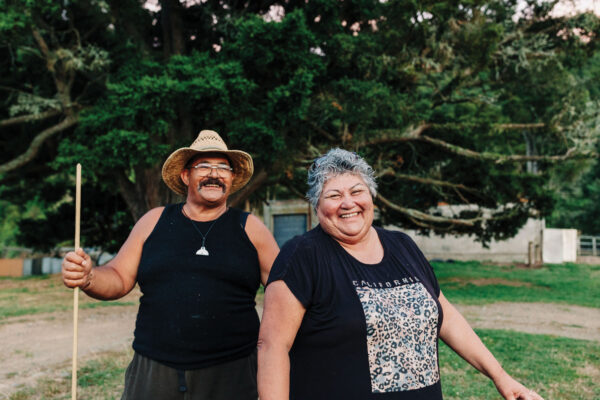
It’s a bright Bay of Plenty morning when Honey and the team gather to recount the garden’s genesis. She’s organised for me to stay at the church marae in Ōhope, where she works with her husband, Tamiana, a minister. Perched on a hill, the marae is close to the beach—you can hear the waves breaking at night—but screened from the nearby campground by tree ferns and pōhutukawa.
Honey arrives early with a huge platter of sushi. Three of her fellow garden committee members arrive soon afterward; Tarnz Ramsay is fresh from the gym and Keitha Sumich, who is married to the Thrupps’ son, Daniel, has her wee puppy in tow. Maurice Tooke can’t stay too long—he’s his wife’s carer. We settle on bench seats around a big kitchen table, rectangles of morning sun pouring in beside us. This is a precious day of holiday for everyone, but these people have achieved something significant together. They’re proud to tell their story.
Right from the start, Honey says, “God was in it.”
She and Tamiana lived most of their lives on Hughes Place, and brought Daniel up there. By 2016, Daniel had children of his own and the couple felt called to build a sense of whanaungatanga, or community, in Tāneatua.
The first question was how. A church, maybe? Somebody suggested a garden. “We prayed about it, and the garden seemed like the right thing to do.” Neither Honey, who is “born and bred Tāneatua,” nor Tamiana, who comes from nearby Rūātoki, had a lot of gardening ability. Both had growing heritage, though; in particular, Tamiana remembers his Rūātoki grandparents tending huge gardens.
Honey had heard plenty of stories about community gardens failing. But from the beginning, there was certainty for her that this felt right, that the many strands of their lives were being woven together in this new venture. “Growing up, my parents owned a fish shop; first one in Tāneatua and later in Whakatāne,” she says. “We were used to dealing with people from farming, business, sales and restaurants. When it came to starting this garden, I realised that all these people came into that story. All came into the plan of the garden, and we were able to lean on them to help us in different ways, because my father had done so much in the past for them, and they were more than willing to bring back community and come back to the community.”
Two friends connected them with grants—Chris Barnard, of the Have a Heart Charitable Trust, and Anne Overton, working for Presbyterian Support Northern. Both would be the garden’s greatest cheerleaders over the years. Now the Thrupps had money to get things started. Next question: where to dig?
“At our street Guy Fawkes party we were talking,” Honey says. “Our neighbour said, ‘Why don’t you get the empty section? Helen Te Waara owns it.’” Honey and Tamiana looked at each other. They knew Helen—she was a Hughes; her father had farmed the land before it was built up. Honey called her the next day. Helen was all for it. She became one of the garden’s many benefactors, paying the rates on the section and finally, before she died, assuring the garden’s future by selling it to Have a Heart at a “very affordable” price.
A fencer who lived on the street put up the solid six-foot fence. An engineer installed the self-latching gates. Local businesses supported with expertise and resources—“I think we hit up everyone in town at some point,” Honey says.
Plenty of time was spent simply talking, most of all with the street’s 22 families and 53 or so children, in the hope of getting as much buy-in as possible. The children were asked what they’d like to see (broccoli, to the surprise of the adults) and who should be involved.
“We likened it to a circle,” Honey says. “We asked, who do we want in that circle? Our rule was that no one was to be left out, and our hope was that everybody would be involved.”
The garden was basic when it opened in November 2016—just a tyre planter full of rhubarb, a sandpit boat and a few raised beds. Unlike many community gardens, which are hauled into being by passionate gardeners trying to instil their skills in others, this one was driven by newbies. It gave the garden a level, democratic start. “You’re looking at people that never did gardens,” Honey reminds me, happily. “But we all found it so exciting to learn.”
Case in point: a baffling batch of donated eggplant seedlings. They grew just fine, into huge plants, but the team somehow had the wrong end of the stick and thought the flowers were the eggplants. “So then, when the actual eggplants started appearing out of the flowers, we got a shock.”
When no one knew how to cook eggplants, Honey says, they organised a barbecue at the garden where they all learned together.
The people of Tāneatua are used to simply getting on with it, alone. There is a sense of frustration that their town is so regularly overlooked. Take the council playground: it’s on the town’s main street, which is also State Highway 2. In 10 minutes there, I count 11 heavy trucks. Tarnz Ramsay fought hard for a pedestrian crossing to connect the playground and the dairy across the highway, and says it was a five-year battle. Whakatāne district councillor Andrew Iles, a long-time local and stalwart supporter of the garden, points to another classic example: a time when roadworks briefly required traffic to be diverted through Ōhope Beach. “There were instantly complaints from Ōhope residents about the safety issues for children and the shaking of houses from all the heavy freight,” Andrew says. “That was just for a couple of days—but people in Tāneatua live with it all the time.”
[Chapter Break]
On the morning of April 6, 2017, after a cyclone and days of heavy rain, the Rangitaiki River burst a stopbank. Fifty-two properties were yellow-stickered in Rūātoki, Tāneatua, and nearby Poroporo. The garden had been open for a year. The water there was so deep that people were kayaking over the back fence.
There was no power, no running water. The residents of Hughes Place took to meeting up in the street. “For three days, we ate in our driveways,” Tarnz Ramsay says. “Everyone just sort of pulled things out of the freezer and we ate together.” One family were new to the neighbourhood, and to begin with were “a bit whakamā”, Tarnz says. “But then she [the mother] turned up and was like, ‘I’ve got no hot water for my baby’s bottle’, so I heated some up in a flask for her. So it was a time of really getting to know people much better.”
For Honey, the flood felt like a cleansing. She sees it as a turning point for the garden. Everything “kind of just took off”, she says.
Bunnings donated a carport, which was tricky to transport; in the end, the police came to the party with a full escort. They closed a bridge on the state highway to get the carport over safely, Tarnz says. The others at the table are already laughing; they know what’s coming. “But instead of going straight to the garden they put the sirens on and did a full loop through town. We were all following in our cars and we couldn’t believe it.”
On site, they found men waiting to install the carport; local businesses had sorted out the earthworks and helped with the concreting. “It was such a great day.”
The carport quickly became a focal point, offering shelter from the sun and rain and a generous gathering place to have kai. It was perfect for movie nights. “We would put up an outdoor screen and have bean bags and popcorn,” Tarnz says. “We were running events all the time—things like Easter egg hunts and Mother’s Day celebrations.” There was a scarecrow festival, quiz nights, school holiday programmes. Local politicians held “meet the candidate” sessions in the carport; it became a venue for community meetings and cooking lessons. In one friendly competition, everyone had to cook something from the garden and bring it along to share. One family made a beetroot cake. It was, says Honey, “basically a high tea with jandals”.
The biggest get-together was for domestic violence organisation White Ribbon: more than 200 people turned up, there were motorbikes and a tug of war, a bouncy castle.
For Yvonne LeSueur, such events were a lifeline. Meeting in the garden one afternoon, we park ourselves on a bench and talk. When the floods hit, she’d just come home to Tāneatua after 26 years in Australia. She had mokopuna in tow; there had been deaths in the family. Yvonne felt deeply disconnected—until she met Honey.
“She could see I was new to the area and she introduced herself. She has such a beautiful way about her—instantly you don’t feel like a stranger. She said, ‘Oh, you’re here with your mokos, you’ll have to come down to the garden and do this and that.’”
One of Yvonne’s mokopuna is autistic and taking him to public places can be challenging. There was no judgement here. “Overseas, you always felt people were looking at you, thinking you shouldn’t be there. Here, everyone sort of kept an eye on the kids. They were so kind.” Yvonne’s grandkids made friends in the garden and made it a second home. She, meanwhile, appreciated the chance to reconnect with her roots. Over time, a certainty grew. “I started to know that, yeah, we’re all good.”
The garden heaved with food during this time. Keitha Sumich was at the garden most days with her boys. When I see her there, she pushes her toddler on the swings while she talks.
The nearest supermarket is a 26-kilometre round trip, she points out. There was enough kai here, though, that instead of automatically hopping into the car, “I would check to see what needed harvesting, and base my meal planning around that”. She cooked vege-packed spaghetti Bolognese and lasagne—meals that were yummy for the kids, and healthy.
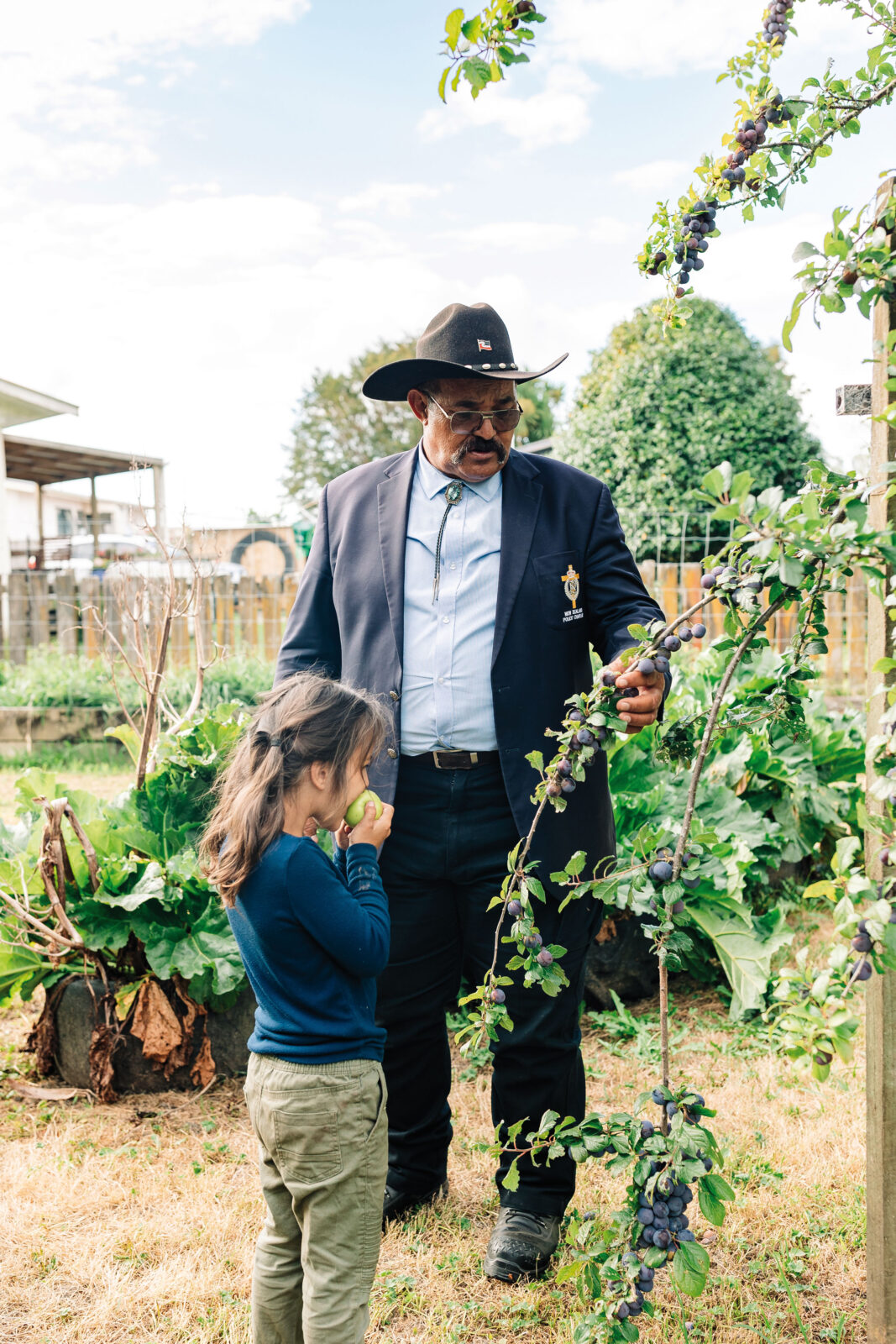
Honey says Facebook was a handy conduit. “We’d put a message out encouraging young families to look in the garden before they went shopping. We’d remind them they could save $20 or $30.” People would sometimes message from the garden, sending a photo of a vegetable and asking what it was and how to cook it. “We’d be able to tell them. Spinach is one thing a lot of families really got to know how to use.”
The distance from Tāneatua—a one-dairy, one-bakery town—to Whakatāne is one reason Honey and Tamiana believe the garden fills such an important role. “We’re quite isolated,” Honey explains. “That and the fact that we have almost no public transport makes us vulnerable in terms of access to food.”
By the time COVID hit, the garden committee was something of a local powerhouse. The group quickly morphed into a response team, delivering pantry basics such as flour, eggs and milk, and medical packages: Lemsip, Panadol. Vaccination drives were held in the garden; the team celebrated when 22 people were vaccinated in one day.
When playgrounds were supposed to be closed, arrangements were made. “We said, ‘No, this is a central place,’” Tarnz says. “Our space created a serenity, a getaway. We knew our people needed it, you know; they’re living in their homes with their partners and their children 24/7.”
[Chapter Break]
When Tāneatua’s in the news, it’s usually because of gangs. Three years ago, a newly patched Mongrel Mob member, Isaiah Natana, attacked 57-year-old Meihana Mason in his home at Tāneatua during a dispute over drugs. The blows were so loud they could be heard from the street. Natana then attacked a man outside a bakery, and a man on a motorbike, stealing the bike and writing it off. Mason died of his injuries. In October last year, a gang-related shooting in Rūātoki spilled over into Tāneatua—a house was set alight; people reported gunfire.
The police station was wrecked by fire in 2018. By late 2019, still without a police station and with no CCTV cameras in town, locals were feeling deeply vulnerable. Tagging and trespassing were on the rise, they told RNZ, and stock were being poached. Three years later, still no police station. Toni Boynton, then a community board member, told Te Karere her town needed support. “The past few years, there’s been a lot of heightened issues and deaths concerning rivalry with gangs,” she said. Meth had a lot to do with the violence. But so did poverty, and addiction, she said.
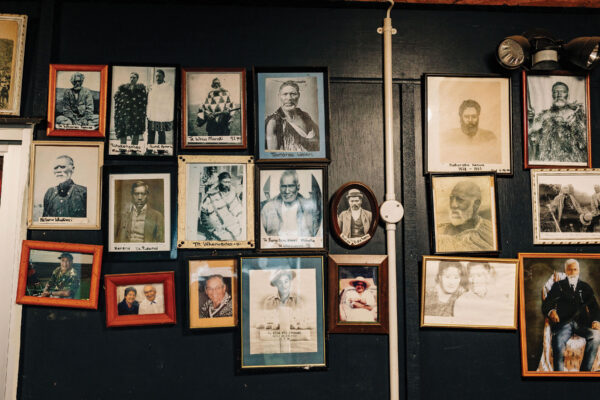
The new station finally opened in April of 2023. While the people waited, the garden on Hughes Place had quietly rolled through six summers.
Presbyterian Support, which helped fund the garden, published an evaluation of the project, including a story from a local man who told the researcher he’d been addicted to methamphetamine for 40 years, since he was 14. Others around him were on similar paths, “chasing the gang life”. But then he started to take notice of what was going on in the garden. One day, curious, he walked in. “There was no talking. Aunty Honey just handed me a spade and asked if I wanted to dig. I’ve never felt something so heavy in all my life.
But I started digging, and that day, I didn’t want to stop. I thought about my father; I remembered the things we used to do when I was a kid. It was the earth… I belong here. I felt Papatūānuku. I’d forgotten all of those things.” By the time he told this story, he was 80 days clean.
[Chapter Break]
Groups of young people on periodic detention, organised by the Department of Corrections, have played a key role in the life of the garden. The teams had the odd whoopsie—for two years running they pulled out asparagus crowns, which should be left in the ground to resprout year after year—but overall, says Maurice Tooke, “they’ve done a lot of work and have kept the place looking good”.
In turn, he’s noticed, the crews seem to find the garden a good place to be. Honey chips in. “We don’t say, “Right, boys, you go and do this and do that.” We treat them as whānau, and we’ve always respected them for the contribution they make.” She tells the story of a work crew supervisor who had a disagreement with the people running another garden he’d been working at. “He walked away from there because he felt like he was going to lose it. He came to the Hughes Place garden and just sat there and felt peaceful and regenerated himself until he felt like he could go back and finish the day with the group.”
Gina Williams, a social worker with the town’s mental health and addictions clinic, brings clients to the garden and has noticed that they, like the periodic detention workers, feel good about the work because they know it is for their own community. She remembers watching one guy mow lawns, and keep going longer than he had to. Small things like that. Gina uses the word “grounded” to describe the way clients feel in the garden. Honey agrees. “They can sense the presence of their ancestors while they work.”
[Chapter Break]
The last year or so, things have frayed at the edges. “Tarnz, Honey and I were often in the garden and out in the community before,” says Keitha. “We were ‘for the people’. We all have real jobs now and you can see the difference.”
The garden is not as well tended as it was. It’s been harder for the Corrections crews to get to the garden, Maurice says—he has noticed how forlorn the gardens look without them.
A group of boys have caused a few headaches. “They’ve come in and terrorised the garden,” Honey says. “If there’s fruit, they’ll throw it around everywhere. They yelled back at a neighbour when he came out and told them off, and when he went inside they threw mud at his house.” Honey and Maurice have various nicknames for the boys. “I jokingly called them our ‘little offenders’ for a while,” Honey explains, “but it’s not the most helpful name.” To Maurice, labels like this matter, even in jest. “There’s nothing worse than that you label kids as little crims. These are just kids that are picking things up from the adult world. It’s how we respond to it.” Growing up in this street is brilliant, he thinks, for most tamariki. “We have to focus on that.”
The kids involved with setting up the garden never vandalised it. “But for these new ones coming in,” Tarnz says, “they haven’t put any work into it so they’re just like, ‘Who cares? Someone’s gonna fix it’, and that’s their mindset. If we can nurture them and get their parents involved, things will change.” But that is work, too. It adds up.
There are something like 150 community gardens sprinkled across New Zealand’s three main centres, researchers estimated five years ago. Some flourish, but many of them fail.
Virginia Webb, a gardener from the Manawatū, studied the cultural politics of community gardens for her doctoral thesis, published in 2020. Looking for community gardens near her home in Palmerston North, she followed the tips of friends and family, but found three of the gardens were abandoned or neglected. (One, she was told, failed because the organisers spent a bomb on an irrigation system that could be controlled remotely, via app—then disagreed over who would run the app, what to plant, and how to divvy up the work.)
Webb spent more than two years volunteering at three active gardens, and watched as two of them became bogged down in personal conflicts and tensions.
In one garden, most of the plots were tended by refugee families from Bhutan and Nepal, as well as nearby Tongan families, but decisions were made by Pākehā organisers. The organisers had certain ideas about how the plots should be allocated and what should be grown—not tobacco, although for years, one Tongan man cheerily defied that edict—how much produce could be taken at one time, and how it should be distributed to the needy. (The Bhutanese were suspected of “potato rustling”, after a whole crop went missing overnight.) In 2018, the Rangitāne o Manawatū iwi regained control of the land through a Treaty of Waitangi claim and ended the garden’s “peppercorn” lease; the garden was uprooted to a council park.
A second garden, set up by Corrections and a local environmental organisation, stalled because the two groups were “incompatible”. “Calling something a community garden isn’t enough to make it one,” Webb notes in her thesis, wryly.
Webb learned, too, that the work of a volunteer, or even a person given free produce, does not end at harvest. Summer was one glut after another. Dealing with the fruit and veges she brought home “was exhausting and often boring. The thrill of self-reliance soon turned into another domestic pressure… I learned to leave the feijoas on the ground.”
[Chapter Break]
For years, the Hughes Place garden boasted one of the most richly stocked pātaka kai I’ve ever seen: doors wide open and shelves heaving with cans, cereals, mayo, pasta. Much of the food was donated by Have a Heart and other organisations, and locals would top it up with homemade soup, apple crumble, butter chicken. All free. No drama. Recently, the committee has had to lock it after school hours, and ask anyone needing food to message the committee on Facebook for a key.
It’s been more than a year now since an event was held in the garden. Honey says they made a decision a while back to focus on food production. But even that side of things has slowed. Heatwaves, insects, tomato blight—as Webb notes, such things have no respect for a community pushed for time. There are bare beds now, baking in the sun. Brassicas are running to seed. The team is behind on planting seedlings of winter veges. There have been talks about whether the garden needs to be closed.
“I believe in seasons,” Honey says. “But my heart sank when our neighbour Les suggested we look at closing it.” She’d like to reach at least the 10-year mark: November, 2026. To pull that off, thinks Maurice, they need a paid coordinator. Which means they need money.
Honey says the committee have always been adamant they needed one of their own in charge. In the early days, the Whakatāne District Council wanted to give them a grant for $30,000, but it stipulated that a supervisor would be provided. “We knew that wouldn’t work for us so we declined the money.”
No matter how it pans out, Honey is proud of what has already been achieved. “For me, the garden has done its purpose,” she says. “It’s taught people to grow from home.” She’s noticed locals making box gardens on their lawns. At Rūātoki, people are building bigger gardens, in paddocks. Driving into town, she’s seeing new kamokamo vines growing beside the
road.
Other gardens have sprung up, too: one at the school, and one around the corner, on Amokura Road. This is a little orchard of donated trees, planted on council land—23 heritage apples, 10 plums, plus grapes, feijoas, and stonefruit. The first trees went in the year after the Hughes Place garden opened; now, they’re really starting to produce. Pruning workshops at the orchard have been attended by more than 40 people.
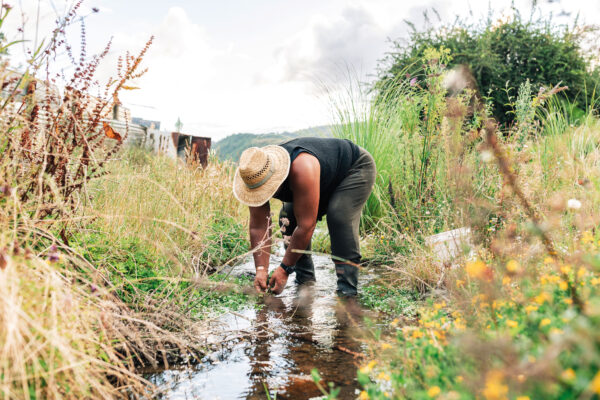
Perhaps the biggest change is that two years ago, Honey and Tamiana uprooted themselves, leaving Hughes Place to farm full-time on family land in Rūātoki. It was a wrench to leave town, says Honey. But: “I absolutely love it up here.”
The plan was that the farm would be a sort of satellite support for the garden, making enough money to keep it ticking over. Three years ago, they sold 10 cows for $6,000, a sum that is still funding the garden’s basic needs. “We mainly buy plant food and a bit of compost,” Honey says. “We get given a lot of seedlings.” Facebook raffles for donated items such as lawnmowers are incredibly well supported by the community, tickets often selling out in 10 to 20 minutes. Honey and Tamiana also have visions of topping up the garden’s pātaka kai with food from the farm. They’re growing figs, walnuts, feijoas, and rearing hens, pigs and cattle. Honey is at the garden only about once a month now, when she goes down there for committee meetings. “I needed to step away and let others step up.” One family are covering the maintenance; another mum is in the garden every week, to get her kids more involved. Her partner and his brother have also started pitching in. “It’s in good hands,” says Honey.
“We’re waiting and watching to see what’s next. But I’m hopeful for the future. I feel sure God’s writing the next chapter of the garden’s story.”