Our future, by the numbers
The fate of New Zealand Geographic will be decided by the cruel precision of accounting—our income less our costs, year on year. Here’s what that looks like.
In my post last week ‘We need your help’, I promised to reveal how New Zealand Geographic is funded, the structure of our costs, and what our immediate future looks like.
I do this with a degree of trepidation. This sort of transparency is rare for private companies, rarer still for media companies. There is a notion that the public have no business knowing how much money a private company makes, and the details of where funds come from and where they go are commercial secrets.
However I have come to believe the opposite is true in 2024. If I’m to ask a subscriber to pay in advance for a product, then they need to have confidence in my ability to make good. More than that, we are suggesting that a subscription is more than a commercial transaction, it’s an ongoing stake in our future. If that is true, you need to see where your hard-earned money is going, and you need to have confidence we’re investing it in journalism rather than stuffing it under a mattress or frittering it away on boozy lunches.
Today I’d like to open the books and give readers some clarity on our financial position. For those who don’t like to talk about money, this might not be for you, but please recognise that New Zealand Geographic lives and dies by whether we can pay our way.
Everything that follows is premised by just one piece of context: NZGeo is doing ok, but the structure of media is being shaken by seismic forces that the sector is not built to withstand. The only firm buttress appears to be subscription support from readers who care about our future and the journalism we produce. Readers like you.
[chapter-break]
For the financially minded, this may be the interesting bit. For those unaccustomed to bean counting, income (or revenue) is the money we receive. Very regrettably, there are always associated costs. At the end of the day a sustainable business gets to bank the difference, profit, which most of the time gets ploughed back into things that help grow the business or re-pay investors.
I am rounding numbers to the nearest 10k so we don’t get bogged down in unnecessary detail. And I have simplified the chart of accounts for ease of reading and to consolidate similar line items. (You’re welcome.)
For the last financial year (Apr 1, 2023 – Mar 31, 2024) New Zealand Geographic’s income looked like this:
| Account | Income |
|---|---|
| Reader subscriptions (print & digital) | 520,000 |
| Media production (content produced with funding) | 520,000 |
| Advertising (mainly print ads) | 310,000 |
| Sponsorship (mostly Photographer of the Year) | 140,000 |
| Institutional subscriptions (digital) | 120,000 |
| Retail sales (print) | 60,000 |
| Other income | 40,000 |
| Total Income | 1,710,000 |
To the practiced eye, this will look like an organisation with a relatively diverse set of income lines. Subscription income is the biggest line, but has a slow leak of about 3% a year—picture an old balloon slowly losing pressure without leaking or popping. Income from institutional digital subscriptions (to public libraries, universities and to every school in New Zealand via the Ministry of Education) remains stable.
Print advertising remains important for us. Remarkably, the 2024 result was better than expected and better than the four previous years. This financial year, however, is as tough for advertisers as it is for us, and we’re tracking at least 15% down—by March next year that will feature as a fairly significant drop in advertising income. (I’ll write more about our advertising, how it works, our relationship with our advertisers and our new advertising policy soon—it’s more interesting than it sounds.)
But now, I’d like to draw your attention to that line called “media production”. Two thirds of that whopping figure came from work done for the Public Interest Journalism Fund (PIJF), which has now wound up. (Note: this was one of the most tightly controlled public funds we have been involved with, and conspiracy theories about it being a method for government to influence media are unfounded.)
With funding from the PIJF we;
- Employed New Zealand’s first oceans journalist and photojournalist and covered production costs for our Voice of Tangaroa series of 16 major features, 42 department stories and six podcast episodes (with RNZ).
- Produced our Being Teen project to document 10 teens over a tumultuous year
- Developed and led Photo Aotearoa, a live-in, week-long photojournalism training workshop with participation from all major media outlets
- Developed Data Aotearoa, a similar live-in workshop for data journalists—again, top data journalists from all major outlets attended
- Employed our te ao Māori partnership editor and writer Nic Low which transformed how we integrate and tell stories with an indigenous perspective
Because of the structure of the fund, we could only claim direct costs and an allowance of eight per cent for overheads. So while the funding supported a troupe of writers and photographers to create some terrific work, nothing filtered down to the bottom line as profit. Indeed we made a loss for most of the projects. Conspiracists, go make a cup of tea, there’s nothing to see here.
The other third of this media production line was the last chunk of production funding for our wildly successful virtual reality project, NZVR, which has been running since 2016. We have filmed hundreds of VR sequences all over New Zealand, from the top of Aoraki Mt Cook to deep underwater, from swimming with humpback whales to flying through cloud forests to give young New Zealanders a virtually real experience of these wild places. New Zealand Geographic films the content and builds the classroom technology, and Blake Trust delivers it into intermediate schools around the country. The project has delivered more than a million VR experiences of our wild places to 130,000 students—it was an enormous privilege to be able to deliver it.
With most of this funding at an end, around $300,000 of this income will not appear in next year’s accounts, and I’ve not yet found a way to replace it.
There are other pressures on income. Sponsorship from commercial partners has made it possible to run events such as Photographer of the Year, but those organisations are operating in the same economic headwinds we’re facing, and sponsorship is becoming difficult to fill. (Three categories were missing sponsors this year.) Retail sales are slowing for most magazines, and NZGeo is no exception. Last year was nearly 40% down on 2023, which was 40% down from a high during COVID when people stayed home and magazine sales boomed. And Flybuys is winding up at Christmas, the source of nearly 15 per cent of our print subscriptions.
There have been big changes in our revenue structure every year for the past five years, so at some level I’m philosophical about it, but the changes listed above are unprecedented.
[chapter-break]
On the other side of the ledger, our expenses look like this:
| Account | Cost |
|---|---|
| Contributor fees (writing, photography) | 390,000 |
| Salaries (publisher, editor, admin/subs, inc Kiwisaver) | 340,000 |
| Printing | 200,000 |
| Contractors (sales, design, science, dev, marketing) | 160,000 |
| Post (mailing magazines) | 150,000 |
| Travel (for contributors working on stories) | 70,000 |
| Rent, office (including opex, wifi, phones, printer) | 65,000 |
| Income Tax Expense | 60,000 |
| Website hosting (including data and email) | 30,000 |
| Advertising (mainly Facebook and Google Ads) | 25,000 |
| Event costs | 25,000 |
| Depreciation | 10,000 |
| All other overheads | 35,000 |
| Total Costs | 1,560,000 |
I’m comfortable that the biggest spend is on the stuff that is most meaningful to readers—writing and photography. This is proportional to the quantity of content we produce, and the quality as well. NZGeo pays the best editorial rates in the country to attract the best writers and photographers, though it’s fair to say none of them are getting rich. Reducing this figure would mean less content or poor-quality content—it would be a hiding to nothing.
Salaries include a publisher (me), editor, subscription manager, and in the 2023/2024 financial year a partnership editor and a digital editor—both finished up in early 2024, so we are saving some salary cost this year. Salaries also include contractors for proofreading and content uploading.
Print costs are significant and have increased 50 per cent in the past few years, largely driven by supply chain issues and industrial action in Finland which produces a substantial amount of the world’s paper pulp. Magazines consume high grade paper, and NZGeo is printed on stock that is from Forest Stewardship Council-certified sustainable forests, which is an additional premium. Energy and transport costs also have a strong bearing on print pricing.
Postage costs for magazines have tripled in the past 10 years. This is remarkable because it outstrips inflation by a factor of 10 and is a dramatically greater increase than other postal categories, such as letters.
We work in a shared office space, with a shared printer. This line also includes software licensing, a storage facility, telephone/internet etc. Our indulgence is a coffee machine in the corner for which we source moderately priced beans.
All said and done we netted $150,000 in the past financial year—about 9% of turnover. That might seem positive, but it is a very lean margin in a volatile market, and not all years have turned a profit.
Almost all of our income lines are under pressure from changing circumstances in media, and almost all costs are increasing, some rapidly.
While the cost of publishing a physical magazine is high, it’s also our biggest revenue generator, and we wouldn’t be able to meet production expenses with only the revenue from digital subscriptions.
In terms of equity, we’re well positioned, with some cash in the bank and no debt. The book-keeper gives me a thumb’s up, but the reason I am writing this long and boring post is because today’s business model doesn’t feel like a good fit for the future.
[chapter-break]
And here’s why. When you break down the accounts by activity, about a million of revenue comes from our core business of journalism, but it’s responsible for just $60k of profit. That’s a witheringly small margin with little scope to accomodate the significant changes in our income. Everything else that we’ve bolted on the sides (VR, events, research) is more profitable—like a plumber making more money on the fishing advice they dispense than the actual plumbing. This should ring alarm bells for any business operator.
We have a new science partnership and an AI application in the pipeline which will create opportunities for new income in due course and contribute to our wider kaupapa, but neither of those activities are focused on our core business.
We might cross our fingers and hope NZPost charges will moderate, that supply chains will come right and print costs will miraculously come down, but that seems unrealistic in an inflationary environment. Likewise, we can petition government to pass the Fair Digital News Bargaining Bill or levy tech giants on domestic revenue to make digital journalism financially sustainable in this country, but international experience suggests this will only benefit the largest media companies and will lead to an increasingly distorted market for smaller or niche publishers.
Something’s got to give, and here’s what I think it is: New Zealand Geographic needs to centre its income on our core business function of journalism, relying on recurring payments from direct audiences who care about our work as much as they do about our products. That’s subscribers. That’s you.
To do that we need to build better relationships with subscribers, treat you like stakeholders in our future, open our books and ask you what you want us to do, and to be.
Next week we’ll run a survey so we can understand what subscribers and readers want. We’ll share the results with you, and then begin actioning them.
In the meantime, we need your support in the form of subscriptions. If you’re already a subscriber, thank you. If you know someone who would enjoy a subscription—in print, digital or both—hook them up or send them to the trial page.
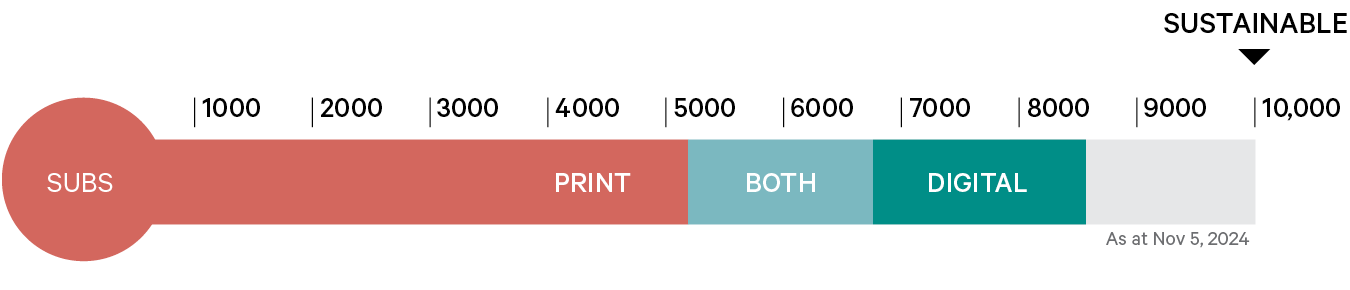
We need all the help we can get, but 10,000 subscriptions will keep this show on the road for now. Last week we had 7900. Today we have 8400. We can do this. If ever you’ve wondered about a sub, now’s the time, click that button.


If you have any questions about the business of publishing or these accounts, drop me a line on james@nzgeographic.co.nz. If you have a question about subscriptions, get in touch with our subscriptions manager Davina on 0800 782 436 or subs@nzgeographic.co.nz.
In the past week we have received numerous requests from readers who would like to donate to support our journalism, as well or instead of a subscription. There are a number of considerations around this which we have detailed in the sidebar below.