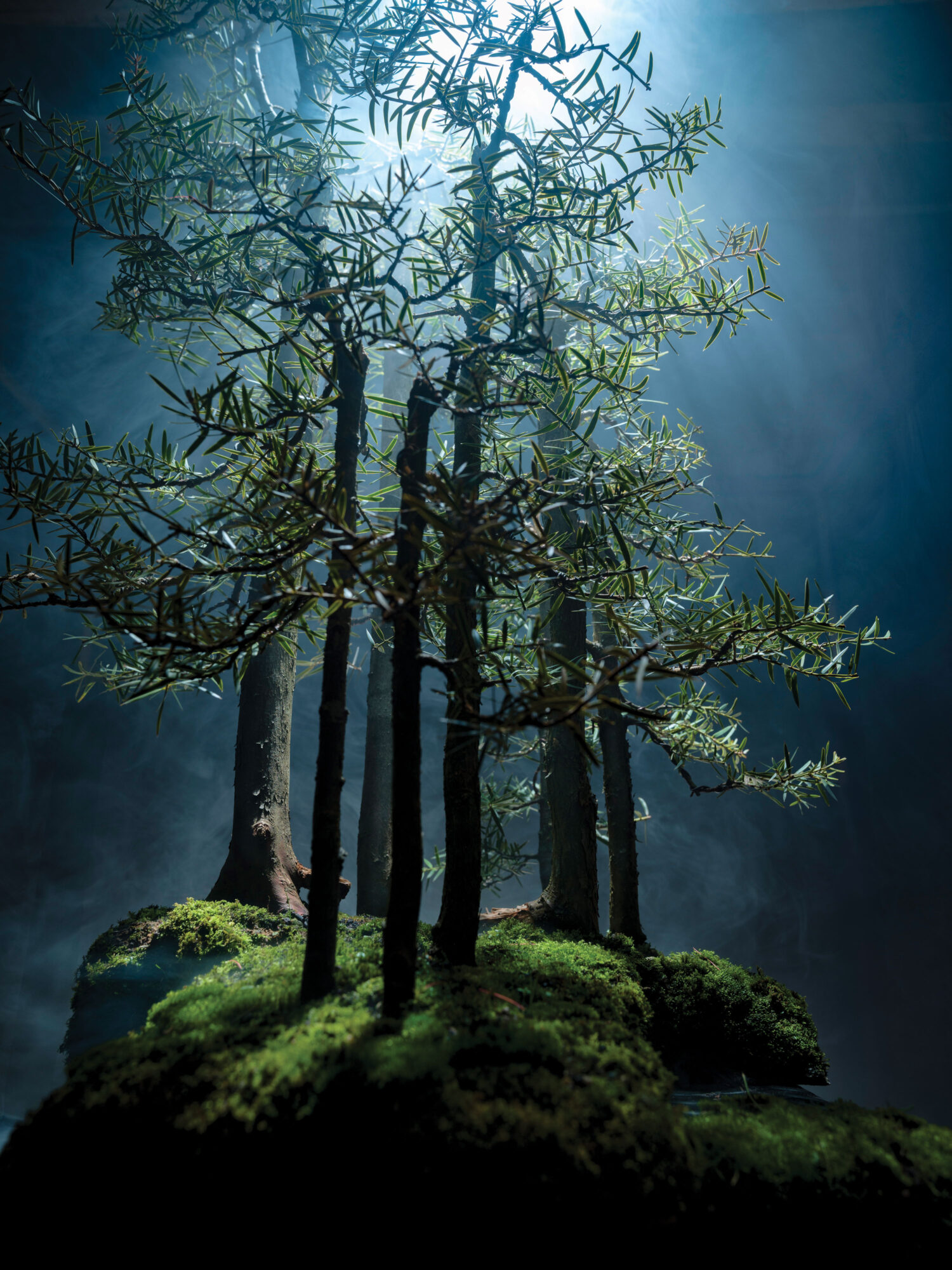
Little Beauties
Bonsai are teeny-tiny. But for some New Zealanders, they have a way of taking over.
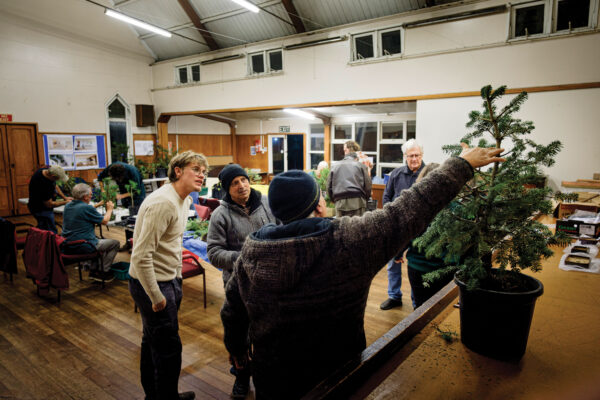
At the Hutt Valley Tramping Club a couple of dozen people sit around a table, tiny trees and cups of tea plopped before them. The cedar smell is heavenly. “Like Christmas and sweat,” somebody says. Garth Lippitt, the secretary of Wellington’s bonsai club, is arranging pines into a tiny grove, dithering over the composition; a group gathers to hmm-haw at it. A woman shares a technique with the newbie beside her, gently wiring copper around branches to shape them, trees and humans entwined.
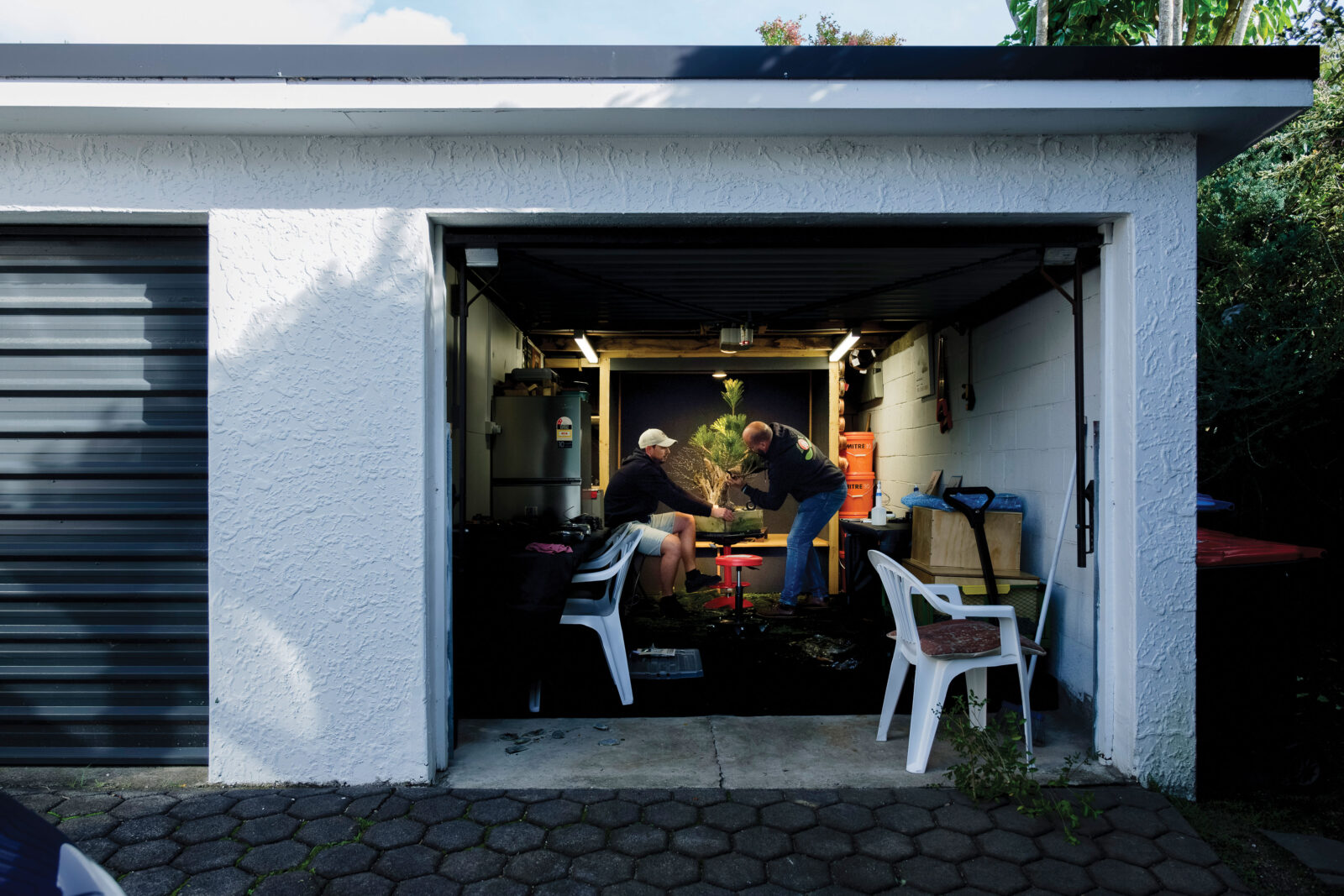
Bonsai, perhaps more than any other form of gardening, is deeply collaborative—each plant’s history is held in the subtleties of its form, in murmurs of shapes and hollows. One man doesn’t want his name used, but is pleased to introduce me to his hawthorn, tracing its lineage with his finger. A crook here, a curve there. “This bonsai was cared for by a Korean guy for 20 years, then an Aussie who follows the Japanese style of sweeping movements as opposed to angular,” he explains. “It’s collective art.”
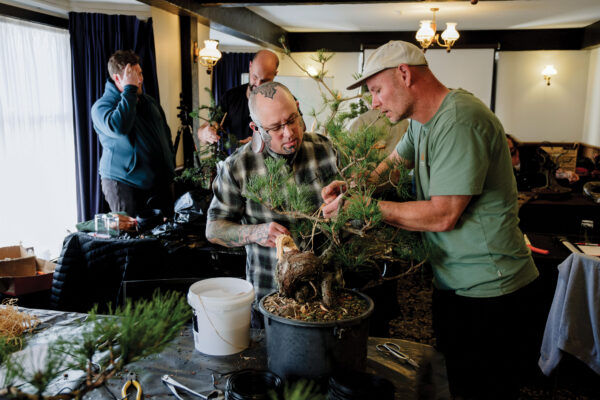
Lippitt introduces me to various people and bonsai. Most of both are decades older than I am. Scott Jania, a piercing technician covered in facial tattoos, stands out from the demographic of friendly grandpas. He tells me his true love is BMX biking, but Wellington is too damn windy, so he needed a new hobby. Bonsai provides him with “vitamin A”—art.
Jania’s an American import and bonsai has helped him connect with the landscape here, too: he keeps an eye out for lush patches of moss on retaining walls, or little weedy pines that might polish up well in a pot. Tonight, he’s working on a fellow club member’s wilding pine that needs a facelift. He babies a plethora of conifers at home, plants which thrive through the cold gales and rain that brought him to bonsai in the first place.
My sister Sophie tried buying a bonsai once. When the seller discovered that she lived in an apartment, he scoffed and refused to sell to her. “It would be inhumane,” he said. Sophie and I had laughed about this—a bonsai, we reasoned, is a plant, not a dog or a baby. But when I ask the bonsai club members about this, they nod, nonplussed.
Bonsai are outside trees. Brought inside, they die. You can make a tree tiny, you can make it art, but it doesn’t stop being a tree. This means security is an eternal headache for high-end collectors—and even for the hobbyists, whose decks and gardens are packed with living, portable artworks worth $100 to $1000 a pop.
In 2021, an elderly man in Mt Albert, Auckland, had 30 treasured bonsai stolen from his garden, losing not only thousands of dollars but a lifetime of work. The thieves came back for a second hit, taking 20 more specimens.
“What my father really wants is for the trees to be looked after and loved,” the man’s son told the Herald at the time. “His biggest fear is that someone will panic and destroy them.”
Other victims: a mature and very heavy conifer, which got up and walked from the public Hamilton Gardens three years ago. A 25-year-old maple, which a Bay of Plenty woman had tended since it was a sapling, disappeared just before Christmas in 2022.
“Stuff like this happens fairly regularly in specialist plant circles,” commented someone in a Reddit thread about New Zealand thefts. “I am very, very careful about who I show my rare plants to.”
Some in the bonsai community have started airtagging special plants—so that if a tree goes missing, it can be tracked via GPS. Security cameras and lights are commonplace. There was jubilation in July when Waikato police announced they had charged a man with receiving multiple stolen bonsai. His case is now before the courts.
[Chapter Break]
Much of the talk and tree-training tonight is geared around the upcoming National Bonsai Convention. The club will be going on a pilgrimage to Auckland, roadtripping with their best bonsai safely seatbelted in.
Such long drives are an opportunity for reconnaissance, because the true bonsai fiend never stops looking for new trees. Many travel with a spade and a saw in the boot, just in case. Wilding pines along the roadside; a gnarly old macrocarpa hedge; wild cherries popping up in council plantings—to the connoisseur, they all look like art in waiting.
The practice of digging up wild plants for bonsai is called yamadori. It can be as simple as whipping out a newborn privet: a single slouch of the spade and you’re done. But the most coveted specimens have spent years growing under stress—ideally getting chomped or trampled or blasted by wind—which makes for interesting branches and trunk “movement” down low. The wise practitioner will wait for the right season, just before the sap surges, to give the tree the best chance of survival. Sometimes they will tag a tree, or strategically prune it in situ, and come back to collect it months later.
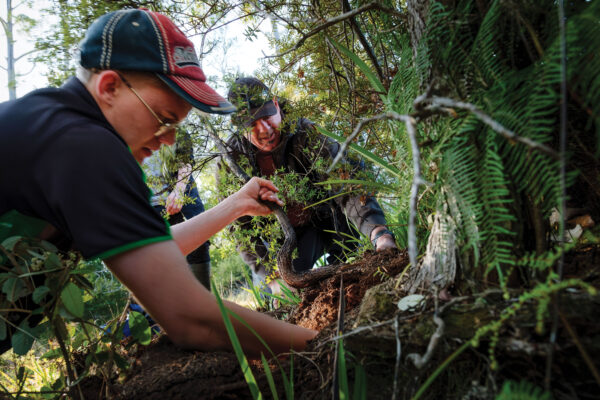
One shining Sunday morning in August, Rossco Phillips spots a hip-high mingimingi curled in the shelter of a golden tōtara. Next to the trunk, wandering in the other direction, is an even smaller mingimingi. Phillips falls to his knees.
“That’s got a sweet base on it, bro,” says his friend Brendon Covich. “I’d just dig the whole lot up together if it was me; you might have a mother-daughter set-up there.” Covich’s son Andy and their mate Zianne van Zyl gather around for the extraction.
Phillips uses his favourite adze, won in a yamadori contest, to nudge dirt out of the way and carefully cut through the root system. Covich fires up a small skill saw. The younger guys stand by ready to hand the surgeons tools. As the big moment nears, someone rolls out a metre or so from a school-camp-sized tube of plastic wrap.
The trees are lifted from the ground in one big plug and placed carefully on the plastic. And all at once, this scrap of undergrowth starts to look like bonsai.
Swaddling the trees is awkward, even for Covich, who’s wrangled seven babies and hundreds of bonsai. He and Phillips work together. The plastic must be firm, to keep the roots and moisture in place for the journey home; it’s topped off with a belt of duct tape.
With a nod from Phillips, Covich lops the bushy top off the mother mingimingi and dabs it with wound sealant. This afternoon, at home, Phillips will unwrap the trees and ease as much of the soil from the roots as he can. Then they’ll go into a wooden “training box”, surrounded by pumice (which must first be washed, to remove dust that can form a claggy layer and block drainage). Phillips will fasten wires to the bottom of the box and tie his new babies in nice and tight, to protect those precious roots from any more damage.
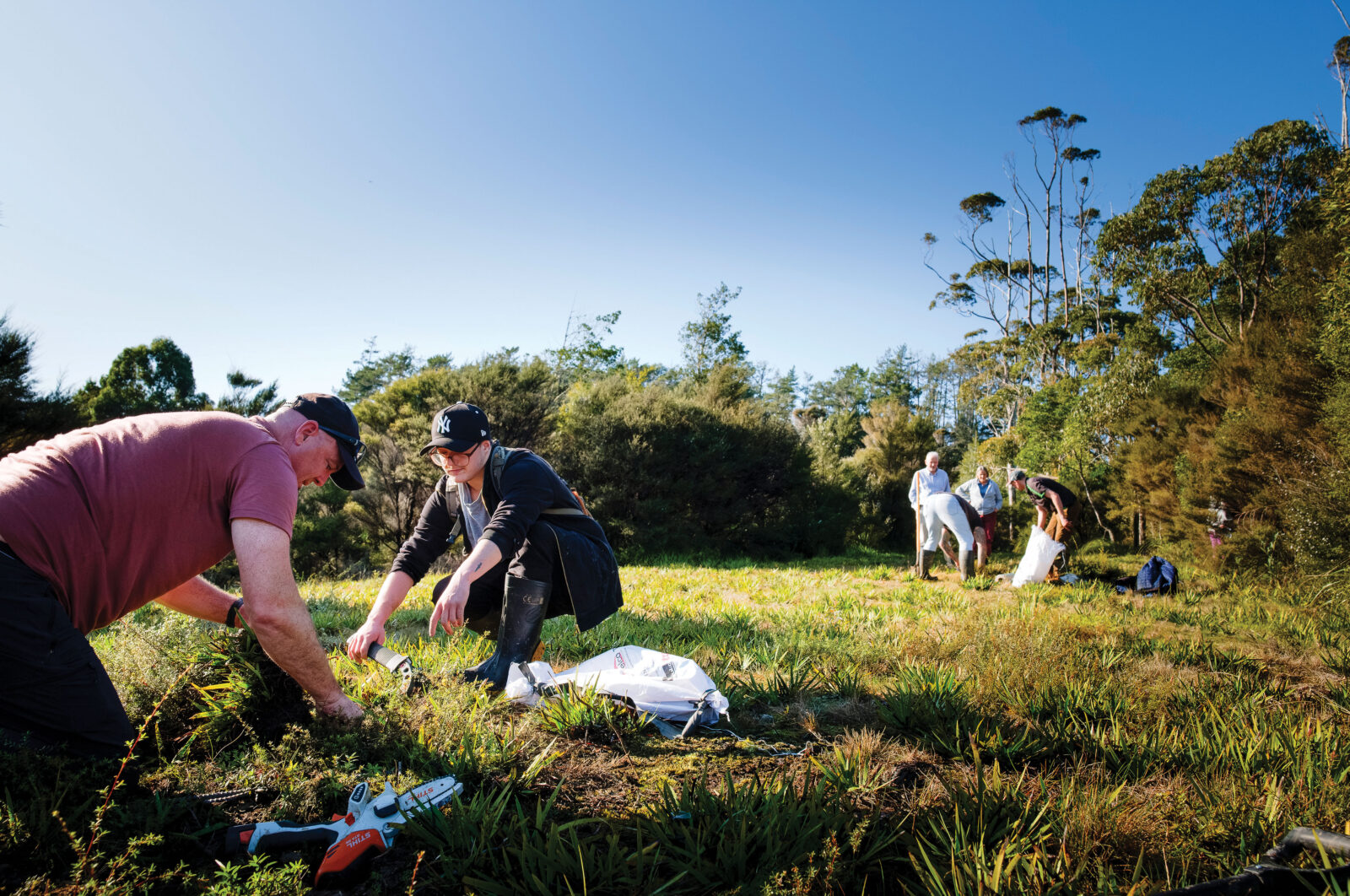
Now, though, he has to leave the trees alone for a few hours—we’ve got 16 hectares of regenerating bush block to scope, on a private property on Auckland’s Hibiscus Coast. While Covich chips away with a shovel, smoothing out the hole left by the removal of the trees, Phillips carries them to a deep pond of shade, and brushes his hand across the foliage in farewell.
Rounding a corner, we walk down a cleared slope that the owner mows a few times every year. A chaffinch hoons into the blue. Covich is looking at his feet. “Anyone want a nice little shohin?” A tiny mānuka is hiding in the grass, the hammered trunk horizontal, twisted. Potted up you could hold it in one hand; an extra-small grade of bonsai. “Mate,” Covich says, “we’re digging that bad boy. That’s a perfect little bonsai. Look at the chunk on that!”
Shouts go up from further down the hill: the clearing is pocked with mown-down yamadori minis. “Beautiful,” says Phillips. “Beautiful.”
There’s a trajectory to bonsai, the men explain. You catch the bug and you go mad for it, collecting everything you clap eyes on, spending too much on middling trees. You don’t have time to tend everything properly, so eventually, you’re forced to curate—hanging on to the best trees and giving the others away to beginners, seeding new frenzies. “We consider ourselves caretakers,” Covich says. “You never actually own these trees.”
Van Zyl has recently dialled back from 162 trees to about 40. “At one point I had a collection where it took me three hours to water them,” he says. “Daily.” He laughs. But the time is not wasted, he says. After a while, you sink into a state of purposeful calm, restorative for practitioner as well as plant.
“I think that’s a drug people chase, when they do bonsai, is that flow state. And the good feeling after you’ve done it, looking back and seeing this tree and going, ‘Man, this is awesome.’”
Phillips, who has about 70 trees at home, is thinking about his mingimingi. “The further I walk away from it, the more anxious I am about not getting back to it,” he says, and he is not joking.
Very old trees, native species, and those of Māori significance are considered the third rail in the bonsai community—it’s widely understood these are a no-go without good reason (perhaps the tree is about to get taken out by a new driveway, for example) and explicit permission. It’s also understood that such trees should not be uplifted without a solid survival plan.
Pest plants such as privet, ivy and pine, though, as well as other exotics such as fruit trees, are considered fair game. If they’re on private land, you just have to ask nicely. But to take a plant from a national park, scenic reserve or public garden, you should secure a permit from the local council or Department of Conservation. (Without a permit, that tree could cost you up to $10,000 and a year in prison.)
It doesn’t always happen by the book. I tried getting a permit, some collectors tell me, but it was really hard, and the plant was just calling to me. Or: it was about to be demolished, so really, it was rescued. Often, they explain that the plant in question was invasive. This is win-win weeding, collectors reason—bonsai and the broader ecosystem both benefit.
Matt Hutson, a jazz musician who now runs a bonsai-sitting and supplies store, has no qualms about yoinking such pests.
“Although I know that it’s not technically allowed, ethically, I’m 100 per cent going to do it. I’m going out to nature reserves, removing a pest plant from that environment, bringing it back to my house where I can control it and make sure it doesn’t multiply. When I think about it from a personal level, I’m doing the country a favour.”
Hutson’s under no illusion that digging up one or two plants is saving the environment on a major scale, but it stops ongoing spread—and he gets a cool tree out of it, too. “I would hope MPI [the Ministry for Primary Industries] has better things to do than to come knocking on my door over it,” he says.
Firethorn, privet, English ivy—they all bend nicely to the bonsai whim. But it’s illegal to buy, sell or propagate these species (as it is for hundreds of others deemed to be biosecurity risks). Facebook Marketplace cares not. Clicking through listings of felonious foliage, I message sellers, asking how they avoid getting in trouble.
“Why would I get in trouble?”
“MPI says you can’t legally sell or distribute firethorn,” I write.
“Never heard of that… they are everywhere,” comes the reply. “Are you buying or not?”
Facebook is proving hard for officials to grapple with, but Hutson has heard that MPI recently raided a nursery for selling invasive bonsai. I envision black SUVs rolling up, men in suits muttering into earpieces, sweeping pots off tables. I put in an Official Information Act request.
Since 2012, responded MPI, there have been six investigations into imports of suspected bonsai seeds and trees. Five of these investigations were about seeds purchased online. One suspect was thought to be smuggling via sea cargo—in that case, no evidence of illegal activity was found.
For a bonsai collector, any international move brings with it a wrenching decision: take the trees and risk the lengthy quarantine, with your plants enduring who knows what, or sell up and start again. When Poppie Engelbrecht and her husband, Adriaan, moved here from South Africa in 2000, their poor jet-set bonsai were quarantined for six months. Many died in limbo. When the couple received their plants, withered and broken, it was akin to losing somebody dear. Some had been collected in the 1980s, rare stinkwoods and olives that reminded them of home.
The alternative—sneaking plant material past Customs—can, of course, have much more dire consequences. One interviewee shows me an invasive grass sprouting in his pot. A fellow bonsai artist had smuggled the grass into the country years ago, he grumbles, because it was cute.
[Chapter Break]
The national convention takes place in the Auckland Zoo domes. It feels like a sci-fi spaceship: a series of black, windowless tunnels and pods. A vendor area bustles with pots and trees for sale, and a showroom glows with artfully lit bonsai. Bonsai meganerds in bonsai T-shirts gossip about pumice, zooming in on phone cameras to capture minute details on an angular kōwhai. One fan trails nervously behind a bonsai master, choking up the courage to ask for an autograph. I spot familiar faces from the Wellington club, including Scott Jania.
I am trying to make “Bon Con” catch on. It doesn’t.
“How is Bon Con, Scott?”
“Tree-mendous,” he responds, deadpan.
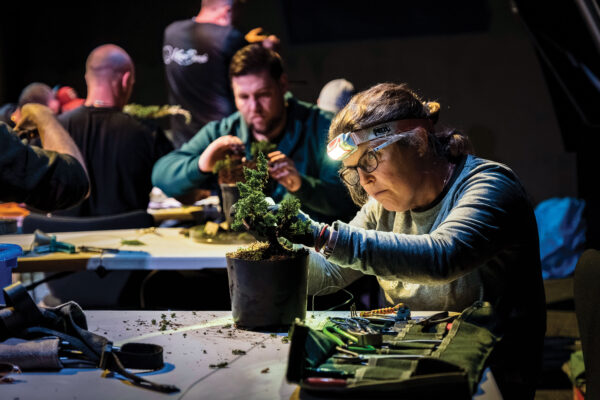
The workshop is heady with pine sap, woody and tangy. Bonsai master Mauro Stemberger has been invited to New Zealand for the convention and stands onstage, wrenching and twisting branches off a wilding pine with expert abandon. Opposite him, a man wearing a head torch is pruning his own tree. They banter casually, like barbers cutting hair.
“You have to prune your tree at the right time, or you basically f*ck it up,” he tells a rapt audience in a thick Italian accent. There can be six months, a year, between making adjustments to a bonsai, as it needs time to heal between tweaks. He spends an hour talking about fertiliser, his audience frantically taking notes on poo.
The bonsai world goes nuts for this guy. Over lunch, Stemberger tells me about a fan who wanted to get the master’s Instagram username tattooed. “Please-a don’t,” Stemberger begged, but the fan did it anyway. (He then contracted hepatitis and had to go to hospital.)
The vending area heaves with buyers and sellers. Among them, pot dealer Elaine Brown. She has flown over from Australia with her husband and a squadron of black, military-grade Pelican cases crammed with ceramics.
In the bonsai world, the pot is as important as the tree. Brown considers herself a picture framer. “I’m very good at matching pots to trees… Clients come and say, ‘What would you recommend?’ When you appreciate art and it’s framed properly, it lifts the whole composition.”
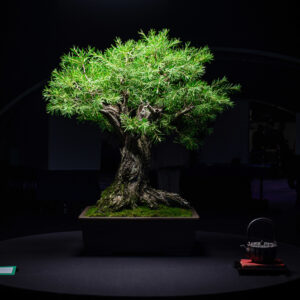
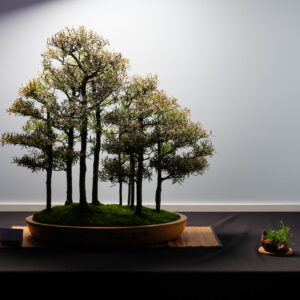
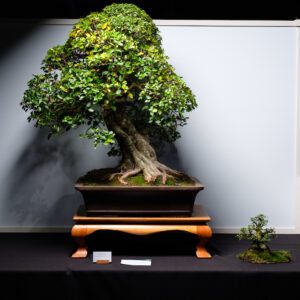
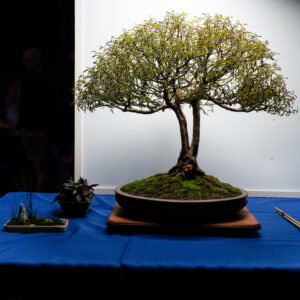
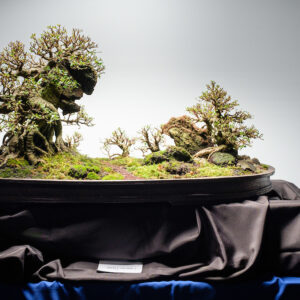
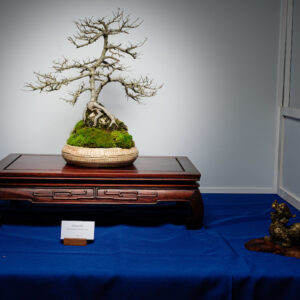
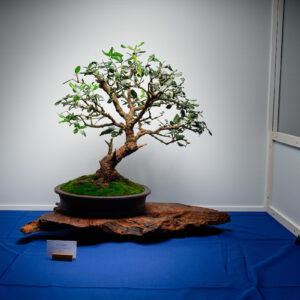
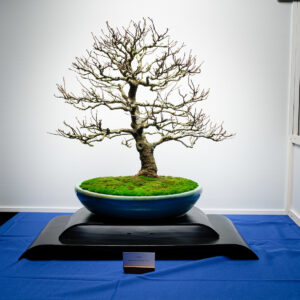
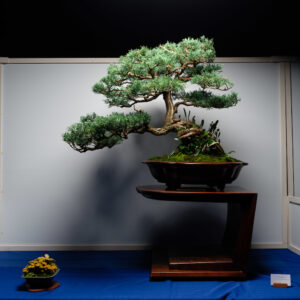
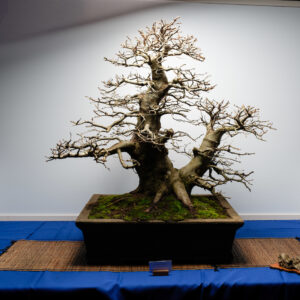
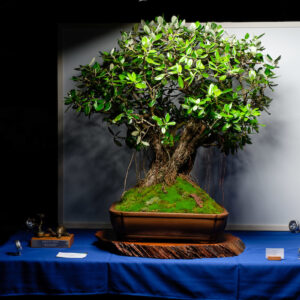
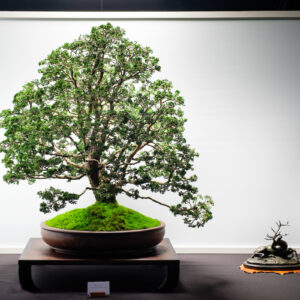
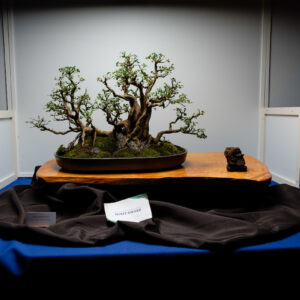
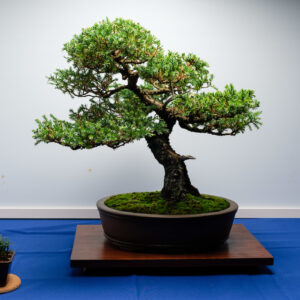
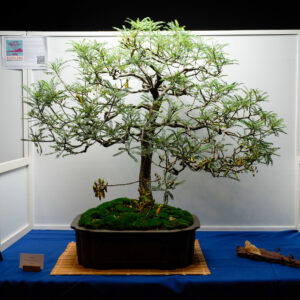
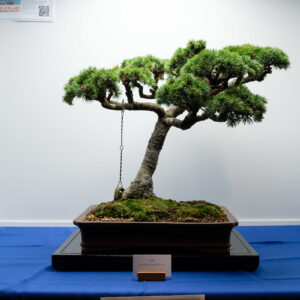
There are “rules”. The pot should be as high as the trunk is wide; the colour of the glaze must complement the leaves or bark; it should be both harmonious and beautiful. “Now that I’ve told you everything I know, I will have to kill you,” Brown says.
Bonsai newbies have visited her stall and asked, “Why is that [pot] $175?” And, “Where’s the nearest defibrillator?” Brown pats a pot. “This is for a finished, established, display-calibre exhibition-standard tree.” Until it reaches that pinnacle, a tree will stay in black plastic or a wooden training container.
Years of exacting care go in before a tree is ready to go out in public. (The worst moment in bonsai, confides Rossco Phillips, is when you’re worrying a significant branch and you hear a snap. “The first rule of Snap Club,” mutters his mate, Zianne van Zyl. “We don’t talk about Snap Club.”)
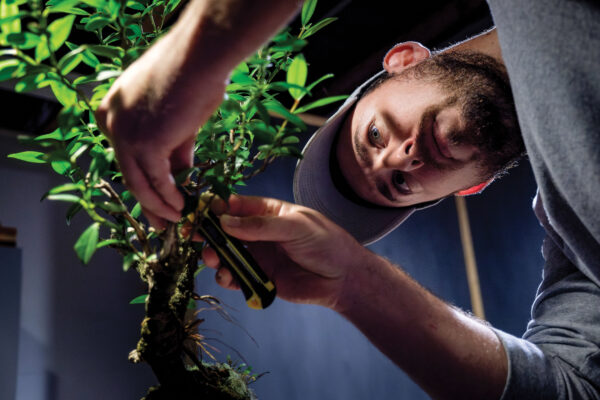
Then comes the dramatic training montage of getting a tree competition-ready. A bonsai undergoes a final trim, and any fallen or yellow leaves are tweezed away. The tree should look watered and moist, though not too much, lest root rot strike. A blowtorch may be used to touch up branches meant to look like they’ve been struck by lightning. The pot should be lightly oiled, on a stand that is slightly wider and approximately one-third longer. One online horticulturist recommends fertilising the plant beforehand, but not immediately beforehand, because then it’ll smell bad.
Some trees are destined to flop, simply because of the season. A wisteria bonsai, draped in sweet-scented purple or white in spring, will be naked and grey if Bon Con happens in winter—though a refined bonsai eye will admire its contours nonetheless.
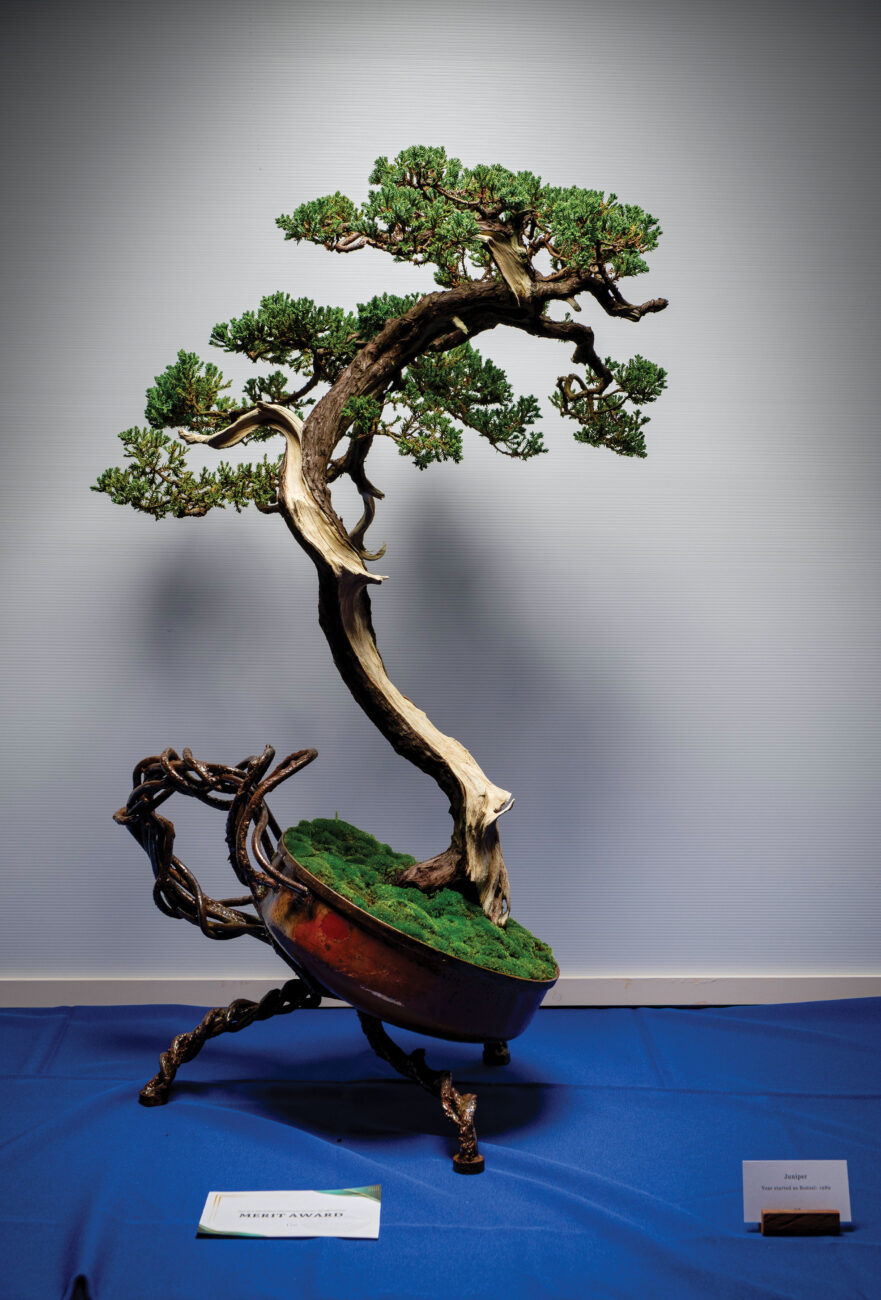
My favourite show bonsai is a pōhutukawa from the 1970s. It’s grown a beard of long aerial roots. The oldest specimens in the world are figs and junipers, topping out at 800 to 1000 years old. Nobody really knows what the oldest tree in New Zealand is; those with priceless “legacy trees”, the heirlooms tended by generation after generation, keep them quiet. As trees age they become more fragile, brittle and susceptible to infection. And they are revered.
Bob Langholm is having a different experience of ageing. He helped get bonsai off the ground in New Zealand, setting up the Auckland Bonsai Society and dedicating more than 60 years to the art. He is known in the community as the Father of Bonsai. At 95, he feels he’s been cast aside by some of the younger folk, who prefer to learn via computers and get a kick out of bonsai Insta. He pooh-poohs YouTube tutorials and wikis. He touches his chest, his head, and claps his fingers together.
“Your heart, your mind and your hands are the three tools you need. If you put your heart into it and think about it, your fingers will do all the work. And quite often, if you ask for it, nature will help you.”
Langholm first got his hands in the soil in Germany, as a 10-year-old working the family vegetable garden. By the time he was 14, slightly too young for the draft, he was tasked with tending wartime farms.
“We became cheap, cheap labour,” he says. “We became slave labour for Hitler. And if the war had gone another six months, I’d have been in the front line.”
Moving to Aotearoa, he landed a job with a city council park, and his boss happened to leave a book about bonsai on his desk. Langholm sat up reading until 2am. He still has the book, shelved among knick-knacks at the suburban Auckland home he shares with partner Simon Misdale.
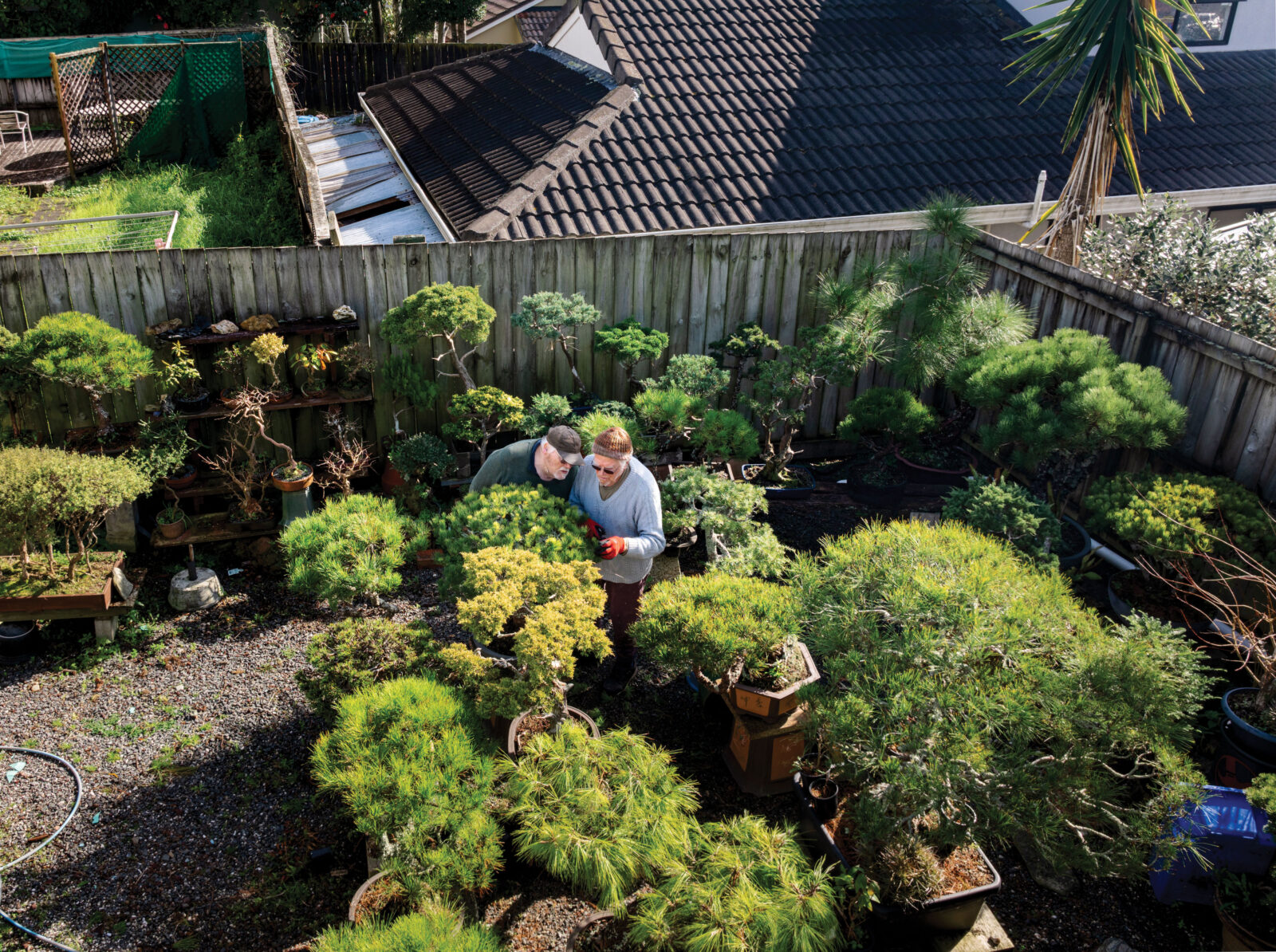
Bonsaiville, they call it. The house is incidental. What’s important here is the giant, tiny forest. Bonsai coil around the property, forming a maze. Workbenches are crammed with sacks of pumice, pots, even pungent rosemary and bay and curry bonsai to garnish Langholm’s dinner. He presses a tiny pinecone into my hand, the size of a thimble, something a fairy might sit on (controlling fertiliser lets the artist dictate the size of fruit and cones, to a point). There are the classics—conifers and hawthorns—but also dozens of kauri. Squatting down, I imagine being very small, and how easy it would be to lose myself in the knee-high kauri grove. I think of Tāne Mahuta, god of the forest, Aotearoa’s largest kauri tree, up north in the Waipoua Forest. Langholm’s little godlings are majestic, but confined, a conflict.
I was under the impression that bonsai was about control. Langholm shakes his head. It’s not about muzzling nature, but learning to work with it. He traces a conifer with a gnarled finger, showing me where a branch snapped off, only to heal into a gnarled burl. When he talks bonsai, his eyes twinkle, and he bubbles.
“Nature has given me peace, quietness, happiness,” he says. “Nature’s given me 95 years—I still have so many plans for what I want to do with the trees.”
[Chapter Break]
Keeping tiny trees in pots seems to encourage an expansiveness in one’s thinking.
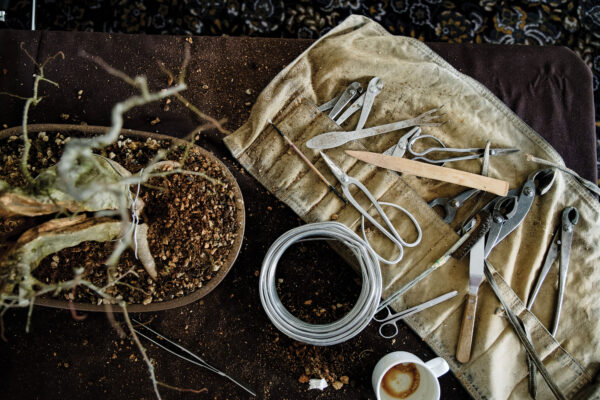
Adrian Bird is at Bon Con eating a tiny banana, which looks normal-sized beside his bonsai pōhutukawa. He believes he is the only person in New Zealand managing to make a fulltime income off bonsai. He bonsai-sits for high-end clients around the country. He also does at-home styling sessions, lugging sacks of tools between cities. When a client doesn’t have the technique to take their plant to the next level, or they can’t envisage the next step, Bird can.
Bird also works with the wider good in mind. He leans on his table, adjusting a tiny harakeke, small as a blade of grass. He believes that bonsai can act as bioindicators, and potentially as test plants for scientists working to protect special individual trees, or to build a species’ resilience more broadly. Bonsai artists, he explains, are the keepers of minute ecosystems, monitoring how the trees react to every slight change in temperature or soil composition.
“Bonsai will help save the planet,” Bird says. “No one works closer with a tree than a bonsai artist.”
Robert Allaway, another relative newcomer, is excited about the way bonsai can showcase our native species—kōwhai, pōhutukawa, and mānuka are particularly gorgeous writ small, and lend themselves well to bonsai. They’re becoming very popular among beginners and casual garden-centre shoppers. Tōtara are Allaway’s favourite, for their simple but majestic form. Tūī love them, too. They flock to his suburban forest. I think of kaiju, Japanese monsters dwarfing the forests they stomp through.
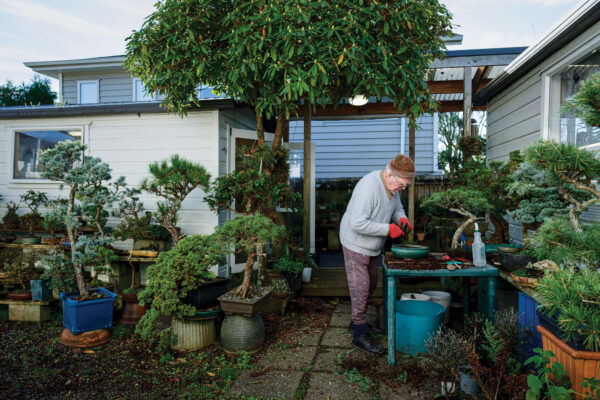
Allaway was an accountant for 13 years. Then COVID-19 lockdowns left his family stuck inside a small apartment and longing for their garden back in South Africa. “My mum actually said, ‘Guys, go and buy some plants.’ I bought myself some roses and hydrangeas.” Before long, YouTube started showing him bonsai. He dropped accounting and now sells bonsai, as well as working on plants for clients.
Recently, he’s been experimenting with air-layering the blue tōtara on his boundary line. First, he wounds the parent tree, removing a ring of cadmium, then he bandages it with sphagnum moss and plastic. From the lesion, a child plant grows, a tiny new root system pushing into the moss. When the roots have established, he cuts the branch and pots it up.
Allaway bends to rotate a tiny weeping fig. Its trunk is split in two, so it looks like it’s standing on tiny legs. Looking at it makes him smile. Another tree has a gnarled deadwood trunk, painstakingly hollowed out with a chisel. Looking at it, I think about a pine near my house that was struck by lightning. Likewise, a cascading, windswept pōhutukawa is a Lilliputian version of the one I climbed as a kid. In shaping it, Allaway was deliberately trying to emulate a tree he saw clinging to a cliff on Waiheke Island. Now, whenever he looks at the tree, he thinks of that holiday.
And he has a grander vision. Imagine, he says, a library of native plants on a miniature, accessible scale, educating and connecting people with nature. Allaway has been fighting the devastating fungal disease myrtle rust on his bonsai. He knows his experience is a potted version of a larger problem—one that threatens dozens of native species in the wild, and the ecosystems they support (see ‘The Forgotten Pandemic’, Issue 188). But he also sees the potential for taking his trees to communities who don’t understand what’s happening in the bush, or why it matters, and find it difficult to get among the real thing. In each of his dozens of specimens, he sees a tiny emissary for the world at large.
[Chapter Break]
Bonsai are gendered. This is, ostensibly, about the form the tree takes, not the person who shapes it: “masculine” bonsai are staunch and thick and sit in unglazed pots, while “feminine” bonsai are flowy, flowery and graceful.
Poppie Engelbrecht, who now owns a nursery in Tauranga, is the only female demonstrator at the national convention. We meet in the showroom before her slot. The bonsai on display around us are beautiful, Engelbrecht says, but she points something out—they are all masculine. The plants, in this case, do reflect their makers: while there are female bonsai practitioners in New Zealand, it is very much a male scene. Engelbrecht suspects this is because it’s simply easier for a man to announce, “It’s bonsai time now”, and disappear out to the shed. And she thinks women are missing out.
Everyone I interviewed for this story tells me that while working on bonsai, the wild, full-scale world falls away. “Serenity,” Engelbrecht says. In her own work, she favours the feminine forms. “You lose yourself in the scene, immerse yourself in the world, and when you leave, it’s like you’ve been in a different place.”
Moments before Engelbrecht heads on stage, she ushers me to her stall and stuffs a tote bag with twigs: grey, full of potential, smelling richly of the earth.
“These are Chinese elm cuttings,” she says. “You can have them.”