Citadel of the giants
We thought the giant wētā of the south were doing okay. Now, they are under siege.
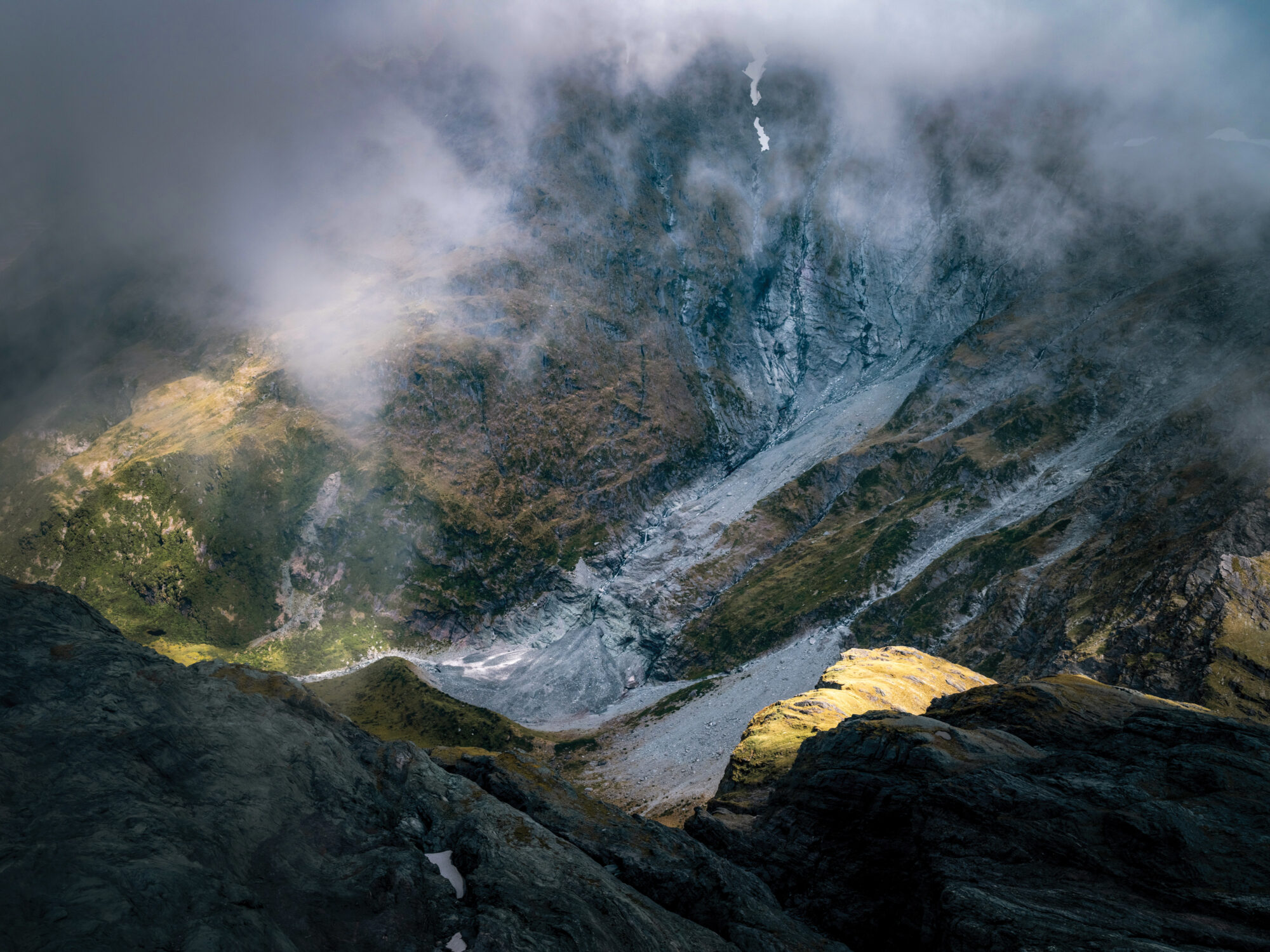
“Epic” is an overused word. I’m in the heart of Mount Aspiring National Park. We’re surrounded on three sides by 400-metre cliffs, over which tumble curtains of water. Boulders the size of townhouses are scattered around. A blue glacier pours out of the sky. Now this is epic. We’ve worked hard for this view—four of us lugging heavy packs up through the bush from the floor of the valley, slogging through thick tussocks in 30-degree summer heat.
We camped a night in a high gully, then kept pushing up, reaching an exposed ridge to take in views of the Southern Alps on all sides before dropping—slipping, sliding—down a steep ravine into a cirque valley at the foot of Mount Aspiring.
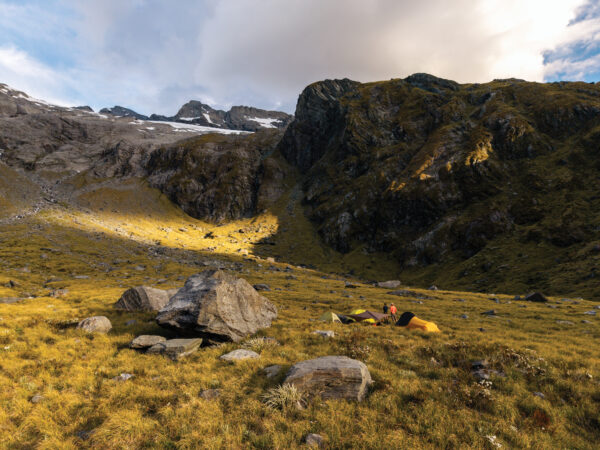
It’s a place few visit. Climbers gaze into it as they tackle the mountain. Adventurers very occasionally come here to navigate the chasm that drains the gorge—considered one of the most challenging canyoning routes in New Zealand. The odd conservation worker walks in to check traps. Otherwise, this place is left to its great roaring silences, its heavy moods, its ancient rock dreams.
And us? We’re here for wētā.
[Chapter Break]
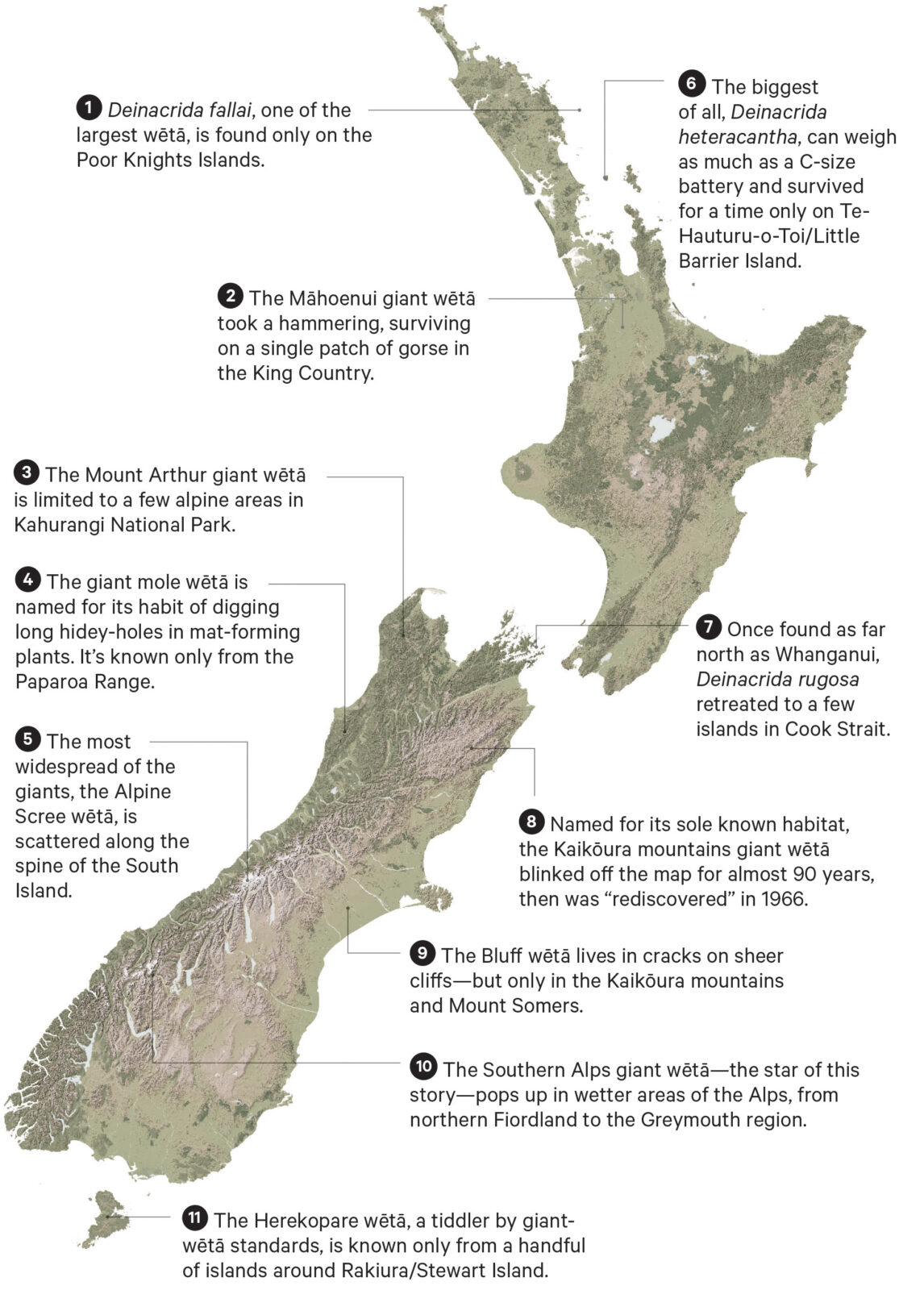
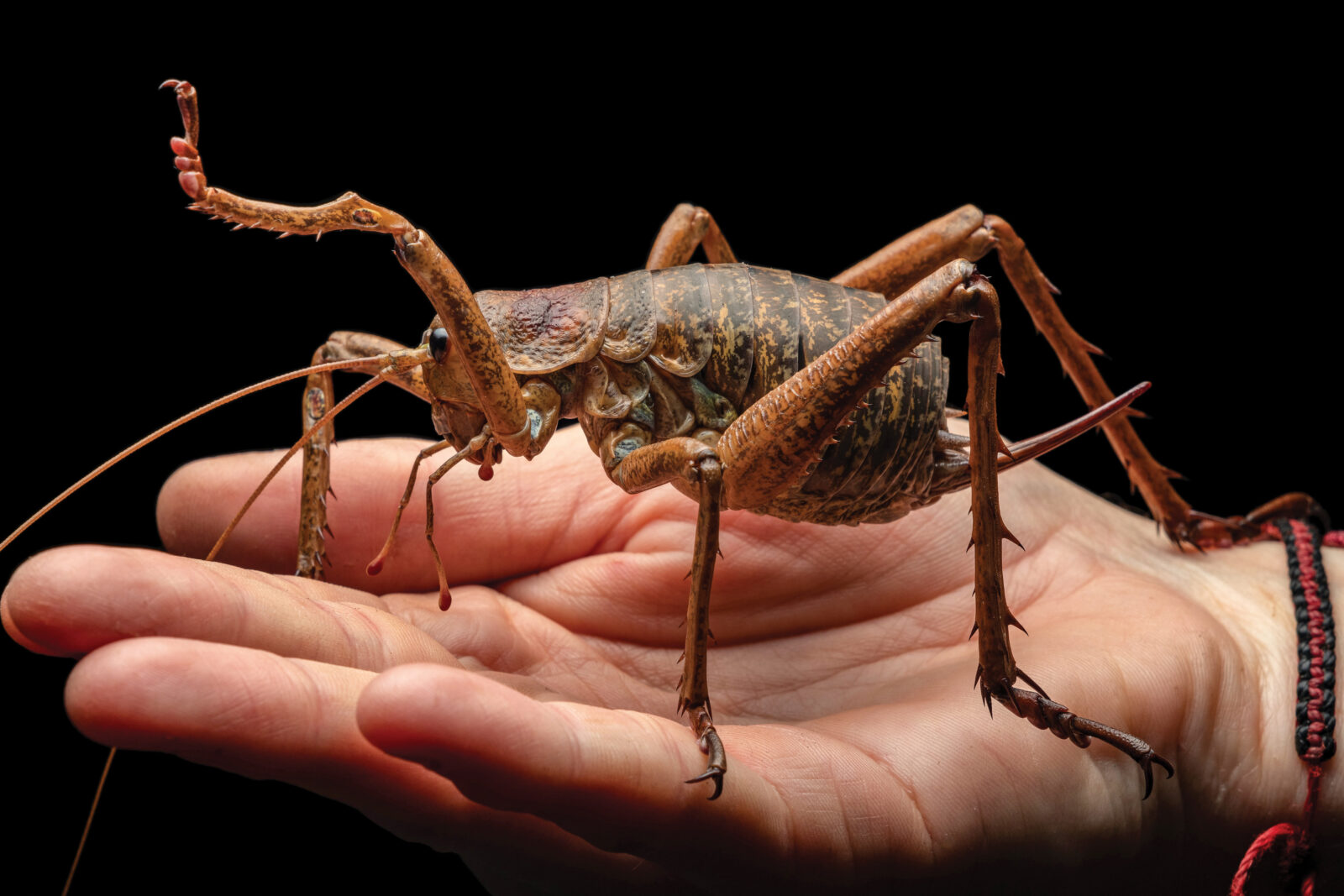
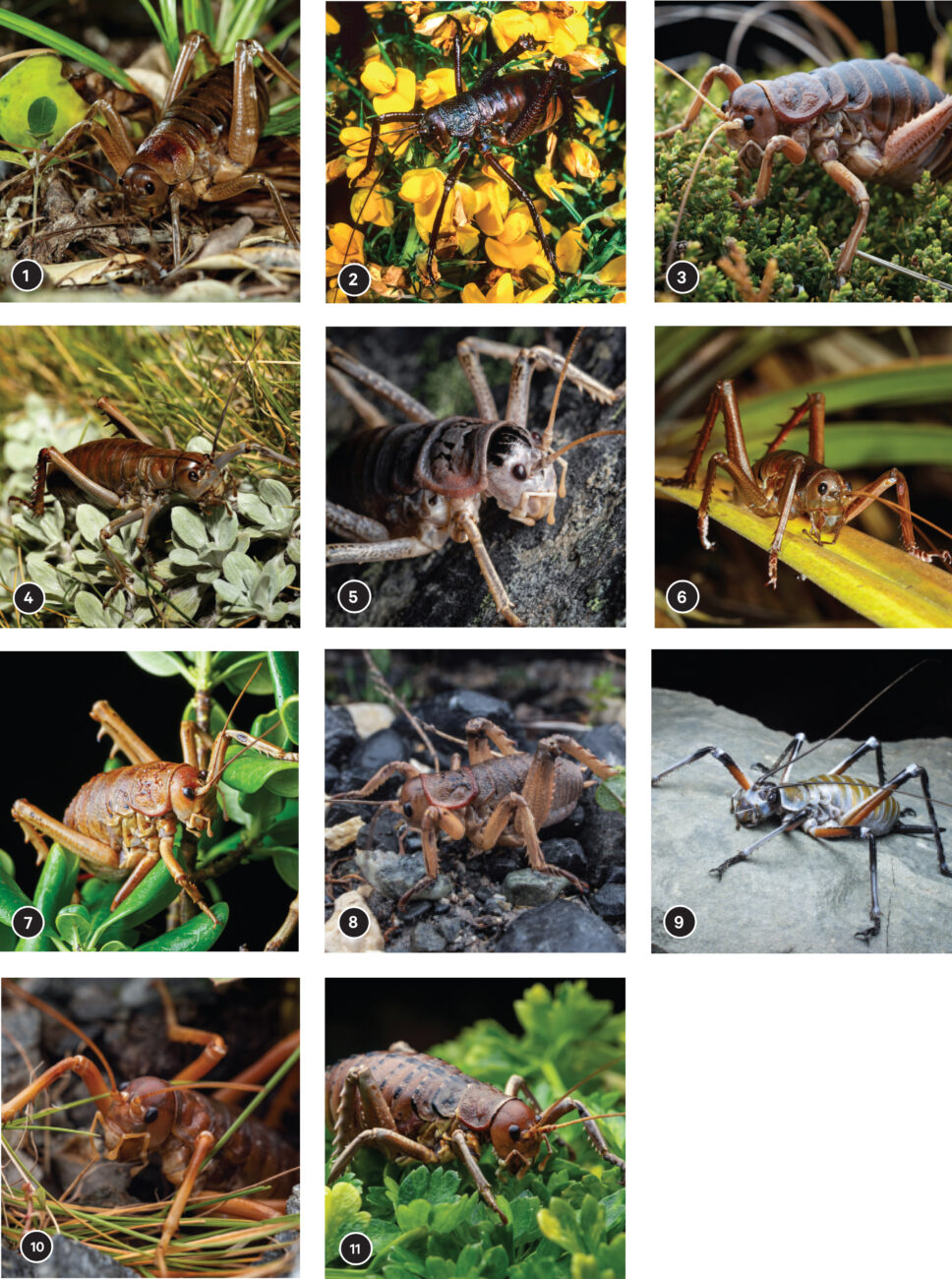
Evolving from an ancestor that survived the Oligocene drowning of New Zealand, giant wētā—whose genus name, Deinacrida, translates to “terrible grasshopper”—reclaimed the country as the land slowly rose from the sea. The enormous insects diversified as the mountains rose, splitting into 11 species from one end of Aotearoa to the other (see map, page 75).
The coming of people and pests was not kind to these walking protein pouches. In the North Island, various species of giant wētā were reduced to just a few scrappy strongholds. Wētāpunga, the largest species, heavier than a house sparrow, clung to Te Hauturu-o-Toi/Little Barrier Island. Eighty-odd kilometres north, its cousins haunted the Poor Knights Islands. The enormous Stephens Island giant wētā existed only on a few islands in Cook Strait. And in the worst shape of all was the Mahoenui giant wētā, confined to just a few patches of tawa and gorse in King Country farmland.
But as recently as the 1990s, it was thought the species of giant wētā in the mountains of the South Island were doing okay. Scientists thought they lived high enough to escape rats and other predators. That, we’re beginning to understand, was a dangerous assumption.
[Chapter Break]
Fittingly, the giant wētā of the south were shaped by mountains. As the land rose, the wētā were driven skyward and forced to adapt. They evolved the ability to survive being turned into icy slurry during the winter months—going into deep hibernation as ice crystals form in their cells.
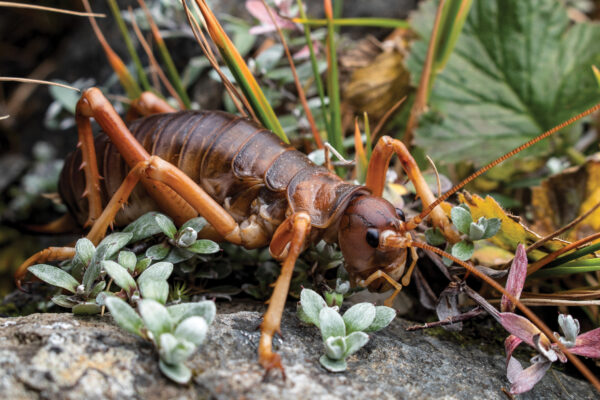
The Southern Alps giant wētā, or the Mount Cook wētā, as it used to be known, has the evocative species name pluvialis—“of rain”—reflecting its preference for wet, high, western areas in the alps.
It was entomologist and author George Gibbs who named them; in the early 1990s, with a small team, he searched the length of the alps for giant wētā, eventually naming four new species.
In most places, recalls Gibbs, wētā were few and far between. “Sometimes you had to look all day to get one.”
A tip-off from a tramper led the team into the head of the Matukituki, and there they struck gold. “Just about every stone we turned over had a giant wētā underneath it,” says Gibbs. There were, by a large margin, more giant wētā here than anywhere else they looked in the entire South Island.
“The basin was almost literally full of these wētā,” says Gibbs. “It was like going back and seeing a Haast’s eagle flying around—a piece of the past.”
In 1998, the Department of Conservation (DOC) noted of Deinacrida pluvialis: “There is no evidence to suggest that this species is in decline, or under any threat, and it appears to be widespread and stable.”Two decades after Gibbs and his team stumbled into the valley of the wētā, DOC entomologist Warren Chinn visited the same area. He found no living wētā, just “bits of legs and carapace”.
Two other researchers, Tony Jewell and Danilo Hegg, also visited the area. Jewell found just a couple of live wētā. Hegg found none.
And it wasn’t just the Matukituki where the insects were vanishing. Wētā were once so common around Mount Cook village that visitors would be introduced to the “Mount Cook demons”.
There are now no pluvialis wētā to be found there. It no longer seemed right to call them the “Mount Cook wētā”—entomologists changed the insect’s name to “Southern Alps giant wētā”.
It’s a similar story down at the Homer Tunnel, the entranceway to Milford Sound. Pluvialis were recorded here last century, but have now vanished. Researchers fear the species is rapidly disappearing across its whole range.
“We haven’t even started finding out about this group of animals before we’ve got a bloody disaster on our hands, which is that they’re going down the throats of mammalian predators,” Chinn tells me.
“It’s an emergency, and it’s all hands to the pump.”
[Chapter Break]
Samuel Purdie has loved wētā ever since one made him cry. He was in primary school in Rotorua at the time, an insect-obsessed child poking around the back of the school buildings, when a tree wētā hiding in some timber bit him. “It just absolutely nailed me and drew blood,” he recalls. It didn’t put him off, though.
“Everything about them is amazing.”
Purdie’s fascination with nature drew him to the South Island, where he studied at the University of Otago. As a student, he got the chance to visit the gorge and, realising it was great habitat for wētā, he went looking for them.
Lifting a boulder, he was elated to find a female Southern Alps giant wētā and two nymphs. Rock-hopping in darkness, when the wētā are out and about feeding on plants, Hegg, a co-founder of the Wētā Conservation Charitable Trust, also systematically surveyed the area. It became apparent the gorge overlooked by Mount Aspiring was a stronghold for the species—by a clear margin the largest population known anywhere. In 2022, the threat classification for the species was changed, from “not threatened” to “nationally endangered”—the second-most-urgent ranking. Queenstown and Wānaka-based conservation project Southern Lakes Sanctuary scrambled, getting a team into the gorge in the first weather window. If the species was going to be saved, coordinator Tom Reeves and his team decided, this was the place to do it.
The cirque valley is a fortress, protected on three sides by near-vertical cliffs. The only way in is via the high route we’ve taken, or up through the steep, densely forested gorge at the bottom.
By concentrating predator control around the gorge, Reeves and his team reasoned, it might be possible to keep the basin relatively clear of hungry pests.
But to conserve an animal, you first have to get to know it. “For being such a big iconic species, we really know very little about their habits, behaviour and habitat use, what they feed on,” says Reeves.
“A lot of it’s assumptions, based on other species. We really need to understand them so we can make the best conservation decisions down the line.”
[Chapter Break]
Everything in this place is poised to freeze, drown or crush you. In the 1970s, a rockfall estimated to weigh a million tonnes rolled over Rob Roy Glacier before dropping hundreds of metres into the gorge, the impact causing a flash flood in the valley below. I’m sitting with Purdie, gazing at the cliffs on the northern side of the gorge. He’d love to search for wētā there, but, he tells me, it’s just too dangerous—huge chunks of rock and ice are constantly falling. He points out a slab of dirty ice the size of a bus lying at the base of cliffs. Last year, he was searching for wētā in that exact spot.
This is a tough office—working here means watching the weather forecast for weeks, before picking a rare window of time to get in, do the work and get out. Purdie has already shortened our trip from three nights to two, to get us out ahead of forecast heavy rain. A chunk of last summer’s field work had to be called off altogether.
On dusk, I follow Purdie as he leaves our camp and heads up into the bluffs. He starts turning over rocks, looking for wētā. He’s careful to replace each rock, as much as possible, exactly the way he found it. Each wētā probably has quite a small home range, he says. That rock might be the creature’s whole world.
“When you move a piece of stone that’s possibly been cemented in soil for decades, you’re invariably going to change the composition of that little piece of earth. Maybe the humidity might change a tiny bit. Maybe there’s a bit more of a draught if you leave a gap.”
We work our way up to the edge of the gully, the spray from a nearby waterfall showering us, then scrabble across an apron of schisty scree. Light drains from the valley, slips off the high peaks. Even with darkness, the heat of day lingers—I’m still in my T-shirt. In winter, though, this place will be gripped by the bone-breaking cold of the mountains, and full of snow and ice. It’s incredible to think that a cold-blooded insect could thrive here.
“I find it fascinating.” says Purdie. “Where we’re finding most of them, it’s really dark. Some of the habitat they live in might get four hours of sunlight at the best time of year. It’s basically perpetual darkness.”
Perhaps these are the last places left for them. Better the dark, and the cold, than the army of predators that’s set up camp below.
The great wheel of southern stars turns above. I pick my way across the boulders, my puny head torch peering into a rocky underworld. A black harvestman—a creature that looks something like a spindly, anxious spider—scurries across boulders. A millipede coils against dry stone.
I step into an area of dense shrubs. Here, pale alpine moths drink from koromiko flowers, pollinating them as they flit from bush to bush, their wings sparkling silver and gold in the gaze of my flashlight.
There’s a whole insect-driven ecosystem at work here, of which the wētā are just a small part. And if we don’t know much about wētā, we know even less about most of these insects. Many are not even scientifically named.
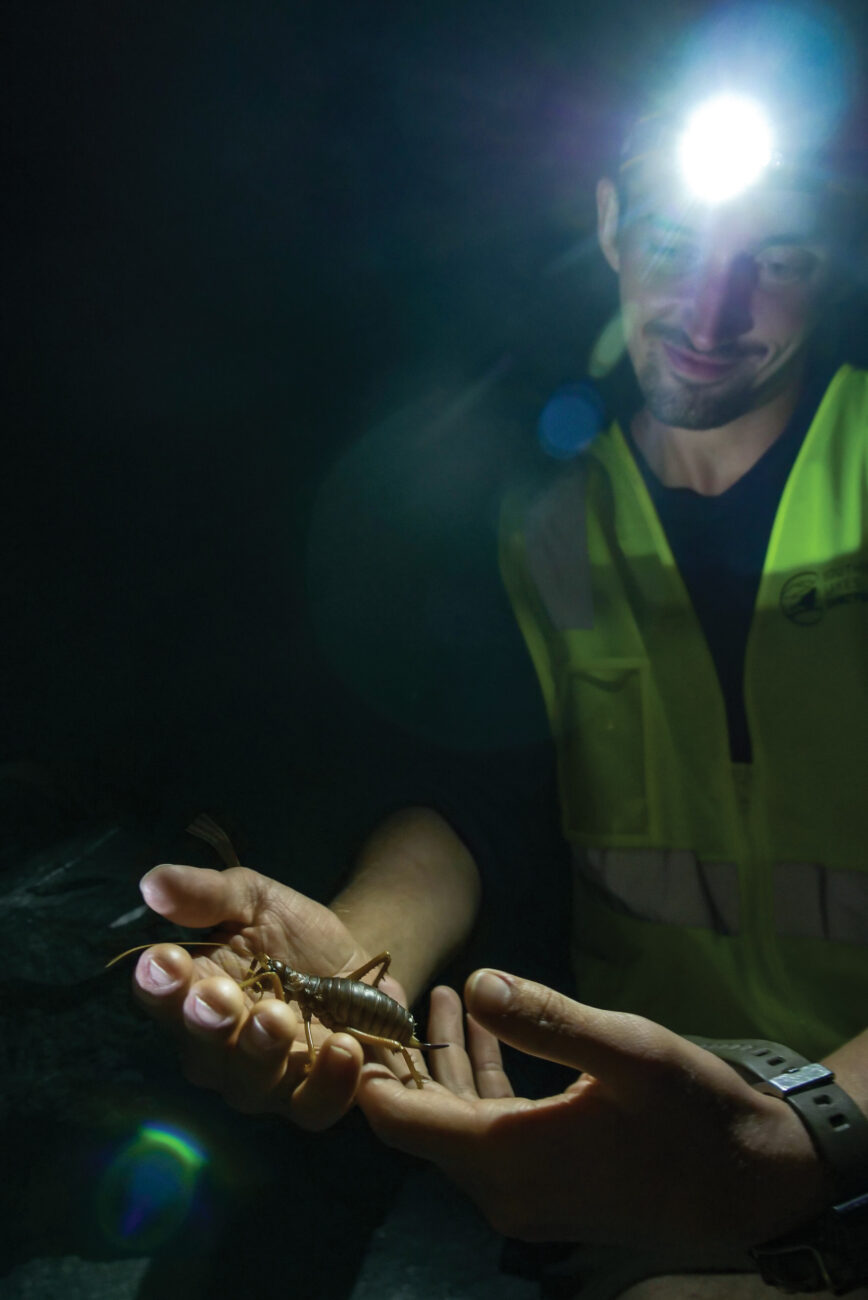
From my right comes a childlike yelp—Purdie. I scramble over to join him, the light from our head torches merging as I look where he’s pointing: a Southern Alps giant wētā. It’s the first one I’ve seen.
It’s the size of a mouse, pale, chunky and jagged, sitting motionless on a rock.
Purdie is beside himself with excitement. He gets out his camera. The wētā doesn’t move.
“They look like some ancient relic of the past,” Purdie says. “They’ve got such an aura about them.”
To any predator that manages to navigate the valley of traps, this wētā no doubt looks like a feast. (“I don’t know what they taste like, but it strikes me they’re not too different from a crayfish,” Chinn told me.) For a rat, one of these giants would certainly provide enough sustenance to knock off work for the day.
Speaking of which, Purdie’s still got the energy to look for more wētā, but it’s now nearly 2am and after a long day of climbing, I’m shattered. Mumbling my excuses, I head for my sleeping bag.
[Chapter Break]
I awake with the morning sun baking my tent and a rustling and clanking in my ear. A young kea has poked its head under the fly and is trying to get at my drink bottle. Pulling on my boots, I shoo the pesky bird away. On stiff legs, I stumble across huge slabs of schist to fill my bottle from a clear mountain stream. The roar of water surrounds us.
After breakfast, we wander the streambed, coming to a trap set amid stones on the riverbed. Team member Ben Carson pulls out the remains of a stoat—even in this fortress, invaders are about.
To protect the wētā, says Purdie, we need to be able to monitor them—to track their population changes as we trial different predator control methods. We need to know how many wētā are being eaten, and who’s doing the eating.
That’s important, because targeting the wrong predators could have unintended consequences. It’s thought mice may be one of their biggest predators, in which case trapping stoats and ferrets could be counterproductive, as these predators also keep mice numbers in check.
And there is, of course, another monster stalking these hills—climate change. As the snowline retreats uphill, the predators follow. There’s nowhere for the wētā of this valley to go—the vertical walls protect, but also imprison them.
[Chapter Break]
The plight of the Southern Alps giant wētā is likely being visited on all of our alpine giant wētā species.
Sandy Toy is chair of Friends of Flora, a volunteer-run conservation group dedicated to protecting the flora and fauna of the Mount Arthur region in Kahurangi National Park, home to Deinacrida tibiospina, the Mount Arthur giant wētā.
Using tracking tunnels, the group set out to try to learn more about the wētā population in the area. The tunnels collect inky footprints of any insects or mammals skittering through. What the group discovered shocked them. That first season, the tussock masted, pumping out huge amounts of delicious seed. Mice numbers exploded. The wētā footprints “vanished”.
The old idea that mice don’t venture into the higher reaches of alpine areas is, Toy says, no longer tenable. Her group has found mice as high as 1500 metres above sea level, close to the height of the summit of Mount Arthur. And the effects of climate change are now undeniable. “We’re not getting the cold winters that knock back the predators,” Toy says.
Wētā, she fears, will be forced higher and higher until they run out of mountain, at which point, they will disappear. It’s not just wētā at stake. “There are so many really cool critters up there that people know even less about. We don’t even know what we’re losing.”
Mary Morgan-Richards of Massey University has studied giant wētā and other alpine insects for decades. She refers to wētā, grasshoppers and other insect herbivores as “community architects”.
By grazing certain plants, they reduce competition for snow tussocks, helping to maintain the iconic, golden tussock grasslands that New Zealanders love.
“We kind of have an inkling that these things are important,” she tells me. “But we don’t really understand the actual relationships between them, and what their role is.”
[sidebar-1]
For Toy, the focus now needs to shift from large predators such as stoats, ferrets and cats. It’s time, she says, to figure out how to hit mice, hard and at scale.
That will be incredibly difficult and expensive. “We know how to deal with rats and stoats, but we don’t know how to control mice effectively and keep them down,” says DOC biodiversity ranger Kate Simister.
Simister is charged with protecting the critically endangered giant mole wētā, which is making its last stand high in Westland’s Paparoa Range. These wētā burrow tunnels deep inside compact, mat-forming plants.
We have no idea how they’re doing. The wētā, Simister says, live in rugged, untracked areas and finding them is both expensive and extremely hard—few people have the experience needed to successfully locate them.
“It’s all very well and good to get people up there,” she says, “but it takes a special sort of person to search for them.”
The only species that’s not currently considered threatened is the scree wētā, which still appears to be quite abundant. But that’s what we thought about the Southern Alps giant wētā two decades ago. With no way to measure scree wētā numbers, Purdie worries about them, too. “We could find in 10 years’ time that these things are disappearing, too.”
In the North Island, the giant wētā once forced into tiny strongholds are now doing well.
Wētāpunga are being bred very successfully in Auckland Zoo. Similarly, the Mahoenui giant wētā has been successfully bred at the Ōtorohanga Kiwi House, 58 kilometres south of Hamilton.
Stephens Island giant wētā have been translocated to the Zealandia Te Māra a Tāne ecosanctuary in Wellington and are thriving in the absence of predators. But it’s not clear that these techniques will work with their southern cousins, which have been calibrated over millennia for altitude and cold. “It’s just not as easy with our mountain species,” says Purdie.
“You might be able to breed Southern Alps giant wētā in captivity, but the trouble is, where are you going to put them that’s safe? There are not many places I can think of.”
Translocating a species is always risky, and usually involves many years of research and planning. But in the south, our giant wētā are out of time. High, wet, predator-free Secretary Island in Doubtful Sound is a possibility—Purdie has been musing about bringing the wētā of the cirque valley there. Perhaps other species could be moved to islands in Lake Wānaka.
“But whether they survive, we simply do not know.”
Island strongholds
As mammals arrived on the mainland they munched their way through giant wētā, decimating populations to the point that some species survived only on tiny islands. Breeding these remnants in captivity, then releasing them in safer homes, means we’ve managed to pull the North Island species back from the brink. But the South Island species, evolved for cold and altitude, may prove much trickier to relocate.