Woman alone
The hard, heavy work of not feeling scared in the bush—and why we persist.
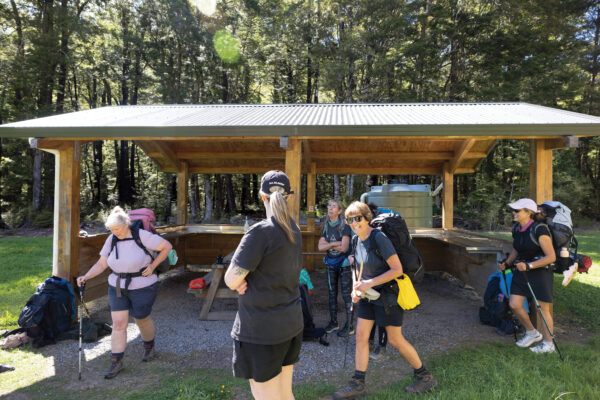
Ten women meet at the Marble Hill campground, where Maruia River crosses the Alpine Fault near the top of the South Island’s spine. In the shade of the beeches, they smear sunscreen over bare shoulders, extend telescopic poles, compare how long it took to get here from Blenheim, Christchurch, the Coast. It looks like the beginning of any group tramping trip, but each of these women will be spending it alone.
Over the next two hours, the group dwindles as one person sets off, then another, at intervals timed far enough apart that they won’t hear or see each other on the track up to Lake Daniell.
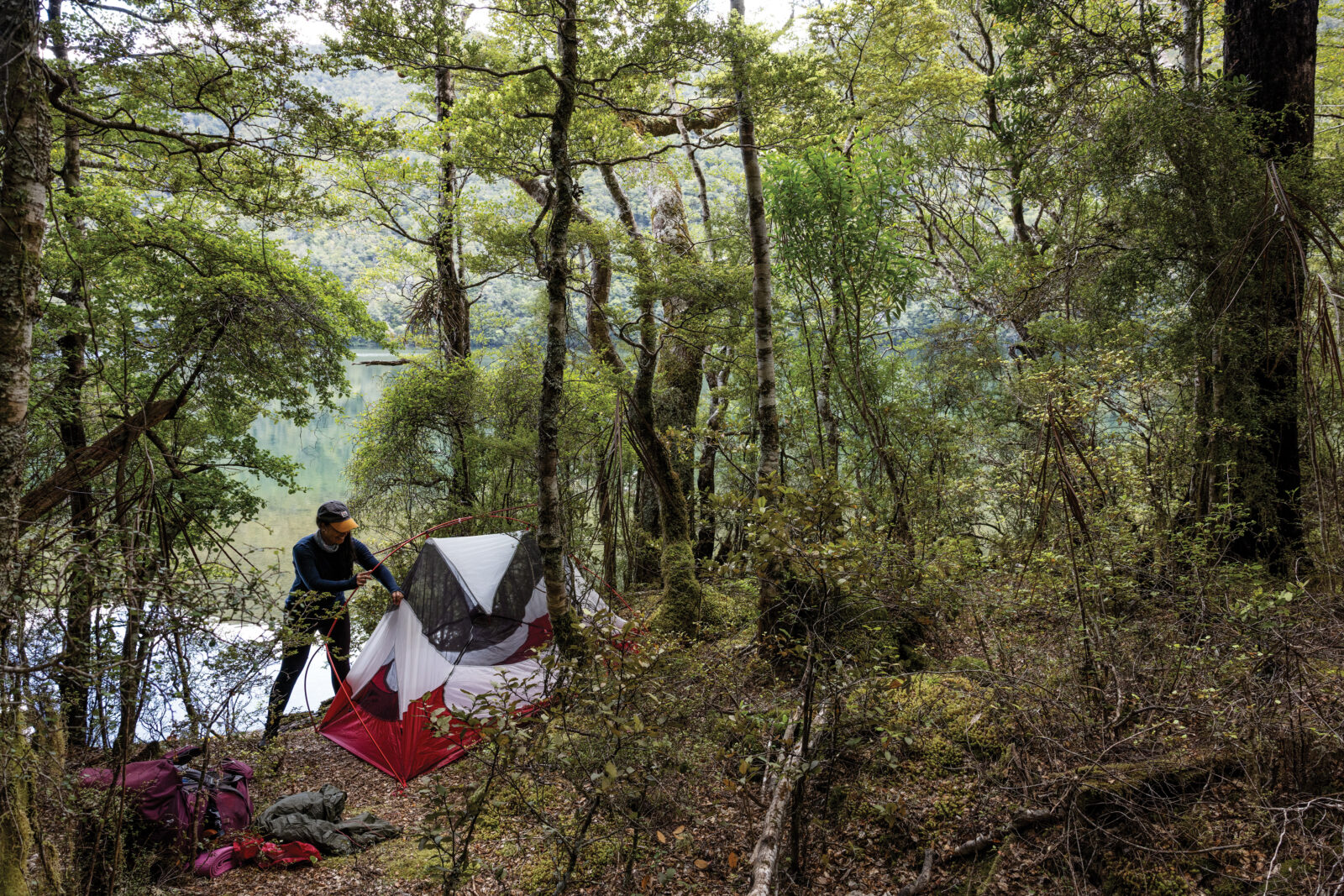
There, each woman will find her own camping spot among the trees on the lakeshore and settle in for the rest of the day and the night. There’ll be no sororising, not till tomorrow. But that’s not a prohibition, it’s the whole point: to be alone.
This exercise is a chance to test nerves, to approach fears. To try out new camping gear. No member of this group regularly goes tramping by herself—except one.
This unusual trip is Fiona McConnochie’s idea: she’s silver-haired, slender, always in motion. A few years ago, she quit her life as a Nelson lawyer, concerned she wasn’t really living it, sold up and moved to Harihari, a tiny community on the West Coast. As she spent more and more time tramping, her friends and relatives felt more and more worried about her going into the hills alone. She noticed how she absorbed and reacted to their anxiety, and wondered if vicarious fear sat beneath the surface of her own decision-making.
Meanwhile, she noticed that the more time she spent alone outdoors, the more comfortable she was. Perhaps that was the key: helping other women get accustomed to the feeling of being by themselves. Help, if they needed it, would be just around the bend of the lake. After all, it’s hard to tell the bad feeling of an unfamiliar situation from the bad feeling of danger; this kind of experience might help others hold them apart.
While we wait for our allotted times to set out on the track, we get to know our together-alone companions.
Michelle Cox’s first-ever tramping trip was right here, to Lake Daniell; she found it hard going, but she was hooked. She’s back, almost three years later, to see how it feels now that she has more fitness and experience. Simone Mullan tells us she wouldn’t normally go tramping unless she knew for sure that there’d be a bed at the hut ahead. She works in education in north Canterbury; she and another group member, Karen Jordan, went to Riccarton High School as teenagers, and they’ve recently reconnected. Jordan is a keen tramper, and her daughter’s a hunter. These days, her left knee makes some of the decisions for her: “I don’t do uphills,” she says.
Mullan talks about running worst-case scenarios in her mind in preparation for a trip like this. “Inside your head, you’re going, ‘How am I going to manage that? What if something else dangerous happens? How are we going to deal with it?’ And then you’re sort of, like, ‘Right, I’ve got a plan’.”
“Yeah, as long as you’ve got a plan, you’re all good,” says Jordan.
Alicia Smith, from Blenheim, is a clinical psychologist who works with victims of sexual assault. The idea of solo camping intimidates her, but she’s here partly in an attempt to understand the intense fear that some of her clients experience simply from leaving the house, and partly to dispel some of her own anxieties. As a therapist, she knows a lot about the human capacity for violence, and hearing about some of the worst days of others’ lives makes her susceptible to taking on their trauma as her own. “There’s a risk that we can start to see the world as being an unsafe place for ourselves,” she says.
Several of the women are repeat group members: this is the second trip McConnochie has organised, via a women’s Facebook group called Wāhine Tramping and Hiking NZ. Smith was on the last trip, and it was memorable for the wrong reasons. “I didn’t really sleep a wink,” she says. She’d set up her tent by the lake, far from the end of the track, and was easing into the feeling of being alone when she was surprised by a pig-hunter and his dog—a shock when she had expected to be totally undisturbed. “It took me a long time to decompress from that,” she says. Even when you can rationalise that a situation is safe, she says, you can’t always convince your nervous system. “There wasn’t actually risk,” she says. “It was just an unexpected encounter, and something for me to get used to.”
The trouble is that the world, in fact, is an unsafe place for women. In New Zealand, nearly 40 per cent of women experienced sexual harassment in the past five years; one in three women will be sexually assaulted in her lifetime, compared to one in eight men. Ninety per cent of sexual assaults aren’t reported to police.
What does make it into the news is harrowing. We all know that at least 70 men in France didn’t ask Gisèle Pelicot for consent, that more than 1000 women and girls were victimised by Jeffrey Epstein’s sex trafficking ring, and that a website featuring tips for assaulting women received 62 million views during the month of February alone. Meanwhile, multiple popular male influencers portray the subjugation of women as an essential component of masculinity.
We know that the risk is global, that it exists in small towns and at the highest echelons of power. It’s both nowhere and everywhere. Why wouldn’t it be in the outdoors as well?
[Chapter Break]
Two years ago, a reporter took to the streets of London to ask women on camera: “Would you rather be stuck in a forest with a man or a bear?” Seven out of eight women picked the bear. The video went viral immediately. People expressed incredulity at women’s apparent failure to understand either statistics or the ferocity of wild animals. The average encounter with a bear is, after all, orders of magnitude more likely to be fatal than the average encounter with a man.
Other women pointed out the advantages of being attacked by a bear as opposed to a man. For instance: If you survive a bear attack, nobody doubts it happened. You don’t have to see the bear at family reunions. Bears don’t attack you just because you’re a woman: they treat men the same way. A bear won’t attack you and then tell everyone that you liked being attacked. A bear won’t hold you prisoner in a basement for 20 years. You know what to expect from a bear. The risks of bears are universally agreed on. The risks of men—well, trying to discuss those provokes arguments. Case in point.
The man versus bear question is, perhaps, most usefully an illustration of how pointless averages are. The fact that the average man is safe does not provide comfort to women who know that the odd man will threaten them. It’s largely impossible to tell the difference between the odd man and the average man. At least we can all agree that a bear is a bear.
[Chapter Break]
Not long ago, I was three days into a solo tramping trip that circled the volcanic massif in the centre of the North Island. It was a random Saturday in March, and I hadn’t seen anybody else for a couple of days. I’d walked from the west side of Mount Ruapehu to the east, and over that time my internal voice faded, until it no longer commented on everything I saw, or everything I could possibly be worried about. Now, I could look at features of the landscape without naming them. It was late afternoon on a cloudless, still day when I reached Rangipō Hut, perched high on the volcano’s flank. I sat above the Rangipō Desert and looked across the whole world, golden and rumpled, and I was the only person for miles and miles, except for the occasional glint of a car on the highway far below.
I turned my face to the sun. There was just one thought left in the back of my mind, thrumming: I hope no one else shows up.
Dusk fell, an awesome pastel rainbow across the sky, and still I thought: what if it’s just me, on the side of a mountain, and some guy turns up, and he’s creepy? The features of the landscape blurred until they were smooth, and no one arrived, but I didn’t get less nervous, only more so. When I looked up from my book to see the light of a headlamp outside, bobbing across the dark, my nerves jumped. Should I climb into my sleeping bag before they arrived? Or maybe it was better to see what kind of person this was? While I dithered, I noticed that there were two headlamps, not one. This was much less concerning. I tried to think of something ordinary to do in the hut when these people arrived so I didn’t seem like a psycho. I got out the gingernuts and started heating water for tea.
It turned out to be a father and daughter, walking in from the road end for the night, and I felt embarrassed about my anxiety. I should have been way more worried about tripping over in Waihianoa Gorge, I told myself.
Whenever I talk to other women about tramping alone, one of the first subjects to arise is creepy men. What if you meet one? Have you met one? What did you do? This anxiety often coalesces around a specific scenario: the idea of sharing a hut with a single strange man. (One man is, by popular consensus, the worst number of men to find yourself alone in a hut with.)
At the time, my fear of men outweighed the other risks of tramping—falling, drowning, hypothermia, and so on. It was harder to make those other risks register in my brain. I’ve never injured myself tramping, but over the course of my life, men have threatened me, hassled me, said disgusting things to me, grabbed me, groped me.
Tramping puts a lot of things in life into their correct proportion, but it doesn’t right-size the fear of men, a thing that can be tiny or huge depending on the circumstance, because there is no correct proportion to it. You never know how big it should be. Then when you get it wrong, it feels like your fault: that you misjudged the size of the risk.
There was another reason I was walking solo on the trip that took me to Rangipō Hut. On a recent tramping trip with a friend, while I had been falling asleep in a tiny tent high in the mountains of a foreign country, he had rolled over in the darkness and tried to embrace me. It wasn’t easy to convince him I wasn’t keen. This memory was impossible to dislodge, but it was harming me: it felt radioactive, emanating a fear that permeated everything else I did.
Sure, you could respond to this with solutions, until you realise that the solutions begin to contradict each other. Take a tent, go to busy huts, go to quiet huts, don’t go alone but don’t go with male friends. It’s no surprise that women tramping alone remain fairly rare: it’s hard to experience the bliss of solitude when you’re always looking over your shoulder.
The brain is a pattern-making machine, and this pattern is bigger than me. Other women have similar experiences to mine, and we swap our stories in order to try to make sense of them, to exorcise them, to figure out how to prevent them happening, to more finely tune our senses for danger. Their stories, my stories, stitched together, form a catalogue of potential horrors. They’re supposed to keep us safe, but they also make us afraid.
[Chapter Break]
One day, not far from Lake Tekapo, Nelson writer Naomi Arnold decided to walk for as long as her legs would carry her. She was on Te Araroa, the track that runs the length of New Zealand, and this was a fast section: lots of road walking, the big open sky. She ate a huge breakfast, passed Pukaki early in the day, stopped for salmon sashimi with the tourists. Someone threw a bottle at her from a car. Or maybe it wasn’t at her. Maybe they were just chucking it out of the window and hadn’t seen her at all. Just as dusk was thickening, she took a wrong turn on a farm track and ended up off the trail, disoriented, spooked by glowing eyes in the dark. She could see Aoraki/Mt Cook on the horizon, turning pink, and a feeling of panic rose in her. Her mind fell back on old stories. Were those wolves in the dark? Did New Zealand have wolves? Normally, the track held her; the track was her lifeline, and she’d lost it.
Later, she’d call it dusk anxiety. “The night would come down, and I’d start to get really nervous, and I’d seek shelter.” A voice inside shouted: Go inside. You’re alone. You need to be safe inside.
As the darkness became more complete, she started to recognise constellations. Taurus. The Magellanic Clouds. Those glowing eyes: they belonged to sheep. She walked until the early hours of the morning, until she could walk no more, until finally she inflated her mattress on the floor of a capacious public toilet and went to sleep.
The further she got along Te Araroa, the more she walked by night. The fear always eased when it was completely dark. It never entirely went away, but it diminished over time.
“When I started, I was hyper-aware of my safety at all times. I felt threatened every time something happened that was slightly off,” she says. “Eventually, I began to realise nothing actually happened, and although the situations were still able to be perceived as threats, they just stopped spiking my anxiety as much.”
Trouble was, the fear was reinforced by many people she met—especially by men in campgrounds. “They were travelling around in motorbikes or cars or whatever, and they would say, ‘How come your husband lets you go out gallivanting around the country?’ It was always ‘gallivanting’ and ‘lets you’. They said, ‘Aren’t you scared?’ And I said, ‘Of what?’
“And they never said, ‘men’. What did they say? ‘Oh, you know, of the world.’ They never f*cking said ‘men’. That’s what they meant, though. What else is there to be scared of? And so I just started asking, ‘Of what? Of what?’”
Worry about women’s safety is collectively held, and it can become heavy, as though other people are loading you up with their own fears. First of all, there’s a broadly held assumption that women aren’t alone in the first place (McConnochie is often asked where her husband is, to which she replies, “At home”) followed by the notion that they should be afraid if they are. The sheer volume of worry would make any confident person second-guess themselves.
In fact, Arnold discovered that people were far kinder than she’d expected, and that an ocean of human goodwill stretched from end to end of the country. “I thought the world was full of bad people. I thought every second person would attack me. But they wanted to help me. I had so many friendly encounters. I never experienced anything like it, and it completely changed me.”
During almost nine months of walking alone, which she writes about in her book Northbound, she had no negative experiences. Instead, people constantly offered help: rides, food, places to stay. When Te Araroa followed roads in remote parts of the country, passing drivers would slow down to check if she needed anything.
One evening, on a stretch of highway near Russell, in Northland, a man pulled over, told Arnold the winding section of road ahead would become dangerous after dark—she risked being hit by a car. He offered to drive her to the local campground. “Come over and meet the missus,” he suggested, “then I’ll drop you off.”
It was an acknowledgement, Arnold thought, that she might feel cautious accepting a ride at dusk from a stranger—and it made her feel safe enough to accept. At the man’s farm, he and his wife loaded Arnold up with freshly baked bread, and fish from the freezer, and made sure there was space for her at the campground before saying goodbye.
These experiences added up over time, and built a dam against her fear: “I really ended up trusting in strangers.”
[Chapter Break]
That’s also what happened to me. That night in Rangipō, and that trip around the mountain, were several stitches in a different pattern. These days, I worry less about who I’m going to encounter in the outdoors and more about falling and hitting my head in Waihianoa Gorge.
That change isn’t by accident; over time, other memories accreted, sediment turning into rock. I spent days and nights outdoors on my own, I shared other tiny tents with other, more trustworthy, male friends. And I noticed that men experience a refracted form of the same anxiety, in the form of concern that they might accidentally cause some harm: a kind of caution that put us at a distance. We’re all trapped in this muck.
It’s taken time—years. But it isn’t possible to rush this kind of thing, no matter the amount of folk wisdom about jumping in at the deep end, as Smith, the psychologist, reassured me over the phone after the solo camping trip. When she makes goals with her own clients about overcoming fears, they have to be realistic, she says: “If we try to leap too far, we’re going to fall down and maybe not try again, which is not going to be constructive for us.”
Instead, she says, we can tread over the edge of what’s comfortable, little by little. This involves finding ordeals of the right size. “Challenging ourselves as women is really important,” she says. “I think it’s so liberating for us, whatever our circumstances, whatever our age.”
It’s a sentiment that Miriam Lancewood, author of Woman in the Wilderness, echoes in her books: fear has to be pushed against. She rarely sees other women alone occupying the same outdoor spaces that she does, and argues that this is territory that women need to claim. This requires repeated effort, she says, and for her, it’s been lifelong: “Always cutting away at the thin threads of fear quietly weaving a fence,” she writes in Alone in the World, “keeping us confined in the paddock of the known.”
It might be uncomfortable, says Smith, but it’s worth it, because then we get to enjoy pursuits like this one.
[Chapter Break]
I left Rangipō Hut early the next morning, before the others were up. A cold wind cut across the desert. I walked through a field of smooth purple-grey boulders that looked like whale backs rising from the earth, then crossed the lahar path, glancing up towards Ruapehu’s caldera rim. The pale-gold scoria sank underfoot gently, as though I was walking across the top of an apple crumble. I was thinking, blissfully, of nothing.
When I tramp alone, I find that the boredom plus the physical effort of it rinse the mind. It has to be longer than three days; eventually my brain runs out of thoughts and goes quiet, in the same way that a tussock valley out of the wind has absolutely no sound.
“It’s almost like time slows down, you know?” says McConnochie. “You get out there, and it’s almost like a meditation or something, it clears your head. Anything that you’re worried about at home just goes.”
You’re in the experience more fully, she says: you feel closer to the world around you, and you notice its detail more finely. “It’s because you’re present, because it’s reasonably physically challenging and you’re decision-making all the time, whether it’s your route or your gear or whatever—it takes up room in your brain.
“But I also think that sometimes if you’re trying to make a decision about something, it just comes to you when you’re walking. Your mind gets clear.”
On my trip around the mountain, I was experimenting: I was walking very long days, just to see if I could. I wanted to see how far I could get before dark, what it felt like in my ankles and hips and shoulders. No one was making me go tramping alone, but it felt important that I trusted myself enough to solve problems on my own, and that I had the opportunity to listen to my own body. When I’m with other people, I’m often too busy thinking about how they’re feeling: are they bored, are they having a good time, are they annoyed with me? It’s hard to turn off this voice, and in the outdoors, there’s nothing to drown it out.
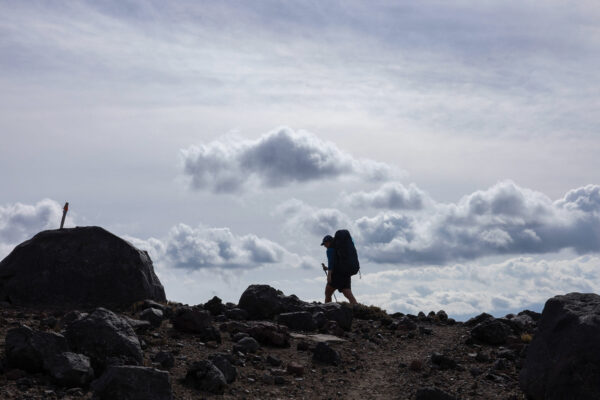
Many women, says McConnochie, are worried about slowing others down or being left behind on group trips. Alone, those concerns no longer exist. “You’re not having to walk fast to catch up with someone, or you’re not waiting to stop. You’re completely doing everything at your own speed, so it’s that sort of freedom, really.”
McConnochie notices that women usually do, in fact, have the competence they feel they lack: what they’re missing is the confidence to go along with it. Women-only events give participants the chance to focus fully on their own skill development without receiving help that might not be entirely helpful.
On the previous solo-camping trip, one woman triumphantly recounted how she fixed a snapped tent pole: something her husband would normally have done for her. “You don’t quite know what your problem might be that you have to confront when you’re out there,” says McConnochie. “Problem-solving is a big one—trusting yourself that you can sort it.”
[Chapter Break]
After our night alone beside Lake Daniell, the women reassemble to trade stories. They skinny-dipped in the lake; they slept badly or well; strange sounds woke them up, or the cold, or the knowledge that they weren’t at home. There are no epiphanies, but McConnochie doesn’t deal in those. It’s more about what doesn’t happen, she says. She regards it as an achievement when women turn up at the carpark. Getting to the start of the track, anticipating what’s to come, is a big enough obstacle. She knows that some participants expect to spend the whole of their time zipped into their tent, freaking out, and are surprised to find that their anxiety is smaller, easier to handle.
Mullan encountered a problem she hadn’t anticipated in advance: her gas canister was faulty, meaning she had no fuel. She thought about popping over to the next woman’s campsite for hot water, then decided instead to find out what happens if she cold-brewed her dehydrated meal. (It works, she discovered, but it’s a bit gross.)
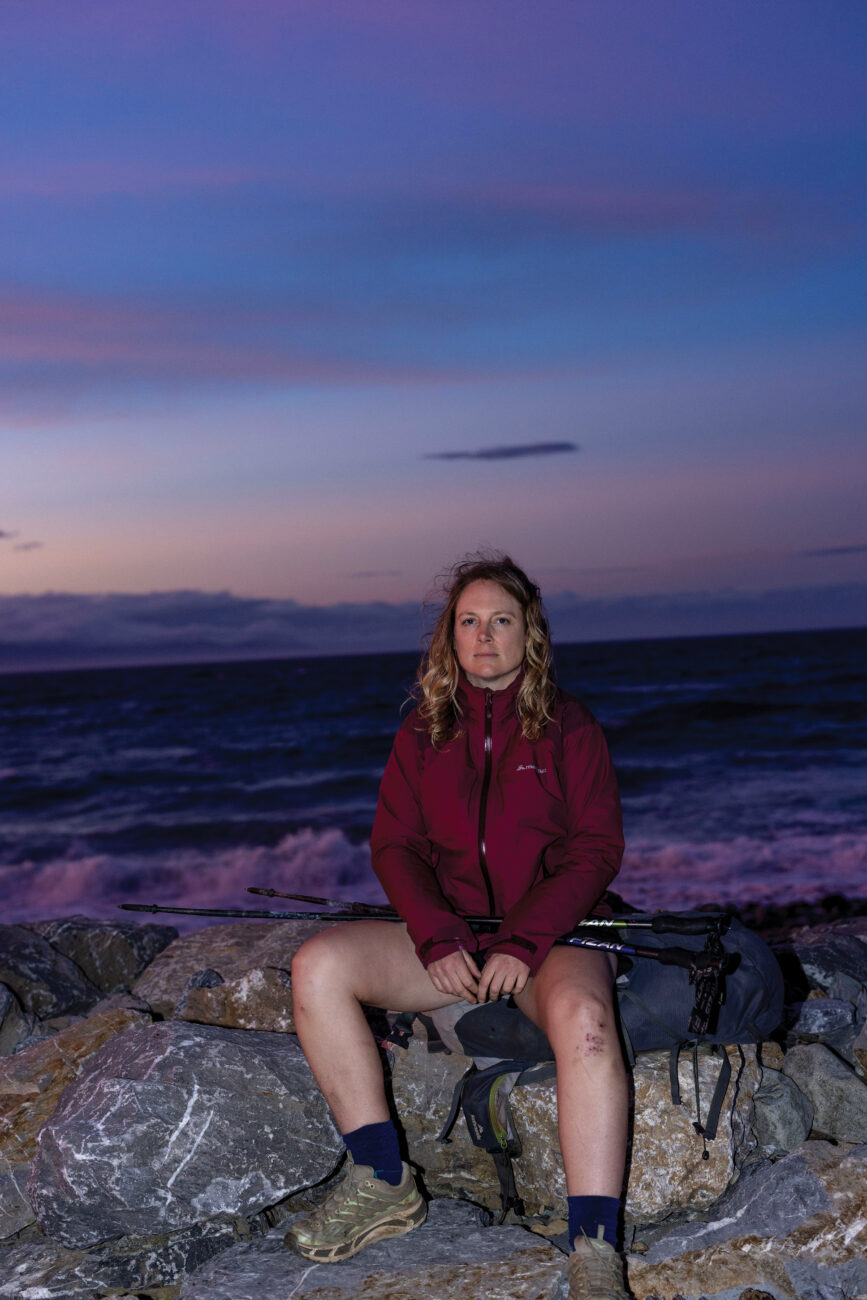
Smith returned from her night alone delighted. She’d improved her camping kit after getting tips from women on the previous trip, and found herself more comfortable as a result. She swam for ages in the lake, read The Hobbit in her new camping chair, and spent the night fast asleep.
“It just felt like I was able to embrace nature much more, rather than the anxiety of, ‘Have I got the right equipment, can I cope on my own?’” she says. “I’d built a bit more trust in myself that actually I could do it.”
McConnochie plans to organise more of these alone-together camping trips, but right now, she’s preparing for a 1000-kilometre solo hike in Western Australia to mark her 60th birthday.
Recently, she walked the Kepler Track alone. Like any tramping trip, it had its own challenges: it snowed on one of the days, and the big climb up to Luxmore Hut took it out of her. “For a while there, when I was nearly at the top and I was getting knackered, I was stopping on just about every corner,” she says. “And I was just, like, ‘Well, here I am,’ you know? And whenever I feel ready, I’ll carry on.”