The big questions
Does an elephant really need to be that massive? Why aren’t there any giant insects? Why did animals in New Zealand evolve to be either unusually large or unusually small? Why do crayfish keep growing for their whole lives, and you and I don’t?
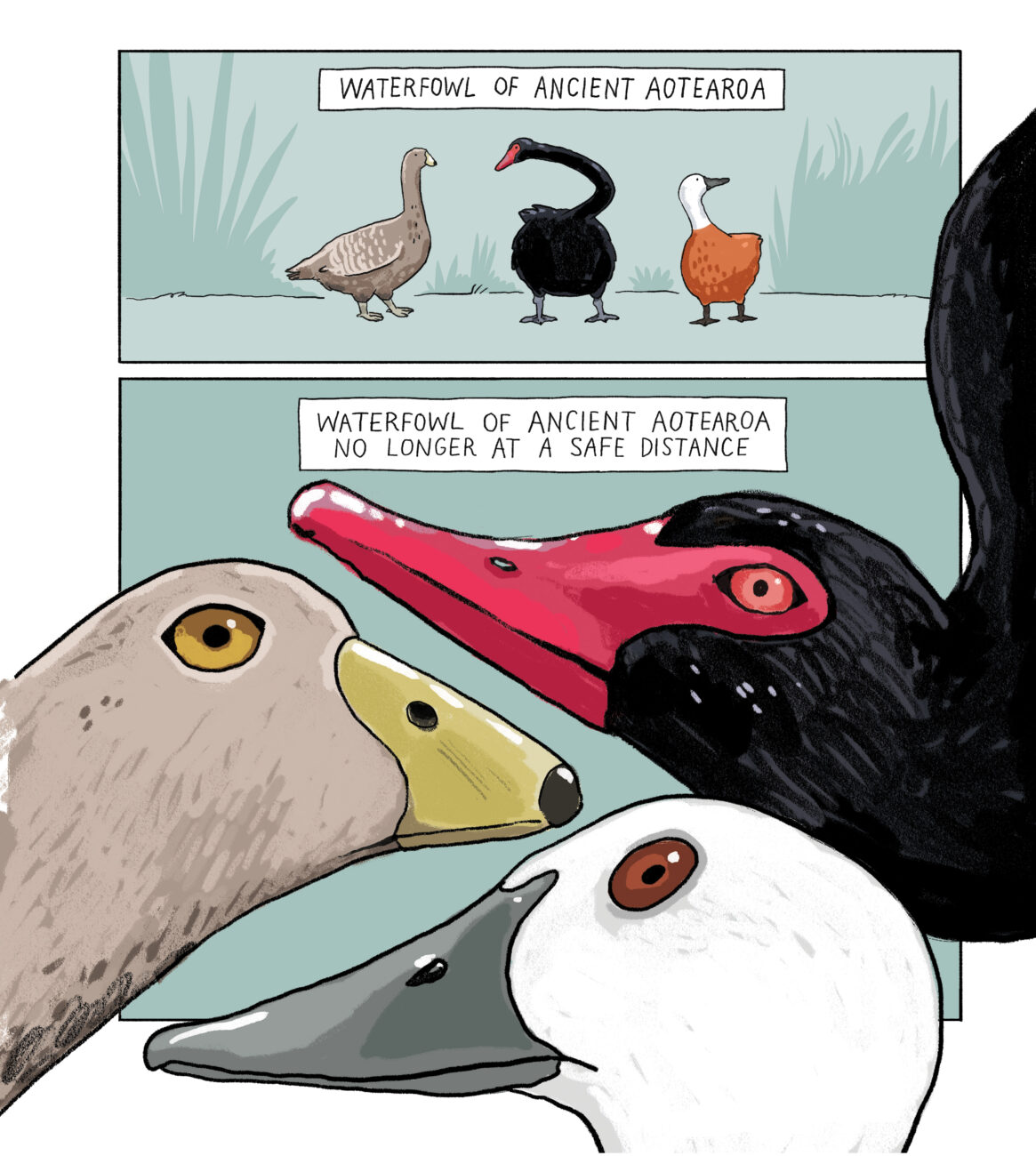
Back when most of Central Otago was a superlake, back when the climate was almost tropical, back when three-metre-long crocodilians lazed in the shallows and giant parrots stalked the bush—well, a lot of things in Aotearoa were way bigger than they are now. What happened?
The question of size is a confusing one. Like: why does Africa still have a bunch of big animals, but all of New Zealand’s giant birds have gone extinct? Why do some species continue growing their whole lives, but I stopped when I was a teenager? How large would my cat have to get before he became terrifying as opposed to cute?
University of Otago palaeontologist Nic Rawlence spends his time filling in the details of New Zealand’s past by digging them up. He was involved in figuring out that, millions of years ago, this country used to have a giant swan, alongside its giant parrot, giant shelduck, giant bat, and other ex-species. Their bones have emerged from the bed of the Central Otago superlake, Lake Manuherikia, in recent years. Over summer, he was back looking for even more of them.
Lake Manuherikia existed around 14 to 19 million years ago, during the Miocene Epoch, when the whole world was about three or four degrees warmer than it is now. New Zealand looked completely different: like Australia, in fact, with eucalypts, palms, gum trees and crocodilians. Manuherikia was probably an ephemeral lake, parts of it appearing and disappearing as lakes in the outback do; at its fullest, it was almost 10 times the size that Lake Taupō is today. Its sediments captured the bodies and kept the bones of all kinds of animals that no longer live—meaning that extinct species keep turning up all over Otago. “It’s an incredibly rich fossil area,” says Rawlence. “You get fossils cropping up all over the region, like in Bannockburn and down the Nevis Valley and around St Bathans and up the Waitaki.”
Rawlence has just returned from a Te Papa expedition to St Bathans—and he’s come back with “heaps of new bones, including of things that are very, very big”. Bones from birds that look too large to fly. “We were going, ‘I don’t know what that is.’ Which is always interesting and good.”
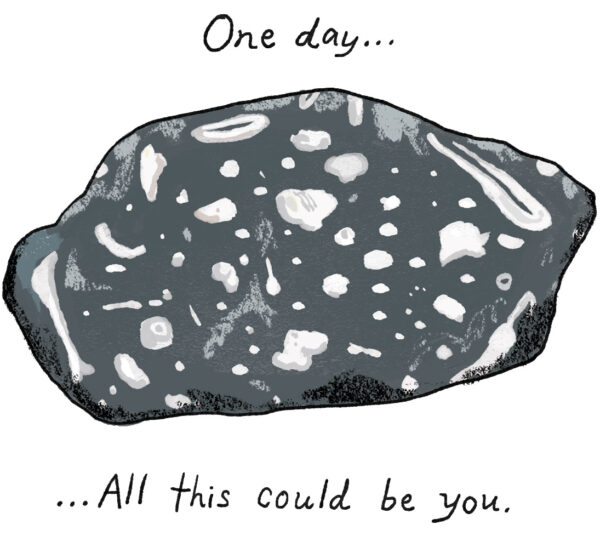
Rawlence’s technique, he says, is to walk along staring at the creek bank until he notices what he calls a “starry night sky” and is in fact blue-grey mud with bits of white rock in it. “So you look for bits of oncolite that might be complete or crushed up. You look for jet-black, sparkly fish fossils. You look for other bits of white flecks—that’ll be bits of bird eggshell.”
When you find it? “We’ll have a scratch around, see what we get, bag a whole lot of sediment, sieve it, see what’s in there.”
What’s in there might be super weird. It might be big, or it might be tiny. “This ecosystem, I tend to call it Alice in Wonderland. You get the familiar, so you get the ancestors of tuatara, skinks, geckos, frogs, bats. And you get the fantastical—palaelodids, which are the relatives of flamingos. Pigeons related to the Nicobar pigeon, which is the closest living relative of the dodo. You get turtles, crocodiles, giant bats, and you get Squawkzilla, giant one-metre-high parrots.”
There are lots of evolutionary reasons that things end up certain sizes, says Rawlence. For dinosaurs, which lived way before the Miocene, it was because of food—not good food, but bad food. “The more un-nutritious food you eat, or the more hard-to-digest food you eat, the bigger you need to be to digest everything. So it’s why elephants are really quite big—because they don’t eat that much nutritious material.”
In the dinosaur era, the Mesozoic—more than 40 million years before the Miocene—this caused an arms race, herbivores versus predators. Result: the giant skeletons in natural history museums all over the world. “As the herbivores get bigger, the predators have to get bigger again,” says Rawlence. “So you’ve got titanosaurs, the giant sauropods, getting bigger and bigger and bigger, and your stegosaurs getting all of the defence mechanisms—the plates and the spines.”
[Chapter Break]
There are a couple of reasons animals in Aotearoa are oddly sized, and the main one is that this country is made up of islands. Islands act like laboratories. Because animals get stuck on them, unable to leave, life acts a little bit more strangely: it gets big. Or small.
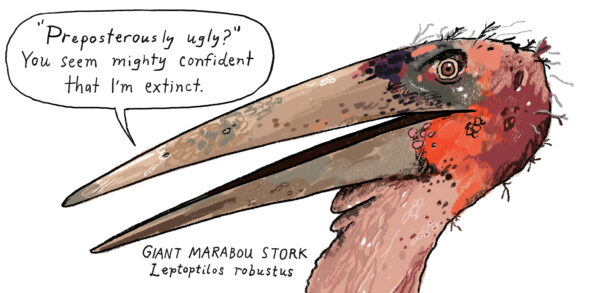
And it isn’t just New Zealand. An Indonesian island called Flores evolved an array of comedy animals: rats the size of rabbits, dwarf elephants the size of cows, the giant Marabou stork, almost two metres tall and preposterously ugly, and Komodo dragons, which are now the largest lizards on the planet. (Flores was also home to an extinct species of humans, which have been nicknamed “Hobbits”; they were only a little more than a metre tall.)
In the Mediterranean, the island of Cyprus had dwarf hippos and elephants; Malta and Sicily were home to an enormous dormouse, twice the size of any now living; Sardinia and Crete had a pygmy mammoth. (Because they’re all extinct, it’s impossible to tell if any of them were cute.)
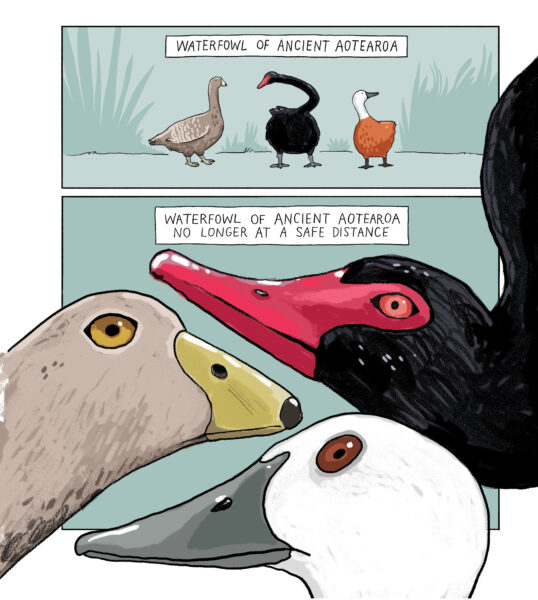
“Island syndrome” sounds like a disease, but it’s not: it’s the theory for why animals which evolved on islands generally get weirder than animals which evolved on continents. And it happens quickly—in evolutionary terms, at least. “So if we think of the extinct New Zealand goose, its tūpuna, or ancestors, only arrived in New Zealand seven million years ago,” says Rawlence. “Within seven million years they evolved into the largest goose in the world at one metre high and 18 kilograms.”
The goose was still around when humans first arrived in New Zealand, says Rawlence. Sounds intimidating, I tell him. “It’s an insane goose,” he agrees. Was it a killer goose? “No, it was a herbivore.”
It lived across both the North and South Islands, in the eastern parts where forest opened to shrubland or grassland. Picture a bigger version of Australia’s hefty Cape Barren goose: its body the gunmetal grey of a naval ship, with a tiny head and stubby neck. It’s about as big as a three-year-old kid, and just as unreasonable. “It will attack you,” says Rawlence.
Or take Haast’s eagle, which turned up only 2.2 million years ago, and rapidly became so big—up to three metres in wingspan, 16 kilograms—that it was close to defying the laws of physics. “It was on the upper limit of flight. It’s been described as a block of concrete dropping on your back from the top of an eight-storey building.”
Usually, on islands, birds make a trade-off. If, like New Zealand’s birds, they don’t have mammalian predators, they eventually quit flying. That’s what happened to the dodo on Mauritius, the club-winged ibis on Jamaica, the elephant bird on Madagascar, the flightless cormorant on the Galapagos, the Tasmanian nativehen, and the Inaccessible Island rail. (Research finds that some flying birds on islands are still evolving their way towards flightlessness; it’ll take a few more million years, but they’re definitely en route.)
This is because flying is energetically expensive: giving it up means animals can put their efforts into other things, like eating, walking around, or finding a mate. Flightless birds also build up their ground defences: becoming heavier, taller, and developing more-powerful legs. “On island ecosystems where the top predators are birds, you need to be able to defend yourself,” says Rawlence.
Having fairly robust legs allows you to kick away predators. Think of cassowary claws—there’s a reason they’re called murder birds.
In other words: lose flight, gain chonk. “And in New Zealand, the birds get chonky.”
[Chapter Break]
Evolutionary biologists have come up with lots of rules about why things are the size they are. There’s Foster’s rule, which says that on islands, large species get smaller and small species get larger—we’ve seen that in action. There’s Allen’s rule, which says that animals get thicker, stubbier limbs the colder it gets, and also Bergmann’s rule, which says that animals also get bigger the colder it gets, in order to retain heat.
In New Zealand, you can trace Bergmann’s rule in action from the warmer north to the cooler south, and from the balmy sea level to chillier alpine zones. The top of the North Island, for instance, had small, turkey-sized moa, and the bottom of the South Island had very large heavy-footed moa, the kind that archaeologist Beverley McCulloch described as “a 40-gallon drum walking in toddler’s gumboots”.
The rule also applies to grasshoppers. For a study published in March, Massey University researchers measured the back legs of 800 native grasshoppers from three species along the length of the Southern Alps. As expected, grasshoppers generally got bigger the further south they lived, but the researchers also discovered that specific environmental drivers were behind the size of each species. For one, size depended on how stable the temperature was; for another, on the variation in rainfall; and for the third, on temperatures in the driest part of the year.
Each alpine grasshopper community evolved slightly differently because mountains act a bit like islands for them. They can’t fly, only jump—which means grasshoppers in one place never meet those on the next mountain over. Instead, each population is its own tiny evolutionary experiment.
[Chapter Break]
Some species could be really big—if death didn’t stop them in their tracks.
While humans and other mammals reach a maximum size, most fish never stop growing: they keep getting bigger and bigger right up until they die.
Same with crabs, crayfish, and trees—even Tāne Mahuta, the largest-known living kauri, is still growing, more than 1000 years after it sprouted. This biological phenomenon is called “indeterminate growth”.
The world’s largest animal, the blue whale, is a mammal, which means that each whale doesn’t keep getting bigger indefinitely over the course of its life. But as a species, blue whales are still increasing in size, found a 2012 study by an international group of researchers.
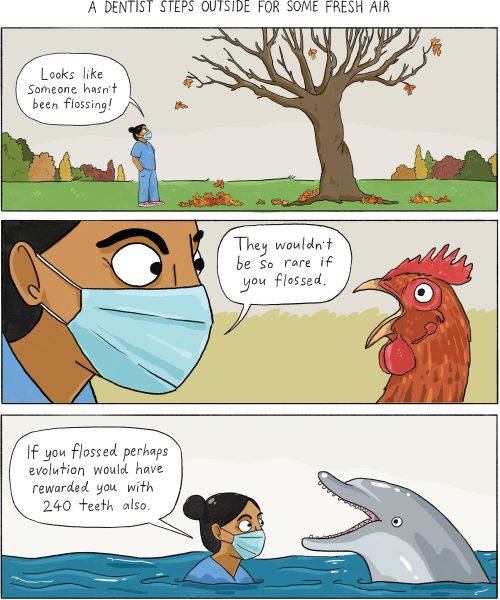
The researchers looked at bones, skulls, and teeth from a variety of species over 70 million years, finding that marine mammals evolved bigness twice as fast as land mammals. (How long, exactly? It took five million generations of blue whales for the species to grow from 30 kilograms to 130,000 kilograms.)
Turns out that if you want your descendants to be massive, and quickly, then it helps to live in the water. Two constraints on a mammal’s size are gravity and heat regulation—it takes energy to stand up to the force of gravity, and to remain the right temperature—and both are less of an issue in the sea.
Blue whales are still trending upwards, but lead author Alistair Evans from Monash University told the ABC that overfishing may be changing that: “Their maximum size might be peaking during our lifetime.”
These days, a female blue whale reaches 33 metres in length (her tongue weighs about as much as an elephant does), with males growing to a modest 29 metres. This difference in size between the sexes is called sexual dimorphism, and while there’s a common assumption that males are usually larger than females, researchers recently discovered that this isn’t true for mammals, and primarily only holds for circumstances where males compete for females’ attention. In most mammal species, males and females are the same size.
And birds? In New Zealand, female moa were more than twice the size of males. Female Haast’s eagles were so much bigger than males that the first scientists to study them confused them for different species. Female huia, kārearea and kiwi are (or were) larger than their counterparts. But when it comes to parrots, it’s the reverse: male kea, kākā and kākāpō are bigger.
[Chapter Break]
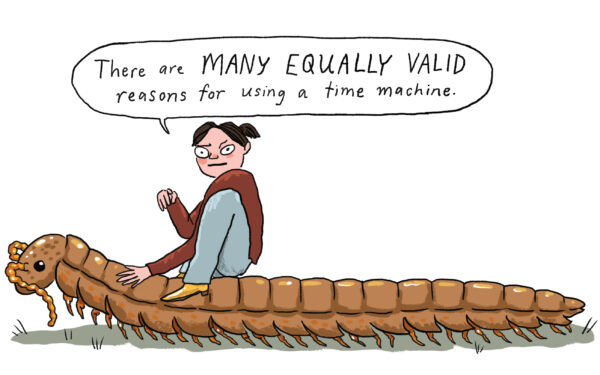
Go back a lot further than the Miocene, all the way back to the Carboniferous Period, more than 300 million years ago, and you’ll find—actually, if you don’t like insects, you shouldn’t time-travel to this particular epoch at all.
Back then, griffinflies sailed the skies—giant dragonflies with a 70-centimetre wingspan. There were also mega cockroaches, a millipede ancestor that was two and a half metres long, a two-metre-long scorpion, and other giant six-winged insects that sucked the sap from plants. At that time, the Earth’s atmosphere had much more oxygen than it does now; one theory goes that these species evolved so large in order to avoid being poisoned by high oxygen levels.
Griffinflies are basically the same as dragonflies, except huge. For a long time, scientists thought it was impossible for them to live in today’s atmosphere, but recent research finds that griffinflies would do just fine if they were teleported to the present day. The reason they’re extinct is the same old one: large species can’t adapt to change fast enough to survive.
Lately—and by lately I mean the past few million years—Earth’s climate has been going through some dramatic changes, and that’s bad news for megafauna.
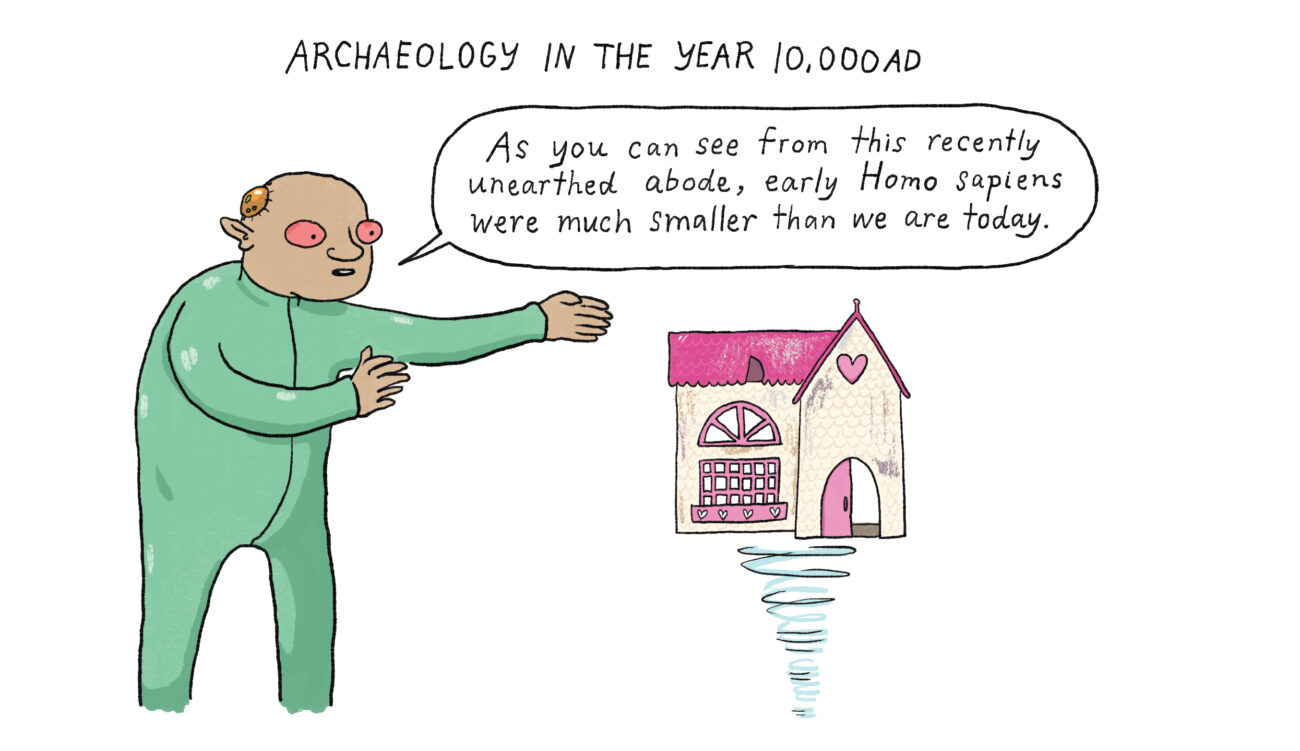
To be considered megafauna, you have to weigh more than 45 kilograms. (Yep, I’m megafauna. You are too, unless you’re a kid.) In the past 50,000 years, much of the world’s megafauna have gone extinct: either because they were hunted to extinction by humans, because what they ate was hunted to extinction by humans, or because they couldn’t evolve fast enough to keep up with the changing climate. It doesn’t help that larger animals are also slow-breeding, compared to boom-and-bust plague species like mice, rats or locusts.
But again, there is an exception to the rule: Africa. The continent still has a lot of its original megafauna, including the world’s largest insects, Goliath beetles: striking black-and-white insects too big to fit into the palm of your hand. The unique mirrored patterns on their backs look like Rorschach blots and unfortunately make them highly collectible. Their survival, like the extinction of so many others, is thought to be connected to us. Humans evolved in Africa before they travelled around the world, which means we lived and evolved with these animals for longer than any others. African megafauna were the least affected by the extinctions in the Pleistocene era when other continents lost their mammoths, dire wolves and sabre-toothed cats. Now, as the climate rapidly shifts, the biggest among us are once again poised for the hardest fall of all.