Becoming Aotearoa
Michael Belgrave, Massey University Press, $65
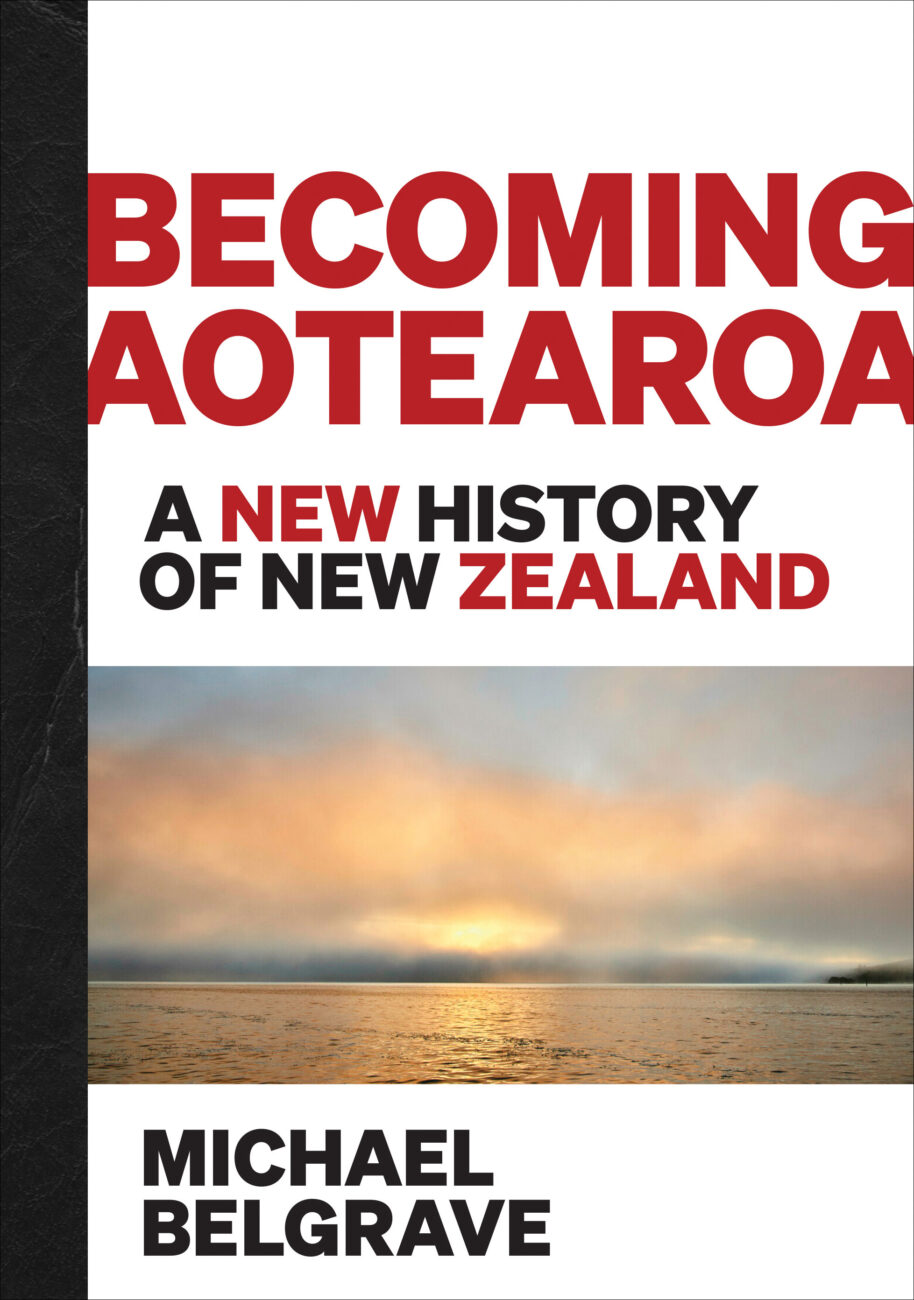
Any attempt to explain the history of a nation usually reveals as much about the times in which it was written as the events it describes. That’s certainly true of Becoming Aotearoa, the first general history of New Zealand to be published in 20 years. Its author, Michael Belgrave, writes that the book is a “response to crisis”, emerging from the 2019 Christchurch mosque shootings.
“They are us,” then-Prime Minister Jacinda Ardern declared of the Muslim community targeted by the gunman. Those three words came to define the tragedy, but they were also an attempt to define New Zealand as a fundamentally inclusive country. The counterargument came quickly, from those who argued that the killer’s racist ideology could be directly connected to our colonial past. That dissonance prompted Belgrave to ask, “Is there an ‘us’?”—and while he was working towards an answer, the question became a lot more fraught.
During those years, a team of five million came together and then fractured. The cracks widened in the 2023 election, which was marked by arguments over racial resentments. And this year, the Act Party took a bill to Select Committee seeking a referendum on the principles of the Treaty of Waitangi, exposing our deepest fault lines.
One reason this debate is already so divisive is that many New Zealanders know little about our past. Unlike in the USA, where the nation’s founding and Constitution are considered essential subjects, Kiwis in their forties and older typically got little to no grounding on the Treaty in school. A recent Human Rights Commission survey found that only 10 per cent of New Zealanders feel “very well informed” about it.
Becoming Aotearoa, then, couldn’t be more timely. While Belgrave (a professor of history at Massey University and former research manager at the Waitangi Tribunal) references scholarly debates and weighs a multitude of sources, this isn’t an academic text. With its concision and interest in linking past and present, it’s more accessible than its most recent predecessor, Michael King’s The Penguin History of New Zealand. Anyone who hasn’t had the chance to go beyond the basics of our history may find a lot here that surprises them.
The chapters on te ao Māori before the arrival of Europeans explore the conditions that shaped the response of tangata whenua to newcomers. The challenges of a colder climate encouraged adaptability; a group-based social structure kept rangatira on the lookout for new ways to benefit their hapū and strengthen their standing. After Cook’s fateful voyage in 1769, Belgrave portrays a place changing at warp speed. Māori worked on ships that took them to England, the USA and Australia. Chiefs seized on the usefulness of literacy and guns and competed for access to both. While missionaries were a common conduit to the European world, Māori saw Christianity mostly as a vehicle for learning to read and write, selectively folding biblical concepts into their own worldview.
The Europeans who were arriving in increasing numbers in the 1830s also came from a world in flux. In the UK, industrialisation had created vast chasms of wealth and people on the wrong side of that divide were seeking a place to change their fortunes. It was a time when the Crown had soured on colonial escapades, and when Britain’s anti-slavery movement was at its most influential. That movement—which included the main Protestant missionary societies in London—saw colonisation as the next great evil to be overcome. Belgrave describes a fascinating presentation to a parliamentary committee in 1836-7 arguing that colonies were immoral unless a treaty was signed with indigenous people, but “that would be impossible until aboriginal communities understood the nature of sovereignty and what they were being asked to give up”. The committee accepted the argument.
New Zealand-based missionaries, meanwhile, viewed settlers as their biggest threat, and not just to their grand ambitions for a Christian Pacific. Māori, they feared, could be wiped out in inevitable clashes over land. For a few years, they successfully lobbied their government not to establish a colony here.
They met their match in Edward Gibbon Wakefield, economic theorist and convicted felon, who had a very different vision for this country (which he had not yet visited). Via the New Zealand Company, Wakefield offered prospective settlers the promise of a comfortable middle-class life that had become unattainable for the British lower classes. The plan depended on buying land cheap and selling it to investors at a premium to fund the infrastructure for an instant society, skipping right over the gruelling pioneer phase. After Wakefield’s agents made fraudulent deals with Māori amounting to nearly a third of New Zealand’s land area, the British government intervened to control its own citizens (and to avoid being shut out of land purchases). It initially wanted to acquire a few small outposts for conducting trade and legal matters, leaving most of Aotearoa under Māori control. But when Wakefield signalled he was going to flood New Zealand with settlers no matter what, the scramble began for a treaty granting Britain sovereignty over the whole country.
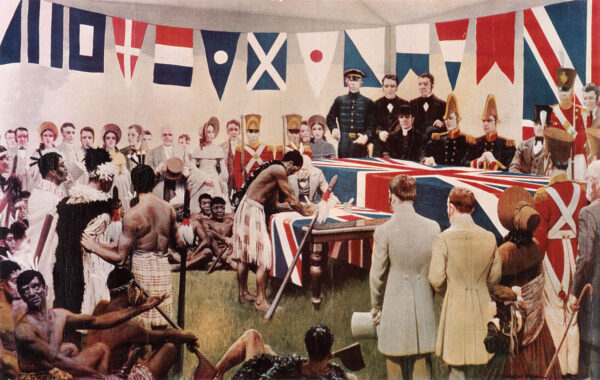
Written by officials with no special expertise, translated in an all-nighter, and debated until people started leaving because the Crown had run out of kai, Aotearoa’s founding document was supremely muddled in both intent and execution.
Belgrave suggests he is departing somewhat from the academic consensus here, and that Māori signed not because of significant discrepancy between the te reo and English versions, but because they were having an entirely different debate—not over the text, but whether New Zealand really needed a governor at all. However, since the te reo preamble to the treaty introduces the Queen’s “kāwana”, or governor, and the key concession sought is “kāwanatanga”, perhaps the lively kōrero over the governor’s presence was related to the text. It’s a point that needed more explanation.
What is clear from first-person accounts, which Belgrave quotes extensively, is that Māori saw the Treaty as a compact to protect their chiefly mana over their land, not to surrender it. Some missionaries worried that rangatira didn’t understand the full implications of what they were signing, but the incoming governor, William Hobson, had no patience for further explanations: he wanted ink on paper. As Belgrave notes, “it was not an auspicious beginning”.
There is a lot more to Becoming Aotearoa, which goes all the way up to 2016. But in its detailed exploration of this period, with its contradictory interests and ideas about what kind of place New Zealand should be, you can see currents that swirl around similar questions today. All of this complexity is absent in the arguments for a Treaty referendum. (Its proponents seem to be relying on that vacuum: an Act website created to “explain” the Treaty distorts its terms in ways that would be quite obvious if it included the full text.)
As Becoming Aotearoa makes clear, dodging this history does Kiwis a huge disservice—not only because it’s so important, but also because it’s so interesting.