The reawakening of waka ama
The joy and community that comes from picking up a paddle—and putting your back into it.
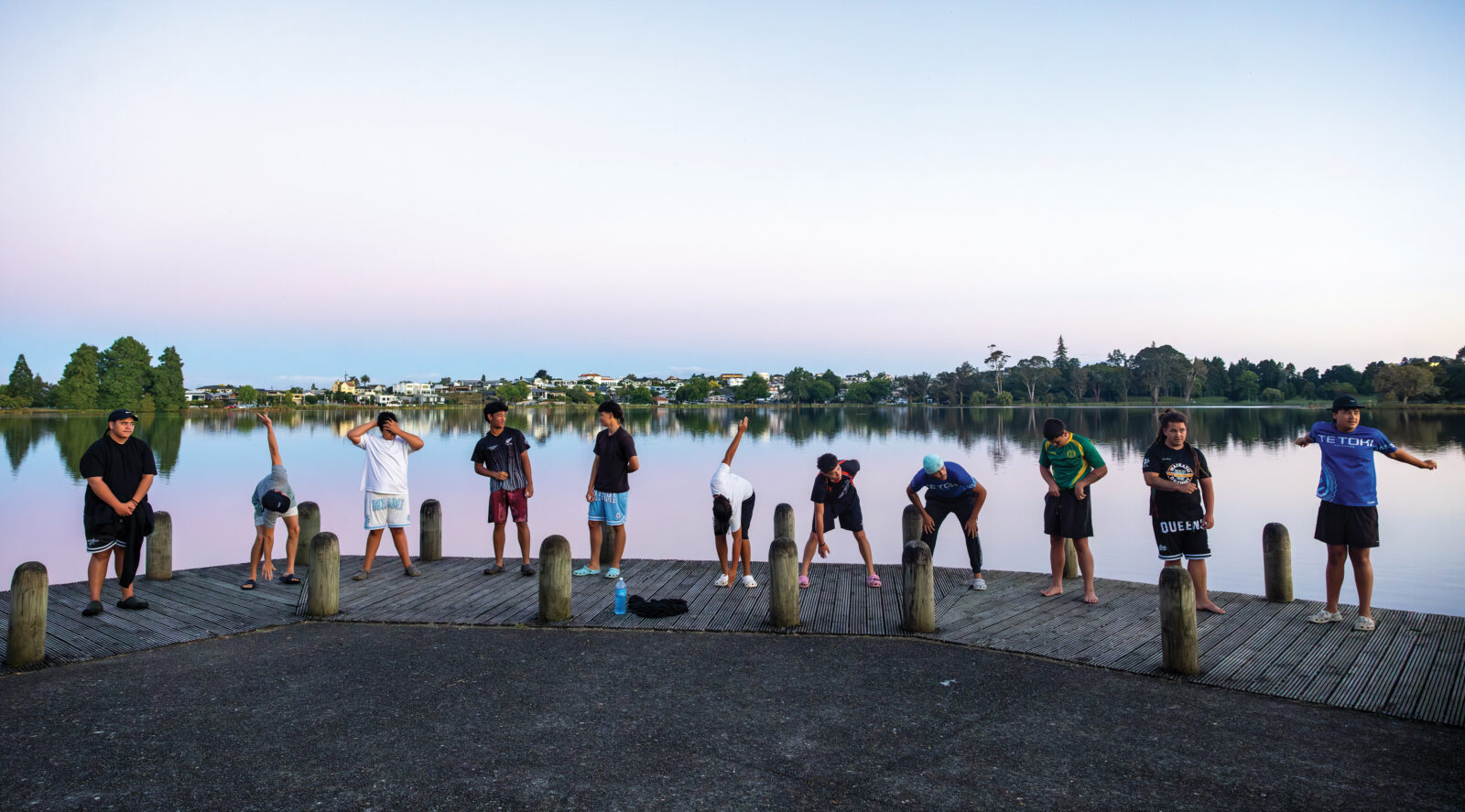
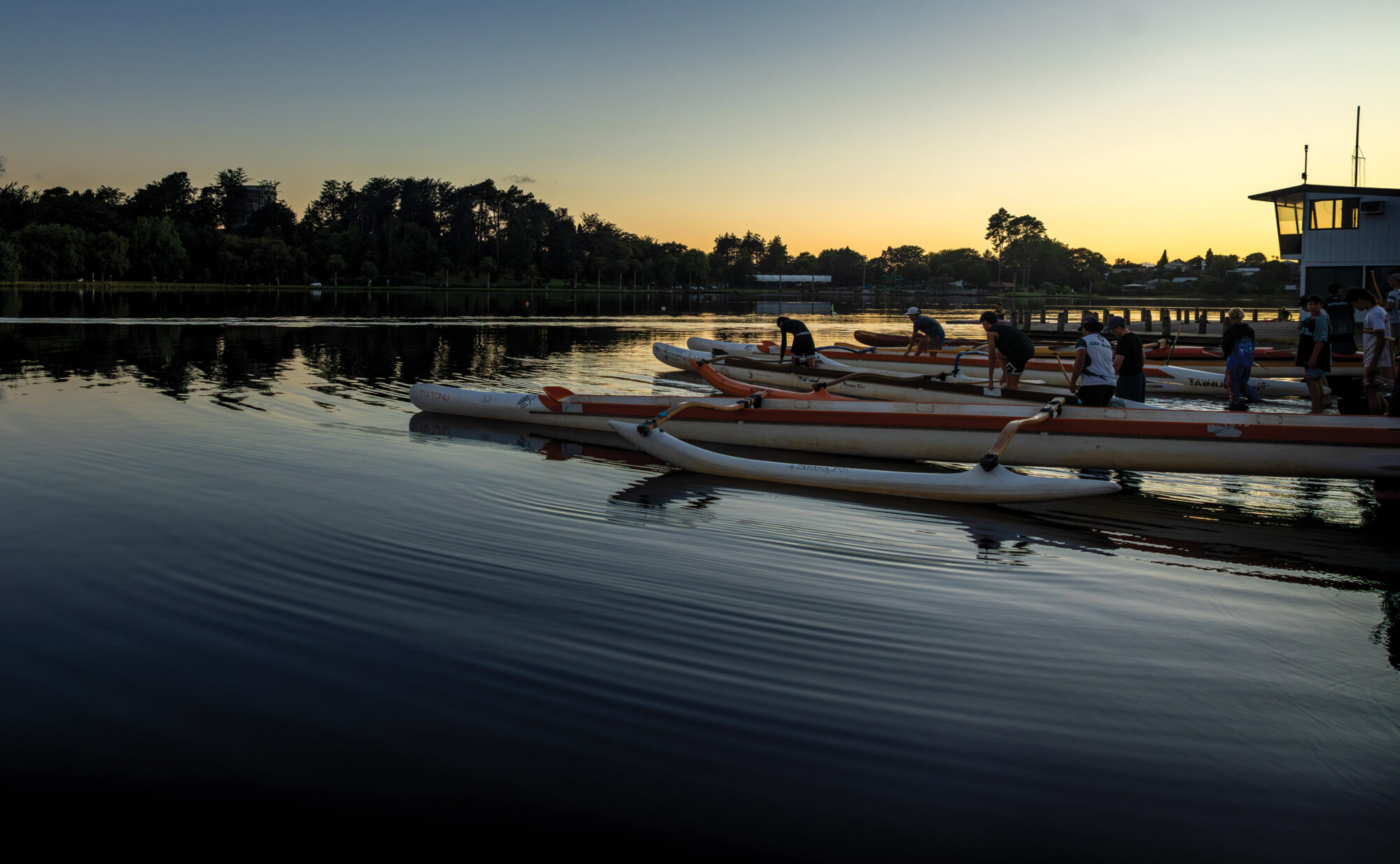
On the south-eastern shore of Lake Rotoroa in Hamilton, the sharp, bright smell of dishwashing detergent is in the air. Children, teenagers and adults fill buckets at the taps by the toilet block and slosh them back to the six waka ama on the grass. They’re washing a year’s worth of grime off the boats—it’s October, and the season is just kicking off. Sprint nationals are about four months away. The people scrub with dish brushes and big sponges. Their waka, together worth about $50,000, are kept outside year-round, exposed to the elements, and whatever else may come.
Teenage boys flick froth at each other, before carefully working together to remove the rubber bands that secure the outrigger float called the ama, and then re-lash it a little closer to the main canoe.
A man stands with his feet planted wide, watching. He has a big, bushy beard, and wears Crocs encrusted with Jibbitz. There is a rope tied around his belly, and on the other end is a huge spotted dog. This man is Turanga Barclay-Kerr, of Tainui: world champ, coach of this club, and deputy chair of the Waka New Zealand board. He’s grown up in waka ama, having first felt the flow and churn of the awa while in his mother’s womb. (It’s been almost 40 years since his parents, Kim and Hoturoa Barclay-Kerr, founded the Te Toki Voyaging Trust, devoted to waka ama and to waka hourua, the larger, ocean-going craft with masts and sails.)
“Waka is going to be around forever in our country,” he says, “and it’s just going to keep growing.”
A girl runs up to Barclay-Kerr and asks him just how clean exactly do the waka need to be? “Don’t worry about cleaning the bottom,” he says. “They’re on the grass so it will just get paru.”
Even as the sport has boomed, trying to sort a storage space for these waka, let alone a club room, has for decades been “unachievable”, he says. Things are moving now, though: Te Toki has recently banded together with two other waka ama clubs and a rowing club on the same lake to work on a plan that is getting more traction.
In the meantime, building or not, the people come.
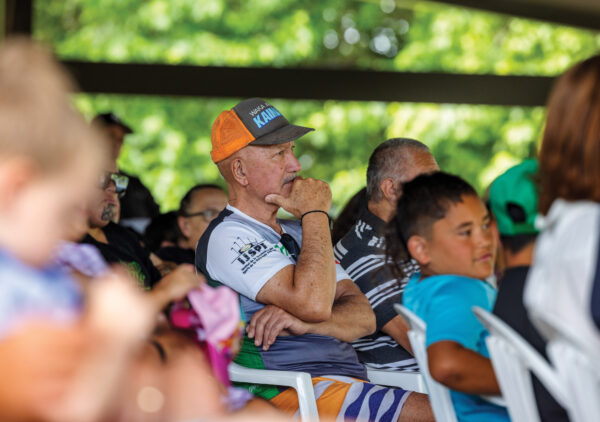
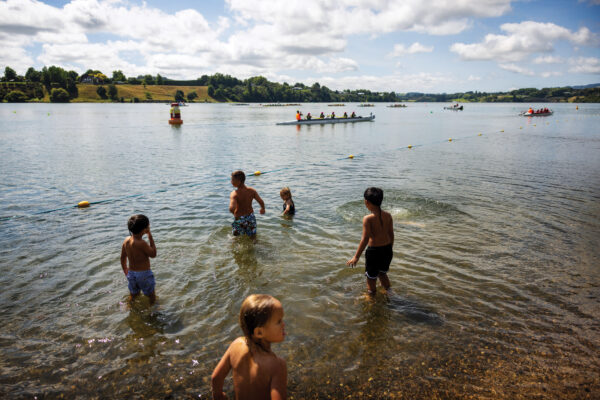
Cleaning done, the club members gather and Barclay-Kerr numbers them off—tahi, rua, toru, whā, rima, ono—into mixed groups of six that will paddle together. Some of these people are only about as tall as a paddle, and about half have never paddled before.
[Chapter Break]
On the bank, a cluster of mums sit on camping chairs and watch through big, glamorous sunglasses. “I don’t paddle anymore,” Keriata Kuiti tells me, “I just can’t keep up with that.” Still, she’s here Mondays, Tuesdays, Wednesdays, Thursdays, Fridays and Saturdays because six of her kids paddle. “My whole family, from my babies right through to my dad, my mum, my grandma—everybody can paddle.” She likes watching them, likes the river. “It’s a good place to just come by, chill and relax.”
Te Toki membership is strongest in the youth categories, with paddlers dropping off after they finish high school, Barclay-Kerr says, because they don’t know how to fit in training as well as being at work all day. Some will return in a couple of years. He’s noticed another influx when people hit about 40. “As you get older,” he says, “paddling is still about the fitness and performance and stuff, but it’s also a bit of you-time, a bit of therapeutic time
for yourself.”
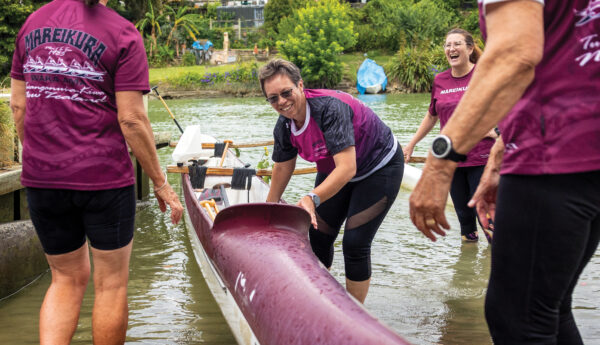
Most of the boats, made out of wood and fibreglass, have six seats in the main hull and an ama out the left-hand side for balance. There are variations: waka for one, double-hulled waka that can accommodate 12, and anything in between. The paddles, or hoe, are either laminated wood or coveted carbon fibre, shaped a little like a banana leaf, and about as long as from your feet to your waist.
Mastering the paddling technique can take a lifetime—watching a team of teenagers from the shore, I hear sighs of frustration as a hoe splashes too much or, worse, hits the side of the waka. The most important thing is to be in sync with your team. It’s not just the moment the hoe slices the surface that matters, but the moment in which real power is applied, and the execution of the all-important, shoulder-saving “switch”. Paddlers know to change the side they’re paddling on when a “Hup!” is called from the backseat. Meanwhile, the steerer’s hoe is deep in the water, keeping the straight line.
This is sport, but it’s also culture. Waka must be respected—they must not be stepped over; instead, you walk around to get to the other side. Paddle blades are not stuck into the ground like a garden spade; instead, they are rested on the top of feet. Karakia are often said before paddling, with hats off and hands on the waka. Smoking, vaping and alcohol are generally not permitted at clubs or events, and neither are fizzy drinks—paddlers must respect themselves, and each other, too.
[Chapter Break]
Waka ama came over the Pacific with the people who became Māori. In this new land, the people found tōtara, kauri—trees big enough to be carved into wide, stable waka that did not require ama.
When Pākehā arrived centuries later, waka ama were rare in Aotearoa. But in 1986, a carver called Matahi Whakataka Brightwell, with whakapapa to Kāti Huirapa, Ngāti Toa, Te Roro-o-te-Rangi, Ngāti Tunohopu, and Rongowhakaata, embarked on a lifelong mission to reintroduce these waka. Many iwi leaders were dismissive. They didn’t consider the outriggers to be a part of Māori culture. Some scoffed, he remembers, and told him, “Don’t bring that island thing here.”
But waka ama had already come from the islands once, and now it would come from them again. In Tahiti, while Brightwell was helping to build the revered 75-foot double-hulled waka Hawaiki Nui, his future wife, Raipoia Cowan, had taken him to see a va’a competition. Hundreds of Tahitians, paddling hundreds of canoes. “I’m bringing that home, too,” he resolved.
Undaunted by the initial response from iwi here, Brightwell borrowed a truck and trailer from a Gisborne rowing club and loaded it with waka ama. He mapped out a national roadshow, crewed by Raipoia, their baby, and Brightwell’s brother. They began in the Hokianga.
At each town, each river, each beach or lake, they would bring the waka to the water and invite people to try. Many hesitated. Brightwell remembers one “rugby guy” he met on a beach in Northland. “What’s all this shit?” the man said. Once he was out on the water, he didn’t want to come back in.
Paddlers tell me the same—once they try it, they get hooked. The water, the focus, the traditions, the fitness, the sense of wellbeing, the kotahitanga, the community, the competitions, the way of life.
Adults tell me waka ama is “life-saving”. Teenagers say they do it because their friends do, although one 16-year-old quietly says—away from his mates—that his paddling is about “just upholding the mana of my people”. At Lake Rotoroa, 14-year-old Mili Qaranivalu, who has been paddling since she was 10, says she likes “going fast”. Speed, she tells me, relies not just on brute force, but also technique. Her 11-year-old brother, Nehana, says he started paddling to make more friends. Now, he feels the Te Toki club is “not really a group—it’s more of a family”. Their father, Tom Qaranivalu, says the investment of time is no small thing, and tends to filter out families who are there purely for the sport, rather than the community and culture that go with it.
Around the country, parents wake early multiple times a week and spend much of their summer watching their children paddle back and forth, back and forth. They pack lunches and changes of clothes and spend money and time to take their kids to competitions because they can see the value of participating.
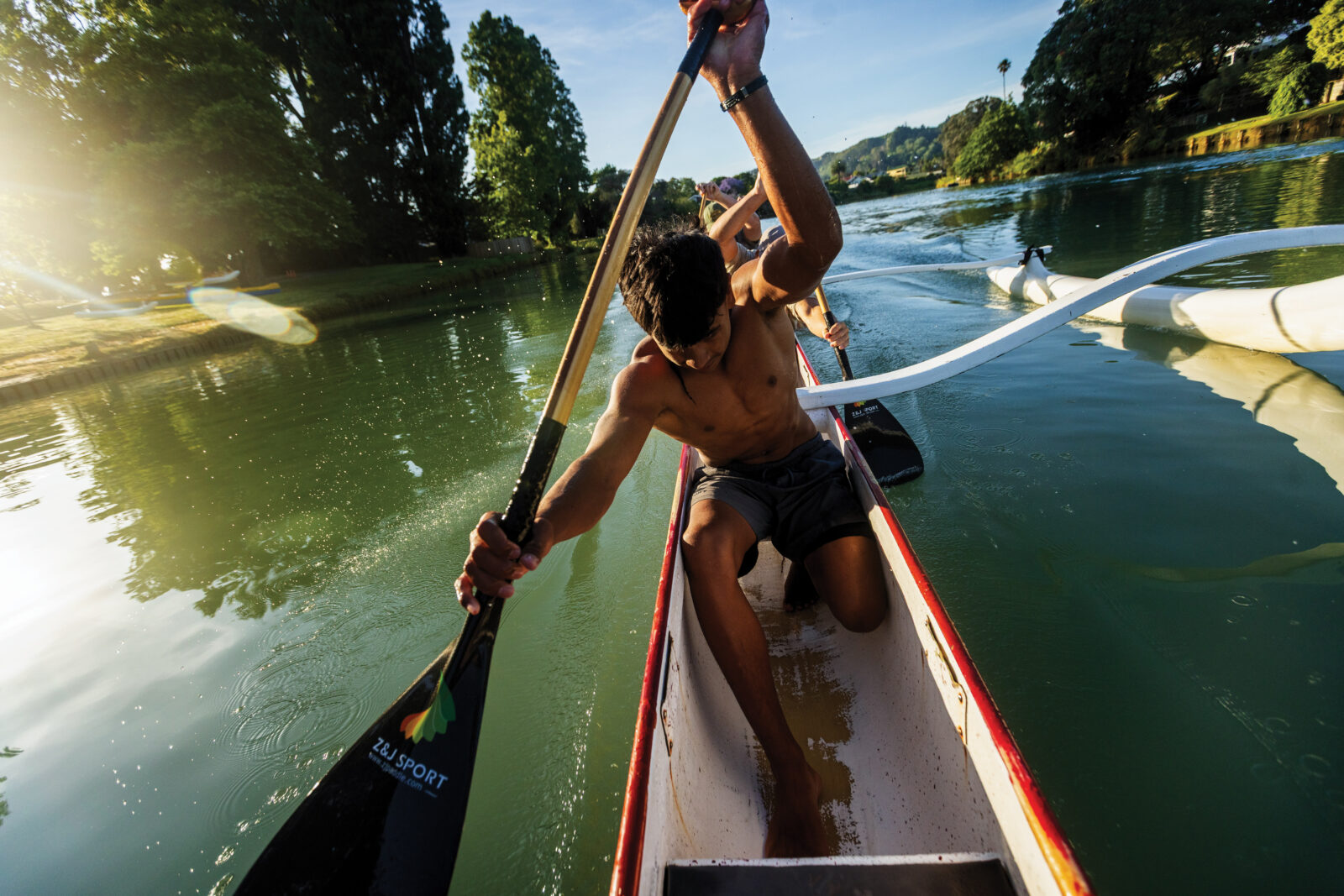
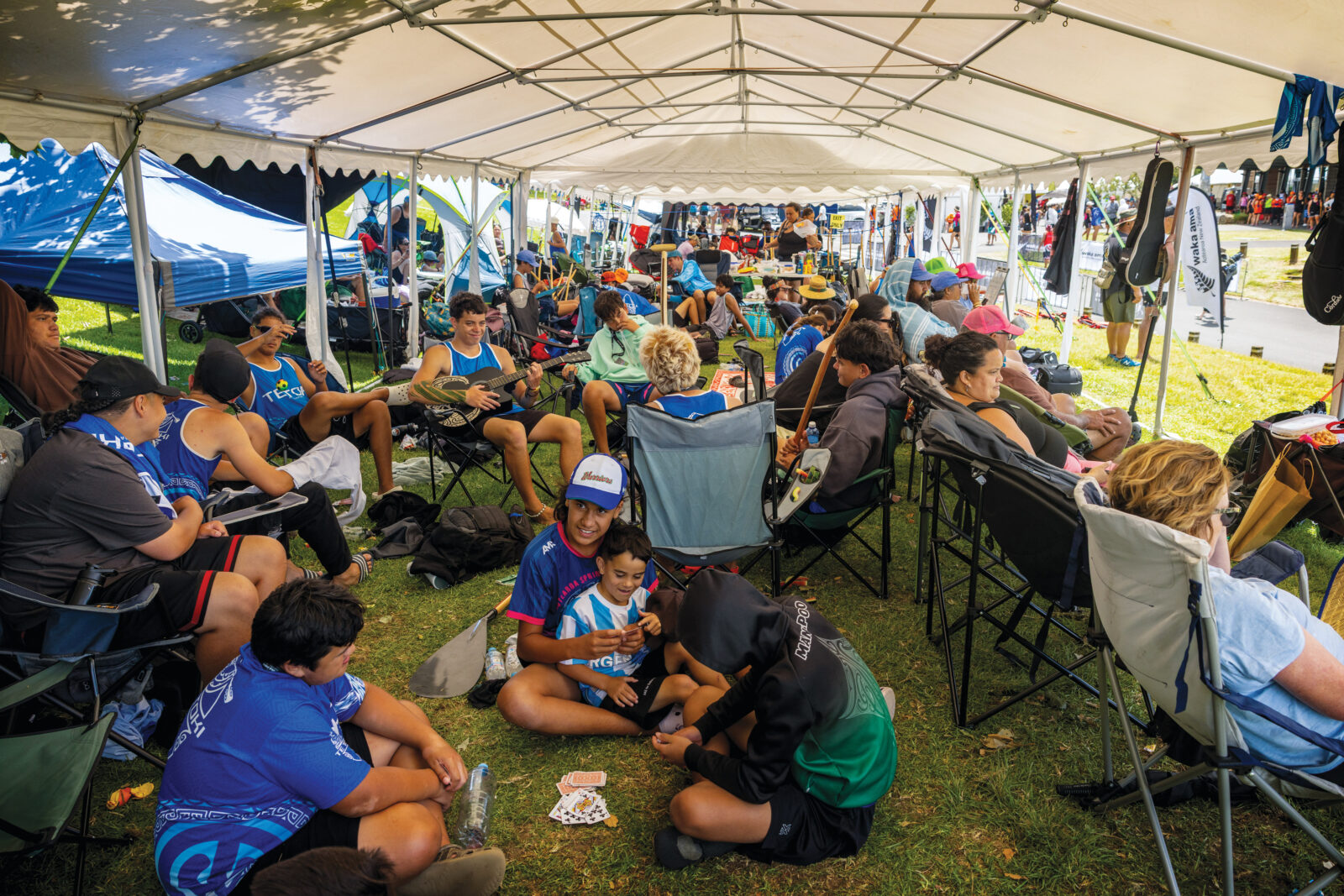
Walton Walker first got involved 20 years ago because his daughter wanted to paddle. He’s now a “waka boy” in the 70+ division and chairs Gisborne’s Horouta Waka Hoe Club. Paddlers in his age group often cruise the waterways in single-person waka, enjoying the peace and place. The focus, says Walker, shifts from competing to wellbeing; getting a team—hip replacements, stents and all—to a national competition is a real bonus. He and his mates laugh at their ailments. “We want to fly the flag for our age group,” Walker says. “It’s not just about us surviving so much, but leading a lifestyle, one that enables us to be able to do this.”
For some, being part of the team is not about being out on the water: every event involves much making of kai, packing up of chairs, and setting up of shades. Olliver Smith, chair of Te Uranga o Te Rā, the regional committee for waka ama in the east of the North Island, is often asked if he paddles, because he gives so much time to the sport—however, it’s been several years since he was in a waka. “It’s everything around it,” he says. “Not just the sport, but the whole community and vibe.”
Waka ama remains Brightwell’s “greatest treasure”.
“I’ve seen it turn drug-soaked, alcohol-soaked communities into other people.”
[Chapter Break]
The sky is beginning to lighten. Birds are warming up their voices. Inside a big open structure, 100 or so people are walking quietly from pou to pou, laying a hand on each. Above, a corrugated iron roof, criss-crossed with bracing and studded with tube lights. Apart from a small wooden-slatted room in one corner, stacked with plastic chairs, there are no walls. The line of people deviates, skipping a pou in the corner. “Don’t miss that pole!” says a mother, pulling her daughter over. A giggle, and the people do as they’re told, palm after palm pressing the neglected post.
The touching of the pou is the final part of the building’s blessing—there have already been karakia and waiata, and three of the under-17 boys have pulled a black cloth from the roof, revealing the building’s name, Te Wharewaka o Mareikura. Beyond the shed, the Waimata River silently glides by. The wharewaka is positioned on an elevated corner of Gisborne’s Anzac Park, and it is the country’s very first facility built just for a waka ama club. (There are at least 93 other clubs, spread from Kaitaia to Riverton, whose waka and members could benefit from a building.)
Mareikura is also the country’s oldest club; Brightwell set it up in 1985. The people consider him a tohunga. He describes himself as the guy who mows the grass. This morning, when Brightwell is called upon to speak, he can’t be found. Later, he laughs and says he had to go for a little walk. Having a building for the people to gather in, a place for the precious waka, has been a dream for decades.
“It’s not just about storage,” he says in his speech. “It’s a space for our tamariki to feel free, safe, and hear their language being spoken.” A place, he says, to be where they’re from.
There is a weight in the air that settles in your throat and banks up tears, happy and sad all at once. Nothing has come easy in the waka ama story, this building included. Over the river are houses of white weatherboard, with big windows and French doors opening out onto tended gardens. The neighbours weren’t happy about the idea of a club building, Brightwell says. One told him they didn’t want it because “you’re going to get drunk and smash your beer bottles on the roof”. (Today the club is serving tea, coffee, water, and spreads of cookies and fruit.)
People from the club went out door-knocking to try to get the neighbours onside. A Pākehā paddler, Carolyn, tells me that one person who answered the door mistook her for a neighbour coming over to deride the project. Before Carolyn could explain who she was and why she was there, the person began to confide in her about how annoying the women’s paddling team were, shouting and swearing all up and down the river. Carolyn is a member of that team. “We don’t swear!” she says. In fact, they call themselves the “nannies team”.
The waka aren’t in their new whare yet. They’re on the bank, as they have been for years, the big ones resting on tyres, smaller waka on metal stands. Apart from a few bike locks, there’s nothing protecting them.
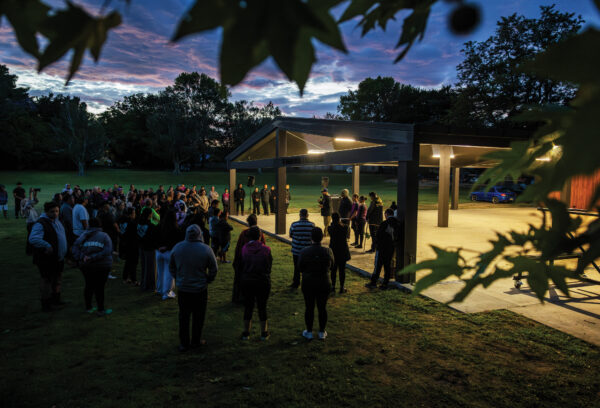
The green awa is quiet, smooth. But three years ago, during Cyclone Gabrielle, the river burst its banks and cut across the sports fields, taking much of the waka ama fleet with it. Downriver, waka from two other clubs were washed away, too. Many were found in pieces in the days that followed.
Since the cyclone, rain brings anxiety. In bad weather, members drive to the club at any hour of the day or night to pull waka to high ground. But no one likes to talk about that too much. Instead, they say that something good came out of the cyclone, too, something catalysing. Billy Maxwell, chairman of the club’s executive committee, says that when they met with the council after the cyclone, they did not ask for permission, as they had so often before. This time, they said a shed would be built.
[Chapter Break]
Last year, New Zealand’s elite rowing nationals involved about 770 competitors, and the rowdiest event in the rowing calendar, the secondary schools’ Maadi Cup, had around 2500. In mid-January, for the week-long waka ama sprint nationals, 4606 paddlers gather at Lake Karāpiro. Like last year, and the year before that, it is by far the biggest-ever waka ama event in
New Zealand.
An hour before their premier 1500-metre final, six wāhine from the Tarawera Outrigger Canoe Club hide inside in the cool, watching races livestreamed by Whakaata Māori. They’re spectacular in ombré pink-and-blue singlets and fluoro-pink caps.
Three years ago, two of this crew, Tui McCaull (Ngāi Tūhoe, Whakatōhea) and Jas Stevenson (Ngāti Kahungungu ki Wairarapa) had an epiphany during just such an off-stage moment.
The pair are world-class paddlers. The day after competing at an international meet in Samoa, they watched the men’s race on TV and were struck by the commentators’ knowledge. “They were rattling off all of their accolades and the races they’ve done and how famous they were, and blah, blah, blah,” says Stevenson. When the women replayed their own race, the commentary was vastly different. “The comments were: ‘Look at them go,’ ‘They’re trying so hard,’” says Stevenson. “It was awful. They knew nothing about the women.”
And so the pair formed Āwai Waka Wāhine, a project to get wāhine into waka ama, to help them succeed—and to make sure that success is seen. They host wānanga to teach practical skills, get past barriers to participation and excellence, and form communities of paddlers.
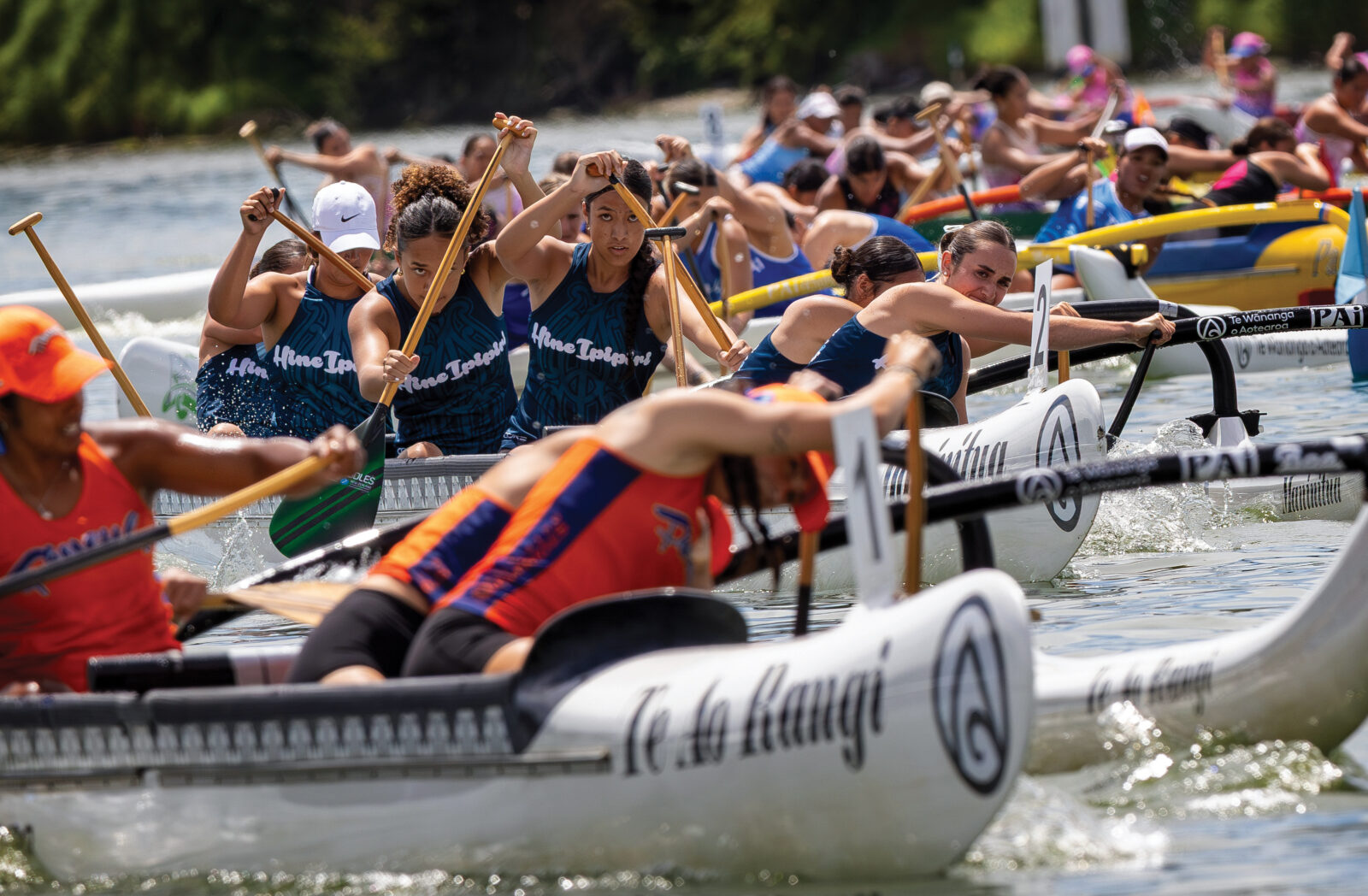
“Wāhine are such enablers of whānau health and wellbeing,” says McCaull. She thinks that’s why many are on the shore instead of in waka. “I started out as a waka ama māmā. I know what it’s like. I was there traipsing my kids up and back to the lake so that they could paddle. And it was only once they’d been paddling for, like, four or five years that I thought, ‘I wonder if I could do that. I’m gonna have a go.’”
At wānanga they talk a lot about how taking time for yourself is not selfish, that mums shouldn’t be pouring from an empty cup—or pouring at all, really. Instead, they should be giving others the overflow from their own brimming cup.
Last year, McCaull surveyed wāhine paddlers as part of her PhD. The women overwhelmingly told her that it was not the physical outcomes of waka ama that appeal—instead, it was whanaungatanga or kinship, a sense of community and belonging, and mental healing.
“Some of the comments that would come back would just about have you in tears,” she says. It’s not surprising to Stevenson. “I feel like waka ama is not even a sport,” she says. “I think the heart of waka ama is about connection, and on so many levels—connection between people, between us and the environment and everything. And that’s what people love about it.”
One way to think about waka ama, she says, is as a taonga tuku iho, a treasure handed down from ancestors.
[Chapter Break]
Down at the water, the women wait for the men to come back; they use the same waka. A volunteer in an orange shirt and bucket hat, young enough to be one of their sons, presses a big sponge into the bottom of the boat and wrings it out into the lake.
The women glide out to the grid of buoys. At the back, steerer Te Rangihuia Henare (Ngāti Huia) is doing as much of the grunt work as she can, to conserve the energy of the others. The women line up with seven other teams. Tight on the line, just how Henare likes it.
For a moment, each paddler lifts her hoe as if to challenge the water; then the green flag, and stillness becomes chop and churn. The waka buck with the momentum. In 250 metres they turn—some paddlers digging their hoe into the water while others keep up the stroke to pull the boat forward.
For this moment the waka belongs to Henare; she is calibrating the line, calling paddlers in and out, and taking all of their force on the blade of her own hoe, sometimes jamming it against the boat as a pivot, at other times “popping”, or backpaddling, at double-speed. It’s a complicated, tight contortion that can make or break the longer races. To race 1500 metres, the longest of the sprints, the teams must make five such turns. Henare’s forearms will be screaming after the first two.
For most of the race, the waka seem to swing around the buoys simultaneously. But in the last stretch, the toughest, another waka noses out ahead of Tarawera’s wāhine.
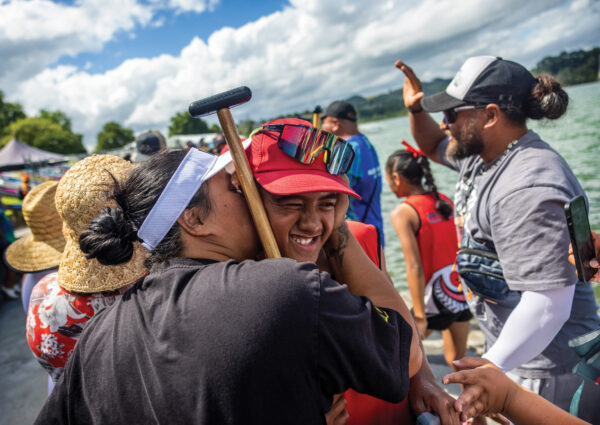
They come second, the gold medal just out of reach. They’re exhausted—strong backs curve over their seats, and breath comes in gulps. There’s not much time for emotion. The waka, and the course, are scheduled for another race in less than a minute. With gentle strokes they glide the waka back to the jetty, step up out of it and hug each other, one by one, with no skips.
The last and 461st race of this year’s nationals is a premier women’s 500-metre final—no turns, just one hard and fast stretch of a longer course. Thirteen waka, each crewed by six young women, line up at the starting buoys.
The waterside is crowded, even in the 2pm sun. People hold up Bunnings umbrellas and slather on SPF50 from pump bottles on steel stakes in the grass. They gather right at the edge of the water, some dangling their feet in.
That moment of challenge and poise; the flag; and the waka are off. With each stroke just a few droplets lift from the green water. The commentator is sprinting to the finish, too, speaking faster and faster, louder and louder.
“Out there in lane five Tavake from Pinelua travelling beautifully as well, second place—no—they could be second or fourth…”
The boats near the line. The crowd is cheering, screaming, clapping, roaring. Everyone’s on their feet now. A man holding a pēpi cranes his neck to see the finish line. Teenaged girls in matching uniforms jump up and down. The commentator is drowned out.