A matter of principles
Misinformation about the Treaty of Waitangi, its language and its intent is at the centre of the Treaty Principles Bill introduced to Parliament this week.


Misinformation about the Treaty of Waitangi, its language and its intent is at the centre of the Treaty Principles Bill introduced to Parliament this week.

Switching up the background on your video call might help you stay perky, Singapore researchers have found. The study, published in Frontiers in Psychology, investigated links between the phenomenon known as “videoconferencing fatigue”— exhaustion caused by juggling the real world and the virtual—and the fake backgrounds many of us deploy during work calls to hide clutter, kids or ratty T shirts. (The researchers focused on callers’ own setups, not those of the people they were on with, because—surprise—in video calls, as in life, it’s ourselves we’re most interested in.) Surveying 610 people who work from home, the researchers found that using a video background put an extra processing load on the brain, and wore callers out. So did blurred backgrounds. To avoid fatigue, they recommend static, in-focus backdrops—especially natural scenes. Study co-author Heng Zhang, of Nanyang Technological University, says his go-to is a photograph of Yosemite National Park in the United States—a spot he’s visited, and loved. Zhang says the “warm and peaceful scene... greatly uplifts my spirit during long meetings”. New Zealand Geographic also recommends just taking your laptop to the park.
How building a traditional vaka, and navigating like her ancestors, led Ana Maine home.
The bill is set to green-light projects that clash with local council planning, the government’s future goals, and our international agreements.
Terressa Shandley Kollat’s a star on TikTok—but she’s much more at home in the water.
Michael Belgrave, Massey University Press, $65
Bonsai are teeny-tiny. But for some New Zealanders, they have a way of taking over.
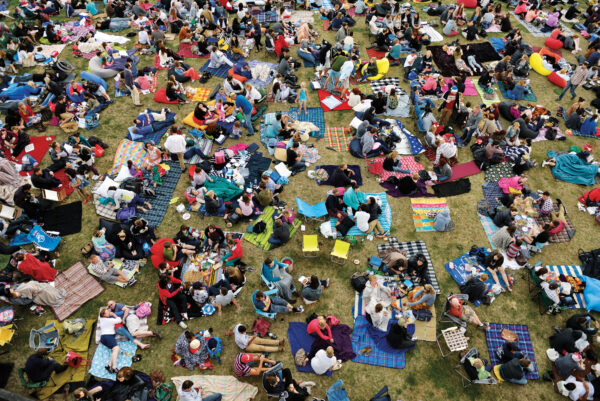
A new experiment suggests the human perception of time is influenced by what we’re looking at. To test this, scientists from George Mason University in the US state of Virginia sorted dozens of images into various categories—a full pantry was “high clutter”, for example, while shots of clouds or empty rooms were “low clutter”. Some images were also categorised as “memorable”—like a close-up of a child laughing. The team flashed the images at participants, asking each to report whether the picture was up for a long or short time, or to hold down a button for the same length of time the image had been up. Over four experiments, the cluttered pictures seemed to zoom past, while the more memorable seemed to linger. Likewise, “larger” images—a stadium, or a pulled-back landscape—dilated the experience of time. One theory presented in the scientists’ paper, published in Nature Human Behaviour, is that this is because our brains are instinctively plotting the body’s movement through space: perhaps a larger image just takes longer to mentally “walk through”. But why would a cluttered picture, like this aerial shot of moviegoers at Auckland’s Silo Park, seem to pass by at warp speed? Perhaps, says one of the authors, cognitive neuroscientist Martin Wiener, this is because our brains simply struggle to process clutter—we skip over it to some degree. (He notes, too, that in the real world these results may differ, depending on what a person is doing and the nature of what they’re looking at.) More importantly: If clutter compresses time, does that mean that your messy co-worker experiences a shorter workday than you, with your immaculate desk? “Ha!” laughs Wiener, “I have no idea.” Stopping to think about it, though, he suggests you would each be accustomed to your respective setups—so each day would feel pretty standard. However: “If you had to work at their desk for a day, then perhaps you’d feel like the day went by quicker—or that you didn’t get enough done.”
When Jennifer Bannister was growing up, girls were secretaries, or teachers, or nurses. She persevered.
Cub reporter Harriet Morris got her start as a toddler, assisting her dad, writer Bill Morris, to document correspondence school and the New Zealand ploughing championships. For this issue, Bill packed up the snacks and the woolly layers and took the three-year-old fossil-hunting. She happily got in among the muck, finding three chunks of amber for her treasure stash at home, secreting lignite all through her pockets, and completing her field work at her favourite playground on the way home. Ruby Pierard-Joel, likewise, enjoyed being part of the action while Lottie Hedley photographed her mum, opera singer Madeleine Pierard, for this issue’s Profile. But the moment Pierard tried to sing, the two-year-old launched into high notes of her own—it was quickly decided that a quiet set would be best all round.
In 1992, a US Baptist pastor called Gary Chapman published a self-help book asserting that there are five “love languages”: physical touch, words of affirmation, acts of service, quality time, and receiving gifts. Everyone has a primary language, he claimed, and couples are happier when they “speak” their partner’s language. The book sold more than 20 million copies and spawned a whole new career for Chapman. His central concept made the jump to meme, becoming a sort of cultural shorthand, and is now being trotted out afresh on TikTok and self-help blogs. There’s just one problem: according to three relationship scientists, citing dozens of studies published over the past two decades, Chapman’s claims are bogus. In a paper published in Current Directions in Psychological Science, the scientists systematically disprove nearly every claim made in the book. No study has found that “shared” love languages increase or decrease satisfaction. The very concept of a “preferred” language was found to be unrealistic—all forms of affection were measured to be important. (The five original “languages” are arbitrary and limited, the authors say, excluding things like a person’s ability to mitigate conflict, or to fit in with their partner’s friends and family.) Even if Chapman’s claims were true, the authors point out another problem: people are pretty bad at pinning down what “language” they’re speaking. This was most clear in our tendency to misrepresent how much we really want our loved ones to buy us gifts: less than four per cent of people self-described “gifts” as their primary language, but when assessed by a multi-question quiz, more than half of the respondents ended up with “gifts” as their preference. The authors conclude with an alternative suggestion: think of love not as a language to be spoken and learned, but rather as a diet, to be well rounded and nourishing. The real language that needs practice, they suggest, is science communication.
Ineke Meredith, HarperCollins, $39.99
Wayne Keen is a man impelled. Even after official searches wind up he’ll go back to a patch of bush, and back again, looking for those who are lost. Why?
Bruce “Chopper” Reay has lived in a remote deerstalkers’ hut on the edge of Fiordland National Park for most of his life. But he’s not exactly off the grid.
Medical care across New Zealand works on the following principle: get to the nearest hospital as fast as possible. But what if storms, flooding, landslides or earthquakes make that impossible? One emergency doctor is determined to equip medical students for our increasingly unpredictable future.
And it didn’t need to. No regional council is required to make detailed emergency plans for natural disasters. The vast majority of Hawke’s Bay residents, however, live in on a flood plain and what happened on the night of February 13-14, 2023, was a test case in unpreparedness.
Building anything in New Zealand takes too long and costs too much. The government plans to solve this with new legislation that will greenlight big projects in one go. Which projects? That’s a secret.
Seven companies representing a third of New Zealand’s carbon emissions will defend their impact on the environment, in a case brought by Māori activist Mike Smith—with help from a 19th-century ruling on Birmingham sewage.
Loading..

3
$1 trial for two weeks, thereafter $8.50 every two months, cancel any time
Already a subscriber? Sign in
Signed in as . Sign out

Ask your librarian to subscribe to this service next year. Alternatively, use a home network and buy a digital subscription—just $1/week...

Subscribe to our free newsletter for news and prizes