|
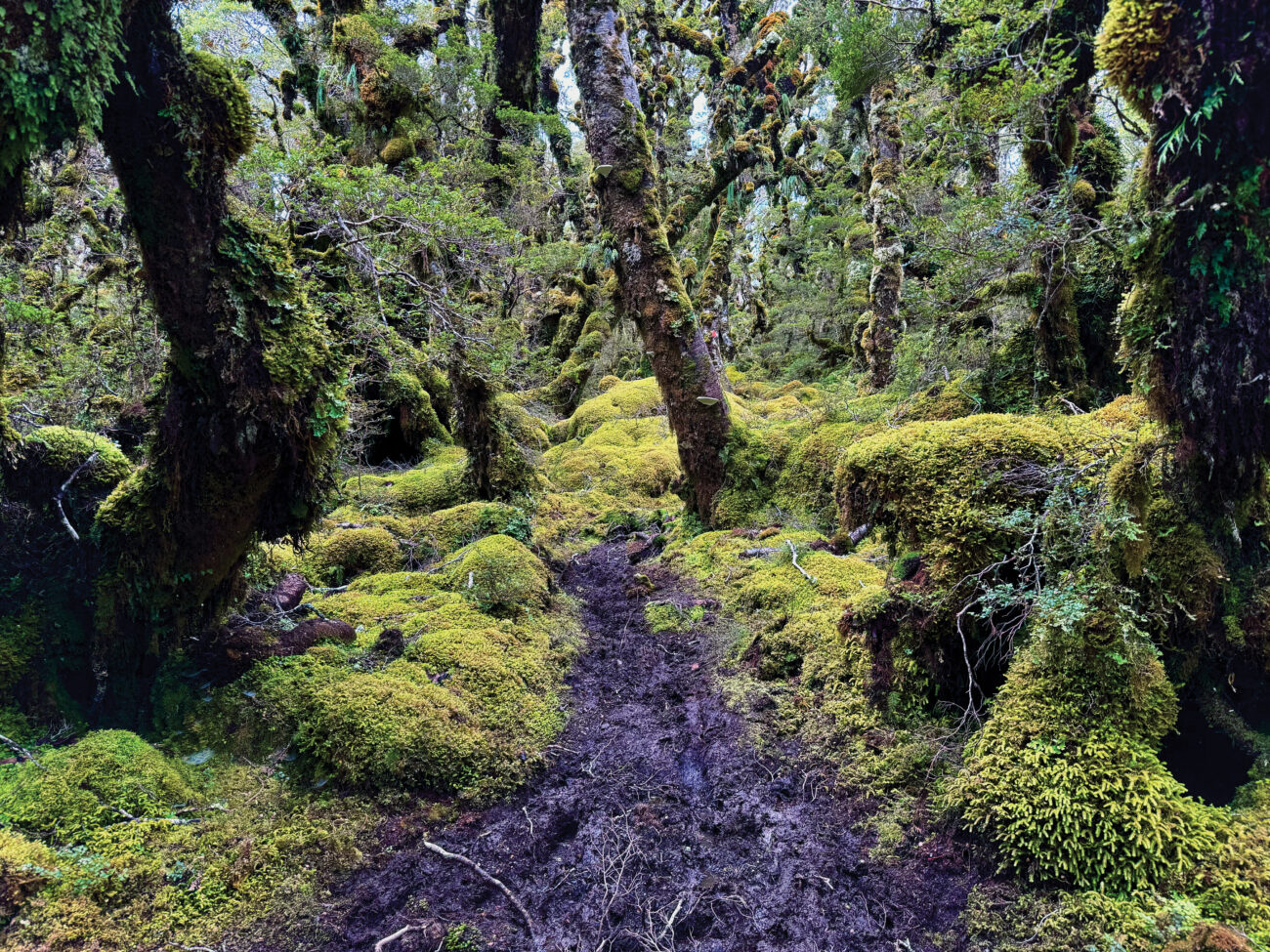
Naomi Arnold tackles Southland’s notoriously boggy Longwood Range.
|
The Weekender |

|
|
|
Free newsletter
|
MAY 30, 2025
|
|

|
Publisher |
|
This month we published an extract of Naomi Arnold’s new book Northbound, which starts by describing an existential battle with the mud of Longwood Forest—see the story below. Yesterday we received a response from Graeme Appleby, Club Captain of the Southland Tramping and Outdoor Recreation Club, reflecting that Te Araroa should never have been routed through such an environmentally sensitive area. “The Longwood Forest is a rain forest area with vey peaty and fragile soils,” wrote Graeme. “The region has a high rainfall and lots of low cloud. People move off the track to avoid the mud and this in turn, causes further damage to this fragile area of the Longwoods.” Over the years the club has re-marked sections of the track and even worked with LandSAR to search for lost or disorientated walkers. He suggests re-routing Te Araroa through the Pourakino River Track, maintained by the club. In the meantime, Graeme avoids the route entirely, “Too much mud!” |
|
|
|
|
Have something to say? Feel free to get in touch with me directly. You can support our work with a subscription—either print or digital or both—please check out the options.The more support we have, the more great work we can produce. |
||
|
|
TE ARAROA Two days in the forest of nightmaresIn the campground kitchen at the Colac Bay Tavern and Holiday Park I meet Sean, an Irish hiker who is walking south and nearly finished with the trail. He tramped 46 kilometres over the tough Longwood Range the day before, which astonishes me; my first biggish day, 27 kilometres along the flat Ōreti Beach, had completely destroyed me. “I’m ruined,” he says. “Are you headed north?” “Yup.” He indicates my hiking pants and says, “You don’t want to wear those in the Longwoods.” “Why not?” “They’ll be wrecked,” he says. “Wear shorts. You’ll be two days in mud up to your knees and there’s no avoiding it. You try to edge around the outside and realise it’s just wall-to-wall mud. You just have to go straight through. But it’s good craic. When else are you going to be doing that?” I leave the campground around nine the next day, wearing shorts as instructed. I walk along State Highway 99 towards the ranges, which are covered halfway in a band of heavy white cloud. The village is silent. A dog is rummaging through a bin on the corner, pulling out fish’n’chip wrappers and snuffling into them. He looks up as I approach and skulks off across the road to a dilapidated shed. A Fonterra truck changes lanes to avoid rushing me and, grateful, I wave and the driver toots. Cattle gather at the fence to watch me. Little socks of spiderwebs cover stems of kānuka. I feel good; I can move quickly on the asphalt. In fact, it is lovely. So many hikers complain about all the road-walking on Te Araroa; is it really so bad? I turn into Round Hill Road and admire a massive spreading macrocarpa, then greet a man working in front of his tidy black cottage. “I hope you like the mud!” he calls with real glee. He has Radio New Zealand going and looks like he’s been in the garden. “I don’t bloody go up there any more.” “Probably because you’ve got too much to do around here, eh?” I say, not without a note of hope. “No, no, no—it’s too bloody muddy,” he says. “Mud! Up to here!” His hand chops his abdomen. “Up to my waist!” |
MORE STORIES ABOUT TE ARAROA: |
|

|

|
PHOTOGRAPHER OF THE YEAR Are you under 25? You enter Photographer of the Year free.To make Photographer of the Year more accessible for youth, we removed the $25 entry fee for photographers under the age of 25 (as at September 30 this year). Clicking the young photographer checkbox in the entry form does two things: It makes your entry free, and it puts you in contention for the Genesis Young Photographer of the Year award. Previous winners of this award have gone on to become professional photographers, doing what they love for a living. So it's time to have a look through your best work of the past year, or get out and shoot some new stuff. Note; this comp is not a rights grab—photographers retain the copyright of their images. |
|

|

|

|
PARTNER CONTENT Flying visit“A lot of people connect really closely with the heritage of MOTAT,” says Senior Curator Technology Nicola Jennings. “We have a very strong base with that, but we also want to showcase what’s happening now.” New Zealand has a rich aviation history and a good chunk of it is on display at MOTAT, but an autonomous aircraft developed in recent years is the focus of a new exhibition called Hautū Aunoa Autopilot, which aims to showcase the innovation happening here. The centrepiece is a Wisk Gen 5 electric vertical takeoff and landing (eVTOL) air taxi, which was tested by the California-based company in Canterbury and is designed to take two passengers without a crew. “It’s really exciting to be able to acquire a Wisk and put it on display so quickly,” Jennings says. “We find that really exciting as it shows that people in the industry see MOTAT representing what’s happening now, not just transport and technology heritage.” Autopilot opens on June 28th and runs until July 2026. The tenth Ngā Korero Rererangi Aviation Conversations will be held on 10 July at the Aviation Hall at MOTAT. Cameron Baker, the CEO of Tauranga-based Envico, will talk about how technology is helping the company’s conservation work. Envico was named Māori Company of the Year at the 2024 Hi-Tech Awards and has loaned a drone for display in Autopilot. |