|
What compelled a South Auckland dairy farmer to amass New Zealand’s most significant collection of seashells?
|
The Weekender |

|
|
|
Free newsletter
|
DECEMBER 20, 2024
|
|
|
Publisher |
|
It's the last day of the year in the New Zealand Geographic editorial office. We feel very encouraged by the rousing response to our subscription appeal, and easing another terrific issue out the door... but like most of Aotearoa, we're ready for a break. I want to hear waves dumping on a beach and screeching cicadas. I want to feel the sticky sap of a vanilla ice cream melting down my arm and see light glance off wave tops, like the sea is winking at me. Most of all, though, I'd like a break from the churn of news and administration and soak up some of that edifying stuff that can only be found in the great outdoors. I wish the same for you and your family. Enjoy the Christmas season, the stories in this last newsletter of the year, and we'll see you in 2025! |
|
|

|
You can still get the latest issue and free calendar in bookstores and supermarkets, then buy a subscription to New Zealand Geographic online as a last-minute—yet very thoughtful—Christmas gift. There are subscription options at every price point and the print magazine arrives six times a year for your lucky recipient, with your name as the donor printed right on the carrier sheet. Your subscription also powers our journalism. Check out the options. |
||
|
|
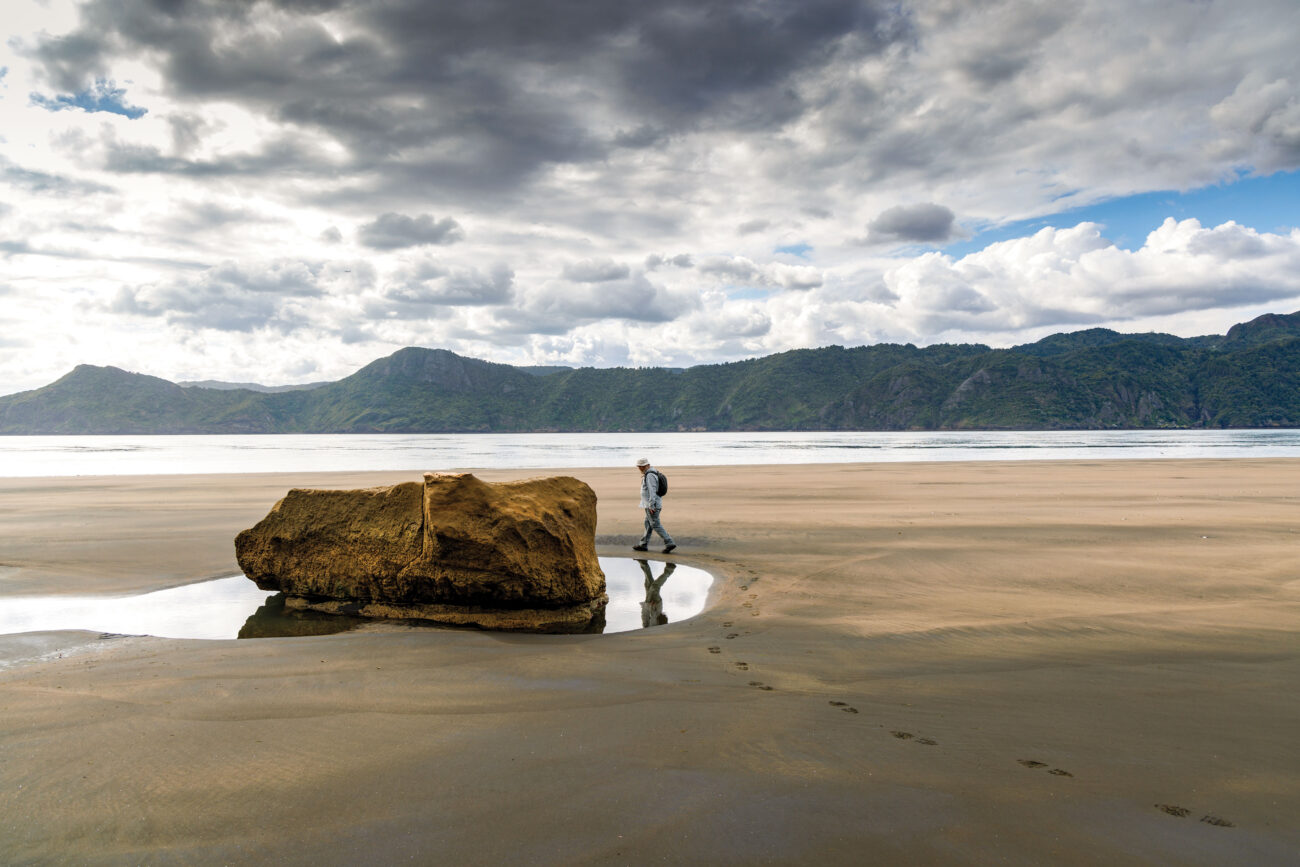
NATURAL HISTORY The keeperIt arrived in a wooden cabinet, each drawer of it a family: Calliostomatinae, Volutidae, Turbinidae. One of every kind of shell to be found in the Manukau Harbour. Sometimes more than one: an ark of molluscs. The cabinet waited in the circular corridor at the heart of Auckland Museum for more than seven years, in between the marine department’s freezer for fish bits and a shelving unit filled with jars, labels, bags. When collections technician Darryl Jeffries sat down to catalogue its contents, he knew little about it or its maker. But the cabinet came with a pair of hand-illustrated journals detailing exactly where and when each specimen had been found. As Jeffries read, hints of the collector, Norman Douglas, emerged. Inside were delicate hand-drawn maps, a meticulous record of observations spanning three decades, and a clear devotion to one particular stretch of coastline on the Āwhitu Peninsula. There was delight at finding spotted whelks laying eggs, at the sight of hundreds of violet globe snails blowing in on a sturdy northwesterly; delight at a shell appearing to move of its own volition and the discovery of a Zegalerus sea snail beneath, using it as a shield or a disguise. Norman had searched comprehensively, Jeffries realised: if he hadn’t found a shell, it probably wasn’t there. He found an extinct species of clam alive and well. He swept others along with him on searches, always noting the true finder of any specimen: often it was Lorna, his wife. Sometimes it was Heather, or Shirley, or Murray, their children. He looked along the tide line and in the crevices of rocks. He dug in the soft sand where waves fan out, to see what was underneath. He convinced boaties to tow a dredge so he could investigate what lay in the seabed. “He was really good at getting all the habitats,” said Jeffries, “at a time where the environment seemed to change a lot—because we had the Pacific oyster come in and get everywhere, and all the industrialisation that happened in Manukau over that period.” Turning the pages of the journals, I turned through years: each page a list of findings, some commonplace, some rare. Like Jeffries, I became curious about Norman: what had sent him back to the coast, over and over again, on a search that never ended, on the fringes of a harbour most regarded as muddy and polluted. But it was impossible to ask Norman anything. He’d passed away in 1989. And so I set out on a search of my own: for the man who had recorded all of this, and why. |
MORE STORIES ABOUT SHELLFISH: |
|

|
|
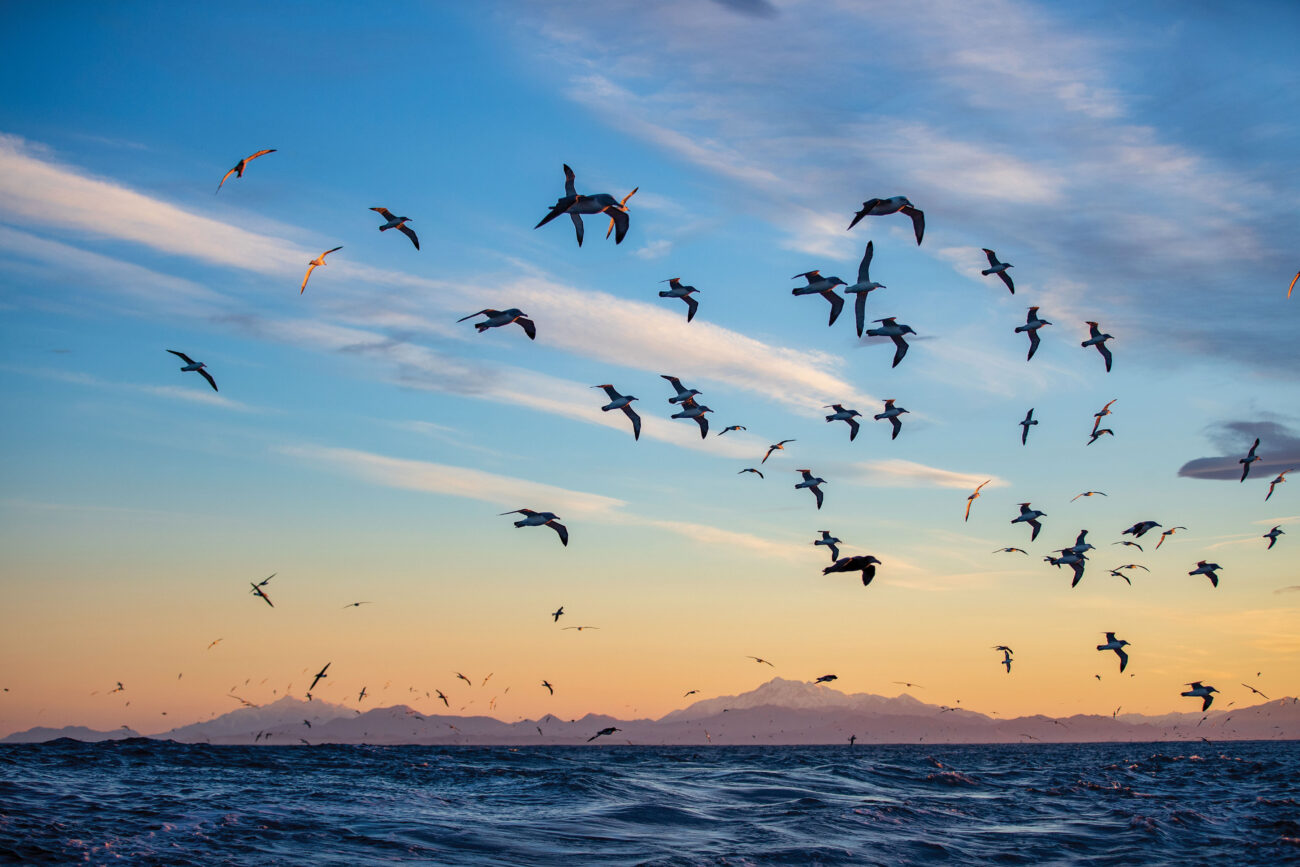
NEWS Seabirds deserve more protection, rules High CourtThe Department of Conservation (DOC) isn’t doing enough to prevent the deaths of protected seabirds and other marine species, ruled the High Court earlier this week. The Environmental Law Initiative argued that DOC failed in its legal obligation to look after New Zealand’s wildlife, partly because it wasn’t setting limits on the number of species accidentally caught by commercial fishers. Commercial fishers must keep daily records of what they catch—numbers that are crucial for understanding how an endangered species is faring. It particularly matters for long-lived species such as wandering albatrosses. Bycatch data is collected by a private company, FishServe, owned by Seafood New Zealand, a lobbying group for commercial fishers, as Andrea Vance reports for The Post. The Environmental Law Initiative argued that the government shouldn’t have delegated the responsibility for monitoring the industry to the industry itself, and that DOC failed to look at the data, which meant that it failed to investigate or prosecute cases where the law hadn’t been followed. In one such example a vessel killed 20 protected seabirds in one day—its seabird-deterring devices didn’t meet the legal standard and it didn’t report its bycatch accurately... yet it wasn’t prosecuted for these failures. The court also found that DOC failed to create population management plans to set limits on the number of deaths. In other jurisdictions, fisheries close for the season when a certain number of animals have been killed, and don’t reopen until the following season. The same thing could happen here, said Matt Hall from the Environmental Law Initiative. “The law is now very clear; DOC has the powers to set hard limits on the killing of threatened marine species.” |
|
|
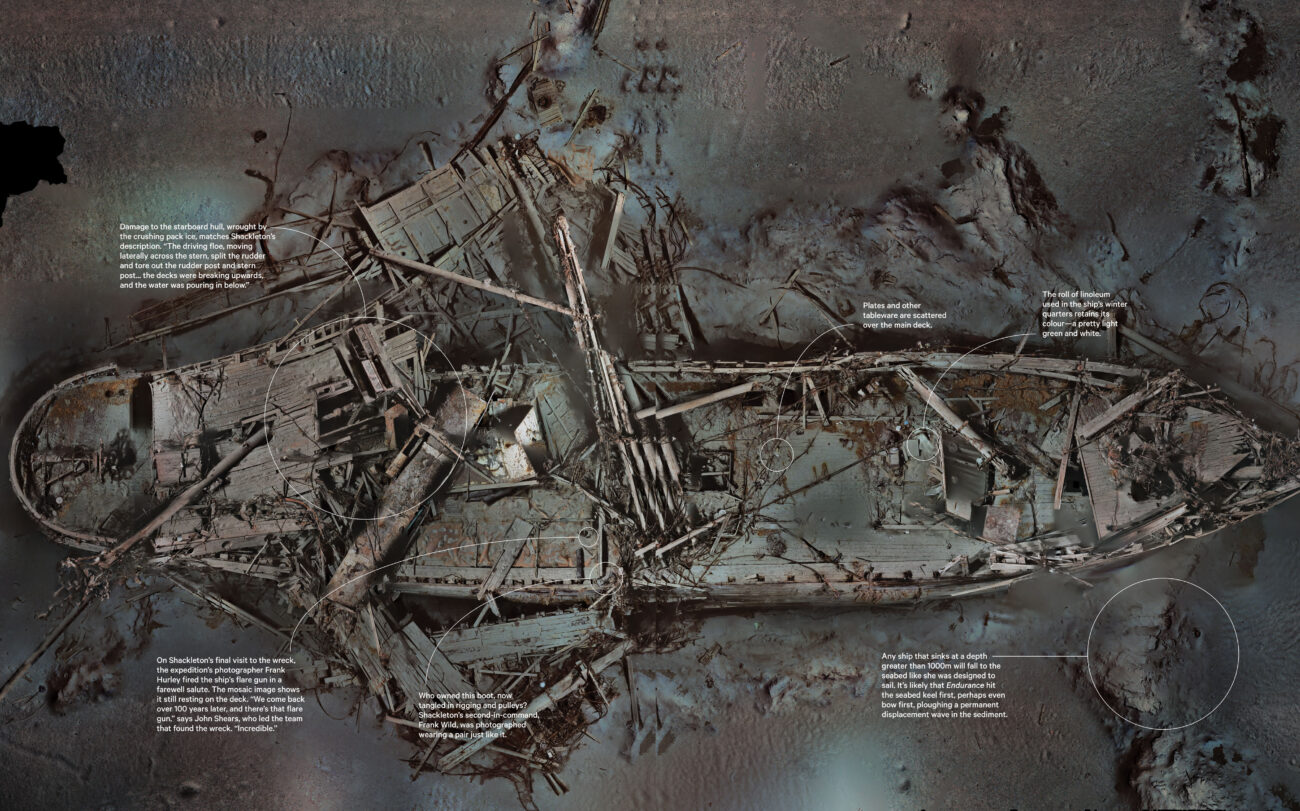
SHIPWRECKS Here lies Endurance
Preserved beneath three kilometres of frigid saltwater and up to five metres of floating sea ice, Sir Ernest Shackleton’s legendary ship “looks like it sank yesterday”, says Nico Vincent, an expert in ultra-deep-sea salvage who helped produce this remarkable new mosaic image. Vincent was part of the Endurance22 team that discovered the wreck in 2022. This image, as well as a series of 3D videos, was made by stitching together some 25,000 digital scans captured by underwater robots fitted with optical laser scanners—the first time the technology had been used at such a depth. The image shows Endurance was aptly named. After 106 years at the bottom of the Weddell Sea, black paint has come off her hull but her bolts still gleam, and artefacts from her last journey to the ice are intact, scattered across her deck. |
|